Within Think Before Sharing
Can One Pause Stop a False Share?
Small prompts to think about accuracy can help people pause before amplifying a claim that feels urgent or identity-confirming.

On this page
- Why sharing changes judgement
- What accuracy prompts do
- Where nudges fall short
Page outline Jump by section
Introduction
Accuracy nudges are small prompts that ask people to think about truth before they share a viral claim. They matter because many false posts spread in the moment between feeling “this is important” and asking “is this accurate?” The best evidence suggests that these nudges can modestly improve the quality of what people share, especially by reducing willingness to pass on false headlines, without requiring platforms to decide every disputed claim in advance. In other words, the pause is the intervention.
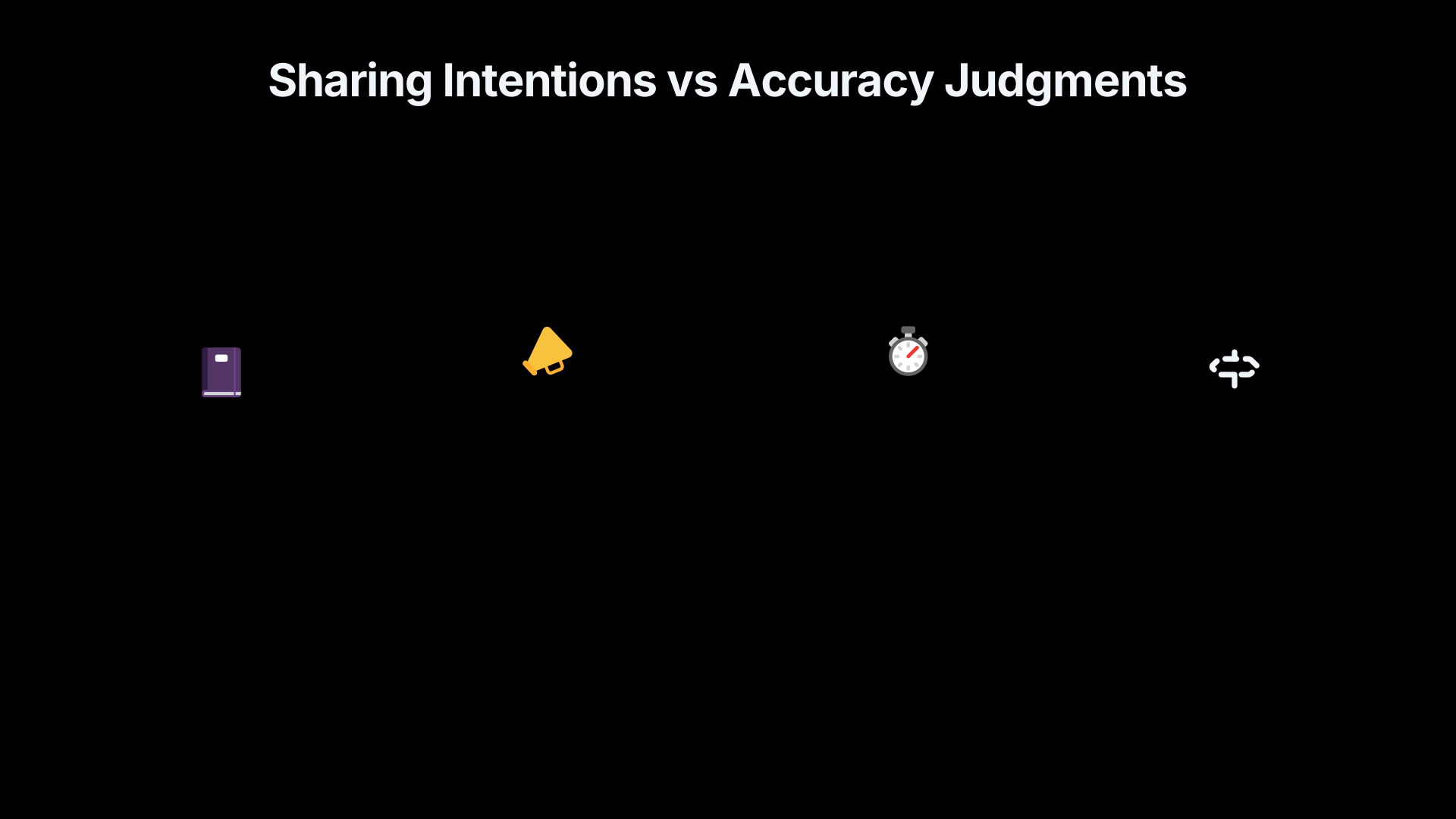
The idea is not that users are foolish or that one pop-up can fix misinformation. It is that social feeds often push accuracy out of focus. Experiments led by Gordon Pennycook and David Rand found that headline truth strongly affected people’s accuracy judgements, but had much less effect on their sharing intentions; when attention was shifted back to accuracy, sharing discernment improved.[Nature]nature.comShifting attention to accuracy can reduce misinformation online | NatureShifting attention to accuracy can reduce misinformation online | Nature…
Why sharing changes judgement
A person reading a headline in private may ask, “Is this true?” A person about to repost it may be answering a different question: “Will my friends care?”, “Does this expose hypocrisy?”, “Will this help my side?”, or “Do I need to warn people quickly?” That shift is central to why accuracy nudges are interesting. They do not primarily add new facts; they change which value is salient at the instant of amplification.
The Nature study “Shifting attention to accuracy can reduce misinformation online” is important because it separates belief from sharing. Its authors report that people’s accuracy judgements were much more sensitive to whether headlines were true or false than their sharing intentions were. Many participants also said that sharing only accurate news was important to them, suggesting a gap between values and platform behaviour rather than simple indifference to truth.[Nature]nature.comShifting attention to accuracy can reduce misinformation online | NatureShifting attention to accuracy can reduce misinformation online | Nature…
This matters for critical thinking because viral posts often arrive wrapped in urgency. A claim about a public health threat, an election rule, a local crime, a war image or an AI-generated scandal may feel too consequential to ignore. But urgency is exactly when a feed’s incentives can be most distorting: the post rewards speed, while verification requires friction.
Accuracy nudges try to insert that friction at the least intrusive point. Instead of warning “this is false”, a prompt might ask the user to rate the accuracy of an unrelated headline, remind them that accuracy matters, or ask them to consider whether the claim is supported before reposting. The mechanism is deliberately light: it makes truth momentarily more visible without blocking speech.

What accuracy prompts do
The strongest case for accuracy nudges is that they are simple, scalable and content-neutral. They do not require a platform to pre-label every post as true or false. They ask users to bring their own truth standards back into the sharing decision.
A 2022 Nature Communications paper reported that accuracy prompts were replicable and generalisable across a large set of experiments. Across 20 experiments with 26,863 participants, prompts increased the quality of news people said they would share, mainly by reducing sharing intentions for false headlines. The reported reduction in false-headline sharing intentions was about 10% relative to control conditions.[PMC]pmc.ncbi.nlm.nih.govPMCAccuracy prompts are a replicable and generalizableby G Pennycook · 2022 · Cited by 364 — Overall, accuracy prompts increased the quality of news that people share (sharing discernment)…
The prompt does not have to be complicated. In some studies, users were simply asked to judge the accuracy of a headline before continuing. That kind of prompt appears to work because it reminds people of a standard they often already endorse. It is less like teaching a whole media literacy course and more like moving the “accuracy” question from the back of the mind to the front of the screen.
A later simulated-newsfeed study tested accuracy prompts in a more realistic environment containing true news, false news and ordinary social posts. It found that prompts improved the quality of news sharing without affecting sharing of social, non-news posts or “liking” behaviour. That distinction is useful for implementation: a prompt may be most appropriate before a user shares news-like claims, not before every emotional reaction or personal update.[Misinformation Review]misinforeview.hks.harvard.eduMisinformation ReviewExamining accuracy-prompt efficacy in combination with using colored borders to differentiate news and social conten…
The same study also tested coloured borders around news posts. Borders increased attention to news, but did not improve the effectiveness of accuracy prompts; in some cases they increased engagement with news regardless of whether it was true or false. The lesson is practical: not every design feature that attracts attention improves judgement. A good accuracy nudge should direct attention towards verification, not merely make news content more visually prominent.[Misinformation Review]misinforeview.hks.harvard.eduMisinformation ReviewExamining accuracy-prompt efficacy in combination with using colored borders to differentiate news and social conten…
The best moment for a nudge is before amplification
Accuracy nudges are most valuable before a post is shared, quote-posted or forwarded into another network. Once a claim has been amplified, later corrections must chase it through screenshots, group chats, copied captions and algorithmic recommendations. The intervention point matters because viral spread is front-loaded: many posts receive much of their engagement early, before formal fact-checking can catch up.
Community Notes on X shows the same timing problem from a different angle. A 2026 Nature Communications study found that once community notes were displayed, they reduced the subsequent spread of misleading posts by an average of 61.2% and increased the odds that users deleted misleading posts. But the study also found that notes often appeared too late for the earliest viral phase, making the system-wide reduction in total engagement more modest at 14.9%.[Nature]nature.comCommunity-based fact-checking reduces the spread of misleading posts on X (formerly Twitter) | Nature Communications…
That finding supports the logic of pre-share nudges. Community fact-checks can be powerful after context appears, but a pre-share prompt acts before the repost. It asks the user to slow down at the point where their action can still prevent a false claim from entering another audience.
This is especially relevant for private or semi-private sharing spaces. A false claim in a public feed may eventually receive a correction label, a fact-check, or a community note. A screenshot forwarded into a family chat or local group may not. In those settings, the most realistic defence may be a habit: pause, check the source, search for corroboration, and avoid adding reach to a claim whose accuracy is unclear.
How to design an accuracy nudge that people will not simply ignore
A useful accuracy nudge is short, timely and specific to the action being taken. It should not feel like a scolding lecture, and it should not appear so often that users learn to dismiss it reflexively.
The best design choices follow from the evidence:
- Place the prompt at sharing time. A nudge works best when it appears immediately before amplification, not after the user has already committed publicly.
- Use neutral language. “How accurate is this claim?” is less politically loaded than “This may be misinformation.”
- Target claim-like posts. Prompts are more defensible for news, public health, elections, disasters, finance and safety claims than for ordinary social updates.
- Avoid attention-only design. Visual highlighting can increase engagement with both true and false news if it does not focus attention on accuracy.
- Keep friction proportionate. A one-click pause may be enough for low-risk claims; higher-risk or rapidly spreading claims may justify stronger friction, such as asking users to open the article before reposting.
There is also a difference between a general accuracy reminder and a specific verification step. A reminder asks the user to consider truth. A verification step asks for a concrete action: read the linked article, check the date, inspect the source, compare against an official notice, or look for independent reporting. Platforms can combine these, but the more friction they add, the more they need to justify when and why it appears.
Where nudges fall short
Accuracy nudges are not a full misinformation policy. They are weakest when users strongly believe the false claim, when sharing is performative, when the claim is identity-signalling rather than evidence-seeking, or when a user’s goal is to provoke, troll or mobilise rather than inform. A prompt that says “think about accuracy” cannot do much if accuracy is not the user’s priority.
They can also fail through fatigue. If prompts appear constantly, users may treat them like cookie banners: another obstacle to click past. If prompts appear only on politically sensitive topics, they may be interpreted as partisan suppression. If prompts appear too late, after a post has already gone viral, they lose much of their preventive value.
Evidence on political differences is mixed but important. A 2024 Psychological Science paper found that accuracy prompts improved sharing discernment among Republicans and conservatives across all 70 tested models, while some models suggested weaker effects among Republicans or Trump voters than among Democrats or Clinton/Biden voters. The practical implication is not that nudges only work for one side; it is that implementation should be tested across audiences, topics and political contexts rather than assumed to generalise perfectly.[Sage Journals]journals.sagepub.comWe observed significant partisan moderationSage JournalsOn the Efficacy of Accuracy Prompts Across Partisan Linesby C Martel · 2024 · Cited by 56 — In all 70 models, accuracy promp…
There is also a policy risk in overclaiming. Accuracy nudges can reduce some careless sharing, but they do not replace fact-checking, source transparency, media literacy, platform enforcement against coordinated manipulation, or better access to trustworthy information. The OECD has framed misinformation as a behavioural and governance problem, not merely an individual literacy problem, and has examined behavioural interventions alongside broader policy responses.[OECD]oecd.orgMisinformation and disinformationMisinformation and disinformation. An international effort using behavioural science to tackle the s…

What the pause teaches as a critical thinking habit
The deeper value of an accuracy nudge is that it trains a small habit: before sharing, ask what role the post is asking you to play. Are you being asked to warn, shame, mock, defend, donate, vote, buy, panic or pile on? The more emotionally obvious the requested action feels, the more useful a pause becomes.
A practical personal version of the nudge is simple:
- Name the claim. What exactly is being asserted?
- Check the source. Is it first-hand, official, journalistic, expert, anonymous or merely reposted?
- Look for date and context. Is an old image, quote or statistic being used as if it is new?
- Search laterally. Do independent sources report the same thing?
- Share less when unsure. Not sharing is often the lowest-cost correction.
This is not about becoming suspicious of everything. It is about resisting the feed’s demand that every feeling become an action. In the age of AI-generated images, synthetic audio, recycled screenshots and fast-moving rumours, the most useful critical thinking move may be deliberately small: pause before giving a claim your credibility and your audience.
The policy takeaway
Accuracy nudges are best understood as a low-cost first line of defence. They are not a truth machine, and they are not a substitute for accountable platform governance. Their value lies in catching the large category of false sharing that happens because people are distracted from accuracy at the decisive moment.
For platforms, the implementation challenge is to make the prompt timely enough to matter, narrow enough to feel legitimate, and varied enough to avoid fatigue. For policymakers, the lesson is that behavioural design should be evaluated in real conditions, not treated as a slogan. For users, the lesson is even simpler: the share button is not just expression. It is distribution. A one-second accuracy check can stop a false claim from borrowing your trust.
Amazon book picks
Further Reading
Books and field guides related to Can One Pause Stop a False Share?. Use these as the next step if you want deeper reading beyond the article.
Foolproof: Why We Fall for Misinformation and How to Build Im...
Covers prebunking, attention, and reducing misinformation spread.

eBay marketplace picks
Marketplace Samples
Example marketplace items related to this page. Use the search link to explore similar finds on eBay.


Endnotes
1.
Source: nature.com
Title: Shifting attention to accuracy can reduce misinformation online | Nature
Link:https://www.nature.com/articles/s41586-021-03344-2
Source snippet
Shifting attention to accuracy can reduce misinformation online | Nature...
2.
Source: pmc.ncbi.nlm.nih.gov
Title: PMCAccuracy prompts are a replicable and generalizable
Link:https://pmc.ncbi.nlm.nih.gov/articles/PMC9051116/
Source snippet
by G Pennycook · 2022 · Cited by 364 — Overall, accuracy prompts increased the quality of news that people share (sharing discernment)...
3.
Source: nature.com
Link:https://www.nature.com/articles/s41467-026-72597-0
Source snippet
Community-based fact-checking reduces the spread of misleading posts on X (formerly Twitter) | Nature Communications...
4.
Source: oecd.org
Link:https://www.oecd.org/en/publications/an-international-effort-using-behavioural-science-to-tackle-the-spread-of-misinformation_b7709d4f-en.html
Source snippet
Misinformation and disinformationMisinformation and disinformation. An international effort using behavioural science to tackle the s...
5.
Source: misinforeview.hks.harvard.edu
Link:https://misinforeview.hks.harvard.edu/article/examining-accuracy-prompt-efficacy-in-combination-with-using-colored-borders-to-differentiate-news-and-social-content-online/
Source snippet
Misinformation ReviewExamining accuracy-prompt efficacy in combination with using colored borders to differentiate news and social conten...
6.
Source: journals.sagepub.com
Title: We observed significant partisan moderation
Link:https://journals.sagepub.com/doi/10.1177/09567976241232905
Source snippet
Sage JournalsOn the Efficacy of Accuracy Prompts Across Partisan Linesby C Martel · 2024 · Cited by 56 — In all 70 models, accuracy promp...
Additional References
7.
Source: youtube.com
Title: Understanding the Science Behind Human Stupidity with Gordon Pennycook
Link:https://www.youtube.com/watch?v=UYMCX6V7NeI
Source snippet
David G. Rand | How polarization can help solve the misinformation problem...
8.
Source: youtube.com
Title: How You Can Help Combat Fake News | David Rand | TEDx Cambridge Salon
Link:https://www.youtube.com/watch?v=uC4JZ7TKAmc
Source snippet
Understanding the Science Behind Human Stupidity with Gordon Pennycook...
9.
Source: youtube.com
Title: S3D Distinguished Speaker Series: David Rand
Link:https://www.youtube.com/watch?v=Ptn7jUPCAyQ
Source snippet
Scaling Laws: The Persuasion Machine: David Rand on How LLMs Can Reshape Political Beliefs...
10.
Source: youtube.com
Title: Why do smart people believe dumb things?
Link:https://www.youtube.com/watch?v=Zc75W18DKRk
Source snippet
S3D Distinguished Speaker Series: David Rand...
11.
Source: youtube.com
Link:https://www.youtube.com/watch?v=5s1IuQe311I
12.
Source: youtube.com
Title: David G. Rand | How polarization can help solve the misinformation problem
Link:https://www.youtube.com/watch?v=dINKXTsI_hc
Topic Tree
Follow this branch
Parent topic
Think Before SharingRelated pages 24
- AI Tutors Should You Trust a Chatbot Tutor?
- AI Virality Why AI Misinformation Travels So Easily
- Community Notes Can the Crowd Correct the Feed?
- Corroboration Who Else Can Confirm This Claim?
- Deepfakes How to Check a Voice or Video Claim
- Emotional Posts Why Outrage Is Not Evidence
- Evidence Types Not All Evidence Deserves Equal Weight
- Fake Authority When Official Looking Posts Are Not Official
- +16 more in sidebar
- Backfire Risk When More Attention Does Not Mean Better Judgement
- Best Timing The Best Moment to Slow a Viral Claim
- Evidence How Much Do Accuracy Prompts Actually Help?
- Notes Timing What Community Notes Teach About Acting Early
- Nudge Design How to Ask About Accuracy Without Scolding
- Sharing Gap Why We Share Claims We Doubt