Within Deepfakes
What Provenance Labels Really Prove
Provenance labels can show parts of a file's history, but they cannot prove every claim attached to the media.
On this page
- What a media credential can certify
- How reposts and screenshots break the chain
- Why a genuine file can still mislead
Page outline Jump by section
Introduction
Content Credentials are often presented as a way to restore trust in digital media, especially as deepfake audio and video become harder to distinguish from authentic recordings. The core idea is simple: attach cryptographically signed provenance information to a file so viewers can see where it came from and what happened to it along the way. Supporters describe them as a kind of “nutrition label” for media, recording creation and editing history in a verifiable format.[Content Authenticity Initiative]contentauthenticity.orgContent Authenticity InitiativeHow it worksContent Credentials are the verifiable metadata that the CAI's tools help implementers generat…
 However, provenance labels answer a narrower question than many people assume. They can help verify aspects of a file’s history, but they do not prove that every claim attached to the media is true. A video can carry valid credentials and still be presented with a misleading caption, stripped of crucial context, or used to support a false narrative. Understanding both the strengths and limits of Content Credentials is therefore an important part of critical thinking in the age of social media and AI.
What a media credential can certify
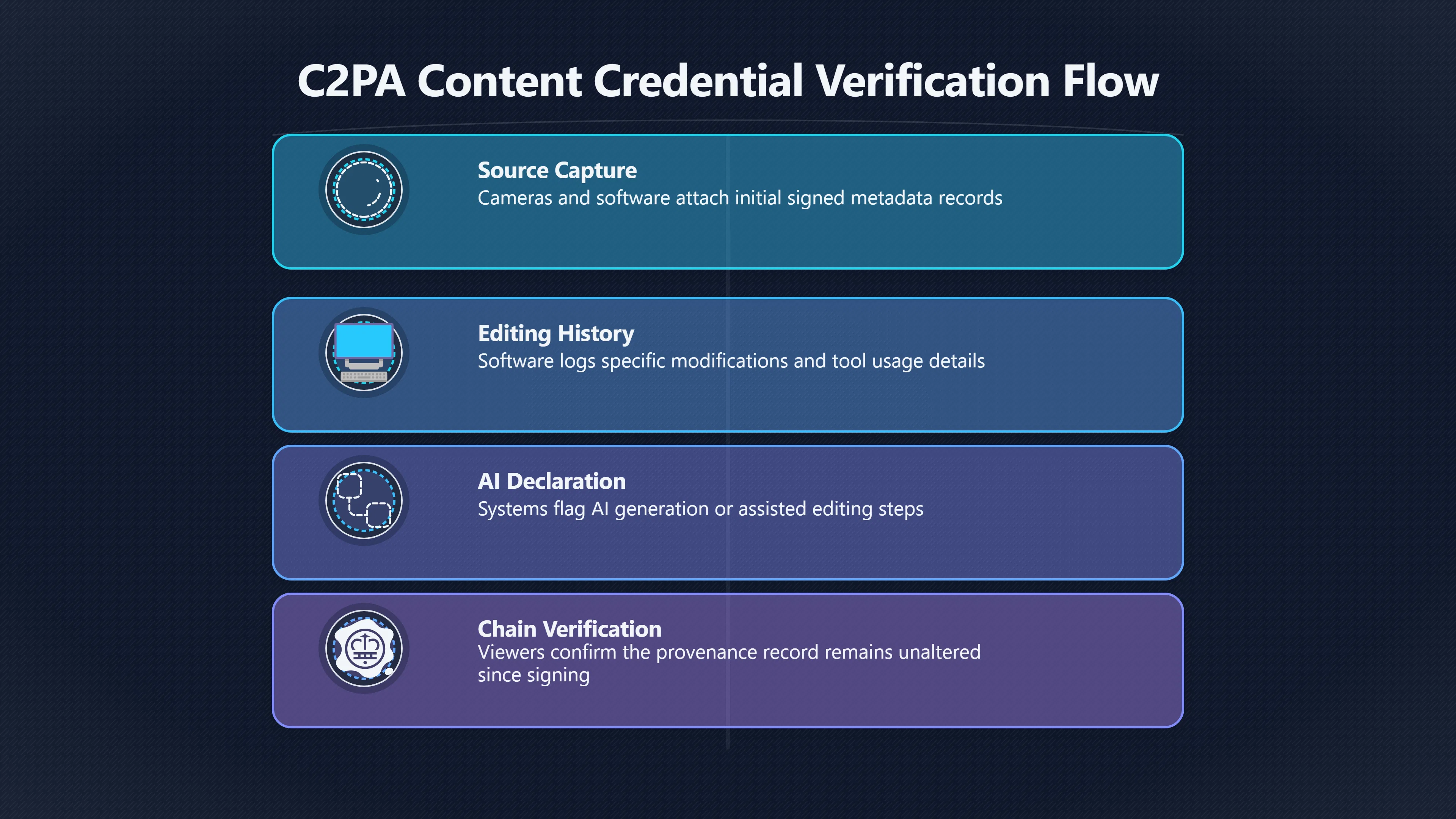
Most Content Credentials systems are built around standards developed by the Coalition for Content Provenance and Authenticity (C2PA). These standards allow software, cameras and AI tools to attach signed metadata describing how a file was created or modified. If the signatures remain intact, viewers can verify that the provenance record has not been altered.[C2PA+2C2PA Specification]c2pa.orgC2PA | Verifying Media Content SourcesC2PA provides an open technical standard for publishers, creators and consumers to establish th…
A valid credential may be able to show:
- Which device, application or service created the file.
- Whether editing occurred and, in some cases, which tools were used.
- Whether AI generation or AI-assisted editing was declared by participating systems.
- The sequence of documented changes recorded within the provenance chain.
- That the recorded provenance information has not been modified since signing.[C2PA+2C2PA]c2pa.orgFAQsContent Credentials provide a cryptographically secure way to capture and express content provenance. They can include informatio…
For deepfake investigations, this information can be valuable. If a video arrives with a trustworthy provenance history showing it was captured by a known camera and edited through documented software workflows, confidence in the file’s origin increases. Likewise, if an image carries credentials indicating it was generated by an AI system, that can provide an important clue about how it was produced.[blog.google]blog.googlegoogle gen ai content transparency c2paHow Google and the C2PA are increasing transparency for…17 Sept 2024 — The latest C2PA provenance technology aims to help people bette…
The key point is that Content Credentials are strongest when answering questions about a file’s documented history. They are much weaker when asked to certify the truth of events depicted in that file.
How reposts and screenshots break the chain
One of the biggest practical limitations is that provenance information often disappears before most people ever see the content.
Many online platforms routinely reprocess uploaded files. Metadata may be stripped during uploads, downloads, format conversions or editing. A screenshot, screen recording or re-exported copy can separate media from its original provenance record. The C2PA specification itself recognises that assets can become separated from their associated manifests, and industry documentation openly notes that screenshots, metadata removal and re-encoding can break the chain.[C2PA Specification+2C2PA]spec.c2pa.orgC2PA SpecificationContent Credentials: C2PA Technical SpecificationEXAMPLE: An asset can become separated from its C2PA Manifest due to…
This creates a familiar social-media scenario. A journalist may publish an authenticated video with intact credentials. Someone then downloads it, crops it, screenshots it or reposts it through a platform that removes metadata. Millions of users encounter the reposted version rather than the original. The credential system worked correctly at the source, but the evidence never reached most viewers.[Glyn Dewis]glyndewis.comcontent credentialsGlyn DewisContent Credentials: The Future of Proving Your Photos…27 Feb 2026 — Many social platforms still strip embedded metadata fro…
The problem is significant enough that researchers and industry groups have begun developing supplementary approaches such as watermarking and fingerprint-based recovery systems designed to reconnect media with provenance information after metadata loss. Even these efforts acknowledge that ordinary sharing workflows remain a major challenge.[opensource.contentauthenticity.org]opensource.contentauthenticity.orget through a lookup process using either a watermarked ID or a perceptual content-…Read more…
For credibility checks, this means that the absence of a credential should not automatically be interpreted as proof of deception. The provenance data may simply have been lost somewhere in the sharing chain. Conversely, a missing credential does not prove authenticity either. It merely leaves an important question unanswered.
Why a genuine file can still mislead
A common misunderstanding is that authenticated provenance equals truthful content. The two are related but fundamentally different.
A credential can show that a particular file originated from a particular source and followed a documented editing path. It cannot independently verify whether the recorded event was interpreted correctly, described accurately or shared honestly.[C2PA]c2pa.orgFAQsContent Credentials provide a cryptographically secure way to capture and express content provenance. They can include informatio…
Consider several scenarios:
- A real video from 2022 is reposted during a 2026 crisis with a false claim that it shows current events.
- A genuine speech is clipped to remove qualifying remarks and change its apparent meaning.
- Authentic footage is paired with a misleading caption about who appears in the recording.
- A real audio recording is used as evidence for a claim that was never actually made.
In all of these cases, the media may be authentic and the provenance record may be valid. The deception occurs in the surrounding narrative rather than inside the file itself.
This distinction matters because misinformation often succeeds through context manipulation rather than outright fabrication. A perfectly genuine video can support a false conclusion if viewers are given incorrect information about when, where or why it was recorded.
Provenance is not the same as trust
Content Credentials also depend on trust relationships. A credential may verify that a specific organisation, device or service signed the provenance record, but viewers still need reasons to trust that signer.
If a source records incorrect information, fails to disclose relevant edits or signs misleading metadata, the cryptographic protections preserve those claims rather than correcting them. The signature proves that the metadata has not changed since signing; it does not automatically prove that the metadata was accurate in the first place. Critics and researchers have repeatedly noted this distinction when evaluating provenance systems.[Wikipedia+2TrueScreen - Trust as a Service]WikipediaContent Authenticity InitiativeContent Authenticity Initiative
Recent academic analyses have also argued that provenance systems remain immature for some high-stakes applications, warning that policymakers and users should avoid treating provenance records as complete solutions to authenticity problems. While researchers generally view provenance as a promising tool, they emphasise that it should be combined with broader verification practices rather than treated as a definitive verdict.[arXiv]arxiv.orgOpen source on arxiv.org.
Using credentials as one clue rather than a final verdict
For evaluating suspected deepfakes, Content Credentials are most useful when treated as one layer of evidence among several.
A valid provenance label can help answer questions such as:
- Where did this file originate?
- Which systems handled it?
- Were documented edits made?
- Was AI involvement declared by participating tools?
But additional questions still matter:
- Does the caption accurately describe the event?
- Are independent witnesses or records available?
- Does the timing match known facts?
- Is the clip complete or selectively edited?
- Are reputable sources reporting the same event?
Content Credentials improve transparency about media history, which is a genuine advance in digital trust infrastructure. Yet they do not solve the broader problem of truthfulness. In the context of deepfake audio and video credibility checks, the most accurate way to think about provenance labels is as evidence about a file’s journey—not proof that every claim attached to that file is correct.[Content Authenticity Initiative+2C2PA]contentauthenticity.orgContent Authenticity InitiativeHow it worksContent Credentials are the verifiable metadata that the CAI's tools help implementers generat…

eBay marketplace picks
Marketplace Samples
Example marketplace items related to this page. Use the search link to explore similar finds on eBay.

Endnotes
1.
Source: contentauthenticity.org
Link:https://contentauthenticity.org/how-it-works
Source snippet
Content Authenticity InitiativeHow it worksContent Credentials are the verifiable metadata that the CAI's tools help implementers generat...
2.
Source: c2pa.org
Link:https://c2pa.org/faqs/
Source snippet
FAQsContent Credentials provide a cryptographically secure way to capture and express content provenance. They can include informatio...
3.
Source: c2pa.org
Link:https://c2pa.org/
Source snippet
C2PA | Verifying Media Content SourcesC2PA provides an open technical standard for publishers, creators and consumers to establish th...
4.
Source: spec.c2pa.org
Link:https://spec.c2pa.org/specifications/specifications/2.4/specs/C2PA_Specification.html
Source snippet
C2PA SpecificationContent Credentials: C2PA Technical SpecificationEXAMPLE: An asset can become separated from its C2PA Manifest due to...
5.
Source: spec.c2pa.org
Link:https://spec.c2pa.org/specifications/specifications/2.4/security/Security_Considerations.html
Source snippet
C2PA SpecificationC2PA Security ConsiderationsValidation of content claim signatures is critical to the C2PA security model. Validation c...
6.
Source: c2pa.wiki
Link:https://c2pa.wiki/
Source snippet
Content Provenance & Authenticity Standard2 Dec 2025 — C2PA (Coalition for Content Provenance and Authenticity) is an open standard...
7.
Source: blog.google
Title: google gen ai content transparency c2pa
Link:https://blog.google/innovation-and-ai/products/google-gen-ai-content-transparency-c2pa/
Source snippet
How Google and the C2PA are increasing transparency for...17 Sept 2024 — The latest C2PA provenance technology aims to help people bette...
8.
Source: c2pa.wiki
Title: Frequently Asked Questions (FAQ)
Link:https://c2pa.wiki/getting-started/faq/
Source snippet
2 Dec 2025 — Can C2PA be removed?” Short answer: Yes, C2PA can be removed by stripping metadata, taking screenshots, or re-encoding...
9.
Source: opensource.contentauthenticity.org
Link:https://opensource.contentauthenticity.org/docs/getting-started/faqs/
Source snippet
et through a lookup process using either a watermarked ID or a perceptual content-...Read more...
10.
Source: contentauthenticity.org
Title: three pillars of provenance
Link:https://contentauthenticity.org/blog/three-pillars-of-provenance
Source snippet
Content Authenticity InitiativeThree pillars of provenance that make up durable...22 Jan 2026 — Durable Content Credentials are the solu...
11.
Source: Wikipedia
Title: Content Authenticity Initiative
Link:https://en.wikipedia.org/wiki/Content_Authenticity_Initiative
12.
Source: truescreen.io
Title: A notary certifies that a document was signed by a person,
Link:https://truescreen.io/articles/c2pa-standard-history-limitations/
Source snippet
Trust as a ServiceC2PA Standard: History, Promises and Structural LimitationsC2PA covers an asset's edit history but has str...
13.
Source: arxiv.org
Link:https://arxiv.org/abs/2604.24890
14.
Source: arxiv.org
Link:https://arxiv.org/abs/2405.12336
15.
Source: verify.contentauthenticity.org
Link:https://verify.contentauthenticity.org/
Source snippet
Content CredentialsIntroducing the new standard for content authentication. Content Credentials provide deeper transparency into how cont...
16.
Source: contentauthenticity.org
Title: durable content credentials
Link:https://contentauthenticity.org/blog/durable-content-credentials
Source snippet
7 Apr 2024 — The promise of Content Credentials is that they can combine secure metadata, undetectable watermarks, and content fingerprin...
17.
Source: glyndewis.com
Title: content credentials
Link:https://glyndewis.com/blog/content-credentials
Source snippet
Glyn DewisContent Credentials: The Future of Proving Your Photos...27 Feb 2026 — Many social platforms still strip embedded metadata fro...
18.
Source: contentcredentials.org
Link:https://contentcredentials.org/
Source snippet
This visual representation previews an interactive component...
19.
Source: linkedin.com
Link:https://www.linkedin.com/help/linkedin/answer/a6282984
Source snippet
Content credentials | LinkedIn HelpWhat is C2PA? The Coalition for Content Provenance and Authenticity (C2PA) is a standards body that ai...
Additional References
20.
Source: envisioning.com
Link:https://www.envisioning.com/research/prism/c2pa-content-credentials
Source snippet
C2PA / Content Credentials | PrismContent Provenance Chains (C2PA). Cryptographic metadata standard that tracks the origin and editing hi...
21.
Source: diyphotography.net
Title: content credentials c2pa for photographers should you turn it on or skip it
Link:https://www.diyphotography.net/content-credentials-c2pa-for-photographers-should-you-turn-it-on-or-skip-it/
Source snippet
C2PA Content Credentials: Should Photographers Turn It...Feb 26, 2026 — Learn what C2PA Content Credentials do, which cameras support it...
22.
Source: youtube.com
Link:https://www.youtube.com/watch?v=wMnVHeXPb6c
Source snippet
What is C2PA? C2PA and Digital AuthenticityEver wondered if the photo you were looking at was manipulated or photoshopped? C2PA, or The C...
23.
Source: aimetadatacleaner.com
Title: Can Content Credentials Be Removed, Faked, or Stripped? Removed — yes
Link:https://aimetadatacleaner.com/content-credentials
Source snippet
Free C2PA Checker & Content Credentials Verifier OnlineHowever, many platforms still strip metadata during upload, which removes credentials...
24.
Source: thetraceabilityhub.com
Title: digital provenance why content authentication matters in 2026
Link:https://thetraceabilityhub.com/digital-provenance-why-content-authentication-matters-in-2026/
Source snippet
Digital Provenance & Content Authentication: Trust in AI...10 Feb 2026 — The digital version creates a detailed content history footprin...
25.
Source: deepidv.com
Title: c2pa content provenance digital watermarks fight deepfakes
Link:https://www.deepidv.com/media/articles/c2pa-content-provenance-digital-watermarks-fight-deepfakes
Source snippet
C2PA Content Provenance: How Digital Watermarks Fight...3 Apr 2026 — The Coalition for Content Provenance and Authenticity has created a...
26.
Source: digimarc.com
Title: how digital watermarks strengthen c2pa content credentials
Link:https://www.digimarc.com/blog/how-digital-watermarks-strengthen-c2pa-content-credentials
Source snippet
Content Credentials popup displaying provenance information... This means that the metadata can easily be stripped from a digital asset...
27.
Source: medium.com
Link:https://medium.com/%40sevrusik/the-death-of-the-screenshot-why-c2pa-fails-against-ai-generated-evidence-a7ac31a6e987
Source snippet
moment of creation, establishing a verifiable chain of custody...Read more...
28.
Source: ssl.com
Link:https://www.ssl.com/products/content-authenticity/content-credentials/
Source snippet
document that prove its provenance: who created it...Read more...
29.
Source: media.defense.gov
Title: CSI CONTENT CREDENTIALS
Link:https://media.defense.gov/2025/Jan/29/2003634788/-1/-1/0/CSI-CONTENT-CREDENTIALS.PDF
Source snippet
Department of WarStrengthening Multimedia Integrity in the Generative AI Era16 Jan 2025 — Another challenge related to Content Credential...
Topic Tree