Within Health Claims
When fake doctors sell health certainty
AI doctor deepfakes exploit visual trust by making weak or fabricated claims look medically endorsed.
On this page
- How deepfakes borrow clinical authority
- Red flags in AI generated endorsement clips
- Verification steps before trusting a medical video
Page outline Jump by section
Introduction
AI doctor deepfakes are a powerful new form of health misinformation because they do not merely present false claims; they borrow the visual and social signals that people associate with medical expertise. A convincing video of someone in a white coat, speaking confidently with apparent clinical knowledge, can make weak, misleading or entirely fabricated health advice feel trustworthy before viewers have evaluated the evidence behind it. As generative AI tools become cheaper and easier to use, scammers and misinformation networks can create realistic doctor personas, clone the voices of real clinicians, or manipulate existing footage to produce false endorsements at scale.[PMC+2Medical Xpress]pmc.ncbi.nlm.nih.govPMCGenerative AI and health misinformationNIHby HR Saeidnia · 2026 · Cited by 6 — Users often struggle to distinguish AI‑generated from human‑authored health misinformation…
 Within the broader challenge of health misinformation, doctor deepfakes matter because they exploit a shortcut in human judgement: people often use professional appearance and perceived expertise as cues for credibility. Critical thinking therefore requires looking beyond the apparent authority of the speaker and examining whether the authority itself is genuine.
How deepfakes borrow clinical authority
Medical advice occupies a special position in public trust. Most people cannot independently verify complex claims about disease, drugs, nutrition or treatment outcomes. Instead, they rely on expert judgement. Deepfake creators exploit this reality by reproducing the symbols of expertise rather than the expertise itself.
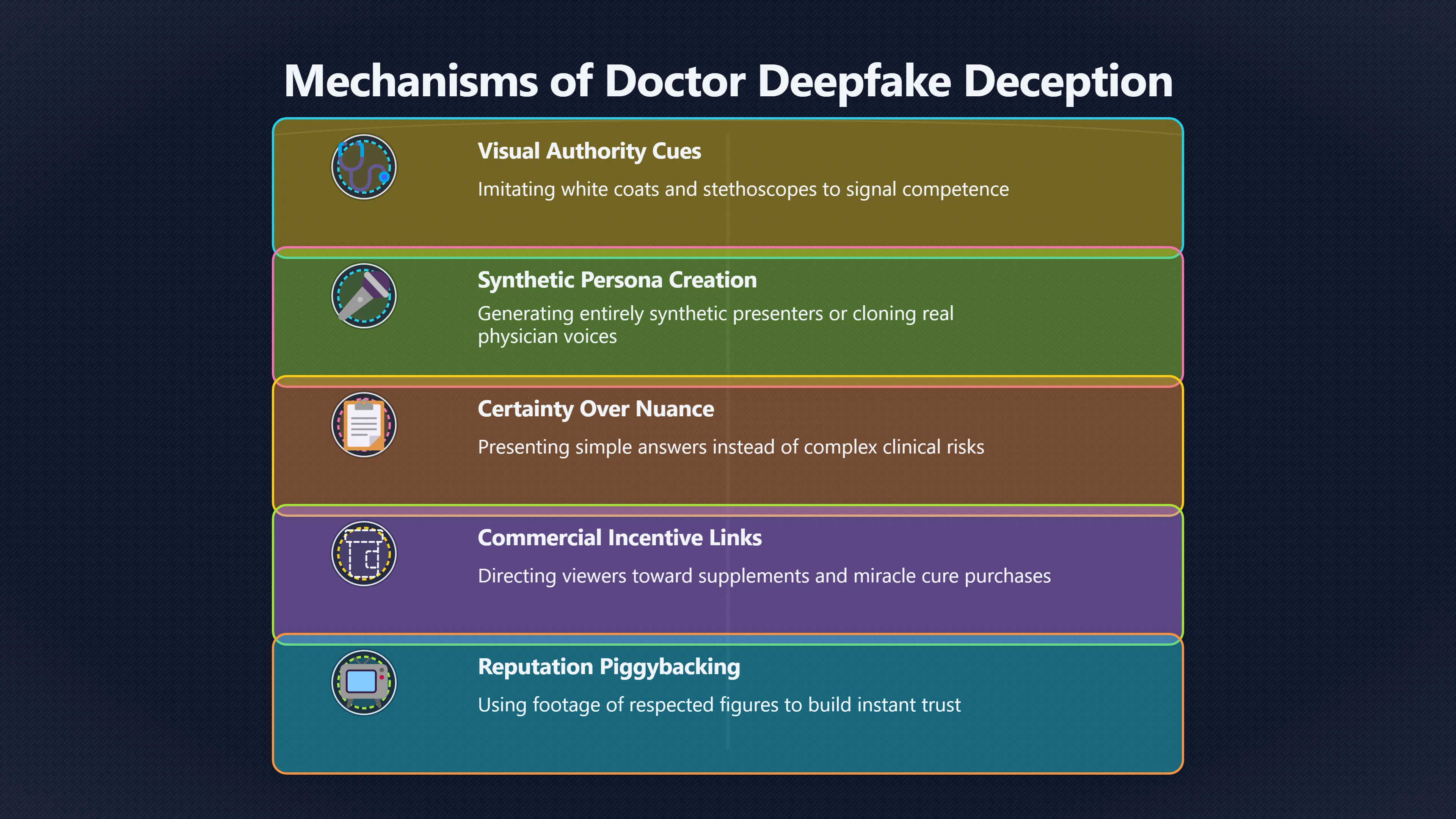
The most obvious cue is visual. White coats, consulting rooms, medical diagrams, stethoscopes and professional titles all signal competence. A deepfake does not need to prove expertise if it can convincingly imitate the appearance of expertise. Research on AI-enabled health technologies has shown that people often infer authority from design features, institutional associations and professional presentation rather than from direct evidence of competence.[arXiv]arxiv.orgThe Medical Authority of AI: A Study of AI-enabled Consumer-facing Health TechnologyJanuary 12, 2021…
Generative AI makes this easier than earlier forms of deception. Instead of hiring actors, scammers can generate entirely synthetic presenters or clone the likeness of real physicians. Investigations in several countries have found manipulated videos that used the faces and voices of genuine doctors to endorse supplements, miracle cures and unsupported treatments without their knowledge or consent.[Axios+3The Guardian+3nphic.org]theguardian.comThese deepfakes, including altered clips of reputable figures such as Prof David Taylor-Robinson and former Public Health England chief D…
A particularly effective tactic is combining authority with certainty. Real clinicians often discuss risks, uncertainty, side effects and individual variation. Deepfake endorsements frequently do the opposite. They present simple answers, dramatic promises and confident conclusions that sound more persuasive than genuine medical communication. The result is a message that feels expert while avoiding the caution that usually accompanies real clinical advice.
Why fake medical endorsements can be persuasive
Many viewers assume that if a doctor appears in a video, the person has already verified the information. Deepfakes exploit that assumption.
Recent research suggests that people struggle to distinguish AI-generated health content from human-generated content and may treat AI-produced material as highly credible. One study found that participants frequently viewed AI-generated medical responses as trustworthy and were often willing to follow advice even when experts judged the information to be inaccurate. The perceived authority attached to medical language and presentation appeared to outweigh careful evaluation of accuracy.[arXiv]arxiv.orgPeople over trust AI-generated medical responses and view them to be as valid as doctors, despite low accuracyAugust 12, 2024…
This creates a dangerous combination when AI-generated authority is attached to commercial incentives. Many documented doctor deepfakes are not random hoaxes. They are marketing tools designed to sell supplements, alternative treatments or health products. The video establishes trust first and directs viewers towards a purchase second. Investigations have uncovered fake endorsements promoting products supposedly capable of treating diabetes, high blood pressure, menopausal symptoms and other conditions. We Live Security+3The Guardian+3ABC News[theguardian.com]theguardian.comThese deepfakes, including altered clips of reputable figures such as Prof David Taylor-Robinson and former Public Health England chief D…
The effectiveness of these videos depends less on medical evidence than on perceived expertise. The viewer is encouraged to think, “A doctor recommended this,” even when no doctor ever did.

Red flags in AI-generated endorsement clips
Deepfakes are improving, but many still reveal clues that something is wrong. Importantly, these clues should trigger verification rather than serve as definitive proof.
Common warning signs include:
- Extraordinary certainty. Claims that a treatment “cures”, “reverses” or “guarantees” results for complex conditions deserve immediate scepticism.
- Direct product pitches. The speaker quickly moves from diagnosis or advice to a specific supplement, pill, gummy or purchase link.
- Lack of verifiable credentials. The video names a doctor but provides no hospital affiliation, professional registration details or traceable medical background.
- Emotional urgency. Viewers are told they must act immediately before information is removed or before their condition worsens.
- Unnatural visual behaviour. Lip movements, facial expressions or speech patterns may appear slightly artificial or mismatched. Some AI-generated avatars also appear in unrelated roles across different accounts.[New York Post]nypost.comThese avatars, often claiming expertise in fields like gynecology or plastic surgery, are completely computer-generated. Users are alerte…
- Claims that conflict with established care. Advice encouraging viewers to abandon prescribed treatments or avoid medical consultation should be treated with particular caution.
Another warning sign is the absence of normal medical nuance. Genuine clinicians typically discuss who a treatment is for, who should avoid it, possible risks, limitations of evidence and circumstances requiring professional assessment. Deepfake endorsements often present health decisions as simple and universal.
When real doctors are impersonated
One of the most troubling developments is the use of real medical professionals as unwilling spokespersons.
Investigations by journalists and fact-checkers have documented cases in which AI systems extracted footage from interviews, television appearances or educational videos and then altered speech, audio or facial movements to create entirely new messages. In some instances, respected public-health figures and media doctors appeared to endorse products they had never heard of.[ABC News+3The Guardian+3nphic.org]theguardian.comThese deepfakes, including altered clips of reputable figures such as Prof David Taylor-Robinson and former Public Health England chief D…
This tactic is effective because it combines two layers of trust. Viewers are not only persuaded by the appearance of a doctor; they recognise a specific doctor whose reputation already carries credibility. The deepfake therefore piggybacks on years of accumulated professional trust.
Medical organisations have increasingly warned that such impersonation threatens both patient safety and confidence in legitimate health communication. The concern is not only that people may buy ineffective products. Repeated exposure to fake endorsements can make it harder to know when a genuine medical message is authentic.[Axios]axios.comThese deceptive videos pose significant ethical and legal concerns, as physicians may unwittingly be implicated in harmful health advice…
Verification steps before trusting a medical video
Critical thinking about AI doctor deepfakes is less about becoming a forensic video analyst and more about adopting reliable verification habits.
Before acting on advice from a medical video:
- Verify the speaker independently. Search for the clinician through a hospital, university, professional regulator or recognised medical organisation rather than relying on information supplied by the video itself.
- Look for the original source. If a clip claims to show a famous doctor, try to locate the full interview, programme or publication from which it supposedly came.
- Separate the claim from the messenger. Even if the doctor is real, ask what evidence supports the recommendation. Authority alone is not evidence.
- Check for independent confirmation. Reliable health guidance is usually reflected across multiple credible organisations, not confined to a single viral video.
- Be especially cautious of commercial links. If the video leads directly to a product purchase, treat the endorsement as advertising until proven otherwise.
- Consult trusted medical sources for major decisions. Decisions about medication, diagnosis or treatment should be checked against established healthcare guidance and, where appropriate, discussed with a qualified clinician. Health fraud regulators regularly warn that products marketed with dramatic treatment claims often lack adequate evidence. U.S. Food and Drug Administration
The deeper lesson about authority online
Doctor deepfakes reveal a broader challenge for critical thinking in the age of AI: visual realism is no longer strong evidence of authenticity. A convincing face, professional setting and authoritative tone can now be generated or manipulated with relative ease.
The key question is no longer simply, “Does this look like a doctor?” It is, “How do I know this person is who they claim to be, and what evidence supports what they are saying?” Deepfakes succeed when viewers substitute appearance for verification. Critical thinking begins when those two things are treated as separate questions.
Amazon book picks
Further Reading
Books and field guides related to When fake doctors sell health certainty. Use these as the next step if you want deeper reading beyond the article.

Data Detective
First published 2021. Subjects: Statistics, Methodology, Social sciences, Statistical methods, Business.
eBay marketplace picks
Marketplace Samples
Example marketplace items related to this page. Use the search link to explore similar finds on eBay.




Endnotes
1.
Source: pmc.ncbi.nlm.nih.gov
Title: PMCGenerative AI and health misinformation
Link:https://pmc.ncbi.nlm.nih.gov/articles/PMC12924558/
Source snippet
NIHby HR Saeidnia · 2026 · Cited by 6 — Users often struggle to distinguish AI‑generated from human‑authored health misinformation...
2.
Source: axios.com
Link:https://www.axios.com/2026/05/06/doctors-ai-deepfakes-misinformation-problem
Source snippet
These deceptive videos pose significant ethical and legal concerns, as physicians may unwittingly be implicated in harmful health advice...
3.
Source: arxiv.org
Link:https://arxiv.org/abs/2101.04794
Source snippet
The Medical Authority of AI: A Study of AI-enabled Consumer-facing Health TechnologyJanuary 12, 2021...
Published: January 12, 2021
4.
Source: nphic.org
Link:https://www.nphic.org/news/news-highlights/2554-ai-deepfakes-of-real-doctors-spreading-health-misinformation-on-social-media
Source snippet
AI Deepfakes of Real Doctors Spreading Health...Dec 22, 2025 — Factcheckers uncovered hundreds of manipulated videos using altered foota...
5.
Source: arxiv.org
Link:https://arxiv.org/abs/2408.15266
Source snippet
People over trust AI-generated medical responses and view them to be as valid as doctors, despite low accuracyAugust 12, 2024...
Published: August 12, 2024
7.
Source: youtube.com
Title: AI accounts impersonating doctors on social media
Link:https://www.youtube.com/watch?v=iNNA-66vKPE
Source snippet
The Guardian...
8.
Source: medicalxpress.com
Title: 2025 03 generative ai deepfakes fueling health
Link:https://medicalxpress.com/news/2025-03-generative-ai-deepfakes-fueling-health.html
Source snippet
Here's what to look out for so you don't get scammed... False and misleading...Read more...
9.
Source: theguardian.com
Link:https://www.theguardian.com/society/2025/dec/05/ai-deepfakes-of-real-doctors-spreading-health-misinformation-on-social-media
Source snippet
These deepfakes, including altered clips of reputable figures such as Prof David Taylor-Robinson and former Public Health England chief D...
10.
Source: abc.net.au
Title: diabetes supplements deepfake ads targeting health professionals
Link:https://www.abc.net.au/news/health/2024-12-10/diabetes-supplements-deepfake-ads-targeting-health-professionals/104665824
Source snippet
Deepfakes of health experts are being used to sell supplements. Hear...Read more...
11.
Source: welivesecurity.com
Title: deepfake doctors tiktok bogus cures
Link:https://www.welivesecurity.com/en/social-media/deepfake-doctors-tiktok-bogus-cures/
Source snippet
Deepfake 'doctors' take to TikTok to peddle bogus cures25 Apr 2025 — Look out for AI-generated 'TikDocs' who exploit the public's trust i...
12.
Source: nypost.com
Link:https://nypost.com/2025/03/07/tech/ai-generated-doctors-are-duping-tiktok-users-with-fake-medical-advice-heres-how-to-spot-a-horrifying-fraud/
Source snippet
These avatars, often claiming expertise in fields like gynecology or plastic surgery, are completely computer-generated. Users are alerte...
Additional References
13.
Source: consumer.ftc.gov
Link:https://consumer.ftc.gov/node/76330
Source snippet
Consumer AdviceFTC & FDA issue warning letters to supplement sellersAds abound for products that claim to treat or prevent serious health...
14.
Source: linkedin.com
Link:https://www.linkedin.com/posts/dr-rachael-kent-88aa9451_digitalhealth-deepfakes-aimisinformation-activity-7381601544015745024-LH8V
Source snippet
AI health scams on social media | Dr. Rachael Kent posted...We've entered a new phase where misinformation is weaponised as marketing. H...
15.
Source: linkedin.com
Link:https://www.linkedin.com/posts/chrismorris3_ai-deepfakes-of-real-doctors-spreading-health-activity-7403381647926054912-EeVP
Source snippet
Full Fact Exposes Fake AI-Generated Health MisinformationGreat investigation by Full Fact's Leo Benedictus on fake AI-generated videos of...
16.
Source: thetimes.co.uk
Link:https://www.thetimes.co.uk/article/deepfakes-of-michael-mosley-used-to-sell-health-scams-bslncmp08
Source snippet
These deepfake videos use artificial intelligence to digitally impersonate these doctors, presenting fake endorsements for supposed mirac...
17.
Source: mountsinai.org
Link:https://www.mountsinai.org/about/newsroom/2025/ai-chatbots-can-run-with-medical-misinformation-study-finds-highlighting-the-need-for-stronger-safeguards
Source snippet
AI Chatbots Can Run With Medical Misinformation, Study...Aug 6, 2025 — “What we saw across the board is that AI chatbots can be easily m...
18.
Source: linkedin.com
Link:https://www.linkedin.com/videos/dr-rachael-kent-88aa9451_digitalhealth-deepfakes-aimisinformation-activity-7381601544015745024-LH8V
Source snippet
Deepfake doctors: AI health scams on social mediaOct 8, 2025 — Deepfake doctors are here. AI isn't just writing health advice — it's perf...
19.
Source: reddit.com
Link:https://www.reddit.com/r/Futurology/comments/1pgkb9i/ai_deepfakes_of_real_doctors_spreading_health/
20.
Source: cbsnews.com
Title: deepfake videos impersonating real doctors push false medical advice treatments
Link:https://www.cbsnews.com/news/deepfake-videos-impersonating-real-doctors-push-false-medical-advice-treatments/
Source snippet
Deepfake videos impersonating real doctors push false...14 Aug 2025 — AI-generated, deepfake videos that appear to show real physicians...
21.
Source: instagram.com
Link:https://www.instagram.com/reel/DNWDA1YxZIW/
Source snippet
Clips like the ones you're seeing now, mimic professionals in the medical field. And in some cases, use real doctors' faces...Read more...
22.
Source: bmjgroup.com
Title: trusted tv doctors deepfaked to promote health scams on social media
Link:https://bmjgroup.com/trusted-tv-doctors-deepfaked-to-promote-health-scams-on-social-media/
Source snippet
Trusted TV doctors “deepfaked” to promote health scams...18 Jul 2024 — The BMJ investigates the rise of videos claiming to be UK's popul...
Topic Tree