Within Emotional Posts
How platforms reward louder moral posts
Likes and shares can teach users that more outraged posts get more attention, making emotional escalation feel normal.
On this page
- How feedback loops shape posting habits
- Why out group anger travels so well
- Ways to notice reward driven escalation
Page outline Jump by section
Introduction
One reason emotional posts can bypass scepticism is that social media does not merely display content; it rewards certain styles of content. When likes, shares, reposts and comments are highly visible, they become signals of success. Over time, users can learn that posts expressing stronger moral condemnation, sharper blame or more intense outrage attract more attention than measured discussion. The result is not necessarily deliberate manipulation. Often it is a gradual learning process in which people adapt their behaviour to the feedback they receive.
 Research increasingly suggests that this is not just a theory about platform culture. Social rewards appear to shape how people express moral emotions online, creating feedback loops that can make public conversation louder, more accusatory and less reflective. Understanding these incentives is an important part of critical thinking because popularity and moral intensity are not reliable indicators of accuracy.[Science]science.orgFor our social media studies, we developed DOC using supervised machine learning.Read more…
How feedback loops shape posting habits
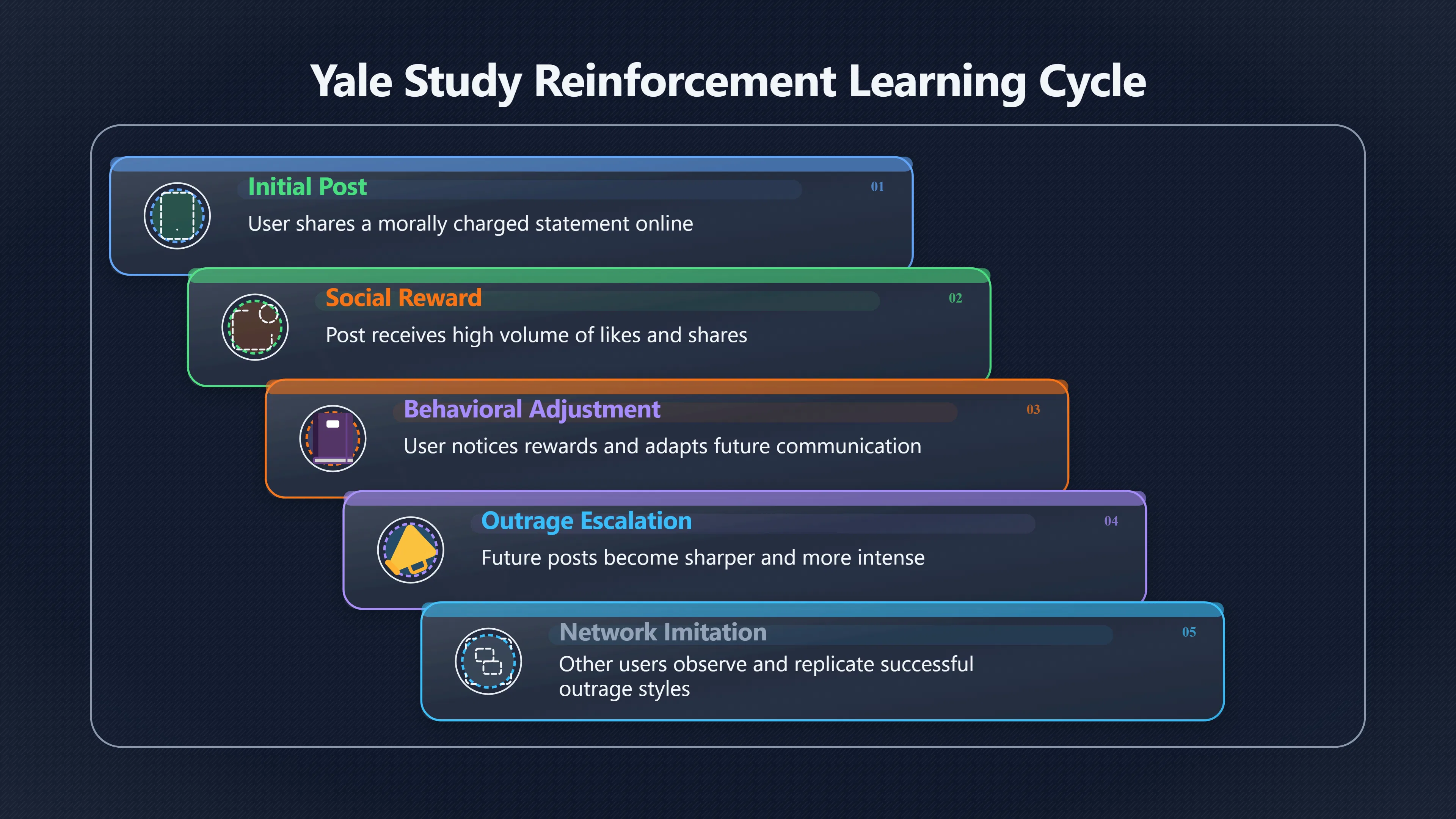
The simplest way to understand the mechanism is to think about social media as a reward environment. Users post something, receive feedback, and adjust future behaviour based on the results. Psychologists describe this process as reinforcement learning: behaviours that receive rewards tend to be repeated.
A major study led by researchers at Yale analysed millions of tweets and conducted controlled experiments to examine whether social feedback influenced expressions of moral outrage. The researchers found that when users received more positive feedback for outrage-related posts, they became more likely to express outrage in future posts. The findings were consistent with reinforcement learning, suggesting that visible rewards such as likes and shares can train users towards more outrage-focused communication.[Science+2PMC]science.orgFor our social media studies, we developed DOC using supervised machine learning.Read more…
Importantly, the study did not argue that social media creates moral concern from nothing. People already care about political, ethical and social issues. The finding was narrower and more significant: platform feedback appears to influence how those concerns are expressed. If outrage receives the strongest rewards, outrage becomes a more attractive communication style.[Science]science.orgFor our social media studies, we developed DOC using supervised machine learning.Read more…
This creates a self-reinforcing cycle:
- A morally charged post receives unusually high engagement.
- The user notices the reward.
- Similar posts are more likely to be written in the future.
- Other users observe which posts succeed and imitate them.
- The overall tone of discussion shifts towards stronger emotional expression.
As more participants adapt to the same incentives, emotional escalation can begin to feel normal rather than exceptional.[Nature]nature.comMoral Outrage Dynamics in Social MediaMoral outrage on social media arises when users perceive violations of ethical norms and resp…
Why out-group anger travels so well
Not all emotional content is rewarded equally. Evidence suggests that posts targeting an opposing group often perform especially well.
A large study published in the Proceedings of the National Academy of Sciences analysed more than 2.7 million Facebook and Twitter posts from news organisations and US politicians. Posts focused on political opponents were shared or retweeted roughly twice as often as posts focused on allies. References to political out-groups were among the strongest predictors of engagement, outperforming several previously recognised drivers of sharing.[PNAS+2PubMed]pnas.orgOut-group animosity drives engagement on social mediaby S Rathje · 2021 · Cited by 869 — We report evidence that posts about politica…
This matters because moral outrage is often directed at an identifiable target. A post condemning an opponent does more than communicate information. It signals group membership. Sharing it can demonstrate loyalty, solidarity and moral commitment to one’s side.
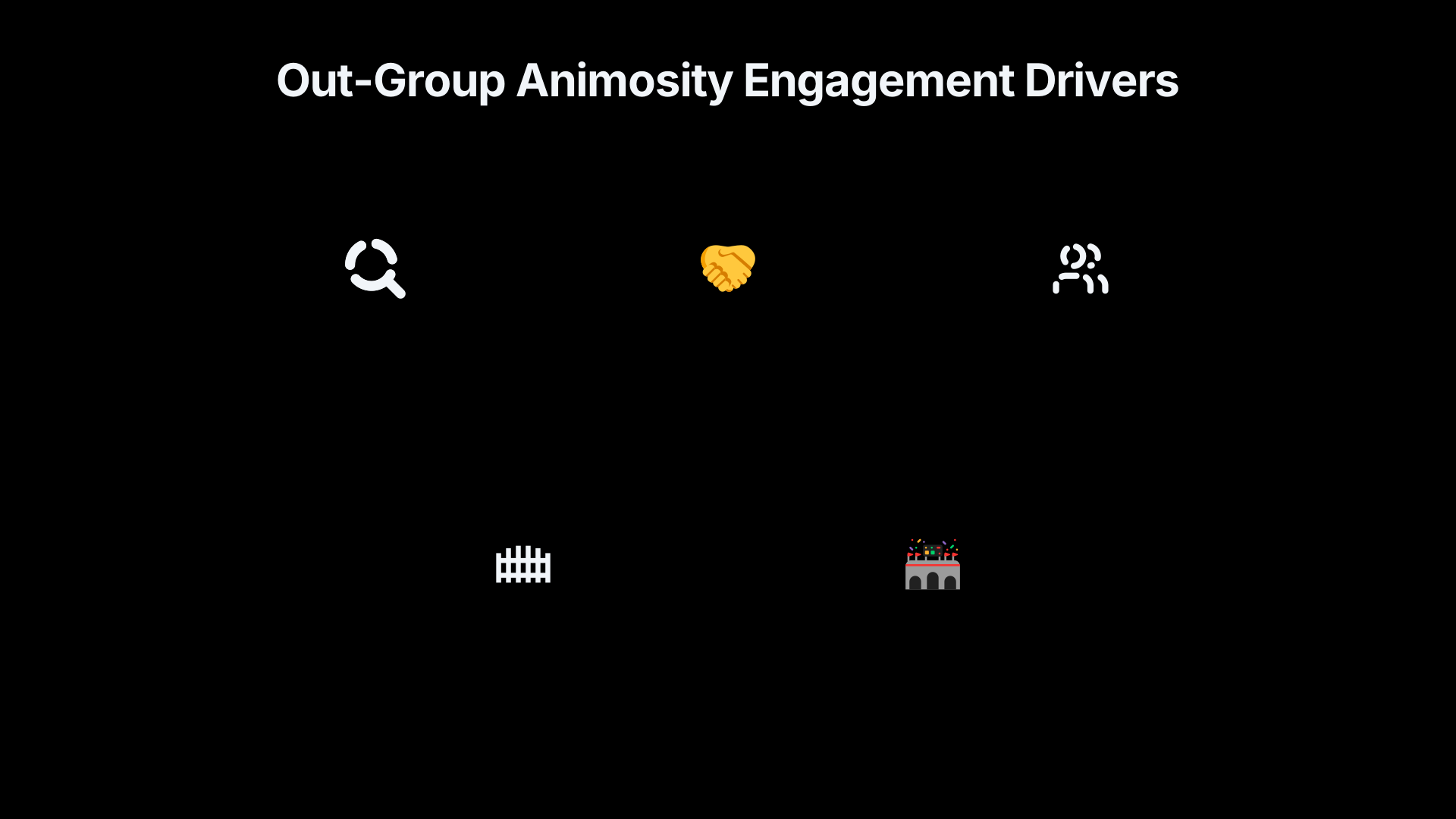
From a social reward perspective, attacking an out-group can deliver multiple benefits at once:
- It attracts attention.
- It invites agreement from allies.
- It generates visible engagement.
- It signals moral commitment.
- It distinguishes insiders from outsiders.
These rewards help explain why many viral posts present events as conflicts between heroes and villains rather than as complex situations requiring investigation. The simpler and more morally charged the narrative, the easier it becomes for audiences to react quickly.[PNAS+2PNAS]pnas.orgOut-group animosity drives engagement on social mediaby S Rathje · 2021 · Cited by 869 — We report evidence that posts about politica…
The danger for critical thinking is that engagement rewards can encourage certainty before verification. A claim may spread because it offers an opportunity for collective condemnation, not because the underlying evidence has been carefully examined.
When visibility is mistaken for evidence
Visible engagement creates a second effect. It influences not only the person posting but also the people reading.
Social media displays signals showing that thousands or millions of others have reacted. Experimental research has found that engagement cues affect users’ willingness to interact with content. When people see evidence that many others have engaged with a post, they are more likely to engage themselves.[arXiv]arxiv.orgHow many others have shared this? Experimentally investigating the effects of social cues on engagement, misinformation, and unpredi…
This can create the impression that a widely shared moral claim must be especially important, obvious or true. Yet the engagement may partly reflect the emotional rewards built into the platform rather than the strength of the evidence.
The distinction is crucial. A post receiving 100,000 shares demonstrates that many people reacted. It does not demonstrate that the claim was verified, contextualised or accurate.
In fast-moving controversies, these social signals can make scepticism feel socially costly. Users may fear that questioning a popular narrative will be interpreted as disloyalty or indifference. The more visible the consensus appears, the harder it can become to slow down and evaluate the underlying facts independently.
Why escalation often happens gradually
Many people imagine online outrage as the product of a small number of unusually angry users. The evidence suggests a more subtle process.
The Yale research found particularly strong learning effects among users embedded in politically moderate networks. This finding suggests that reinforcement does not only affect highly ideological participants. Ordinary users can gradually adapt to the incentives around them.[YaleNews]news.yale.edulikes and shares teach people express more outrage onlineNews'Likes' and 'shares' teach people to express more outrage onlineAug 13, 2021 — Social media platforms like Twitter amplify expres…
A typical progression might look like this:
- A user posts a balanced criticism and receives modest engagement.
- A stronger, more emotionally charged version receives more attention.
- Future posts become slightly sharper.
- Over months or years, the user’s communication style shifts.
At no point is there necessarily a conscious decision to become more outraged. The change emerges from repeated interactions with a reward system.
Researchers studying social media more broadly have found that online behaviour often follows the same reward-learning principles observed in other forms of human learning. Large-scale analyses of millions of posts show that users adapt behaviour in response to social rewards and feedback.[PMC]pmc.ncbi.nlm.nih.govMoral outrage in the digital age. NatA computational reward learning account of social media…by B Lindström · 2021 · Cited by 252 — In conclusion, our findings reveal t…
Ways to notice reward-driven escalation
For readers trying to think critically, the goal is not to ignore moral emotions. Moral concern often points to genuine problems. The challenge is recognising when platform incentives may be amplifying expression beyond what the evidence alone would justify.
Useful questions include:
- Does the post provide evidence, or mainly emotional cues? Strong condemnation is not the same as strong proof.
- Would the message still be persuasive without the likes, shares and supportive comments? Visible approval can make weak claims appear stronger.
- Is the post explaining a problem or performing outrage for an audience? Both can occur simultaneously.
- Does the content focus heavily on an opposing group? Out-group attacks often receive disproportionate engagement.
- Has certainty appeared faster than verification? Rapid moral consensus can sometimes form before key facts are established.
Another useful habit is comparing the emotional intensity of a post with the quality of its sourcing. When outrage rises while evidence remains thin, the reward structure may be doing part of the persuasive work.
What this means for critical thinking
Social rewards do not force people to become more outraged, and outrage itself is not evidence of manipulation. Many important social movements have relied on morally charged communication. The key point is that platforms create incentives that can selectively reward the most emotionally expressive versions of a message.
Research suggests that likes, shares and other forms of feedback can teach users which styles of communication gain attention, while hostility towards opposing groups often generates especially strong engagement. Over time, these incentives can make louder moral expression appear more common, more effective and more socially expected than it would otherwise be.[PubMed+3Science+3PMC]science.orgFor our social media studies, we developed DOC using supervised machine learning.Read more…
For critical thinkers, the practical lesson is straightforward: treat engagement as evidence of reaction, not evidence of truth. The more a post seems designed to attract applause, condemnation or group loyalty, the more important it becomes to separate the emotional reward from the factual claim being made.


eBay marketplace picks
Marketplace Samples
Example marketplace items related to this page. Use the search link to explore similar finds on eBay.


Endnotes
1.
Source: pmc.ncbi.nlm.nih.gov
Link:https://pmc.ncbi.nlm.nih.gov/articles/PMC8363141/
Source snippet
social learning amplifies moral outrage expression in...by WJ Brady · 2021 · Cited by 471 — Social reinforcement and norm learning inter...
2.
Source: isps.yale.edu
Title: isps21 25
Link:https://isps.yale.edu/research/publications/isps21-25
Source snippet
How Social Learning Amplifies Moral Outrage Expression in...Here, we show how social learning processes amplify online moral outrage exp...
3.
Source: nature.com
Link:https://www.nature.com/nature-index/topics/l4/moral-outrage-dynamics-in-social-media
Source snippet
Moral Outrage Dynamics in Social MediaMoral outrage on social media arises when users perceive violations of ethical norms and resp...
4.
Source: pnas.org
Link:https://www.pnas.org/doi/10.1073/pnas.2024292118
Source snippet
Out-group animosity drives engagement on social mediaby S Rathje · 2021 · Cited by 869 — We report evidence that posts about politica...
5.
Source: pnas.org
Link:https://www.pnas.org/doi/pdf/10.1073/pnas.2024292118
Source snippet
Out-group animosity drives engagement on social mediaby S Rathje · 2021 · Cited by 869 — High-arousal emotions, whether they are positive...
6.
Source: arxiv.org
Link:https://arxiv.org/abs/2207.07562
Source snippet
How many others have shared this? Experimentally investigating the effects of social cues on engagement, misinformation, and unpredi...
7.
Source: news.yale.edu
Title: likes and shares teach people express more outrage online
Link:https://news.yale.edu/2021/08/13/likes-and-shares-teach-people-express-more-outrage-online
Source snippet
News'Likes' and 'shares' teach people to express more outrage onlineAug 13, 2021 — Social media platforms like Twitter amplify expres...
8.
Source: nature.com
Link:https://www.nature.com/articles/s41467-020-19607-x
Source snippet
A computational reward learning account of social media...by B Lindström · 2021 · Cited by 247 — We analyze over one million posts...
9.
Source: pnas.org
Link:https://www.pnas.org/doi/10.1073/pnas.2400928121
Source snippet
J. Crockett, How social learning amplifies moral outrage expression in online social networks. Sci. Adv. 7, eabe5641 (2021). Go to refere...
10.
Source: facebook.com
Title: research from the yale human nature lab found that expressions of moral outrage
Link:https://www.facebook.com/KeatingBigPicture/posts/research-from-the-yale-human-nature-lab-found-that-expressions-of-moral-outrage-/1404857884347320/
Source snippet
Research from the Yale Human Nature Lab found that...Feb 7, 2026 — Here, we propose that social media users overperceive levels of moral...
11.
Source: science.org
Link:https://www.science.org/doi/10.1126/sciadv.abe5641
Source snippet
For our social media studies, we developed DOC using supervised machine learning.Read more...
12.
Source: pubmed.ncbi.nlm.nih.gov
Link:https://pubmed.ncbi.nlm.nih.gov/34162706/
Source snippet
Out-group animosity drives engagement on social mediaby S Rathje · 2021 · Cited by 923 — We investigated whether out-group animosit...
13.
Source: pmc.ncbi.nlm.nih.gov
Title: Moral outrage in the digital age. Nat
Link:https://pmc.ncbi.nlm.nih.gov/articles/PMC7910435/
Source snippet
A computational reward learning account of social media...by B Lindström · 2021 · Cited by 252 — In conclusion, our findings reveal t...
14.
Source: pmc.ncbi.nlm.nih.gov
Link:https://pmc.ncbi.nlm.nih.gov/articles/PMC10259455/
Source snippet
the incentive structure of social media platforms to...by LK Globig · 2023 · Cited by 44 — We show that a slight change to the incentive...
15.
Source: science.org
Link:https://www.science.org/doi/10.1126/science.adl2829
Source snippet
Misinformation exploits outrage to spread onlineby KL McLoughlin · 2024 · Cited by 80 — We investigated the relationship between misinfor...
16.
Source: sciencealert.com
Title: social media networks are training us to express more outrage online
Link:https://www.sciencealert.com/social-media-networks-are-training-us-to-express-more-outrage-online
Source snippet
Social Media Is Training Us to Unleash More Moral...16 Aug 2021 — A new study shows how these online networks are encouraging us to expr...
17.
Source: ora.ox.ac.uk
Link:https://ora.ox.ac.uk/objects/uuid%3A5b207292-0d98-4d17-9631-3596a03dcaba/files/rpk02cb67r
Source snippet
Nature Human Behaviour, 1-28. Marlowe FW, Berbesque JC...Read more...
Additional References
18.
Source: researchgate.net
Link:https://www.researchgate.net/publication/348611916_How_social_learning_amplifies_moral_outrage_expression_in_online_social_networks
Source snippet
How social learning amplifies moral outrage expression in...Jan 26, 2021 — We find that positive social feedback for outrage expressions...
19.
Source: ebsco.com
Link:https://www.ebsco.com/research-starters/social-sciences-and-humanities/ingroups-and-outgroups
Source snippet
Ingroups and Outgroups | Social Sciences and HumanitiesIngroups and outgroups are sociological concepts that describe the dynamics betwee...
20.
Source: reddit.com
Link:https://www.reddit.com/r/AcademicPsychology/comments/o9zkq2/outgroup_animosity_drives_engagement_on_social/
Source snippet
Out-group animosity drives engagement on social mediaWe investigated whether out-group animosity was particularly successful at generatin...
21.
Source: linkedin.com
Link:https://www.linkedin.com/showcase/pnas-news/
22.
Source: Wikipedia
Title: Proceedings of the National Academy of Sciences of the United States of America
Link:https://en.wikipedia.org/wiki/Proceedings_of_the_National_Academy_of_Sciences_of_the_United_States_of_America
Source snippet
Proceedings of the National Academy of SciencesIt is the official journal of the National Academy of Sciences, published since 1915, a...
23.
Source: youtube.com
Link:https://www.youtube.com/watch?v=AkYJOYrNiSw
Source snippet
In-group/Out-group | Ethics DefinedThe In-group/Out-group phenomenon describes the fact that we tend to judge and treat people who are li...
24.
Source: collaborate.princeton.edu
Title: how social learning amplifies moral outrage expression in online
Link:https://collaborate.princeton.edu/en/publications/how-social-learning-amplifies-moral-outrage-expression-in-online-/
Source snippet
social learning amplifies moral outrage expression in...by WJ Brady · 2021 · Cited by 481 — Here, we show how social learning processes...
25.
Source: researchgate.net
Title: 352698571 Out group animosity drives engagement on social media
Link:https://www.researchgate.net/publication/352698571_Out-group_animosity_drives_engagement_on_social_media
Source snippet
(2021) document this mechanism, showing that out-group animosity, an affective driver amplified by platform engagement incentives...Rea...
26.
Source: semanticscholar.org
Link:https://www.semanticscholar.org/paper/Out-group-animosity-drives-engagement-on-social-Rathje-Bavel/5b4e16bb013cc36c2025db914837547cc9b7300d
Source snippet
Van Bavel, S. van der Linden · Published in Proceedings of the National… 23 June 2021...Read more...
Published: June 2021
27.
Source: theswaddle.com
Title: how retweets and likes on social media reward moral outrage
Link:https://www.theswaddle.com/how-retweets-and-likes-on-social-media-reward-moral-outrage
Source snippet
How Retweets and Likes on Social Media 'Reward' Moral...16 Aug 2021 — According to a new study, social media users who receive more “lik...
Topic Tree