Within Corroboration
Checking danger before sharing warnings
For crime and emergency posts, useful confirmation usually comes from sources close to the event and accountable for corrections.

On this page
- Police, courts, emergency services, and local reporters
- Named witnesses versus anonymous rumour
- What remains unconfirmed in fast moving incidents
Page outline Jump by section
Introduction
When a social-media post warns of a shooting, a missing suspect, a dangerous chemical release, a riot, a terrorist incident, or an unfolding disaster, the key question is not whether the claim sounds plausible. It is whether the claim has been independently confirmed by sources that obtained information separately and can be held accountable if they are wrong.
 In public-safety situations, misinformation can have immediate consequences. False warnings can cause panic, overwhelm emergency lines, divert aid, damage reputations, and discourage people from following genuine instructions. Emergency-management agencies have repeatedly warned that rumours circulating during disasters can interfere with response efforts and prevent people from obtaining accurate assistance.[FEMA+2Brookings]fema.govhurricane rumor responseHurricane Rumor Response14 Oct 2024 — We have seen many rumors that have the potential to seriously hamper storm response efforts or…
Independent evidence is therefore not simply “more people saying the same thing”. It is evidence that comes from separate channels of observation, reporting, or documentation and that can be checked against identifiable facts.
Police, courts, emergency services, and local reporters
For public-safety claims, the strongest corroboration usually comes from organisations that are both close to the event and accountable for corrections.
Police statements, emergency-service updates, court records, official incident reports, and public warnings issued by recognised authorities are often among the first reliable forms of confirmation. These sources may still make mistakes, but they have identifiable responsibilities, documented procedures, and public records that can later be scrutinised. Emergency-management agencies routinely advise the public to rely on official response organisations and verified government channels during crises.[ncdps.gov]ncdps.govguide highlighting trusted information sourcesState Emergency Response Team Publishing Guide…Oct 4, 2024 — The public should get information about storm response and impacts from t…
Local journalists can also provide valuable independent evidence. A reporter physically present at a scene may verify road closures, evacuation orders, arrests, or emergency activity without relying on the same social-media rumour that sparked public attention. The important question is whether the reporting reflects direct observation, official confirmation, or independently gathered information rather than repetition of an online claim.
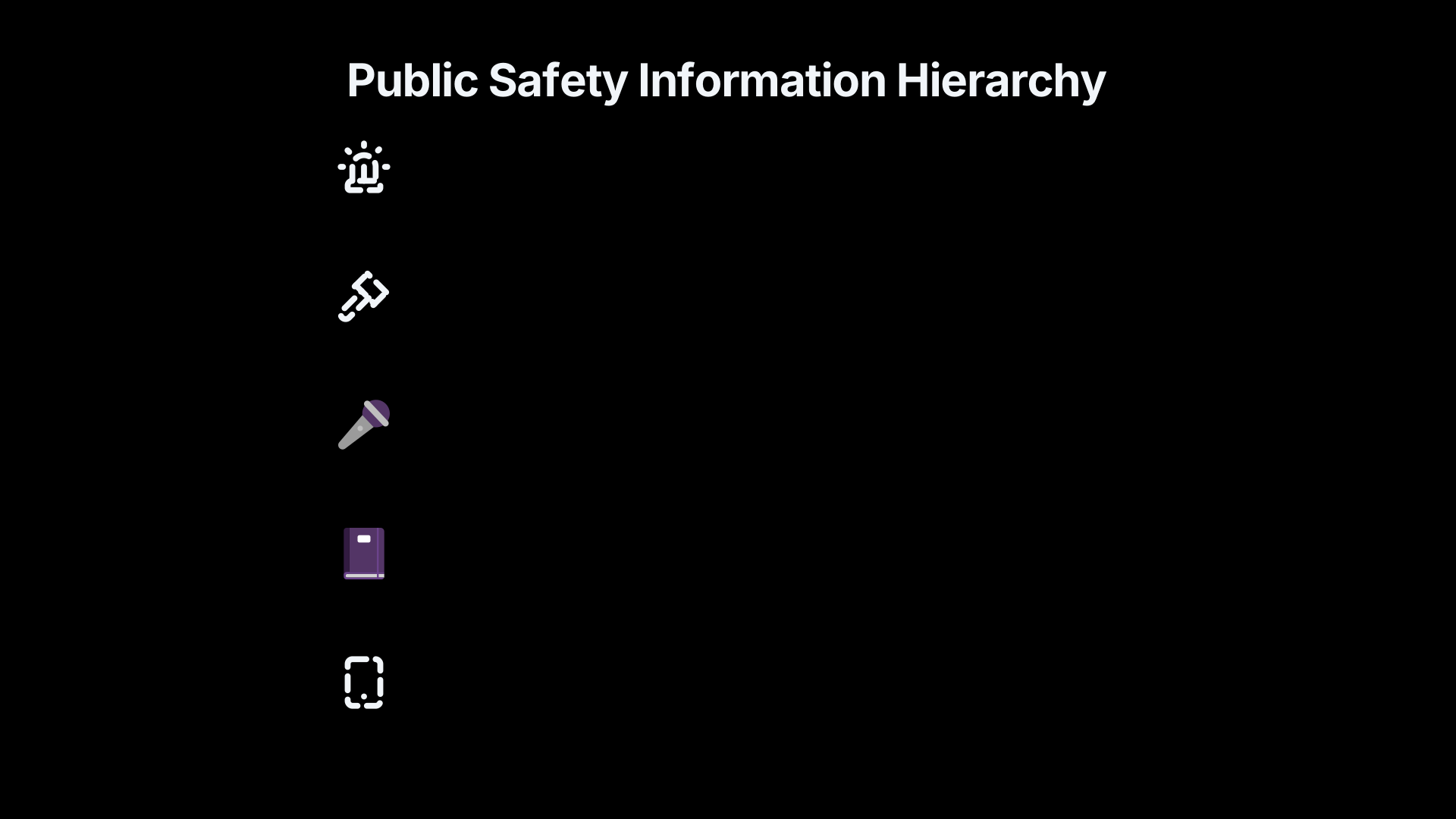
A useful hierarchy for breaking public-safety reports is:
- Direct official information from responsible agencies.
- Court filings, charging documents, or public records.
- Local reporters conducting on-the-ground reporting.
- Named witnesses whose presence can be verified.
- Social-media posts that have not been independently checked.
The order can change in unusual circumstances, but claims generally become stronger when multiple categories point to the same conclusion.
Named witnesses versus anonymous rumour
Eyewitnesses matter, but not all witness accounts carry equal evidential weight.
A named witness who can explain where they were, what they saw, and when they saw it provides information that can potentially be checked against CCTV footage, photographs, official timelines, or other witnesses. Even then, eyewitness memory is often incomplete during stressful events. People may accurately report that something happened while misidentifying who was involved or misunderstanding what caused it.[First Draft]firstdraftnews.orgFirst DraftVerifying online information: The absolute essentialsOctober 14, 2019 — 14 Oct 2019 — This is your little condensed guide to t…
Anonymous claims are more difficult. An unnamed social-media account stating that “my friend in the police confirmed this” provides almost no way to evaluate access, competence, motives, or accuracy. Journalism ethics organisations generally treat anonymous sourcing as an exception requiring additional verification rather than a substitute for it.[Ethics and Journalism]ethicsandjournalism.orgEthics and JournalismBest Practices: Anonymous SourcesIn this post, we're exploring the best practices and ethical considerations when us…
When assessing witness-based evidence, several questions help:
- Is the witness identifiable?
- Is there evidence they were actually present?
- Do they describe observations rather than conclusions?
- Do other independent witnesses report similar facts?
- Does their account match known timelines and locations?
The more a claim depends on unnamed intermediaries—“someone told someone who heard from emergency services”—the weaker it becomes.
The difference between multiple reports and independent confirmation
One of the most common mistakes during fast-moving incidents is confusing repetition with corroboration.
A rumour may appear on dozens of accounts within minutes while still originating from a single unverified source. Screenshots, reposts, AI-generated summaries, and news aggregators can create the illusion that many different people have confirmed a story when they are all repeating the same initial claim.
True independence means separate access to information.
For example:
- A police statement and a local hospital announcement may provide independent confirmation of a mass-casualty event.
- Two witnesses who were in different locations may independently confirm a road closure.
- Court records and police records may independently support details about an arrest.
By contrast:
- Ten accounts reposting the same video are not ten sources.
- Several articles quoting one police scanner recording are not multiple confirmations.
- AI-generated summaries based on the same original post add no new evidence.
Verification specialists often emphasise tracing information back to its origin and identifying whether each purported source actually gathered information independently.[First Draft]firstdraftnews.orgFirst DraftVerifying online information: The absolute essentialsOctober 14, 2019 — 14 Oct 2019 — This is your little condensed guide to t…

What remains unconfirmed in fast-moving incidents
A reliable public-safety update often contains uncertainty.
One hallmark of trustworthy reporting is that it separates confirmed facts from unresolved questions. Early in an incident, authorities may confirm that emergency crews responded to a location while remaining unable to verify casualty numbers, motives, identities, or causes.
Readers should pay attention to statements such as:
- “Authorities have confirmed the incident.”
- “The cause remains under investigation.”
- “Officials have not identified a suspect.”
- “Reports of additional victims have not been verified.”
These distinctions matter because misinformation frequently enters the information stream through premature certainty rather than outright fabrication.
Many disaster-related rumours have spread by filling gaps before officials had enough information to speak confidently. During major hurricanes and wildfires, emergency agencies have maintained dedicated rumour-control pages specifically because inaccurate claims often emerge before facts are established.[FEMA+2FEMA]fema.govhurricane rumor responseHurricane Rumor Response14 Oct 2024 — We have seen many rumors that have the potential to seriously hamper storm response efforts or…
A claim should not become more believable merely because it offers a complete explanation before investigators have finished gathering evidence.
Practical examples of strong and weak evidence
Consider a social-media post claiming that residents must immediately evacuate because a dam has failed.
Stronger evidence:
- Emergency-management alerts.[facebook.com]facebook.comFEMA Federal Emergency Management AgencyRumor: FEMA will only provide $750 to #Helene survivors. Fact: This is false. Disaster assistance…
- Local authority evacuation orders.
- Confirmations from emergency services.[ncdps.gov]ncdps.govguide highlighting trusted information sourcesState Emergency Response Team Publishing Guide…Oct 4, 2024 — The public should get information about storm response and impacts from t…
- On-the-ground reporting from local journalists.
- Multiple independently verified photographs from the location.
Weaker evidence:
- A screenshot with no source.
- An AI-generated summary citing unnamed reports.
- Viral reposts repeating one original claim.
- Anonymous messages forwarded through private groups.
Another example is a claim that authorities are withholding information about a crime.
Stronger evidence:
- Court documents.
- Recorded public statements.
- Official records obtained through lawful disclosure.
- Independent reporting from multiple news organisations.
Weaker evidence:
- “A police insider told me.”
- Edited clips without context.
- Anonymous posts lacking documentation.
- Claims that cannot be checked against any identifiable source.

Why accountability matters
The best public-safety evidence usually comes from people and institutions that risk reputational, legal, professional, or political consequences if they publish false information.
A police force can be questioned. A court record can be inspected. An emergency-management agency can issue corrections. A local reporter’s work can be challenged publicly. These accountability mechanisms do not guarantee accuracy, but they provide a way to evaluate and correct errors.
Rumour accounts, anonymous reposts, and automated content often lack those safeguards. If a warning turns out to be false, there may be no identifiable person responsible for correcting it.
For that reason, independent evidence in public-safety claims is not merely about quantity. It is about separate access to facts, transparency about uncertainty, and accountability for getting the story right. When those elements are present, readers have a much stronger basis for deciding whether a warning deserves attention—or whether it should remain unconfirmed until better evidence arrives.
Amazon book picks
Further Reading
Books and field guides related to Checking danger before sharing warnings. Use these as the next step if you want deeper reading beyond the article.
A field guide to lies
Provides practical tools for evaluating evidence quality in urgent situations.
Unspun Finding Facts in a World of Disinformation
Helps readers distinguish accountable sources from rumours.
Verification Handbook
Directly relevant to checking public-safety claims before sharing them.
eBay marketplace picks
Marketplace Samples
Example marketplace items related to this page. Use the search link to explore similar finds on eBay.


Endnotes
1.
Source: fema.gov
Title: hurricane rumor response
Link:https://www.fema.gov/disaster/recover/rumor/hurricane-rumor-response
Source snippet
Hurricane Rumor Response14 Oct 2024 — We have seen many rumors that have the potential to seriously hamper storm response efforts or...
2.
Source: brookings.edu
Title: fighting hurricane misinformation requires aggressive pushback
Link:https://www.brookings.edu/articles/fighting-hurricane-misinformation-requires-aggressive-pushback/
Source snippet
Fighting hurricane misinformation requires aggressive...9 Oct 2024 — FEMA has a rumor control page to deal with disaster-related misinfo...
3.
Source: ncdps.gov
Title: guide highlighting trusted information sources
Link:https://www.ncdps.gov/news/press-releases/2024/10/04/guide-highlighting-trusted-information-sources
Source snippet
State Emergency Response Team Publishing Guide...Oct 4, 2024 — The public should get information about storm response and impacts from t...
4.
Source: fema.gov
Link:https://www.fema.gov/disaster/historic/coronavirus/rumor-control
5.
Source: fema.gov
Title: rumor response
Link:https://www.fema.gov/disaster/recover/rumor-response
Source snippet
Common Disaster-Related Rumors18 Nov 2025 — There often are many rumors and scams after a disaster. Do your part to stop the spread of ru...
6.
Source: accc.gov.au
Link:https://www.accc.gov.au/system/files/ACCC%2Bcommissioned%2Breport%2B-%2BThe%2Bimpact%2Bof%2Bdigital%2Bplatforms%2Bon%2Bnews%2Band%2Bjournalistic%2Bcontent%2C%2BCentre%2Bfor%2BMedia%2BTransition%2B%282%29.pdf
Source snippet
The Impact of Digital Platforms on News and Journalistic...by S CRIC · 2018 · Cited by 268 — We investigate key areas of media evolution...
7.
Source: firstdraftnews.org
Link:https://firstdraftnews.org/articles/verifying-online-information-the-absolute-essentials/
Source snippet
First DraftVerifying online information: The absolute essentialsOctober 14, 2019 — 14 Oct 2019 — This is your little condensed guide to t...
Published: October 14, 2019
8.
Source: ethicsandjournalism.org
Link:https://ethicsandjournalism.org/resources/best-practices/best-practices-anonymous-sources/
Source snippet
Ethics and JournalismBest Practices: Anonymous SourcesIn this post, we're exploring the best practices and ethical considerations when us...
9.
Source: cjr.org
Title: first draft field guide fake news
Link:https://www.cjr.org/analysis/first-draft-field-guide-fake-news.php
Source snippet
First Draft and Public Data Lab release guide to savvy...7 Apr 2017 — Public Data Lab and First Draft News have produced a “Field Guide...
Additional References
10.
Source: ross.house.gov
Link:https://ross.house.gov/2024/10/lawmakers-call-for-investigation-into-social-media-fueled-hurricane-misinformation
Source snippet
Representative Deborah RossLawmakers call for investigation into social media-fueled...Oct 23, 2024 — FEMA Director Deanne Criswell call...
11.
Source: facebook.com
Link:https://www.facebook.com/FEMA/posts/during-a-disaster-its-critical-to-avoid-spreading-false-informationrumor-fema-wi/974470851377436/
Source snippet
FEMA Federal Emergency Management AgencyRumor: FEMA will only provide $750 to #Helene survivors. Fact: This is false. Disaster assistance...
12.
Source: vocal.media
Link:https://vocal.media/journal/fema-launches-rumor-response-page-to-counter-misinformation-after-disasters
Source snippet
FEMA Launches “Rumor Response” Page to Counter...The rumor response page is organized to provide accurate, accessible information that c...
13.
Source: linkedin.com
Link:https://www.linkedin.com/posts/thecrisislab_crisismanagement-disinformation-emergencymanagement-activity-7435330794929266688-ywaf
Source snippet
FEMA's Hurricane Rumor Response Fails to Keep Pace...Most emergency communication plans follow a reactive model: monitor social media, i...
14.
Source: reuters.com
Link:https://www.reuters.com/fact-check/
Source snippet
Reuters Fact CheckReuters Fact Check addresses online misinformation with coverage that maintains accuracy, integrity and impartiality. T...
15.
Source: apmreports.org
Link:https://www.apmreports.org/news-ethics-guidelines
Source snippet
News Ethics GuidelinesWe expect APM Reports journalists to use this document to guide their conduct and to hold themselves and each other...
16.
Source: reddit.com
Link:https://www.reddit.com/r/EmergencyManagement/comments/1fwbsb9/official_fema_hurricane_helene_rumor_response_page/
Source snippet
Official FEMA Hurricane Helene: Rumor Response PageFact: Rumors about FEMA turning away donations, stopping trucks or vehicles with donat...
17.
Source: reddit.com
Link:https://www.reddit.com/r/Appalachia/comments/1fx3b4x/quashing_rumors_about_fema/
Source snippet
Quashing rumors about FEMA: r/AppalachiaThe most absurd rumor going around is if you take the initial payment from them they can automat...
18.
Source: reuters.com
Link:https://www.reuters.com/investigations/
Source snippet
Special Reports from Reuters journalists around the worldA Reuters investigation found nearly all clemency decisions made by Trump this t...
19.
Source: hstoday.us
Link:https://www.hstoday.us/subject-matter-areas/emergency-preparedness/fema-launches-web-page-to-respond-to-rumors-and-confirm-the-facts-related-to-hurricane-helene/
Source snippet
FEMA Launches Web Page to Respond to Rumors and...Oct 7, 2024 — FEMA launched a rumor response page and Hurricane Helene web page to pro...
Topic Tree