Within Synthetic Images
When reverse image search helps and fails
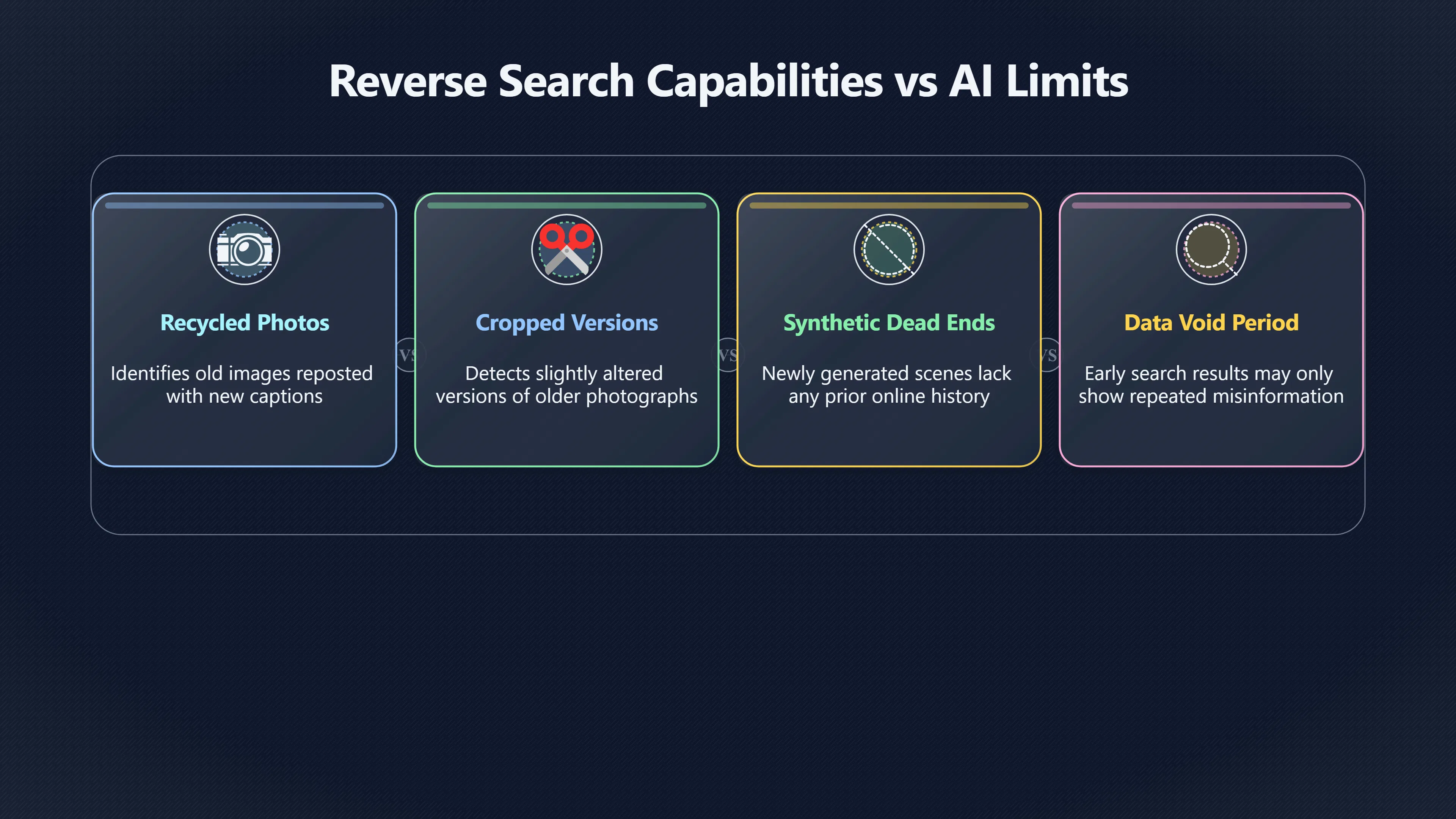
Reverse image search can expose recycled photos, but newly generated images may leave no earlier copy to find.
On this page
- What reverse search can still catch
- Why new synthetic images create dead ends
- How to pair search with geolocation and source checks
Page outline Jump by section
Introduction
Reverse image search remains one of the most useful tools for checking visual claims online, but generative AI has changed what it can and cannot do. Traditionally, a reverse search could reveal that a dramatic photograph was actually years old, taken in another country, or repeatedly recycled in misleading posts. Today, however, a convincing image may have been generated from scratch only minutes before it was shared. In those cases, there may be no earlier copy to find and no visual history to trace.
 This creates an important shift in critical thinking. Reverse image search is no longer a stand-alone test of authenticity. Instead, it has become one step in a broader verification process that combines source analysis, geolocation, contextual reporting and corroborating evidence. The key question is no longer simply “Has this image appeared before?” but also “What independent evidence connects this image to a real event?”[blog.google]blog.googlegoogle search new fact checking features3 new ways to check images and sources online25 Oct 2023 — Today, we're announcing three new ways that you can get more context about the…
What reverse search can still catch
Despite the rise of synthetic imagery, reverse image search remains highly effective against several common forms of visual misinformation.
The most obvious success case is the recycled photograph. During breaking news events, old images are frequently reposted with new captions claiming to show a current disaster, protest or conflict. Reverse search can often reveal earlier appearances of the same image, exposing the mismatch between the picture and the claim attached to it. Verification guides used by journalists and fact-checkers continue to recommend reverse searching as a first-line check for exactly this reason.[First Draft+2GIJN]firstdraftnews.orgFirst DraftVISUAL VERIFICATION GUIDE PHOTOS | First Draft NewsMarch 16, 2017 — A reverse image search returns identical photos indexed on…
It can also uncover:
- Images that have been taken from unrelated events.
- Cropped or slightly altered versions of older photographs.
- Pictures that have already been investigated by fact-checkers.
- Cases where a claimed news photograph first appeared on an anonymous account rather than through a credible source.[Time+2Google Toolbox]time.comHow to Spot an AI-Generated Image Like the 'Balenciaga PopeDespite some telltale signs of fakery, the image was convincing enough to become a significant viral misinformation event. AI-generated i…
Modern search tools increasingly provide contextual information beyond visual matches. Google’s “About this image” feature, for example, can show when an image or similar versions were first indexed and where they have appeared online. That historical trail often matters more than analysing pixels.[WIRED]wired.comGoogle Image Search Will Now Show a Photo's HistoryCan It Spot Fakes?October 25, 2023 — Google has introduced a new feature called "About this image" in its image search results to help co…
In practice, reverse search still answers an important question: is this image part of an existing online history? When the answer is yes, that history can reveal whether the current claim is misleading.
Why new synthetic images create dead ends
The weakness of reverse image search becomes clear when dealing with newly generated images.
A diffusion model such as Midjourney, DALL-E or Flux can create an entirely novel scene that has never existed before. Because there is no earlier version on the web, a reverse search may return few matches or no meaningful history at all. The absence of matches does not prove authenticity; it may simply indicate that the image is new.[NYU Guides]guides.nyu.eduimages and aiNYU GuidesFinding Images: Images and AI1 Apr 2026 — Pro tip: If these reverse search engines do not find a source, or any similar images…
This creates a verification dead end that did not exist to the same extent before generative AI. In the past, many fake images were edits or composites built from existing photographs. Reverse search often led investigators back to the original source material. A fully synthetic image leaves no such trail.
Researchers studying reverse image search in misinformation environments have identified another complication. When a false visual claim first emerges, search systems may enter what researchers call a “data void” period. Early search results can contain repeated misinformation, speculation and irrelevant material while reliable debunks are still being produced. In other words, even when search results exist, they may not immediately provide trustworthy answers.[arXiv]arxiv.orgFrom Verification to Amplification: Auditing Reverse Image Search as Algorithmic Gatekeeping in Visual Misinformation Fact-checkingM…
The result is a subtle but important change in interpretation:
- A successful reverse search can provide valuable evidence.
- An unsuccessful reverse search provides much less information than many users assume.
- “No matches found” is not evidence that an image depicts a real event.[NYU Guides]guides.nyu.eduimages and aiNYU GuidesFinding Images: Images and AI1 Apr 2026 — Pro tip: If these reverse search engines do not find a source, or any similar images…
Why image authenticity is no longer the only question
The generative-AI era has exposed a deeper limitation in reverse search: authenticity and truth are not identical.
An image can be entirely synthetic, yet accurately illustrate a hypothetical scenario. Conversely, a completely genuine photograph can be attached to a false caption. Some of the most influential misinformation online now comes from real images presented out of context rather than from obviously fabricated pictures.[WIRED]wired.comThese images can bolster conspiracy theories and propaganda. Notable examples include videos altered to misrepresent public figures and p…
For that reason, verification increasingly focuses on provenance: the documented chain linking an image to its creator, publication history and claimed event. Researchers, journalists and fact-checking organisations increasingly emphasise source-chain analysis rather than relying solely on visual inspection or AI-detection software.[arXiv]arxiv.orgFrontier Image Generation Models, Synthetic Visual…27 Apr 2026 — Newsrooms should maintain a visual verification desk with source…
This matters because AI-detection systems themselves remain imperfect. Independent audits have found that detection tools can wrongly classify authentic photographs as AI-generated while missing some synthetic images. Verification therefore depends on multiple forms of evidence rather than any single technical test.[EDMO+2NewsGuard]edmo.euAudit: AI Image Detection Tools Often Classify Authentic…7 days ago — Major AI image detection tools deceive online users, often c…
How to pair search with geolocation and source checks
When reverse image search reaches a dead end, other verification methods become more important.
Check who published the image first
The first account to post an image often provides valuable clues. A photograph supposedly taken by a professional photojournalist should usually have a traceable publication history, attribution and supporting reporting. If the earliest known appearance comes from an anonymous account with no evidence of being at the scene, confidence should decrease.[Time]time.comHow to Spot an AI-Generated Image Like the 'Balenciaga PopeDespite some telltale signs of fakery, the image was convincing enough to become a significant viral misinformation event. AI-generated i…
Look for:
- Original upload dates.
- Photographer or agency credits.
- Consistent posting history.
- Independent reporting that references the same image.
Compare the image with known facts
A synthetic image may look realistic while conflicting with verified information.
Fact-checkers often compare a suspicious image against:
- Maps and satellite imagery.
- Street-level photographs.
- Weather conditions.
- Building layouts.
- Clothing, vehicles and signage known to be present at the location.[Trusting News+2Toolkit Facta]trustingnews.orgin ai age explain how you verify visualsTrusting NewsIn AI age, explain how you verify visuals20 Jan 2026 — The article explains how the Reuters team verified the image was fals…
Geolocation techniques can sometimes establish that a claimed location is impossible even when the image itself appears convincing.
Seek independent corroboration
The strongest evidence usually comes from multiple independent sources.
If a social-media post claims to show a major fire, military strike or public event, ask whether:
- Reputable news organisations report the same event.
- Witnesses uploaded additional images or videos.
- Official agencies acknowledged the incident.
- Multiple viewpoints of the scene exist.[TrueScreen - Trust as a Service]truescreen.ioTrue ScreenFor investigative journalists… 2025, misinformation was ranked as the number one global risk.Read more…
A single image rarely carries enough weight on its own, especially when generative tools can create photorealistic scenes that never occurred.
A new role for reverse search
Reverse image search has not become obsolete; its role has become narrower and more strategic.
It remains one of the best tools for exposing recycled photographs, finding prior publications and locating fact-checks. Yet the spread of high-quality generative imagery means that a missing search history no longer tells us much. The practical lesson for critical thinking is that image verification must move beyond the question of whether pixels look real. Reverse search works best when treated as the beginning of an investigation rather than the final verdict. In an environment where entirely new synthetic images can appear instantly, credibility increasingly comes from origin, context and corroboration rather than from visual realism alone.
Amazon book picks
Further Reading
Books and field guides related to When reverse image search helps and fails. Use these as the next step if you want deeper reading beyond the article.

eBay marketplace picks
Marketplace Samples
Example marketplace items related to this page. Use the search link to explore similar finds on eBay.



Endnotes
1.
Source: blog.google
Title: google search new fact checking features
Link:https://blog.google/products-and-platforms/products/search/google-search-new-fact-checking-features/
Source snippet
3 new ways to check images and sources online25 Oct 2023 — Today, we're announcing three new ways that you can get more context about the...
2.
Source: gijn.org
Link:https://gijn.org/stories/3-quick-ways-verify-images-smartphone/
Source snippet
3 Quick Ways to Verify Images on a SmartphoneThis step-by-step guide explains how to do a reverse image search to check whether the p...
3.
Source: wired.com
Link:https://www.wired.com/story/how-to-spot-fake-images
Source snippet
These images can bolster conspiracy theories and propaganda. Notable examples include videos altered to misrepresent public figures and p...
4.
Source: time.com
Title: How to Spot an AI-Generated Image Like the ‘Balenciaga Pope’
Link:https://time.com/6266606/how-to-spot-deepfake-pope/
Source snippet
Despite some telltale signs of fakery, the image was convincing enough to become a significant viral misinformation event. AI-generated i...
5.
Source: toolbox.google.com
Link:https://toolbox.google.com/factcheck
Source snippet
Google ToolboxFact Check Tools RecentsAFP Fact Check rating: False. Images of Bangladeshi motorcyclists sleeping at petrol pumps are AI-g...
6.
Source: wired.com
Title: Google Image Search Will Now Show a Photo’s History
Link:https://www.wired.com/story/google-about-this-image-misinformation
Source snippet
Can It Spot Fakes?October 25, 2023 — Google has introduced a new feature called "About this image" in its image search results to help co...
Published: October 25, 2023
7.
Source: guides.nyu.edu
Title: images and ai
Link:https://guides.nyu.edu/finding-images/images-and-ai
Source snippet
NYU GuidesFinding Images: Images and AI1 Apr 2026 — Pro tip: If these reverse search engines do not find a source, or any similar images...
8.
Source: arxiv.org
Link:https://arxiv.org/abs/2603.09130
Source snippet
From Verification to Amplification: Auditing Reverse Image Search as Algorithmic Gatekeeping in Visual Misinformation Fact-checkingM...
9.
Source: arxiv.org
Link:https://arxiv.org/html/2604.24197v1
Source snippet
Frontier Image Generation Models, Synthetic Visual...27 Apr 2026 — Newsrooms should maintain a visual verification desk with source...
10.
Source: edmo.eu
Link:https://edmo.eu/publications/major-ai-image-detection-tools-deceive-online-users-often-classifying-authentic-images-as-fakes/
Source snippet
Audit: AI Image Detection Tools Often Classify Authentic...7 days ago — Major AI image detection tools deceive online users, often c...
11.
Source: arxiv.org
Link:https://arxiv.org/abs/2302.10174
12.
Source: toolkit.facta.news
Title: Toolkit Facta Image verification
Link:https://toolkit.facta.news/en/image-verification
Source snippet
Image verification - Toolkit FactaHow to Recognize AI-Generated Images: A National Geographic guide to identifying AI-create...
13.
Source: truescreen.io
Title: True Screen
Link:https://truescreen.io/articles/photo-verification/
Source snippet
For investigative journalists... 2025, misinformation was ranked as the number one global risk.Read more...
14.
Source: firstdraftnews.org
Link:https://firstdraftnews.org/wp-content/uploads/2017/03/FDN_verificationguide_photos.pdf
Source snippet
First DraftVISUAL VERIFICATION GUIDE PHOTOS | First Draft NewsMarch 16, 2017 — A reverse image search returns identical photos indexed on...
Published: March 16, 2017
15.
Source: newsguardtech.com
Link:https://www.newsguardtech.com/special-reports/leading-ai-image-detection-tools-mislead-online-users-often-declaring-authentic-content-fake
Source snippet
NewsGuardLeading AI Image Detection Tools Mislead Online Users...8 May 2026 — NewsGuard's findings suggest that human verification could...
Published: May 2026
16.
Source: trustingnews.org
Title: in ai age explain how you verify visuals
Link:https://trustingnews.org/in-ai-age-explain-how-you-verify-visuals/
Source snippet
Trusting NewsIn AI age, explain how you verify visuals20 Jan 2026 — The article explains how the Reuters team verified the image was fals...
Additional References
17.
Source: fullfact.org
Title: technologyinaccurate google ai overviews
Link:https://fullfact.org/technology/technologyinaccurate-google-ai-overviews/
Source snippet
Full FactGoogle Lens's AI overviews shared misleading information...13 Aug 2025 — The visual search tool failed to identify certain imag...
18.
Source: youtube.com
Title: Are AI Videos Too Good Now? How to Spot AI and Why It’s So Hard
Link:https://www.youtube.com/watch?v=ALGsFOldpE4
Source snippet
Together against digital disinformation: Journalists and content creators confront fake news and...
19.
Source: youtube.com
Title: Deepfake or real? How to spot AI fakes and why labeling isn’t enough
Link:https://www.youtube.com/watch?v=yJ1baFmzbnA
Source snippet
Are AI Videos Too Good Now? How to Spot AI and Why It's So Hard...
20.
Source: youtube.com
Link:https://www.youtube.com/watch?v=ZnCKmy-eyys
Source snippet
How to Verify AI images...
21.
Source: youtube.com
Title: Is Reverse Image Search Effective Against AI Visuals?
Link:https://www.youtube.com/watch?v=VJ3J8M3-zcA
Source snippet
Deepfake or real? How to spot AI fakes and why labeling isn't enough...
22.
Source: youtube.com
Title: How to Verify AI images
Link:https://www.youtube.com/watch?v=5DuAsPGfFXY
Topic Tree