Within Think Before Sharing
How to Check a Voice or Video Claim
Synthetic voices and videos require new habits for checking provenance, corroboration, and the original recording context.
On this page
- Why audio and video feel convincing
- Provenance and corroboration checks
- Limits of detection tools
Page outline Jump by section
Introduction
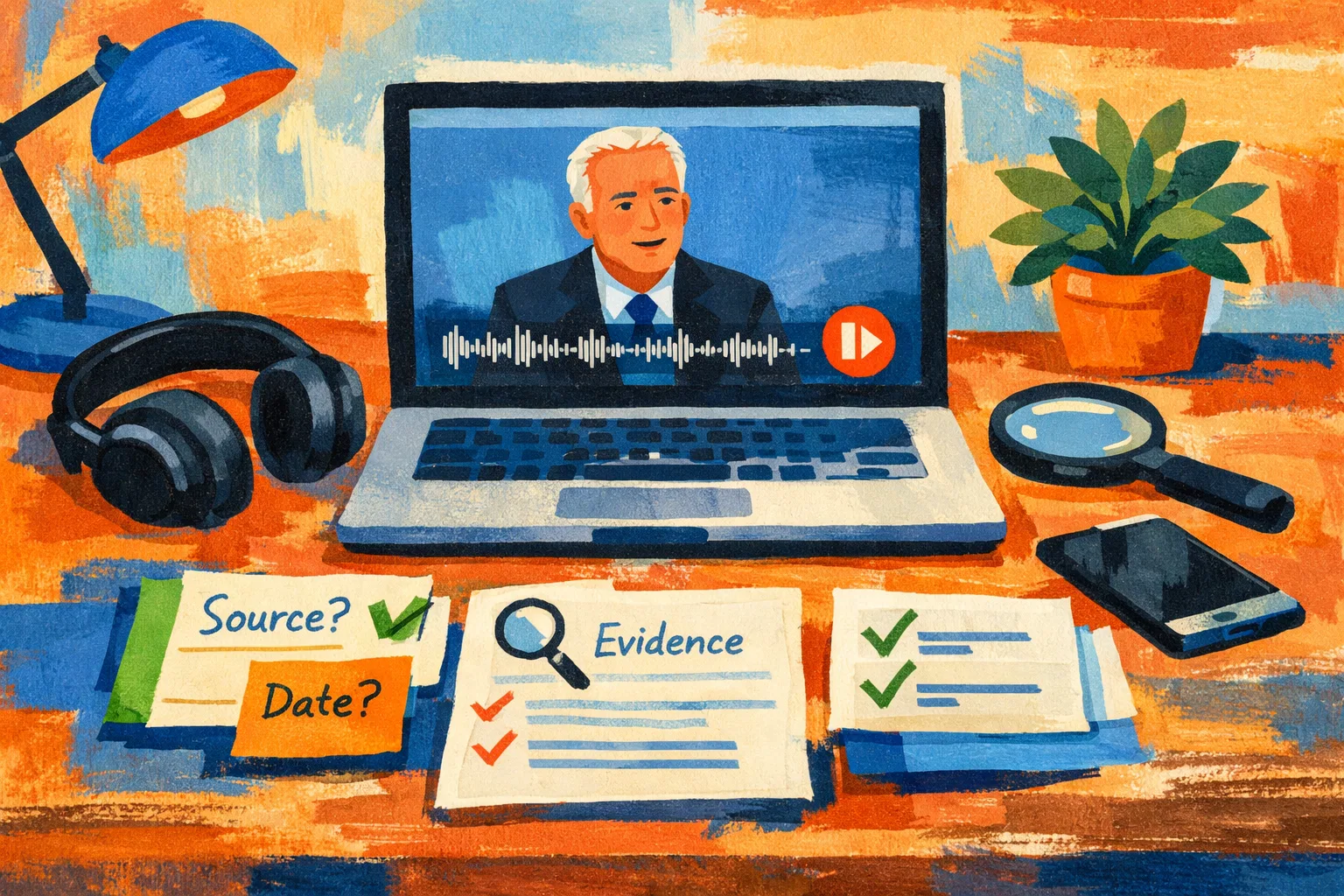
A deepfake voice or video claim should be checked as a claim, not simply inspected as a clip. The practical question is not “Does this look or sound real?” but “Can I trace where it came from, confirm the event through independent evidence, and understand the original recording context?” Synthetic media is powerful because it borrows the emotional force of apparent direct evidence: a familiar voice, a face on camera, a clipped confession, a panicked phone call, or a video meeting. That is exactly why the strongest credibility checks combine provenance, corroboration and caution about detection tools rather than relying on one visual clue or one AI detector score.
This matters because deepfakes now appear in situations where people are pushed to react quickly: elections, scams, workplace fraud, family emergencies and viral social media claims. A fake audio robocall mimicking Joe Biden reached New Hampshire voters before the January 2024 primary; investigators later traced it through telecom and campaign actors, not by asking voters to “hear” the fake in real time.[AP News+2AP News]apnews.comAP News Fake Biden robocall being investigated in New Hampshire2024 a year of unprecedented election disinformation around the world. Generative AI deepfakes already have appeared in campaign ads in t…

Why audio and video feel convincing
Audio and video feel persuasive because they seem to collapse the distance between a claim and an event. A written post says that someone said something; a recording appears to let the audience witness it. Deepfakes exploit that shortcut. They imitate the sensory form of evidence while leaving out the chain of custody: who recorded it, where, when, with what device, how it was edited, and why only this fragment is circulating.
Voice cloning is especially dangerous because people are used to treating voices as intimate identifiers. The US Federal Trade Commission has warned that scammers can clone a loved one’s voice from short online clips and use it in family-emergency scams, where the pressure comes not only from the fake voice but from panic and urgency.[Consumer Advice]consumer.ftc.govAll he needs is a short audio clip of your family member's voice.Read moreConsumer AdviceScammers use AI to enhance their family emergency schemesMarch 17, 2023 — 20 Mar 2023 — A scammer could use AI to clone th… The important lesson is that the credibility problem is behavioural as well as technical: a frightened parent, employee or voter may not have time to perform forensic analysis.
Video adds another layer of false reassurance. A face in motion, synchronised lips, a familiar room, or a plausible video-call interface can make a fabricated scene feel socially real. In 2024, the UK engineering firm Arup confirmed that it had been targeted in a Hong Kong fraud involving a deepfake video conference, with losses reported at about £20 million or $25 million.[The Guardian]theguardian.comThe Guardian UK engineering firm Arup falls victim to £20m deepfake scamUn empleado fue engañado al transferir HK$200m (£20m) a los criminales en Hong Kong en febrero. La llamada era una falsificación en la qu… For ordinary viewers, the case is a warning against treating “I saw them on a call” as enough proof when the request is unusual, urgent or financially consequential.
The most useful first habit is therefore simple: separate the media from the claim attached to it. A clip may be genuine but miscaptioned. It may be edited from a longer recording. It may be synthetic. It may show one real person but use cloned audio. It may be an old clip recirculated as new. The check begins by asking what the clip is being used to prove.

Provenance and corroboration checks
The strongest verification starts outside the pixels and waveform. Provenance means the origin and history of the media: who captured it, how it moved, and what happened to it before you saw it. Corroboration means independent evidence that the claimed event occurred. A deepfake check works best when those two questions are asked together.
A practical credibility check can follow this order:
- Find the earliest reachable version. Search for exact phrases, distinctive screenshots, names, place clues and repost text. A clip that appears first on an anonymous account, then spreads through reposts, is weaker than one published by an identifiable source with a clear recording context.
- Check whether the source could plausibly have recorded it. A person claiming to have captured a private meeting, battlefield scene, police interaction or family call should be able to explain where they were, when it happened, and how the recording was obtained. Lack of context does not prove fakery, but it lowers confidence.
-
Look for independent confirmation. For public events, check whether reputable newsrooms, official bodies, local witnesses, full livestreams, court records, campaign statements or police updates support the central claim. In the Biden robocall case, the credibility trail later involved New Hampshire officials, telecom routing, FCC action and reporting by established outlets. AP News+2Reuters
- Ask whether the full recording exists. Short clips are easier to manipulate, miscaption and emotionally frame. A 12-second “gotcha” video may omit the question, preceding sentence, setting or obvious joke. The absence of a longer version is not proof of deception, but it should stop instant sharing.
- Check timing and motive. Deepfake claims often appear at moments when confusion is useful: just before a vote, during a crisis, after a breaking news event, or inside an urgent payment request. The suspicious feature may be the timing, not a visible glitch.
For video, ordinary visual checks can still help, but they should not carry the whole decision. Mismatched shadows, odd hand movements, blurred jewellery, unnatural blinking, distorted teeth, inconsistent reflections, poor lip synchronisation, or background warping can all be clues. The problem is that modern generative systems have improved, and compression on social platforms can hide or create artefacts. A real low-quality video can look strange; a synthetic high-quality one can look smooth.
For audio, listen for flat emotion, strange pacing, missing breath, unnatural pauses, repeated background noise, or a voice that sounds like the person but does not respond naturally to questions. These are useful warning signs, not verdicts. A bad phone connection, illness, stress or recording compression can also make real speech sound odd. That is why the safest response to a high-stakes voice claim is to move to a trusted channel: call the person back on a known number, use a pre-agreed family phrase, or verify the request through a second person.
What provenance technology can and cannot prove
Technical provenance systems are trying to make media history more visible. The Coalition for Content Provenance and Authenticity, or C2PA, provides an open standard for attaching signed information about a file’s origin and edits, and Content Credentials is a public-facing way of displaying that information. C2PA In plain terms, this is less like a deepfake detector and more like a tamper-evident label: it can help show that a file came from a particular device, publisher or editing process if the chain has been preserved.
That is useful, but it is not magic. A clip without Content Credentials is not automatically fake; most real media online still lacks robust provenance metadata. A clip with credentials is not automatically trustworthy either; the credential may describe only part of the media’s history, and the surrounding claim may still be false. Recent independent research has also argued that current C2PA specifications have security and deployment limitations that make them risky to rely on prematurely in high-stakes settings. arXiv
The reader-friendly way to use provenance labels is to ask three questions:
- What exactly is being certified? Is it capture by a camera, editing history, publisher identity, or simply that an AI tool generated the file?
- Has the chain stayed intact? Screenshots, screen recordings, downloads, reposts and platform conversions can strip metadata.
- Does the label support the claim? A genuine recording of a real person can still be edited deceptively or attached to a false caption.
News organisations and platforms are experimenting with these systems because they can shift verification from “spot the glitch” towards “show the chain”. The BBC has described using Content Credentials to show how journalists verified media authenticity, while YouTube has tested labels for video captured with supported real-camera workflows. Public Media Alliance The direction is promising, but ordinary users should treat provenance as one part of a wider credibility check.
Why detection tools should be treated as triage, not truth machines
Deepfake detectors analyse patterns in faces, pixels, compression, audio spectra, lip movements or audio-visual synchronisation. They can be valuable for journalists, investigators and platforms, especially when they help prioritise suspicious material. But they should not be treated as final arbiters.
The core limitation is generalisation. Detectors often perform well on the datasets they were trained or tested on, then struggle with new generators, new languages, heavy compression, editing, screen recording, background noise or unfamiliar social media formats. A 2025 benchmark of real-world deepfakes circulating in 2024 found that open-source state-of-the-art detector performance dropped sharply compared with older academic benchmarks: by about 50% for video, 48% for audio and 45% for image models measured by AUC, a common performance metric. arXiv
Audio detection has its own challenges. Research surveys describe progress in identifying synthetic speech through acoustic features and model architectures, but also show that voice cloning and text-to-speech systems keep changing. PMC Some studies propose speaker-verification-style methods because detectors trained on known fake generators may fail against unseen ones. arXiv
This means detector results should be read like risk signals:
- A “likely fake” result is a reason to pause, preserve the file and seek corroboration, not necessarily to accuse someone publicly.
- A “likely real” result is not proof that the clip is authentic, complete or correctly captioned.
- Conflicting detector results are common enough that they should push the viewer back to provenance and independent evidence.
- A detector score without method, confidence, test conditions or false-positive information has limited value.
The UK government’s 2026 overview of deepfake detection technology describes rising demand across fraud prevention, brand protection, identity verification, moderation, national security and law enforcement, while noting the importance of evaluation and the wider ecosystem around such tools. GOV.UK The practical takeaway is not “ignore detectors”. It is “use them as one instrument in a verification process”.
A practical check for social media clips
When a voice or video claim appears in a feed, the right response depends on stakes. A silly entertainment clip may only need mild scepticism. A claim about a crime, election, war, public health issue, financial instruction or private scandal needs a higher standard.
Use this quick decision path:
Pause before sharing. Deepfakes are designed to benefit from speed. If the clip makes you angry, frightened, vindicated or eager to warn others, that is exactly the moment to slow down.
Name the claim in one sentence. For example: “This video claims the mayor admitted taking a bribe yesterday” or “This call claims my son needs money immediately.” This prevents you from checking vague authenticity while missing the real issue.
Search for the original. Look for the same clip on the alleged speaker’s official channels, reputable news outlets, full livestreams or local reporting. Be wary when every result traces back to the same anonymous upload.
Check context before content. Ask where the recording was made, who was present, whether there is a longer version, and whether the date and location fit known facts.
Use a second channel for urgent requests. In family, workplace or finance settings, do not verify the request within the suspicious call or meeting. End the interaction and contact the person through a known number, internal directory, secure workplace channel or agreed verification phrase.
Escalate high-stakes material. If the clip could damage someone’s reputation, affect a vote, trigger violence, move money, or expose private information, do not treat personal inspection as enough. Preserve the link and file if safe, then seek confirmation from trusted institutions, professional fact-checkers, newsroom verification desks, platform reporting tools or law enforcement where appropriate.
Common mistakes that make deepfakes more effective
One mistake is expecting deepfakes to look obviously wrong. Early advice often focused on blinking, teeth and lip-sync errors. Those clues still sometimes matter, but deepfake quality varies widely, and platforms degrade video in ways that can confuse the eye. A smooth clip can be false; a messy clip can be real.
Another mistake is assuming that the presence of a famous person makes verification easier. Public figures have abundant voice and video samples online, which can help both impersonators and verifiers. The Biden robocall showed how a familiar voice can be used in a narrow, time-sensitive channel where many recipients cannot immediately inspect the source. AP News
A third mistake is treating “AI-generated” and “false” as the same category. Synthetic media can be labelled parody, translated dubbing, accessibility narration, film production, satire, reconstruction or authorised marketing. The credibility question is whether the media is being presented as evidence of a real event, real speech or real identity in a way that misleads the audience.
A fourth mistake is overcorrecting into cynicism. The deepfake age does not mean “nothing can be believed”. It means trust needs a better route. Original files, transparent sourcing, multiple witnesses, full context, institutional accountability and secure verification channels become more important, not less.
The best habit: verify the event, not just the file
The most reliable deepfake check is not a single trick. It is a shift in attention from appearance to evidence. A convincing voice does not prove who is speaking. A face on video does not prove who is giving instructions. A detector score does not prove the social claim attached to a clip. Credibility comes from the chain around the media: source, context, independent confirmation, technical signals and the incentives of the person spreading it.
For everyday critical thinking, the safest rule is proportionate doubt. Do not dismiss every clip as fake. Do not accept every clip as proof. Ask what would have to be true for the claim to be reliable, then look for that evidence outside the most emotionally compelling version of the media.

eBay marketplace picks
Marketplace Samples
Example marketplace items related to this page. Use the search link to explore similar finds on eBay.

Endnotes
1.
Source: reuters.com
Link:https://www.reuters.com/world/us/fcc-finalizes-6-million-fine-over-ai-generated-biden-robocalls-2024-09-26/
Source snippet
These calls urged New Hampshire voters not to participate in the state's Democratic primary, potentially disrupting the election process...
3.
Source: arxiv.org
Link:https://arxiv.org/abs/2604.24890
4.
Source: arxiv.org
Link:https://arxiv.org/abs/2503.02857
5.
Source: pmc.ncbi.nlm.nih.gov
Title: PMCAudio Deepfake Detection: What Has Been Achieved
Link:https://pmc.ncbi.nlm.nih.gov/articles/PMC11991371/
6.
Source: arxiv.org
Title: arXiv How Deep Are the Fakes? Focusing on Audio Deepfake: A Survey
Link:https://arxiv.org/abs/2111.14203
7.
Source: arxiv.org
Title: arXiv Deepfake audio detection by speaker verification
Link:https://arxiv.org/abs/2209.14098
8.
Source: GOV.UK
Title: Deepfake detection technology
Link:https://www.gov.uk/government/publications/deepfake-detection-technology/deepfake-detection-technology
9.
Source: security.org
Title: deepfake statistics
Link:https://www.security.org/resources/deepfake-statistics/
10.
Source: youtube.com
Link:https://www.youtube.com/watch?v=HbQafWO2Hhw
11.
Source: youtube.com
Link:https://www.youtube.com/watch?v=vIpW–xk_pE
12.
Source: identity.org
Title: deepfake detection how to spot and prevent synthetic media
Link:https://www.identity.org/deepfake-detection-how-to-spot-and-prevent-synthetic-media/
13.
Source: c2pa.org
Link:https://c2pa.org/faqs/
14.
Source: spec.c2pa.org
Link:https://spec.c2pa.org/specifications/specifications/2.4/specs/C2PA_Specification.html
15.
Source: arxiv.org
Link:https://arxiv.org/html/2410.07436v1
16.
Source: fcc.gov
Title: proposes 6 million fine deepfake robocalls around nh primary
Link:https://www.fcc.gov/document/fcc-proposes-6-million-fine-deepfake-robocalls-around-nh-primary
17.
Source: c2pa.wiki
Title: Frequently Asked Questions (FAQ)
Link:https://c2pa.wiki/getting-started/faq/
18.
Source: youtube.com
Title: How to Detect Deepfakes: The Science of Recognizing AI Generated Content
Link:https://www.youtube.com/watch?v=GMoOCKkcd_w
Source snippet
How Ryzen AI PRO and McAfee Detect Deepfake Scams in Real Time...
19.
Source: youtube.com
Title: How Ryzen AI PRO and Mc Afee Detect Deepfake Scams in Real Time
Link:https://www.youtube.com/watch?v=bFykLbe46Jw
Source snippet
Voice Clone Scams: AI Tools Used for Fraud | WION Podcast...
20.
Source: youtube.com
Title: Voice Clone Scams: AI Tools Used for Fraud | WION Podcast
Link:https://www.youtube.com/watch?v=QeWxY4E3UCg
Source snippet
Did New Hampshire voters receive a Biden deepfake robocall telling them not to vote? • FRANCE 24...
21.
Source: youtube.com
Link:https://www.youtube.com/watch?v=TkgKIIuSybc
Source snippet
2 Texas-Based Companies Linked to Deepfake of President Biden's Voice...
22.
Source: apnews.com
Title: AP News Fake Biden robocall being investigated in New Hampshire
Link:https://apnews.com/article/new-hampshire-primary-biden-ai-deepfake-robocall-f3469ceb6dd613079092287994663db5
Source snippet
2024 a year of unprecedented election disinformation around the world. Generative AI deepfakes already have appeared in campaign ads in t...
24.
Source: consumer.ftc.gov
Title: All he needs is a short audio clip of your family member’s voice.Read more
Link:https://consumer.ftc.gov/consumer-alerts/2023/03/scammers-use-ai-enhance-their-family-emergency-schemes
Source snippet
Consumer AdviceScammers use AI to enhance their family emergency schemesMarch 17, 2023 — 20 Mar 2023 — A scammer could use AI to clone th...
Published: March 17, 2023
25.
Source: theguardian.com
Title: The Guardian UK engineering firm Arup falls victim to £20m deepfake scam
Link:https://www.theguardian.com/technology/article/2024/may/17/uk-engineering-arup-deepfake-scam-hong-kong-ai-video
Source snippet
Un empleado fue engañado al transferir HK$200m (£20m) a los criminales en Hong Kong en febrero. La llamada era una falsificación en la qu...
26.
Source: apnews.com
Title: biden robocalls ai new hampshire charges fines 9e9cc63a71eb9c78b9bb0d1ec2aa6e9c
Link:https://apnews.com/article/biden-robocalls-ai-new-hampshire-charges-fines-9e9cc63a71eb9c78b9bb0d1ec2aa6e9c
27.
Source: publicmediaalliance.org
Title: Public Media Alliance New technology to show why images and video are
Link:https://www.publicmediaalliance.org/new-technology-to-show-why-images-and-video-are-genuine-launches-on-bbc-news/
28.
Source: apnews.com
Title: ai robocall biden new hampshire primary 2024 f94aa2d7f835ccc3cc254a90cd481a99
Link:https://apnews.com/article/ai-robocall-biden-new-hampshire-primary-2024-f94aa2d7f835ccc3cc254a90cd481a99
29.
Source: apnews.com
Link:https://apnews.com/article/biden-robocalls-ai-magician-new-hampshire-louisiana-155b3ffe9d24048f3380104f95b48a57
30.
Source: apnews.com
Title: deepfake trump ai biden tiktok 72194f59823037391b3888a1720ba7c2
Link:https://apnews.com/article/deepfake-trump-ai-biden-tiktok-72194f59823037391b3888a1720ba7c2
31.
Source: apnews.com
Link:https://apnews.com/article/artificial-intelligence-local-races-deepfakes-2024-1d5080a5c916d5ff10eadd1d81f43dfd
32.
Source: theguardian.com
Title: biden robocall indicted primary
Link:https://www.theguardian.com/us-news/article/2024/may/23/biden-robocall-indicted-primary
33.
Source: ftc.gov
Link:https://www.ftc.gov/news-events/contests/ftc-voice-cloning-challenge
34.
Source: consumer.ftc.gov
Title: fighting back against harmful voice cloning
Link:https://consumer.ftc.gov/consumer-alerts/2024/04/fighting-back-against-harmful-voice-cloning
35.
Source: pmc.ncbi.nlm.nih.gov
Link:https://pmc.ncbi.nlm.nih.gov/articles/PMC12508882/
Additional References
36.
Source: ft.com
Link:https://www.ft.com/content/b977e8d4-664c-4ae4-8a8e-eb93bdf785ea
Source snippet
Fraudsters used a digitally cloned version of a senior manager during a video conference to order financial transfers. This incident, one...
37.
Source: facebook.com
Link:https://www.facebook.com/europol/videos/icymi-last-week-the-europol-innovation-lab-published-an-observatory-report-on-de/3144223835815985/
38.
Source: researchgate.net
Link:https://www.researchgate.net/publication/399422607_Deepfake_detection_critical_review_of_state-of-the-art_approaches_and_future_perspectives
39.
Source: mcafee.com
Link:https://www.mcafee.com/learn/a-guide-to-deepfake-scams-and-ai-voice-spoofing/
40.
Source: aidailyshot.com
Link:https://aidailyshot.com/blog/ai-deepfake-corporate-video-detection-tools-2026
41.
Source: linkedin.com
Link:https://www.linkedin.com/pulse/ai-deepfake-detection-provenance-arms-race-between-berkovac-phd-tfilf
42.
Source: foxnews.com
Link:https://www.foxnews.com/tech/ai-[voice-scams
43.
Source: facebook.com
Link:https://www.facebook.com/samuel.jarman/posts/ai-voice-cloning-scams-are-becoming-increasingly-convincing-how-do-you-verify-un/1048953027795302/
44.
Source: limablog.org
Link:https://limablog.org/ai-based-deepfake-detection-in-judicial-proceedings-a-socio-technical-perspective/
45.
Source: itic.org
Link:https://www.itic.org/policy/ITI_AIContentAuthorizationPolicy_122123.pdf
Topic Tree
Follow this branch
Parent topic
Think Before SharingRelated pages 24
- Accuracy Nudge Can One Pause Stop a False Share?
- AI Tutors Should You Trust a Chatbot Tutor?
- AI Virality Why AI Misinformation Travels So Easily
- Community Notes Can the Crowd Correct the Feed?
- Corroboration Who Else Can Confirm This Claim?
- Emotional Posts Why Outrage Is Not Evidence
- Evidence Types Not All Evidence Deserves Equal Weight
- Fake Authority When Official Looking Posts Are Not Official
- +16 more in sidebar