Within Own Research
Are Your Search Terms Choosing the Answer?
The words used to search a claim can quietly steer the results before any evidence is weighed.
On this page
- Why loaded wording changes the evidence path
- Neutral rewrites for suspicious claims
- Checking whether results are independent or duplicated
Page outline Jump by section
Introduction
When people say they are “doing their own research”, they often focus on which sources they read. A less obvious question comes earlier: how did they search in the first place?
 The words used in a search query can quietly steer the investigation before any evidence is examined. A search for “evidence that climate data is manipulated” follows a different path from “how climate data is collected and audited”. A search for “vaccine dangers being hidden” differs from “evidence on vaccine risks and benefits”. In each case, the query already contains assumptions about what is likely to be true. Research on both academic and general search systems suggests that biased or confirmation-seeking queries can produce correspondingly biased result sets, reinforcing the user’s starting belief.[First Monday+2First Monday]firstmonday.orgFirst MondayExamining bias perpetuation in academic search enginesby C Kacperski · 2024 · Cited by 12 — This study examines whether confi…
This matters because personal research can become distorted long before the first article is opened. The search terms themselves may be choosing the route through the information landscape.
Are Your Search Terms Choosing the Answer?
A search engine does not simply answer questions. It interprets words, ranks documents and predicts what the user wants. If the query already points strongly towards one conclusion, the system will often prioritise material that appears relevant to that framing.
Consider three searches about the same topic:
- “Is this medicine a dangerous scam?”
- “Reviews of this medicine”
- “Evidence for and against this medicine”
The first query asks the search engine to find material consistent with a scam narrative. The second seeks mixed evaluations. The third explicitly requests competing evidence. Even when all three searches concern the same claim, they are likely to produce noticeably different result sets.
This is not merely a theoretical concern. An audit of Google Scholar and Semantic Scholar found that queries framed around risks or benefits produced results aligned with the embedded bias. The researchers concluded that biased queries affected search outcomes in the direction of the bias contained within the query.[First Monday+2arXiv]firstmonday.orgFirst MondayExamining bias perpetuation in academic search enginesby C Kacperski · 2024 · Cited by 12 — This study examines whether confi…
The key point is that search engines are generally responding to the user’s wording rather than independently balancing the evidence.
Why Loaded Wording Changes the Evidence Path
Loaded search terms are words or phrases that carry an implied judgement. Examples include:
- “cover-up”
- “hidden truth”
- “what they don’t want you to know”
- “exposed”
- “scam”
- “fraud”
- “lies”
- “debunked narrative”
Such language does two things simultaneously.
First, it narrows the retrieval process. The search engine looks for documents containing or relating to those concepts. Pages that discuss ordinary explanations may rank lower because they appear less relevant to the query.
Second, it frames interpretation. If a person repeatedly searches using terms such as “cover-up” or “suppressed evidence”, they encounter information through a lens that assumes concealment. Every result is then evaluated within that frame.
Researchers studying online search behaviour have also shown that users’ prior beliefs influence the search terms they choose, creating a feedback loop in which beliefs shape queries and queries shape the information encountered. Recent work describes this as a “narrow search effect”, where belief-driven query choices can limit exposure to alternative evidence and reduce meaningful belief updating.[PNAS]pnas.orgThe narrow search effect and how broadening…24 Mar 2025 — We demonstrate that the combination of users' prior beliefs influencing…
The distortion often occurs gradually. A user may believe they are following the evidence, while the search process is repeatedly filtering evidence through assumption-laden wording.
Neutral Rewrites for Suspicious Claims
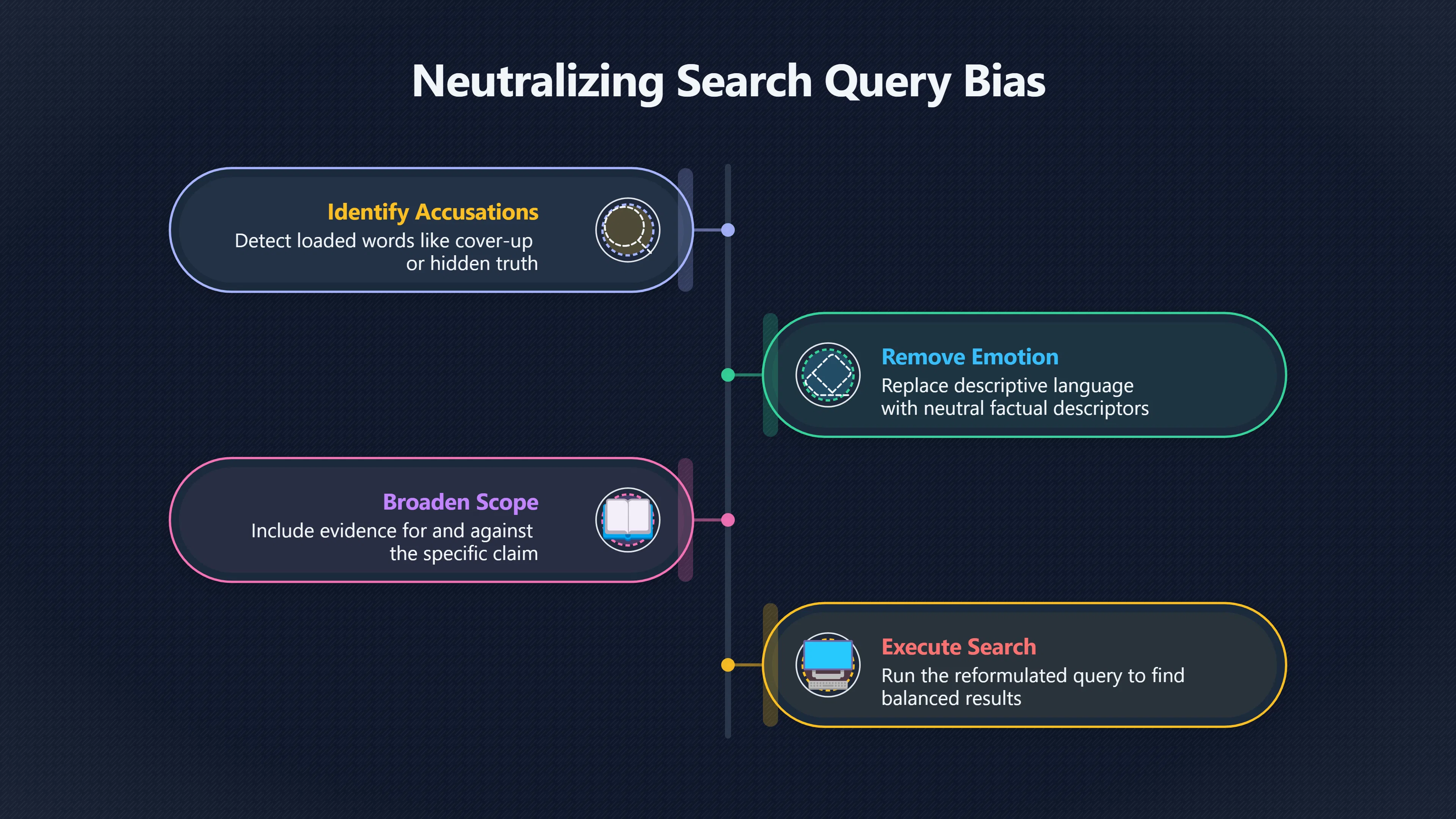
One practical way to reduce search bias is to rewrite a query so that it investigates a claim rather than presuming its truth.
From accusation to investigation
Instead of:
- “Government cover-up of water contamination”
Try:
- “Evidence regarding water contamination reports”
- “Independent investigations into water contamination”
- “What do regulators, researchers and local groups report about water contamination?”
The rewritten versions leave room for multiple outcomes.
From certainty to comparison
Instead of:
- “Proof that election machines were rigged”
Try:
- “Evidence for and against claims about election machine manipulation”
- “How election machine security is evaluated”
- “Independent audits of election systems”
The second set of searches allows the possibility that the claim is true, false, partly true or unresolved.

From emotional language to descriptive language
Instead of:
- “Dangerous vaccine secrets”
Try:
- “Known vaccine risks and benefits”
- “Vaccine safety monitoring systems”
- “How adverse events are investigated”
Emotional wording often functions as a conclusion disguised as a question. Descriptive wording is more likely to surface a wider range of evidence.
The Hidden Influence of Autocomplete and Suggested Queries
Search distortion does not always begin with the user’s final query. It can start while the query is being typed.
Autocomplete systems suggest likely completions based on patterns in previous searches and other signals. Researchers have noted that query suggestions can influence search behaviour by steering users towards particular formulations of a topic.[arXiv]arxiv.orgarXiv Reducing Misinformation in Query AutocompletionsReducing Misinformation in Query AutocompletionsJuly 6, 2020…
For example, someone beginning with a neutral query may encounter suggested phrases that imply controversy, fraud or scandal. Clicking a suggestion can move the search from exploration towards a predetermined narrative without the user consciously deciding to make that shift.
This does not mean autocomplete is intentionally misleading. It means that suggested wording can become part of the information-selection process, making it worth pausing to ask whether a recommended phrase is introducing assumptions that were not present in the original question.
Checking Whether Results Are Independent or Duplicated
A common mistake in personal research is treating many similar results as many independent confirmations.
In reality, search results often repeat the same source material.
A claim may appear in:
- multiple news stories quoting the same interview
- dozens of blogs referencing the same article
- social media posts repeating the same screenshot
- videos discussing the same original allegation
At first glance, this can look like overwhelming evidence. In practice, it may be a single source echoed across numerous platforms.
To test independence:

- Trace claims back to the earliest available source.
- Check whether different articles rely on the same documents, witnesses or studies.
- Look for genuinely separate reporting or analysis.
- Compare how sources with different viewpoints describe the same evidence.
The goal is not simply to count results but to determine whether they represent distinct lines of evidence.
AI Search and the Risk of Query Amplification
AI-assisted search tools introduce a related challenge. Large language models often generate responses by synthesising material retrieved from searches or training data. The wording of a prompt can strongly influence what evidence is emphasised.
A prompt such as “Explain why this theory is true” encourages a different response from “What is the strongest evidence for and against this theory?” The first invites a supportive narrative; the second asks for comparison.
Researchers studying fact-checking tools and information retrieval have found that even small wording changes can lead to substantially different results and evidence paths. Variations in claim phrasing may retrieve different fact-checking records or different supporting materials.[arXiv]arxiv.orgAre Fact-Checking Tools Helpful? An Evaluation of Google…19 Jul 2024 — Google Fact Check is a promising search engine that facili…
For this reason, the discipline of query reformulation remains important even when AI appears to be doing the searching on the user’s behalf.
A Simple Test Before Pressing Enter
Before running a search, ask three questions:
- Does my wording assume the answer?
- Could someone with the opposite view use the same query fairly?
- Have I searched for evidence both for and against the claim?
If the answer to the first question is yes, the search may already be steering the investigation.
The strongest personal research habit is not finding more sources. It is learning to recognise when a search term has quietly embedded a conclusion. Once that happens, the research process risks becoming an exercise in locating support rather than discovering what the evidence actually shows.


eBay marketplace picks
Marketplace Samples
Example marketplace items related to this page. Use the search link to explore similar finds on eBay.
Endnotes
1.
Source: arxiv.org
Link:https://arxiv.org/abs/2311.09969
2.
Source: arxiv.org
Link:https://arxiv.org/pdf/2311.09969
Source snippet
Audit of academic search engines 1 The final version of...by C Kacperski · 2023 · Cited by 12 — This study examines whether confirmation...
3.
Source: pnas.org
Link:https://www.pnas.org/doi/10.1073/pnas.2408175122
Source snippet
The narrow search effect and how broadening...24 Mar 2025 — We demonstrate that the combination of users' prior beliefs influencing...
4.
Source: arxiv.org
Link:https://arxiv.org/abs/2403.17286
5.
Source: arxiv.org
Title: arXiv Reducing Misinformation in Query Autocompletions
Link:https://arxiv.org/abs/2007.02620
Source snippet
Reducing Misinformation in Query AutocompletionsJuly 6, 2020...
Published: July 6, 2020
6.
Source: arxiv.org
Link:https://arxiv.org/html/2402.13244v3
Source snippet
Are Fact-Checking Tools Helpful? An Evaluation of Google...19 Jul 2024 — Google Fact Check is a promising search engine that facili...
7.
Source: arxiv.org
Link:https://arxiv.org/abs/2402.13244
8.
Source: developers.google.com
Link:https://developers.google.com/search/docs/appearance/structured-data/factcheck
Source snippet
Check (ClaimReview) Markup for SearchDiscover how you can use ClaimReview structured data to enable a summarized fact check to display in...
9.
Source: toolbox.google.com
Link:https://toolbox.google.com/factcheck/about
Source snippet
Fact Check ToolsThis tool allows you to easily browse and search for [fact checks]({{ 'fact-checks/' | relative_url }}). For example, you can search for a politician's statemen...
10.
Source: google.com
Link:https://www.google.com/intl/en_us/search/howsearchworks/information-quality
Source snippet
Helping you evaluate information onlineCritically evaluate information online. Discover tools from Google, like "About this Result" and F...
11.
Source: firstmonday.org
Link:https://firstmonday.org/ojs/index.php/fm/article/view/13730
Source snippet
First MondayExamining bias perpetuation in academic search enginesby C Kacperski · 2024 · Cited by 12 — This study examines whether confi...
12.
Source: firstmonday.org
Link:https://firstmonday.org/ojs/index.php/fm/article/download/13730/11709
Source snippet
An algorithm audit of Google and Semantic Scholarby C Kacperski · 2024 · Cited by 12 — This study examines whether confirmation biased qu...
Additional References
13.
Source: carnegieendowment.org
Title: countering disinformation effectively an evidence based policy guide
Link:https://carnegieendowment.org/russia-eurasia/research/2024/01/countering-disinformation-effectively-an-evidence-based-policy-guide
Source snippet
Countering Disinformation Effectively: An Evidence-Based...31 Jan 2024 — A high-level, evidence-informed guide to some of the major prop...
14.
Source: researchgate.net
Link:https://www.researchgate.net/publication/385538931_Examining_bias_perpetuation_in_academic_search_engines_An_algorithm_audit_of_Google_and_Semantic_Scholar
Source snippet
Examining bias perpetuation in academic search enginesThis study examines whether confirmation biased queries prompted into Google Schola...
15.
Source: firstdraftnews.org
Link:https://firstdraftnews.org/articles/verifying-online-information-the-absolute-essentials/
Source snippet
Verifying online information: The absolute essentials14 Oct 2019 — This is your little condensed guide to the wizardry of verification...
16.
Source: Tech Policy Press
Title: new research suggests online search can increase belief in misinformation
Link:https://techpolicy.press/new-research-suggests-online-search-can-increase-belief-in-misinformation
Source snippet
New Research Suggests Online Search Can Increase...20 Dec 2023 — The paper, titled “Online searches to evaluate misinformation can incre...
17.
Source: youtube.com
Link:https://www.youtube.com/watch?v=LTJygQwYV84
Source snippet
Online Research: Tips for Effective Search StrategiesGo to channel Learning and Technology with Frank · How to research on the Int...
18.
Source: blog.google
Link:https://blog.google/products-and-platforms/products/search/evaluating-information-online-tools/
Source snippet
Helpful Search tools for evaluating information online29 Sept 2021 — We highlight relevant fact checks on results in Search, News and Goo...
19.
Source: cambridge.org
Link:https://www.cambridge.org/core/journals/american-political-science-review/article/when-to-worry-about-sensitivity-bias-a-social-reference-theory-and-evidence-from-30-years-of-list-experiments/3B922CC54881BA694E4D4B07FD286060
Source snippet
When to Worry about Sensitivity Bias: A Social Reference...by G BLAIR · 2020 · Cited by 349 — We find that sensitivity biases are typica...
20.
Source: apa.org
Title: how why misinformation spreads
Link:https://www.apa.org/topics/journalism-facts/how-why-misinformation-spreads
Source snippet
How and why does misinformation spread?29 Nov 2023 — People are more likely to share misinformation when it aligns with personal identity...
21.
Source: researchgate.net
Title: Google, How Should I Vote?
Link:https://www.researchgate.net/publication/384563048_Google_How_Should_I_Vote_How_Users_Formulate_Search_Queries_to_Find_Political_Information_on_Search_Engines
Source snippet
How Users Formulate Search...by V Vziatysheva · 2024 · Cited by 1 — This study examines how users formulate search queries related to th...
22.
Source: ofcom.org.uk
Title: rea online misinformation
Link:https://www.ofcom.org.uk/siteassets/resources/documents/research-and-data/online-research/online-nation/2021/rea-online-misinformation.pdf?v=326529
Source snippet
Rapid Evidence Assessment on Online Misinformation and...9 Jun 2021 — The review is focused on studies that measure the effectiveness of...
Topic Tree