Within News Deserts
Why Local Election Rumors Spread Fast
Local elections sharpen misinformation because claims about candidates, services and identity can spread before reporters or officials respond.
On this page
- Why campaigns raise the stakes
- How candidate and service claims gain traction
- What corrections can and cannot fix
Page outline Jump by section
Introduction
Local election rumours spread quickly in Facebook groups because election periods combine three powerful forces at once: higher public attention, stronger emotions, and a shortage of fast, trusted local verification. During local campaigns, voters suddenly care about candidates, schools, planning decisions, council services, taxes, policing and community identity. At the same time, many communities have fewer local reporters available to check claims before they circulate. In that environment, a screenshot, a quote attributed to a candidate, or a warning about a local service can travel through neighbourhood groups long before anyone confirms whether it is true. Research on news deserts and local misinformation suggests that misinformation increases noticeably around local elections, making these periods especially vulnerable to rumours and misleading claims.[SMF+2itrportal.com]smf.co.ukMisinformation is generally associated with the spread of false or…Read more…
 The result is not simply more false information. It is a temporary information vacuum in which people are asked to make voting decisions while competing claims race through trusted social networks faster than corrections can keep up.
Why Campaigns Raise the Stakes
Local elections create unusual information conditions. Most of the time, local politics receives limited attention. During a campaign, however, residents who rarely follow council meetings or local government suddenly seek information about candidates and issues.
This surge in attention rewards content that feels urgent or revealing. A Facebook post claiming that a candidate made a controversial remark, supports an unpopular policy, or is connected to a local controversy can attract engagement because voters believe they are learning something important before others do. Rumours gain additional traction when they appear to offer insider knowledge unavailable through official channels.
Research from the Social Market Foundation found that misinformation rises during election periods. Across locations holding local elections, the share of news-related posts classified as misinformation increased substantially in the weeks leading up to polling day. Analysis of Facebook groups during a recent by-election also found elevated levels of misinformation in local discussion spaces.[itrportal.com]itrportal.comby-election found that 7.3% of news-related posts were misinformation.Read more…
Election campaigns also compress time. A false claim posted a few days before voting may influence perceptions before journalists, election officials or candidates can respond. Even if corrected later, the original claim may have already reached thousands of local residents.
How Candidate and Service Claims Gain Traction
Many local election rumours are not dramatic conspiracy theories. Instead, they often involve everyday claims that sound plausible because they concern familiar places and people.
Common examples include:
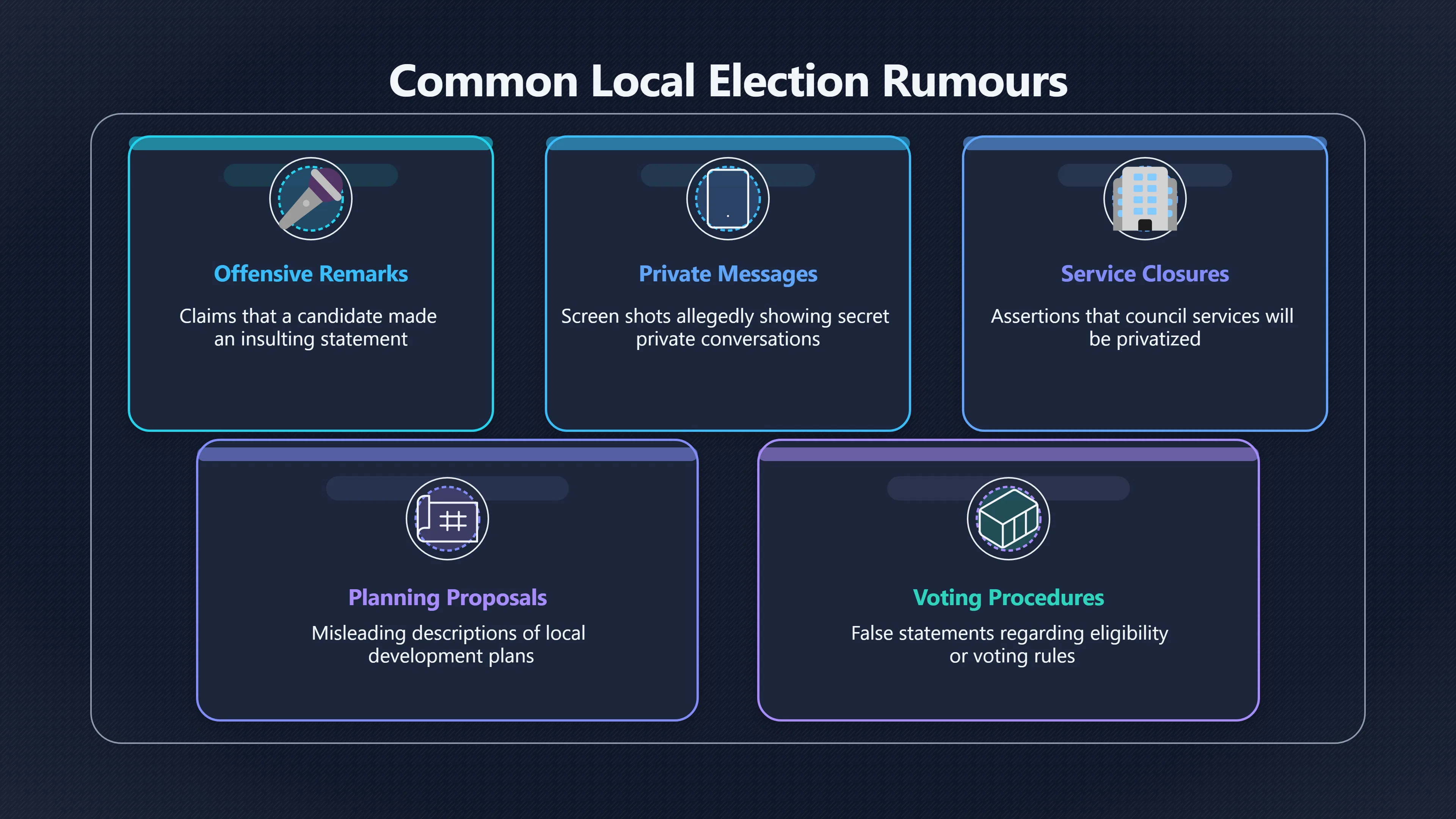
- Claims that a candidate said something offensive.
- Screenshots allegedly showing private messages or comments.
- Assertions that a council service will close or be privatised.
- Misleading descriptions of planning proposals.
- False statements about voting procedures or eligibility.
- AI-generated images, altered documents or fabricated quotations.[The Guardian]theguardian.comTopics such as immigration and Islamophobia are the most frequent subjects of false claims. The spread intensifies around elections, with…
These claims succeed partly because local knowledge cuts both ways. Familiarity helps people identify obvious mistakes, but it can also make rumours seem more credible. A post mentioning a real school, street, community centre or councillor appears grounded in reality, even when key details are wrong.
Facebook groups amplify this effect through social trust. Information often arrives from neighbours, friends, parents at the same school, or long-standing community members rather than from anonymous websites. Readers may judge the messenger before they judge the evidence. This social trust can cause unverified claims to spread rapidly through shares, comments and screenshots. Research on misinformation diffusion consistently finds that people tend to engage with information that confirms existing beliefs or fits familiar community narratives.[arXiv]arxiv.orgarXiv Misinformation spreading on FacebookMisinformation spreading on FacebookJune 28, 2017…
Local elections can also activate identity-based concerns. Questions about housing, migration, school places, public safety or local development are often experienced personally rather than abstractly. When rumours connect to these sensitive topics, they are more likely to provoke emotional responses and sharing.[The Guardian]theguardian.comTopics such as immigration and Islamophobia are the most frequent subjects of false claims. The spread intensifies around elections, with…

Why Facebook Groups Are Especially Vulnerable
Neighbourhood Facebook groups are not designed to operate like newsrooms. Their primary purpose is community discussion, not verification.
Several characteristics make them vulnerable during elections:
Speed over verification. Posts can be shared instantly, while fact-checking requires time. By the time evidence emerges, the rumour may already be widespread.
Community trust. Members often assume that local participants are acting in good faith. That assumption is useful for community building but can reduce scepticism toward unverified claims.
Algorithmic visibility. Content that generates reactions and comments is more likely to be seen by others. Election rumours often trigger exactly the kind of engagement that platforms reward.
Limited moderation resources. Volunteer moderators may struggle to verify political claims, especially when dozens of posts appear during a campaign.
Weak local news ecosystems. In areas with fewer local journalists, there may be no readily available source capable of quickly checking claims about candidates or council decisions. Studies of news deserts repeatedly identify this lack of verification capacity as a factor that increases vulnerability to misinformation. UK Parliament+3Brennan Center for Justice+3citap.unc.edu[brennancenter.org]brennancenter.orgBrennan Center for Justice'News Deserts' Could Impact Midterm Elections31 Oct 2022 — As local newspapers and digital news sites vanish, v…
The Social Market Foundation’s recent analysis found misinformation was significantly more common in areas with weaker local journalism, reinforcing concerns that social media groups increasingly function as informal information hubs without the verification standards of professional reporting.[The Guardian+2SMF]theguardian.comTopics such as immigration and Islamophobia are the most frequent subjects of false claims. The spread intensifies around elections, with…
What Corrections Can and Cannot Fix
Correcting election rumours is essential, but corrections face structural disadvantages.
The first problem is timing. Research on misinformation diffusion has long shown that false claims can achieve large audiences before fact-checkers or journalists respond. Once a story has spread through multiple groups, later corrections may reach only a fraction of the original audience.[Pure]pure.uva.nltask, the large reach of some fake news stories (well before fact-checks have.Read more…
The second problem is audience mismatch. People who encounter a correction are not always the same people who encountered the original rumour. A fact-check published by a local newspaper or election authority may never appear in the Facebook feeds where the claim initially spread.[Pure]pure.uva.nltask, the large reach of some fake news stories (well before fact-checks have.Read more…
The third problem is motivated reasoning. Some individuals evaluate information according to whether it fits existing beliefs rather than whether it is accurate. Research on online misinformation suggests that corrective information can be ignored or dismissed when it conflicts with strongly held views.[arXiv]arxiv.orgarXiv Misinformation spreading on FacebookMisinformation spreading on FacebookJune 28, 2017…
Yet corrections still matter. Evidence suggests that providing context, linking to supporting documents, and offering reliable alternative explanations can reduce the impact of false claims more effectively than simple warning labels alone. Platforms and researchers have increasingly emphasised contextual information and fact-checked explanations rather than relying exclusively on disputed-content warnings.[Time+2Carnegie Endowment]time.comThe red warning icon, intended to combat misinformation, occasionally reinforced readers' beliefs and led to more sharing of disputed con…

What This Means for Critical Thinking
Election rumours flourish in local Facebook groups not because residents are uniquely gullible, but because local campaigns create conditions that favour rapid, emotionally charged information sharing. The combination of heightened political attention, familiar community networks, weakened local journalism and platform incentives gives rumours an unusually favourable environment.
For voters, the critical-thinking challenge is recognising that local information can feel trustworthy precisely because it is local. During election periods, claims about candidates, council services or voting procedures deserve the same scrutiny as national political stories. A familiar street name, a neighbour’s endorsement or a widely shared screenshot may signal relevance, but none of them guarantee accuracy. In communities where professional local reporting is limited, that distinction becomes especially important.[UK Parliament+3The Guardian+3SMF]theguardian.comTopics such as immigration and Islamophobia are the most frequent subjects of false claims. The spread intensifies around elections, with…
Amazon book picks
Further Reading
Books and field guides related to Why Local Election Rumors Spread Fast. Use these as the next step if you want deeper reading beyond the article.
Thinking, Fast and Slow
Helps readers recognise intuitive errors during election periods.

eBay marketplace picks
Marketplace Samples
Example marketplace items related to this page. Use the search link to explore similar finds on eBay.



Endnotes
1.
Source: smf.co.uk
Link:https://www.smf.co.uk/fake-news-nearly-three-times-more-common-in-areas-without-local-journalism-and-spikes-during-elections-new-research-finds/
Source snippet
Misinformation is generally associated with the spread of false or...Read more...
2.
Source: itrportal.com
Link:https://www.itrportal.com/articles/2026/06/09/fake-news-nearly-three-times-more-common-in-areas-without-local-journalism-and-spikes-during-elections%2C-new-research-finds/
Source snippet
by-election found that 7.3% of news-related posts were misinformation.Read more...
3.
Source: arxiv.org
Title: arXiv Misinformation spreading on Facebook
Link:https://arxiv.org/abs/1706.09494
Source snippet
Misinformation spreading on FacebookJune 28, 2017...
Published: June 28, 2017
4.
Source: publications.parliament.uk
Title: UK Parliament Chapter 2: Informed Citizens
Link:https://publications.parliament.uk/pa/ld5801/ldselect/lddemdigi/77/7706.htm
Source snippet
UK ParliamentChapter 2: Informed Citizens - Parliament UKResearch from Full Fact during the 2019 General Election showed that misinformat...
5.
Source: citap.unc.edu
Link:https://citap.unc.edu/news/local-news-platforms-mis-disinformation/
Source snippet
the decline of local news, the rise of platforms, and the spread of mis- and...Read more...
6.
Source: publications.parliament.uk
Title: UK Parliament Sustainability of local journalism
Link:https://publications.parliament.uk/pa/cm5803/cmselect/cmcumeds/153/report.html
Source snippet
More than 320 local newspaper titles closed between 2009 and 2019, a trend likely to have been...Read more...
7.
Source: smf.co.uk
Link:https://www.smf.co.uk/publications/social-media-local-misinformation/
Source snippet
The hidden threat of unchecked local misinformation6 days ago — SMF quantifies the scale and nature of 'fake news' in local online spaces...
8.
Source: arxiv.org
Title: arXiv The spread of low-credibility content by social bots
Link:https://arxiv.org/abs/1707.07592
9.
Source: time.com
Link:https://time.com/5077002/facebook-fake-news-articles/
Source snippet
The red warning icon, intended to combat misinformation, occasionally reinforced readers' beliefs and led to more sharing of disputed con...
10.
Source: time.com
Link:https://time.com/6124637/misinformation-fact-checking-facebook/
Source snippet
The concept, highlighted by Francis Galton in 1907, suggests that the collective judgment of a group can be highly accurate. Fact-checkin...
11.
Source: facebook.com
Link:https://www.facebook.com/groups/384926985723985/posts/1751943585688978/
Source snippet
where local elections or by-elections are taking place.Read more...
12.
Source: facebook.com
Link:https://www.facebook.com/groups/1458438024296291/posts/3340831912723550/
Source snippet
as UK towns become 'news deserts' Report says people often find...Read more...
13.
Source: facebook.com
Link:https://www.facebook.com/groups/671022767060782/posts/2243057433190633/
Source snippet
> **Fake news is nearly three times more likely to spread in...Fake news is nearly three times more likely to spread in areas without tr...
14.
Source: facebook.com
Title: a us mayoral race triggered a flood of misinformation from online influencers sp
Link:https://www.facebook.com/abscbnNEWS/posts/a-us-mayoral-race-triggered-a-flood-of-misinformation-from-online-influencers-sp/1549915510517033/
Source snippet
A US mayoral race triggered a flood of misinformation from...#Election2024 #Misinformation #VotingIntegrity #ElectionSecurity #USPolitic...
15.
Source: facebook.com
Link:https://www.facebook.com/TheBushCenter/posts/what-drives-the-relationship-between-loneliness-and-a-decline-in-local-news-this/1467019138801396/
Source snippet
s is the question Danny Hayes, a political science professor...
16.
Source: facebook.com
Link:https://www.facebook.com/eff/posts/a-news-site-has-quoted-at-least-six-non-existent-eff-experts-in-the-past-two-mon/1436624281825458/
Source snippet
A “news” site has quoted at least six non-existent EFF...Some news organizations published reports spotlighting examples of hoaxes, fake...
17.
Source: theguardian.com
Link:https://www.theguardian.com/media/2026/jun/08/social-media-groups-fuel-misinfomation-uk-news-deserts-report
Source snippet
Topics such as immigration and Islamophobia are the most frequent subjects of false claims. The spread intensifies around elections, with...
18.
Source: brennancenter.org
Link:https://www.brennancenter.org/our-work/analysis-opinion/news-deserts-could-impact-midterm-elections
Source snippet
Brennan Center for Justice'News Deserts' Could Impact Midterm Elections31 Oct 2022 — As local newspapers and digital news sites vanish, v...
19.
Source: pure.uva.nl
Link:https://pure.uva.nl/ws/files/122729832/9789048554249.pdf
Source snippet
task, the large reach of some fake news stories (well before [fact-checks]({{ 'fact-checks/' | relative_url }}) have.Read more...
20.
Source: carnegieendowment.org
Title: countering disinformation effectively an evidence based policy guide
Link:https://carnegieendowment.org/russia-eurasia/research/2024/01/countering-disinformation-effectively-an-evidence-based-policy-guide
Source snippet
Countering Disinformation Effectively: An Evidence-Based...31 Jan 2024 — A high-level, evidence-informed guide to some of the major prop...
21.
Source: brennancenter.org
Title: digital disinformation and vote suppression
Link:https://www.brennancenter.org/our-work/research-reports/digital-disinformation-and-vote-suppression
Source snippet
2 Sept 2020 — Bad actors have circulated lies to trick certain groups out of voting — and thanks to social media, these deceptive practic...
Additional References
22.
Source: axios.com
Link:https://www.axios.com/2019/03/18/facebook-local-news-deserts
Source snippet
According to research released in collaboration with four academic researchers, one-third of U.S. Facebook users live in areas where ther...
23.
Source: lemonde.fr
Link:https://www.lemonde.fr/en/politics/article/2026/03/10/french-local-elections-radical-left-candidates-targeted-in-disinformation-campaign_6751301_5.html
Source snippet
The smear campaign involves a coordinated effort using fake online accounts, AI-generated images, false accusations (such as rape and chi...
24.
Source: youtube.com
Link:http://www.youtube.com/watch?v=whPm87HaN-o
Source snippet
Truth Matters: What Happens When Facebook Replaces Local Newspapers | Stephanie Ruhle | MSNBC...
25.
Source: youtube.com
Link:http://www.youtube.com/watch?v=qTvjbiUxlfU
Source snippet
How Facebook Groups are Filling the Void after Local Newspapers Fold | The Mehdi Hasan Show...
26.
Source: youtube.com
Title: Curbing misinformation on social media ahead of the U.S. election
Link:http://www.youtube.com/watch?v=Dm2T1zO2gGA
Source snippet
"Election" misinformation local "Facebook groups" Facebook groups are destroying America, says disinformation expert KGW News...
27.
Source: tandfonline.com
Link:https://www.tandfonline.com/doi/full/10.1080/10383441.2022.2138140
Source snippet
Regulating disinformation on Twitter and Facebookby C Tan · 2022 · Cited by 40 — In this article, I examine selected legislation implemen...
28.
Source: linkedin.com
Link:https://www.linkedin.com/posts/social-market-foundation_next-weeks-local-elections-may-be-shaped-activity-7454494946063065088-fUbT
Source snippet
as traditional media. For The House Magazine...
29.
Source: youtube.com
Link:http://www.youtube.com/watch?v=wpnVXDh0RlA
Source snippet
Facebook groups are destroying America, says disinformation expert...
30.
Source: pmc.ncbi.nlm.nih.gov
Link:https://pmc.ncbi.nlm.nih.gov/articles/PMC10623619/
Source snippet
by Z Adams · 2023 · Cited by 147 — This analysis shows how viral fake election news stories outperformed real news on facebook. https...
31.
Source: pmc.ncbi.nlm.nih.gov
Link:https://pmc.ncbi.nlm.nih.gov/articles/PMC9910783/
Source snippet
Fake news, disinformation and misinformation have become such a scourge that Marcia McNutt, president of the National Academy of...Read mo...
Topic Tree