Within Influencers
Can AI Fake Trustworthy Messengers?
AI tools can imitate polish, intimacy and local detail, making fabricated messengers or claims look more credible.
On this page
- Which identity cues AI can imitate
- Why polish and local detail can mislead
- How to check voices, screenshots and creator identity
Page outline Jump by section
Introduction
AI can now imitate many of the signals people use to decide whether a messenger is trustworthy. A convincing accent, a familiar voice, a polished explainer, a believable local reference, or even a screenshot that appears to show insider information can all be generated or manipulated at scale. The result is not merely fake content. It is the appearance of credibility itself.
 This matters because people rarely assess every claim from first principles. Instead, they rely on shortcuts: Does this person seem genuine? Do they sound knowledgeable? Do they appear connected to my community? AI systems can increasingly reproduce those cues, making fabricated messengers and fabricated claims look more persuasive than they would have been only a few years ago. Researchers have begun describing this problem as one of “synthetic credibility” or “synthetic trust”: the ability of AI-generated content to borrow the surface signals that normally help people judge reliability.[arXiv]arxiv.orgSynCred-Bench: Benchmarking Synthetic Credibility in AI-Generated Visual MisinformationJune 2, 2026…
Which Identity Cues AI Can Imitate
The most powerful feature of modern generative AI is not that it can create content. It is that it can create content that appears to come from a particular kind of person.
A fake messenger no longer has to be a generic anonymous account. AI can help construct an entire identity package that feels authentic to a specific audience.
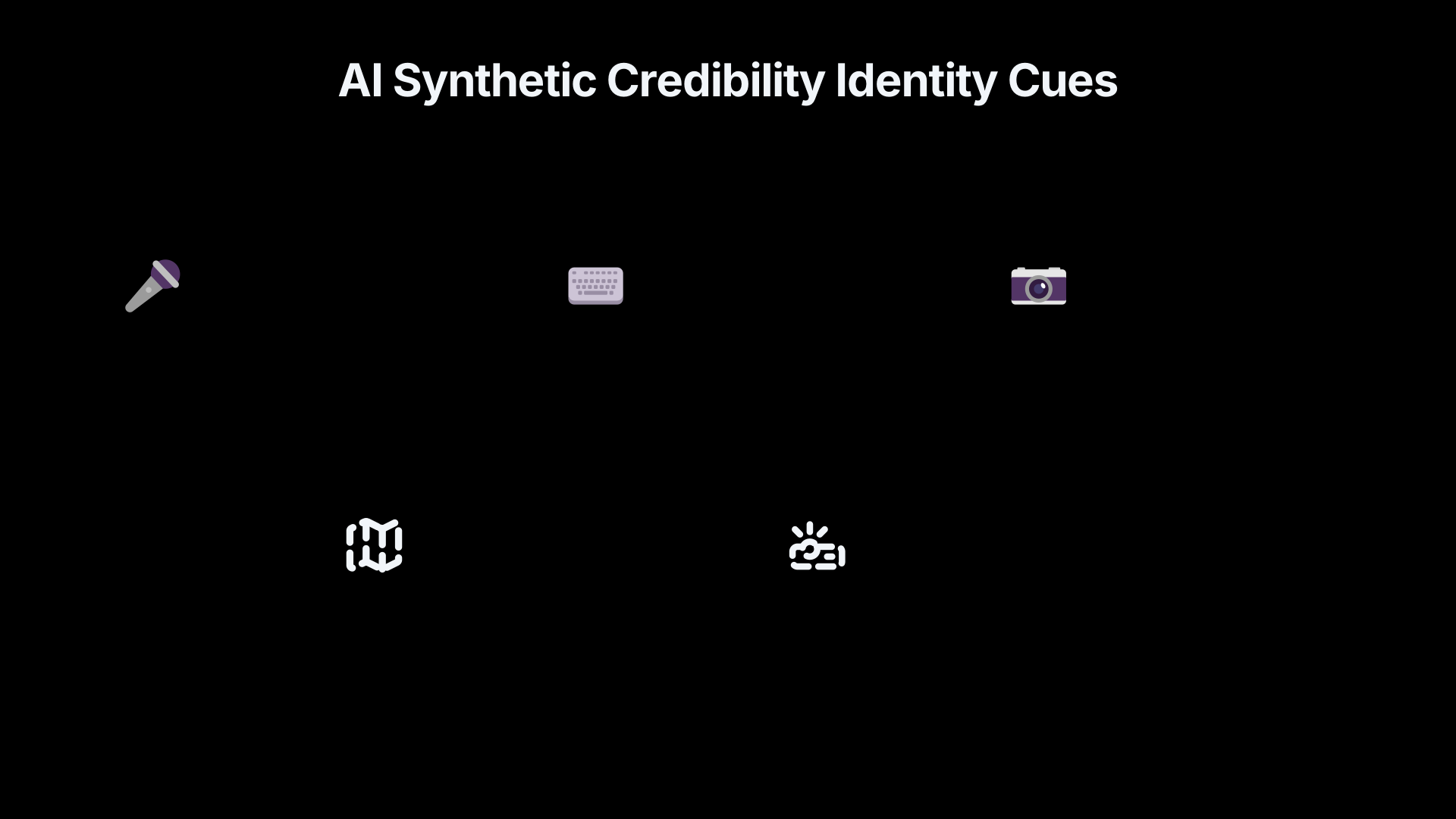
Some of the cues AI can imitate include:
- Voice and speech patterns. Voice-cloning systems can reproduce tone, pacing, pronunciation and emotional style from relatively small audio samples. This allows scammers, propagandists and impersonators to sound like family members, creators, executives or public figures.[Federal Trade Commission+2Federal Trade Commission]ftc.govpreventing harms ai enabled voice cloningFederal Trade CommissionPreventing the Harms of AI-enabled Voice Cloning16 Nov 2023 — The FTC is announcing the Voice Cloning Challenge t…
- Writing style. Large language models can mimic the structure, vocabulary and mannerisms associated with particular communities, professions or personalities.
- Visual identity. AI-generated images and video can create faces that appear trustworthy, professional or relatable while depicting people who do not exist. Deepfake systems can also place real identities into fabricated situations.[arXiv]arxiv.orgUnmasking Synthetic Realities in Generative AI: A Comprehensive Review of Adversarially Robust Deepfake Detection SystemsJuly 24, 2025…
- Community belonging. AI can incorporate local references, neighbourhood names, cultural jokes, sports teams, regional slang or shared concerns that signal “I am one of you”.
- Apparent expertise. Professionally formatted charts, diagrams, presentations and explainers can make a fabricated source appear knowledgeable even when the underlying information is weak or false.
The important point is that trust cues are often social rather than factual. People frequently judge credibility from signals surrounding a claim before evaluating the evidence itself. AI systems are becoming increasingly effective at reproducing those surrounding signals.[arXiv]arxiv.orgOpen source on arxiv.org.
Why Polish and Local Detail Can Mislead
For many years, obvious errors were a warning sign. Scam messages often contained poor grammar, awkward phrasing or unrealistic stories. Generative AI changes that dynamic.
Modern AI systems can produce fluent text, coherent explanations and persuasive narratives. They can also customise messages for particular audiences, creating the impression that a speaker understands local conditions, shared experiences or community concerns. This can make a message feel authentic even when the source is fabricated.
Researchers studying synthetic credibility have found that AI-generated misinformation can incorporate realistic layouts, convincing visual design and familiar credibility markers that make detection difficult for both people and technical systems. Human reviewers in one recent benchmark struggled to identify many examples of AI-generated misinformation built around these credibility cues.[arXiv]arxiv.orgSynCred-Bench: Benchmarking Synthetic Credibility in AI-Generated Visual MisinformationJune 2, 2026…
The persuasive effect often comes from accumulation. A single detail might not convince anyone. But a message that includes:
- a believable profile photograph,
- references to local events,
- emotionally appropriate language,
- apparent insider knowledge,
- and professional presentation,
can create a powerful impression that the messenger is genuine.
This is especially relevant in communities built around influencers and identity-based trust. Followers may already be accustomed to informal communication styles, personal stories and local references. AI can reproduce many of those same patterns, making it harder to distinguish genuine familiarity from manufactured familiarity.
When a Familiar Voice Is Not Proof
Voice cloning illustrates the problem particularly clearly.
People often regard voices as strong evidence of identity. Hearing a familiar voice feels different from reading a message. Yet AI systems can now generate highly convincing synthetic speech from brief recordings. Regulators and consumer-protection agencies have repeatedly warned that voice-cloning technology is being used in fraud schemes involving relatives, executives and public officials.[Federal Trade Commission+2wiley.law]ftc.govpreventing harms ai enabled voice cloningFederal Trade CommissionPreventing the Harms of AI-enabled Voice Cloning16 Nov 2023 — The FTC is announcing the Voice Cloning Challenge t…
The psychological effect is significant because voice carries emotional signals. A panicked voice, an excited voice or a reassuring voice can trigger rapid reactions before deliberate verification takes place.
Research on speech deepfakes has found that people are not consistently reliable at identifying synthetic voices. Even when participants know deepfakes exist, detection performance remains imperfect and is expected to become more difficult as synthesis quality improves.[arXiv]arxiv.orgarXiv Warning: Humans Cannot Reliably Detect Speech DeepfakesWarning: Humans Cannot Reliably Detect Speech DeepfakesJanuary 19, 2023…
The lesson is straightforward: a familiar voice is no longer strong proof that a familiar person is actually speaking.
Screenshots, Documents and “Evidence” Can Be Manufactured
Another trust signal that AI can imitate is documentary evidence.
Social media users often treat screenshots as proof. A screenshot appears concrete. It seems to show a message, a search result, a private conversation or an official document. Yet generative image systems can now create realistic interfaces, chat logs and document layouts.
Recent research on synthetic credibility highlights how AI can generate visual artefacts that resemble trusted forms of evidence, including realistic embedded text, official-looking formats and familiar platform designs.[arXiv]arxiv.orgSynCred-Bench: Benchmarking Synthetic Credibility in AI-Generated Visual MisinformationJune 2, 2026…
This creates a subtle problem. People may spend time checking whether a claim sounds plausible while spending little time checking whether the supposed evidence is genuine.
A screenshot should therefore be treated as a lead, not as verification. The key question is whether the original source can be independently located.
How to Check Voices, Screenshots and Creator Identity
The most effective defence is not learning to spot every deepfake. Experts increasingly argue that the real challenge is verifying identity and evidence rather than relying on intuition about whether something “looks fake”.[arXiv]arxiv.orgOpen source on arxiv.org.
For voices
If a voice message or call requests money, urgent action or sensitive information:
- Pause before responding.
- Contact the person through a known channel rather than replying directly.
- Verify details independently.
- Be especially cautious when urgency or secrecy is emphasised.[Investopedia+2NYC Government]investopedia.comWhat To Know About AI-Generated Scam Calls and DeepfakesScammers use AI to clone voices from social media or produce deepfake videos, convincingly impersonating family members, government offic…
For screenshots
When presented with a screenshot:
- Look for the original post, article or document.
- Check whether reputable outlets or primary sources show the same material.
- Treat cropped images and isolated screenshots with extra caution.
- Remember that realistic formatting is no longer evidence of authenticity.
For creator identity
When evaluating an account or creator:
- Look beyond profile photos and follower counts.
- Check whether the account has a consistent history over time.
- Examine whether external sources recognise or reference the creator.
- Be cautious if the account suddenly appears with highly polished content but little verifiable background.
For images and video
Increasingly, provenance tools can help verify where media came from. Standards such as Content Credentials and the Coalition for Content Provenance and Authenticity (C2PA) aim to provide information about a file’s origin and editing history. These systems are not perfect and are not yet universally adopted, but they represent an attempt to shift verification away from appearance and towards documented provenance.[blog.google+3C2PA+3Content Credentials]c2pa.orgC2PA | Verifying Media Content SourcesNavigate media literacy with the use of media verification tools. C2PA provides an analysis of…
The Key Shift: Trust the Verification Process, Not the Performance
In the past, many trust cues were expensive to fake. Producing a convincing voice recording, professional video, polished article or community-specific message required substantial time and skill. Generative AI dramatically lowers those costs.
That does not mean trust is impossible. It means that the visible performance of trustworthiness is becoming easier to manufacture.
A convincing voice, relatable personality, local reference or professional presentation may still be genuine. The problem is that these signals are no longer reliable on their own. In an environment shaped by AI-generated media, the safest habit is to separate the messenger from the evidence and to verify both independently. Trust cues remain useful, but they should start an investigation rather than end it.
Amazon book picks
Further Reading
Books and field guides related to Can AI Fake Trustworthy Messengers?. Use these as the next step if you want deeper reading beyond the article.
Foolproof: Why We Fall for Misinformation and How to Build Im...
Explains psychological vulnerabilities exploited by AI fakes.

eBay marketplace picks
Marketplace Samples
Example marketplace items related to this page. Use the search link to explore similar finds on eBay.




Endnotes
1.
Source: arxiv.org
Link:https://arxiv.org/abs/2606.03348
Source snippet
SynCred-Bench: Benchmarking Synthetic Credibility in AI-Generated Visual MisinformationJune 2, 2026...
Published: June 2, 2026
2.
Source: arxiv.org
Link:https://arxiv.org/abs/2604.04951
3.
Source: arxiv.org
Link:https://arxiv.org/abs/2507.21157
Source snippet
Unmasking Synthetic Realities in Generative AI: A Comprehensive Review of Adversarially Robust Deepfake Detection SystemsJuly 24, 2025...
Published: July 24, 2025
4.
Source: wiley.law
Title: alert FCC and FTC Launch Inquiries on AI and Voice Cloning
Link:https://www.wiley.law/alert-FCC-and-FTC-Launch-Inquiries-on-AI-and-Voice-Cloning
Source snippet
FCC and FTC Launch Inquiries on AI and Voice Cloning17 Nov 2023 — The Federal Trade Commission (FTC) released a voice cloning initiative...
5.
Source: arxiv.org
Title: arXiv Warning: Humans Cannot Reliably Detect Speech Deepfakes
Link:https://arxiv.org/abs/2301.07829
Source snippet
Warning: Humans Cannot Reliably Detect Speech DeepfakesJanuary 19, 2023...
Published: January 19, 2023
6.
Source: investopedia.com
Title: What To Know About AI-Generated Scam Calls and Deepfakes
Link:https://www.investopedia.com/what-to-know-about-ai-generated-scam-calls-and-deepfakes-11938099
Source snippet
Scammers use AI to clone voices from social media or produce deepfake videos, convincingly impersonating family members, government offic...
7.
Source: nyc.gov
Title: Government Artificial Intelligence Scam Tips
Link:https://www.nyc.gov/site/dca/consumers/artificial-intelligence-scam-tips.page
Source snippet
ernmentArtificial Intelligence Scam Tips - DCWPThese are called voice cloning or deepfakes. During these scams, you'll typically receive...
8.
Source: c2pa.org
Link:https://c2pa.org/
Source snippet
C2PA | Verifying Media Content SourcesNavigate media literacy with the use of media verification tools. C2PA provides an analysis of...
9.
Source: spec.c2pa.org
Link:https://spec.c2pa.org/specifications/specifications/2.4/explainer/Explainer.html
Source snippet
C2PA SpecC2PA and Content Credentials ExplainerBy utilizing the Content Credential-provided provenance in the video, the social media pla...
10.
Source: blog.google
Title: identifying ai generated media online
Link:https://blog.google/innovation-and-ai/products/identifying-ai-generated-media-online/
Source snippet
Tools to understand how content was created and edited19 May 2026 — Just ask, "Is this made with AI?” or “Is this AI generated?” We're al...
Published: May 2026
11.
Source: arxiv.org
Title: Full Disclosure, Less Trust?
Link:https://arxiv.org/html/2601.09620v1
Source snippet
How the Level of Detail about AI Use in...January 14, 2026 — Recent studies suggest that AI disclosures can lead to a “transparency dile...
Published: January 14, 2026
12.
Source: c2pa.ai
Link:https://c2pa.ai/
Source snippet
Independent Coverage of Content Provenance and...Five methods to detect AI-generated images, ranked by reliability - from visual clues t...
13.
Source: ftc.gov
Title: preventing harms ai enabled voice cloning
Link:https://www.ftc.gov/policy/advocacy-research/tech-at-ftc/2023/11/preventing-harms-ai-enabled-voice-cloning
Source snippet
Federal Trade CommissionPreventing the Harms of AI-enabled Voice Cloning16 Nov 2023 — The FTC is announcing the Voice Cloning Challenge t...
14.
Source: ftc.gov
Link:https://www.ftc.gov/news-events/contests/ftc-voice-cloning-challenge
Source snippet
The FTC Voice Cloning ChallengeThe Voice Cloning Challenge is one part of a larger strategy. The risks posed by voice cloning and other A...
15.
Source: contentcredentials.org
Link:https://contentcredentials.org/
Source snippet
Content Credentials | Verify Media AuthenticityContent Credentials provides media transparency with advanced authenticity detection tools...
16.
Source: ftc.gov
Title: If you have been targeted by an illegal business practice or
Link:https://www.ftc.gov/
Source snippet
Federal Trade Commission | Protecting America's ConsumersThe FTC will never demand money, make threats, tell you to transfer money, or pr...
17.
Source: consumer.ftc.gov
Title: fighting back against harmful voice cloning
Link:https://consumer.ftc.gov/consumer-alerts/2024/04/fighting-back-against-harmful-voice-cloning
Source snippet
back against harmful voice cloning8 Apr 2024 — Scammers use voice cloning to make their requests for money or information more believable...
Additional References
18.
Source: mcafee.com
Link:https://www.mcafee.com/learn/a-guide-to-deepfake-scams-and-ai-voice-spoofing/
Source snippet
A Guide to Deepfake Scams and AI Voice SpoofingDiscover the hidden dangers of deepfake scams and AI voice spoofing. Learn how these cyber...
19.
Source: lifewire.com
Link:https://www.lifewire.com/ai-voice-cloning-helps-scammers-heres-how-to-protect-yourself-7370878
Source snippet
This technology can replicate an individual's voice with just a short audio sample, allowing fraudsters to deceive victims into sending m...
20.
Source: starlingbank.com
Link:https://www.starlingbank.com/safe-phrases/
Source snippet
Safe Phrases: Stay safe against AI voice cloningAI voice cloning is an emerging threat used by scammers. The technology can clone a human...
21.
Source: techradar.com
Link:https://www.techradar.com/pro/voice-is-the-next-cybersecurity-battleground-and-ai-is-accelerating-the-risk
Source snippet
Voice communications, which happen in real time, offer no delay for verification, making them particularly prone to social engineering. A...
22.
Source: theverge.com
Link:https://www.theverge.com/report/806359/openai-sora-deepfake-detection-c2pa-content-credentials
Source snippet
Although these videos are embedded with metadata from the C2PA (Coalition for Content Provenance and Authenticity), the system is failing...
23.
Source: medium.com
Link:https://medium.com/%40altruistic_patriarch_fish_753/why-content-credentials-alone-wont-save-us-from-deepfakes-and-what-will-f29a7ec8ba83
Source snippet
VeraSnap — Why Content Credentials Alone Won't Save...For the first time, a mainstream smartphone could attach cryptographic “Content Cr...
24.
Source: ojs.mruni.eu
Link:https://ojs.mruni.eu/ojs/vsvt/article/download/9207/6247/22897
Source snippet
mruni.eu[PDF] AI-GENERATED MEDIA AND PUBLIC TRUSTFrom a communication theory perspective, AI blurs the cues such as tone, source, or styl...
25.
Source: news.ku.edu
Link:https://news.ku.edu/news/article/study-finds-readers-trust-news-less-when-ai-is-involved-even-when-they-dont-understand-to-what-extent
Source snippet
finds readers trust news less when AI is involved, even when...December 9, 2024 — New research from the University of Kansas has found t...
Published: December 9, 2024
26.
Source: red.library.usd.edu
Link:https://red.library.usd.edu/diss-thesis/255/
Source snippet
intelligence and news consumption: a study of trust...This thesis focused particularly on analyzing trust in the organization, trust in...
27.
Source: reutersinstitute.politics.ox.ac.uk
Link:https://reutersinstitute.politics.ox.ac.uk/generative-ai-and-news-report-2025-how-people-think-about-ais-role-journalism-and-society
Source snippet
AI and news report 2025: How people think about AI's...October 7, 2025 — The report is based on a survey conducted by YouGov on behalf o...
Published: October 7, 2025
Topic Tree