Within Think Before Sharing
Who Else Can Confirm This Claim?
Urgent claims about disasters, politics, war, health, or crime should be checked against independent sources before sharing.
On this page
- Why one source is fragile
- Independence versus repetition
- When waiting is the best choice
Page outline Jump by section
Introduction
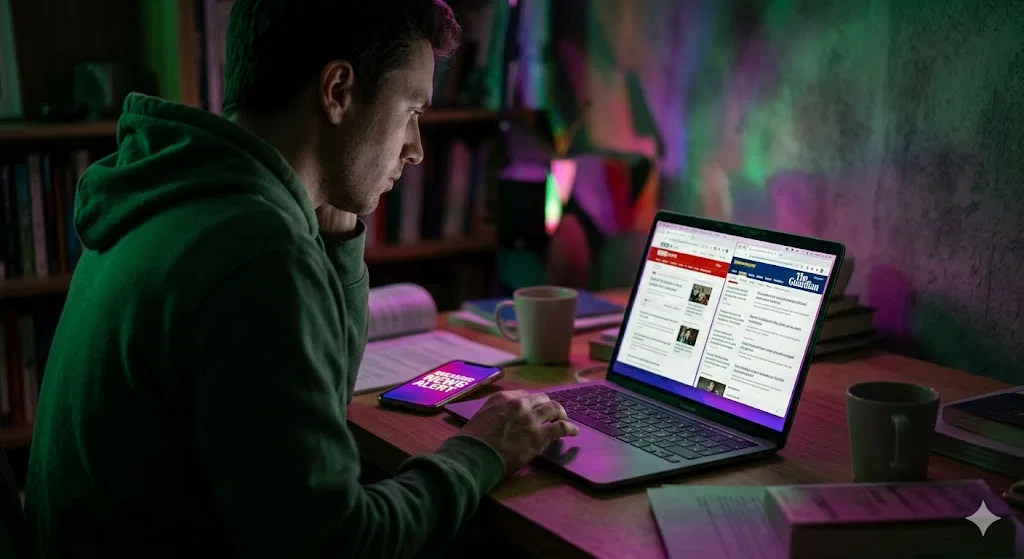
Independent corroboration is the habit of asking a simple question before sharing a breaking claim: who else, genuinely separate from the first source, can confirm this? It matters most when a post concerns disasters, politics, war, health or crime, because early information often arrives before investigators, journalists, emergency services or public-health bodies have had time to verify it. A viral screenshot, eyewitness clip or confident AI-generated summary may be useful as a lead, but it is fragile evidence on its own.
The practical rule is not “wait until everyone agrees”. It is: before amplifying an urgent claim, look for confirmation from sources that are independent in origin, transparent about what they know, and close enough to the evidence to be useful. Professional news organisations treat single-source reporting as exceptional; Reuters says a single anonymous source should be used only in exceptional cases, with special authorisation and clear context about what is and is not known.[Reuters Agency]reutersagency.comReuters AgencyReuters Journalistic StandardsReuters will publish news from a single, anonymous source in exceptional cases, when it is cr…
Why one source is fragile
Breaking claims are unstable because the first public version is often incomplete. A bystander may capture real footage but misidentify the place. A local rumour may name the wrong suspect. A partisan account may take an authentic police update and add a false motive. An AI system may summarise a claim fluently without having access to reliable confirmation. The danger is not only fabrication; it is premature certainty.
Research on social-media rumours shows why the earliest phase is risky. During breaking news, people post fragments, questions, denials and interpretations before the truth status of a claim is resolved. One study of rumour threads around newsworthy events found that many rumours remain unverified for significant periods, while users continue to spread, support or challenge them in public conversation.[arXiv]arxiv.orgAnalysing How People Orient to and Spread Rumours in Social Media by Looking at Conversational ThreadsNovember 23, 2015… Another study on rumour detection describes breaking news as a fast-paced reporting environment where early updates often include information that is still unverified at the moment of posting.[arXiv]arxiv.orgLearning Reporting Dynamics during Breaking News for Rumour Detection in Social MediaOctober 24, 2016…
The 2024 Southport case in the UK shows the cost of weak corroboration. False claims about the attacker’s identity spread on social media after the killing of three children, and Full Fact reported that the circulated name was incorrect, with police also stating that the suspect had been born in Cardiff.[Full Fact]fullfact.orgFull FactWhat role did misinformation play in riots after the…August 2, 2024 — 2 Aug 2024 — They told Full Fact “Ali Al-Shakati” was t… Parliamentary material later described the wider riots that followed as being driven in part by false claims spreading on social platforms after the attack.[UK Parliament Committees]committees.parliament.ukSome targeted mosques and hotels housingUK Parliament CommitteesSocial media, misinformation and harmful algorithmsBetween 30 July and 7 August 2024, a wave of anti-immigration…
For an ordinary reader, the lesson is direct: a claim can be emotionally urgent and still evidentially weak. The more a post asks people to act immediately, blame someone, avoid a place, buy a treatment, donate money or share a warning, the more it needs corroboration before amplification.
Independence versus repetition
The hardest part of corroboration is distinguishing true independence from repetition. Three posts saying the same thing are not three confirmations if they all trace back to one screenshot, one anonymous Telegram message, one misread police scanner clip or one influencer’s claim. Social media often creates the illusion of confirmation because the same claim appears in many places at once.
Professional sourcing rules warn against this exact problem. AFP’s sourcing principles say journalists should not turn a single source into a multiple-source claim and should not present the same source under different guises in a way that misleads readers into thinking there is more than one source.[AFP]afp.comtwenty principles of sourcingtwenty principles of sourcingJune 16, 2016 — Anonymous sources should be concisely sourced, unless the event is in the public domain a… That principle transfers well to everyday sharing: if every “confirmation” points back to the same original account, the claim has not really been corroborated.
A useful independence test asks four questions:
- Origin: Did this source obtain the information separately, or is it quoting the same post?
- Access: Is the source close to the evidence, such as an emergency service, court document, hospital authority, local reporter at the scene, satellite imagery analyst, or named witness?
- Transparency: Does the source explain what is confirmed, what is alleged, and what remains unknown?
- Accountability: Is the source identifiable and likely to correct the record if wrong?
This is why “lateral reading” is more useful than staring harder at the original post. Lateral reading means leaving the page or post and checking what other credible sources say about the source and the claim. Poynter describes it as a technique for vetting websites or accounts by opening other sources rather than relying only on the page in front of you.[Poynter Institute]poynter.orglateral reading the best media literacy tip to vet credible sourcesPoynter InstituteLateral reading: The best media literacy tip to vet credible…20 Jul 2023 — Use lateral reading when you stumble upon…
What counts as meaningful corroboration?
Different kinds of claims need different kinds of confirmation. The key is to match the source to the claim, not simply to find a familiar logo.
For a crime or public-safety claim, strong corroboration may come from police, courts, emergency services, named local officials, reputable local reporters at the scene, or multiple independent witnesses whose accounts can be checked against time and place. In volatile cases, official sources can be slow or incomplete, but they are still essential for claims about suspects, deaths, arrests, locations, road closures and public danger.
For a health claim, credible corroboration should come from public-health authorities, peer-reviewed research, recognised medical bodies or named specialists with relevant expertise. The World Health Organization defines an infodemic as an overload of information, including false or misleading information, during a disease outbreak, and warns that it can cause confusion, risk-taking behaviour and mistrust in health authorities.[World Health Organization]who.intOpen source on who.int. WHO’s public guidance on “flattening the infodemic curve” tells people to assess the source and ask where the information came from before sharing it, even if it arrived through friends or family.[World Health Organization]who.intOpen source on who.int.
For a war or disaster claim, useful corroboration may include official briefings, reputable wire services, verified footage, geolocation, satellite imagery, humanitarian organisations, local journalists and independent open-source investigators. No single type is perfect. Governments may frame events strategically; eyewitnesses may be mistaken; images may be old or miscaptioned. Corroboration is strongest when different evidence types point in the same direction.
For a political claim, corroboration should separate the claim itself from commentary about it. A screenshot of a politician’s alleged statement should be checked against the original speech, transcript, official account, parliamentary record or full video. A claim about polling, spending, crime, migration or health policy should be checked against the underlying dataset or official publication, not just against a partisan interpretation.
When repetition becomes a policy problem
Independent corroboration is not only an individual skill. It is increasingly treated as a platform and public-safety issue because false claims can produce real-world harm before correction catches up.
Ofcom’s 2026 crisis-response statement says illegal content spreading rapidly online can pose a serious threat to public safety, citing violent riots after the 2024 Southport murders and the possibility of terrorist attacks being livestreamed. The regulator said normal moderation systems may not be enough in such exceptional circumstances.[www.ofcom.org.uk]ofcom.org.ukwww.ofcom.org.uk Stopping illegal content going viral in a crisiswww.ofcom.org.uk Stopping illegal content going viral in a crisis Its crisis protocol recommends that certain online services prepare for spikes in illegal or harmful content and maintain dedicated communication channels so law enforcement can contact them during a crisis.[www.ofcom.org.uk]ofcom.org.ukwww.ofcom.org.uk Statement: Crisis response protocolwww.ofcom.org.uk Statement: Crisis response protocol
That policy direction reflects a larger implementation problem: by the time a false claim is debunked, it may already have shaped behaviour. Reuters reported that Ofcom’s newer rules require platforms to prepare crisis-response protocols, scale moderation and maintain law-enforcement communication lines during surges of illegal content.[Reuters]reuters.comOpen source on reuters.com.
For readers, this means personal corroboration still matters even when platforms and regulators are involved. Platform labels, fact-checks and moderation can help, but they are often slower than the initial spread. A user who pauses before sharing can reduce the reach of a rumour during the most dangerous window: the period when certainty feels high but evidence is still thin.
A practical corroboration routine before sharing
The routine should be quick enough to use in real life, but strong enough to stop the most common mistakes.
First, identify the exact claim. “Something happened in the city centre” is different from “a named suspect from a named group did it”. The more specific and blame-heavy the claim, the stronger the corroboration needed.
Second, trace the claim backwards. Look for the earliest visible source. Is it a named reporter, a public agency, a court document, a livestream, a local resident, a meme page, an anonymous account or an AI-generated summary? If you cannot find the origin, treat the claim as unconfirmed.
Third, check independent confirmation. Look for at least one source that did not simply repeat the first. For urgent public-safety claims, a reliable local newsroom plus an official agency is stronger than ten reposts from accounts that all cite the same screenshot.
Fourth, look for contradiction as actively as confirmation. Search for the core claim plus words such as “false”, “police statement”, “fact check”, “correction”, “old video” or “misidentified”. This prevents confirmation shopping, where a person only looks for sources that support what they already want to share.
Fifth, decide whether sharing helps. If the claim is not confirmed and people do not need it for immediate safety, the best action may be to wait. If the information is safety-relevant but uncertain, share only the confirmed part and say what remains unverified.
This routine is especially important when the content is visual. Reuters says its fact-checking unit focuses heavily on claims and visual material posted on social media, because images and videos can be powerful but misleading when old, edited, miscaptioned or placed in the wrong context.[Reuters]reuters.comAbout Reuters Fact CheckAbout Reuters Fact Check
When waiting is the best choice
Waiting is often misread as passivity. In breaking-news verification, it is an active decision to avoid adding noise to an already confused information environment. The goal is not to be last; it is to avoid making others more wrong.
Waiting is the best choice when a claim:
- names a suspect before police or courts have confirmed it;
- assigns motive, religion, nationality or political affiliation without direct evidence;
- gives medical advice during an outbreak without recognised health sources;
- claims deaths, kidnappings, attacks or evacuations based only on reposts;
- asks readers to share urgently but provides no traceable source;
- uses AI-generated images, synthetic audio or screenshots without original context;
- relies on “people are saying” rather than identifiable evidence.
In these moments, the most responsible post may be no post at all. A better alternative is to save the claim, check later, and share a correction only if doing so would reduce harm. The Southport example shows why: false identity claims did not merely misinform; they helped create a climate in which public anger could be misdirected.[Institute for Strategic Dialogue]isdglobal.orgOpen source on isdglobal.org.

The critical-thinking payoff
Independent corroboration turns critical thinking from a vague attitude into a share-or-wait decision. It asks readers to judge not only whether a claim feels plausible, but whether the route by which it reached them is strong enough for the stakes attached to it.
In the age of social media and AI, this matters because fluent presentation is cheap. A post can look professional, a video can look authentic, and an AI summary can sound certain while still resting on a single unverified claim. Corroboration slows the jump from exposure to belief, and from belief to amplification.
The strongest everyday standard is simple: do not help a fragile claim travel faster than the evidence can support. When independent sources confirm it, share with context. When sources conflict, say so. When confirmation is absent, waiting is not weakness; it is the critical-thinking intervention.

eBay marketplace picks
Marketplace Samples
Example marketplace items related to this page. Use the search link to explore similar finds on eBay.



Endnotes
1.
Source: arxiv.org
Link:https://arxiv.org/abs/1511.07487
Source snippet
Analysing How People Orient to and Spread Rumours in Social Media by Looking at Conversational ThreadsNovember 23, 2015...
Published: November 23, 2015
2.
Source: arxiv.org
Link:https://arxiv.org/abs/1610.07363
Source snippet
Learning Reporting Dynamics during Breaking News for Rumour Detection in Social MediaOctober 24, 2016...
Published: October 24, 2016
3.
Source: committees.parliament.uk
Title: Some targeted mosques and hotels housing
Link:https://committees.parliament.uk/work/8641/social-media-misinformation-and-harmful-algorithms/news/
Source snippet
UK Parliament CommitteesSocial media, misinformation and harmful algorithmsBetween 30 July and 7 August 2024, a wave of anti-immigration...
Published: August 2024
4.
Source: afp.com
Title: twenty principles of sourcing
Link:https://www.afp.com/sites/default/files/afp-20-sourcing-principles-may-2016.pdf
Source snippet
twenty principles of sourcingJune 16, 2016 — Anonymous sources should be concisely sourced, unless the event is in the public domain a...
Published: June 16, 2016
5.
Source: poynter.org
Title: lateral reading the best media literacy tip to vet credible sources
Link:https://www.poynter.org/fact-checking/media-literacy/2023/lateral-reading-the-best-media-literacy-tip-to-vet-credible-sources/
Source snippet
Poynter InstituteLateral reading: The best media literacy tip to vet credible...20 Jul 2023 — Use lateral reading when you stumble upon...
6.
Source: who.int
Link:https://www.who.int/health-topics/infodemic
7.
Source: who.int
Link:https://www.who.int/news-room/spotlight/let-s-flatten-the-infodemic-curve
8.
Source: ofcom.org.uk
Title: www.ofcom.org.uk Stopping illegal content going viral in a crisis
Link:https://www.ofcom.org.uk/online-safety/illegal-and-harmful-content/stopping-illegal-content-going-viral-in-a-crisis
9.
Source: ofcom.org.uk
Title: www.ofcom.org.uk Statement: Crisis response protocol
Link:https://www.ofcom.org.uk/online-safety/illegal-and-harmful-content/statement-crisis-response-protocol
10.
Source: reuters.com
Link:https://www.reuters.com/business/media-telecom/tech-firms-uk-must-have-plan-illegal-content-spikes-during-crises-like-southport-2026-06-09/
11.
Source: reuters.com
Title: About Reuters Fact Check
Link:https://www.reuters.com/fact-check/about/
12.
Source: publications.parliament.uk
Link:https://publications.parliament.uk/pa/cm5901/cmselect/cmsctech/441/report.html
13.
Source: publications.parliament.uk
Link:https://publications.parliament.uk/pa/cm5901/cmselect/cmhaff/381/report.html
14.
Source: committees.parliament.uk
Link:https://committees.parliament.uk/writtenevidence/132987/pdf/
15.
Source: committees.parliament.uk
Link:https://committees.parliament.uk/writtenevidence/132908/pdf/
16.
Source: poynter.org
Link:https://www.poynter.org/media-news/fact-checking/
17.
Source: reuters.com
Link:https://www.reuters.com/
18.
Source: who.int
Link:https://www.who.int/docs/default-source/coronaviruse/policy-briefs/policy-brief_covid-19_rcce.pdf?download=true&sfvrsn=ada67c54_4
19.
Source: who.int
Link:https://www.who.int/docs/default-source/coronaviruse/risk-comms-updates/instructions-for-making-overview-of-infodemic-response-experience.pdf
20.
Source: ofcom.org.uk
Title: rea online misinformation
Link:https://www.ofcom.org.uk/siteassets/resources/documents/research-and-data/online-research/online-nation/2021/rea-online-misinformation.pdf?v=326529
21.
Source: reutersagency.com
Link:https://reutersagency.com/about/standards-values/
Source snippet
Reuters AgencyReuters Journalistic StandardsReuters will publish news from a single, anonymous source in exceptional cases, when it is cr...
22.
Source: fullfact.org
Link:https://fullfact.org/news/misinformation-southport-stabbings/
Source snippet
Full FactWhat role did misinformation play in riots after the...August 2, 2024 — 2 Aug 2024 — They told Full Fact “Ali Al-Shakati” was t...
Published: August 2, 2024
23.
Source: isdglobal.org
Link:https://www.isdglobal.org/digital-dispatch/from-rumours-to-riots-how-online-misinformation-fuelled-violence-in-the-aftermath-of-the-southport-attack/
24.
Source: mediareform.org.uk
Link:https://www.mediareform.org.uk/wp-content/uploads/2015/12/Reuters_Handbook_of_Journalism.pdf
25.
Source: firstdraftnews.org
Link:https://firstdraftnews.org/training/verification/
26.
Source: instagram.com
Link:https://www.instagram.com/reel/DU8xoZgkT6D/
27.
Source: slideshare.net
Link:https://www.slideshare.net/slideshow/reuters-handbook-of-journalism/24946316
28.
Source: reutersinstitute.politics.ox.ac.uk
Title: Digital News Report 2025
Link:https://reutersinstitute.politics.ox.ac.uk/sites/default/files/2025-06/Digital_News-Report_2025.pdf
29.
Source: linkedin.com
Link:https://www.linkedin.com/posts/katielsanders_poynter-launches-new-research-service-to-activity-7457451692289261568-Fq1q
30.
Source: frontiersin.org
Link:https://www.frontiersin.org/journals/communication/articles/10.3389/fcomm.2026.1790164/full
Additional References
31.
Source: youtube.com
Title: Breaking News or Breaking It Down? The Rise of Fact-Checking in Newsrooms
Link:https://www.youtube.com/watch?v=4iX8LlFi1Xg
Source snippet
"First Draft" news verification source corroboration Col. Douglas Macgregor: Trump Just Triggered America’s First Draft Since Vietnam Atl...
32.
Source: youtube.com
Link:https://www.youtube.com/watch?v=GoQG6Tin-1E
Source snippet
Intro to Lateral Reading - Teaching Online Fact-Checking...
33.
Source: youtube.com
Title: How to Fact-Check & Verify the News
Link:https://www.youtube.com/watch?v=U6o8bo7qB2I
Source snippet
Breaking News or Breaking It Down? The Rise of Fact-Checking in Newsrooms...
34.
Source: researchgate.net
Link:https://www.researchgate.net/publication/323381716_Combating_Fake_News_An_Investigation_of_Information_Verification_Behaviors_on_Social_Networking_Sites
35.
Source: falmouth.ac.uk
Link:https://www.falmouth.ac.uk/news/5-ways-journalists-fact-check-stories-fake-news
36.
Source: scribd.com
Link:https://www.scribd.com/document/290158276/BBC-Guidelines-3
37.
Source: ethicsandjournalism.org
Link:https://ethicsandjournalism.org/resources/best-practices/best-practices-anonymous-sources/
38.
Source: centerfornewsliteracy.org
Link:https://centerfornewsliteracy.org/
39.
Source: newslit.org
Link:https://newslit.org/checkology-resources/
40.
Source: un.org
Link:https://www.un.org/en/countering-disinformation
Topic Tree
Follow this branch
Parent topic
Think Before SharingRelated pages 24
- Accuracy Nudge Can One Pause Stop a False Share?
- AI Tutors Should You Trust a Chatbot Tutor?
- AI Virality Why AI Misinformation Travels So Easily
- Community Notes Can the Crowd Correct the Feed?
- Deepfakes How to Check a Voice or Video Claim
- Emotional Posts Why Outrage Is Not Evidence
- Evidence Types Not All Evidence Deserves Equal Weight
- Fake Authority When Official Looking Posts Are Not Official
- +16 more in sidebar
- Crisis Rules Can platforms slow rumours in a crisis?
- False Echoes Why many posts can mean one source
- Risk Triggers When one source is not enough
- Safety Claims Checking danger before sharing warnings
- Source Trail Who really started the claim?
- Southport Case When false identity claims become dangerous