Within Synthetic Images
What proves a viral image came from reality
The strongest question is not whether an image looks real, but what source trail connects it to a real place, time and witness.
On this page
- Uploader, timestamp and first appearance checks
- Corroboration from people and institutions
- Why screenshots and reposts break provenance
Page outline Jump by section
Introduction
As synthetic images become harder to distinguish from photographs, the most important question is no longer whether an image looks real. The stronger question is whether there is a reliable source chain connecting the image to a real event, place, time and witness. A convincing picture can now be generated from text prompts, altered repeatedly, or stripped of its original context. What matters is not visual realism but provenance: the documented history of where the image came from, how it travelled, and whether independent evidence supports the claim attached to it.
 This shift changes how critical thinking works online. Instead of treating a viral image as evidence in itself, viewers increasingly need to examine the trail around the image. A photograph with a traceable origin, consistent timestamps and independent corroboration is usually more trustworthy than a more visually impressive image with no verifiable history. Provenance has become the new credibility test.[C2PA+2C2PA Specification]c2pa.orgC2PA | Verifying Media Content SourcesC2PA provides an open technical standard for publishers, creators and consumers to establish th…
What proves a viral image came from reality
A provenance chain is similar to a chain of custody in journalism, science or legal evidence. The aim is not merely to identify whether an image is synthetic, but to establish whether there is a documented route from capture to publication.
A strong provenance chain answers several questions:
- Who first published the image?
- When did it first appear?
- What device, software or account created it?
- Has it been edited, cropped or transformed?
- Do independent witnesses or institutions confirm the depicted event?
- Does the image remain connected to its original source file?
The more links that can be verified, the harder it becomes to fabricate a convincing false narrative around the image. Conversely, an image that appears only as reposts, screenshots and anonymous uploads may have little evidential value even if it looks completely authentic.[C2PA Specification+2C2PA]spec.c2pa.orgC2PA SpecificationC2PA and Content Credentials ExplainerProvenance, as C2PA defines it, refers to the facts about the history of a piece…
Uploader, timestamp and first-appearance checks
The first practical step in assessing a viral image is identifying where it appeared before it became popular.
A common pattern in misinformation is that a dramatic image spreads rapidly while the original source remains unclear. If no credible first uploader can be identified, confidence should immediately decrease. An image that supposedly documents a major event should usually have an identifiable publication history rather than appearing suddenly through reposts and screenshots.
First-appearance checks help answer several questions:
- Did the image originate from a recognised witness, journalist, institution or organisation?
- Does the upload date match the claimed event?
- Are earlier versions available through reverse-image searches or archives?
- Has the image circulated previously with different captions?
These checks matter because synthetic images often acquire credibility through repetition rather than evidence. Thousands of reposts do not create authenticity if all of them ultimately trace back to the same unverified source.
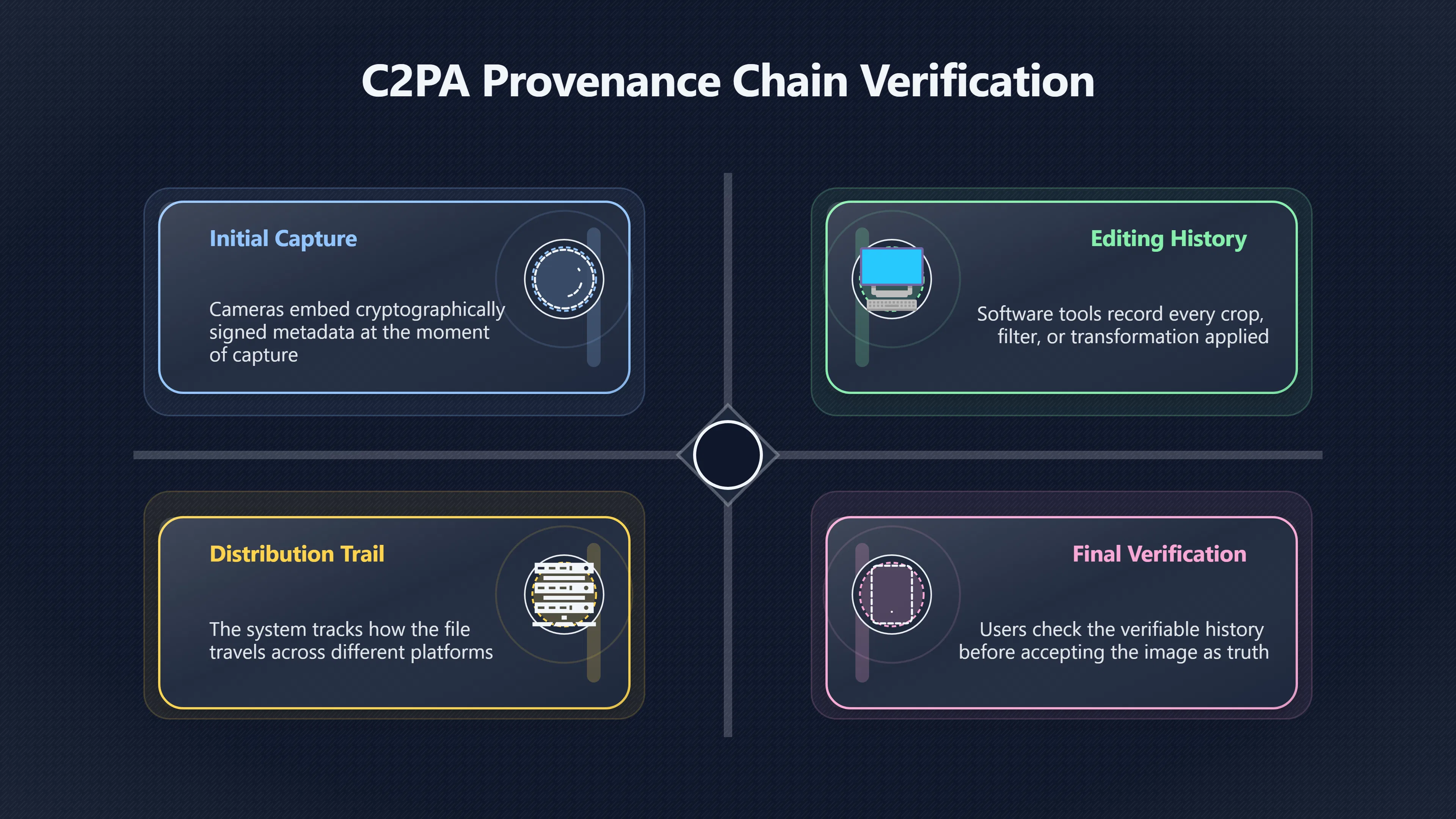
Technical provenance systems are increasingly being designed to support this process. The Coalition for Content Provenance and Authenticity (C2PA) standard allows creators, cameras and software tools to attach cryptographically signed information recording where media originated and how it was edited. This information can function as a verifiable history rather than a simple claim made by an uploader.[C2PA+2C2PA Specification]c2pa.orgC2PA | Verifying Media Content SourcesC2PA provides an open technical standard for publishers, creators and consumers to establish th…
Recent deployments illustrate the idea. Camera manufacturers and news organisations have begun testing systems that embed authenticated timestamps, device information and edit histories directly into image files at capture. The goal is to provide evidence that an image existed in a particular form at a particular time before it entered the social-media ecosystem.[Digital Camera World+2Adobe Blog]digitalcameraworld.comOfficially launching in May 2026 across Europe, the Middle East, and Africa, the system is initially compatible with Canon's EOS R1 and E…
Corroboration from people and institutions
Even a strong technical provenance trail should not be treated as the sole source of truth. The strongest verification comes when an image is supported by independent evidence.
Suppose an image claims to show a fire, protest, flood or military event. A critical thinker should ask whether other evidence exists beyond the image itself. Useful corroboration can include:
- Eyewitness accounts from unrelated individuals.
- Reporting from established news organisations.
- Official statements from emergency services or public authorities.
- Additional photographs or videos captured from different viewpoints.
- Satellite imagery, public records or geolocation evidence.
This principle is important because authenticity and truth are not identical. An image may be genuine yet miscaptioned. A real photograph from one location can be falsely presented as evidence of a different event. Provenance helps establish origin, while corroboration helps establish meaning.
For this reason, forensic and evidentiary guidance increasingly emphasises independent confirmation rather than reliance on a single digital artefact. Researchers and policy organisations studying synthetic media consistently highlight the need for multiple evidence sources when evaluating disputed visual claims.[NIST Publications+2LCG Discovery Experts]nvlpubs.nist.govAI.100 4NIST PublicationsReducing Risks Posed by Synthetic Contentby N AI · 2024 · Cited by 3 — Synthetic content detection may detect the existe…
In practice, the most reliable viral images are usually those that sit within a broader evidence network. Multiple witnesses, multiple recordings and institutional confirmation create a much stronger basis for belief than any isolated image, no matter how realistic it appears.
Why screenshots and reposts break provenance
One of the biggest obstacles to provenance is the ordinary screenshot.
When users take screenshots of images and share those screenshots instead of the original files, critical information is often lost. Metadata can disappear, embedded authenticity records can be removed, and any connection to the original source file may be severed.
This matters because provenance systems depend on continuity. If an image is created with authenticated source information but then repeatedly screenshotted, compressed, cropped and reposted, later viewers may receive only a detached copy. The image remains visible, but the evidence trail becomes much harder to reconstruct.[contentauthenticity.org]contentauthenticity.orgdurable content credentialsInstead, they would ensure that the chain of custody between…Read more…
The problem extends beyond screenshots. Social platforms often alter files during upload, and some platforms have historically failed to preserve provenance information attached to media. Investigations into platform handling of authenticity metadata have shown that provenance signals are frequently lost or hidden as content moves across services.[The Washington Post]washingtonpost.comThe Washington Post We uploaded a fake video to 8 social appsOnly one told users it wasn't real.October 22, 2025 — A Washington Post investigation revealed that among eight major social media platfo…
As a result, the familiar social-media chain of reposts can produce the opposite of verification. Every additional repost may increase visibility while simultaneously reducing access to the original evidence.
A useful rule is simple: whenever possible, seek the earliest available version of an image rather than evaluating a screenshot of a screenshot of a repost.
Why provenance is becoming a governance issue
The move from visual inspection to provenance verification is not only a technical change; it is also a governance challenge.
For decades, public trust in photographs relied largely on social assumptions. Most people assumed that creating convincing fake images required specialised skills and significant effort. Generative AI has altered that assumption. Policymakers, news organisations and technology companies are now exploring systems that preserve evidence about origin and editing history rather than relying on human perception alone.[NIST Publications+2Federation of American Scientists]nvlpubs.nist.govAI.100 4NIST PublicationsReducing Risks Posed by Synthetic Contentby N AI · 2024 · Cited by 3 — Synthetic content detection may detect the existe…
Content Credentials, C2PA manifests and related provenance technologies are part of this effort. They aim to provide something like a digital record of an image’s history: who created it, what tools were used, whether AI contributed to its production, and what edits occurred over time. Supporters often describe these records as a kind of nutritional label for media.[Adobe Blog+2Content Credentials]blog.adobe.comAdobe BlogAuthenticity in the Age of AI: Growing Content Credentials…18 Sept 2024 — Content Credentials are essentially a “nutrition l…
At the same time, researchers caution against treating provenance technology as a complete solution. Standards remain unevenly adopted, metadata can be stripped during distribution, and recent academic analyses have identified limitations and potential weaknesses in existing systems. Provenance records can strengthen trust, but they cannot replace broader verification and corroboration practices.[arXiv+2The Verge]arxiv.orgVerifying Provenance of Digital Media: Why the C2PA Specifications Fall ShortApril 27, 2026…
The key lesson for critical thinking is therefore straightforward. In an environment where synthetic images can easily pass the looks-real test, trust increasingly depends on the quality of the source chain surrounding the image. The strongest evidence is not a realistic picture. It is a picture whose path back to reality can be independently traced, checked and confirmed.[C2PA Specification+2C2PA]spec.c2pa.orgC2PA SpecificationC2PA and Content Credentials ExplainerProvenance, as C2PA defines it, refers to the facts about the history of a piece…
Amazon book picks
Further Reading
Books and field guides related to What proves a viral image came from reality. Use these as the next step if you want deeper reading beyond the article.

On Photography
Provides foundational thinking about photographic evidence and interpretation.

Fake news, propaganda, and plain old lies
Focuses on evaluating trustworthiness of information sources.

Ways of Seeing
First published 1972. Subjects: Art, Art appreciation, Technique, Nonfiction, Visual perception.
eBay marketplace picks
Marketplace Samples
Example marketplace items related to this page. Use the search link to explore similar finds on eBay.



Endnotes
1.
Source: c2pa.org
Link:https://c2pa.org/
Source snippet
C2PA | Verifying Media Content SourcesC2PA provides an open technical standard for publishers, creators and consumers to establish th...
2.
Source: spec.c2pa.org
Link:https://spec.c2pa.org/specifications/specifications/2.4/explainer/Explainer.html
Source snippet
C2PA SpecificationC2PA and Content Credentials ExplainerProvenance, as C2PA defines it, refers to the facts about the history of a piece...
3.
Source: nvlpubs.nist.gov
Title: AI.100 4
Link:https://nvlpubs.nist.gov/nistpubs/ai/NIST.AI.100-4.pdf
Source snippet
NIST PublicationsReducing Risks Posed by Synthetic Contentby N AI · 2024 · Cited by 3 — Synthetic content detection may detect the existe...
4.
Source: spec.c2pa.org
Link:https://spec.c2pa.org/specifications/specifications/2.4/specs/C2PA_Specification.html
Source snippet
C2PA SpecificationContent Credentials: C2PA Technical SpecificationThe set of information about the provenance of an asset based on the...
5.
Source: c2pa.wiki
Link:https://c2pa.wiki/
Source snippet
Content Provenance & Authenticity Standard2 Dec 2025 — C2PA (Coalition for Content Provenance and Authenticity) is an open standard...
6.
Source: blog.adobe.com
Link:https://blog.adobe.com/en/publish/2024/09/18/authenticity-age-ai-growing-content-credentials-momentum-across-social-media-platforms-ai-companies-rising-consumer-awareness
Source snippet
Adobe BlogAuthenticity in the Age of AI: Growing Content Credentials...18 Sept 2024 — Content Credentials are essentially a “nutrition l...
7.
Source: blog.google
Title: google gen ai content transparency c2pa
Link:https://blog.google/innovation-and-ai/products/google-gen-ai-content-transparency-c2pa/
Source snippet
How Google and the C2PA are increasing transparency for...17 Sept 2024 — Search: If an image contains C2PA metadata, people will be able...
8.
Source: contentauthenticity.org
Title: durable content credentials
Link:https://contentauthenticity.org/blog/durable-content-credentials
Source snippet
Instead, they would ensure that the chain of custody between...Read more...
9.
Source: contentauthenticity.org
Link:https://contentauthenticity.org/how-it-works
10.
Source: arxiv.org
Link:https://arxiv.org/abs/2604.24890
Source snippet
Verifying Provenance of Digital Media: Why the C2PA Specifications Fall ShortApril 27, 2026...
Published: April 27, 2026
11.
Source: nist.gov
Link:https://www.nist.gov/
Source snippet
National Institute of Standards and TechnologyNIST promotes U.S. innovation and industrial competitiveness by advancing measurement scien...
12.
Source: nist.gov
Link:https://www.nist.gov/publications/guardians-forensic-evidence-evaluating-analytic-systems-against-ai-generated-[deepfakes
Source snippet
Guardians of Forensic Evidence: Evaluating Analytic...by H Guan · 2025 — Guardians of Forensic Evidence: Evaluating Analytic Systems Aga...
13.
Source: nist.gov
Title: provenience based cross verification digital forensic artifacts applied ntfs
Link:https://www.nist.gov/publications/provenience-based-cross-verification-digital-forensic-artifacts-applied-ntfs
Source snippet
Provenience-based cross-verification of digital forensic...by A Nelson · 2024 — This work focuses on a model of a file system where an a...
14.
Source: opensource.contentauthenticity.org
Link:https://opensource.contentauthenticity.org/docs/getting-started/faqs/
Source snippet
Conversely, if you use a C2PA-enabled camera to take a photo of an image, the...
15.
Source: digitalcameraworld.com
Link:https://www.digitalcameraworld.com/photography/photojournalism/canon-rolls-out-c2pa-compliant-image-verification-for-professional-newsrooms
Source snippet
Officially launching in May 2026 across Europe, the Middle East, and Africa, the system is initially compatible with Canon's EOS R1 and E...
Published: May 2026
16.
Source: lcgdiscovery.com
Title: forensics and futures navigating digital evidence ai and risk in 2026 part 1
Link:https://lcgdiscovery.com/forensics-and-futures-navigating-digital-evidence-ai-and-risk-in-2026-part-1/
Source snippet
Are you relying on a single artifact class (e.g., screenshots) without support? NIST's...Read more...
17.
Source: washingtonpost.com
Title: The Washington Post We uploaded a fake video to 8 social apps
Link:https://www.washingtonpost.com/technology/2025/10/22/ai-deepfake-sora-platforms-c2pa/
Source snippet
Only one told users it wasn't real.October 22, 2025 — A Washington Post investigation revealed that among eight major social media platfo...
Published: October 22, 2025
18.
Source: theverge.com
Title: The Verge This system can sort real pictures from AI fakes
Link:https://www.theverge.com/2024/8/21/24223932/c2pa-standard-verify-ai-generated-images-content-credentials
Source snippet
The C2PA authentication standard, supported by companies such as Microsoft, Adobe, Google, and others, provides a technical solution by a...
19.
Source: fas.org
Title: digital content authentication ecosystem
Link:https://fas.org/publication/digital-content-authentication-ecosystem/
Source snippet
Federation of American ScientistsBuilding a Digital Content Authentication Research...17 Jan 2025 — Informed by NIST's report NIST AI 10...
20.
Source: contentcredentials.org
Link:https://contentcredentials.org/
Source snippet
Content Credentials | Verify Media AuthenticityContent Credentials provides media transparency with advanced authenticity detection tools...
21.
Source: contentcredentials.org
Link:https://contentcredentials.org/about/
22.
Source: linkedin.com
Link:https://www.linkedin.com/help/linkedin/answer/a6282984
Source snippet
Content credentials | LinkedIn HelpContent Credentials were developed using the C2PA standard to make detailed information about a piece...
Additional References
23.
Source: pmc.ncbi.nlm.nih.gov
Link:https://pmc.ncbi.nlm.nih.gov/articles/PMC10311201/
Source snippet
survey of prosecutors and investigators using digital evidenceby CM Miller · 2022 · Cited by 69 — By one estimate, digital evidence is a...
24.
Source: researchgate.net
Link:https://www.researchgate.net/publication/401066315_Deepfake_Forensics_and_Detection_Authentication_of_Digital_Evidence_in_an_Era_of_Synthetic_Media
Source snippet
(PDF) Deepfake Forensics and Detection: Authentication of...Feb 23, 2026 — In this paper, the author evaluates the problems facing digit...
25.
Source: medium.com
Link:https://medium.com/%40adnanmasood/toward-reliable-provenance-in-ai-generated-content-text-images-and-code-9ebe8c57ceae
Source snippet
Toward Reliable Provenance in AI-Generated ContentIts generative image tool Firefly embeds Content Credentials — which can be seen as a f...
26.
Source: medium.com
Link:https://medium.com/%40altruistic_patriarch_fish_753/why-content-credentials-alone-wont-save-us-from-deepfakes-and-what-will-f29a7ec8ba83
Source snippet
VeraSnap — Why Content Credentials Alone Won't Save...When an image's authenticity is challenged as a deepfake, the LiDAR depth data and...
27.
Source: linkedin.com
Link:https://www.linkedin.com/pulse/digital-forensics-age-ai-fundamentals-capabilities-michael-s–2duyc
Source snippet
Digital Forensics in the Age of AIDigital forensics involves the identification, preservation, collection, analysis, and presentation of...
28.
Source: capacanada.ca
Link:https://capacanada.ca/new-ai-authentication-standards/
29.
Source: medium.com
Link:https://medium.com/tebs-lab/provenance-authentication-of-ai-generated-content-e0b1984d944d
30.
Source: ediscoverytoday.com
Link:https://ediscoverytoday.com/2026/02/26/a-practitioners-guide-to-detecting-deep-fakes-and-authenticating-digital-evidence-artificial-intelligence-trends/
Source snippet
He has just released a new practitioner's guide to detecting deep fakes and authenticating digital evidence...
31.
Source: medium.com
Link:https://medium.com/%40sevrusik/the-death-of-the-screenshot-why-c2pa-fails-against-ai-generated-evidence-a7ac31a6e987
Source snippet
The chain of custody — the entire foundation of C2PA's trust model — is severed at the moment...Read more...
32.
Source: netarx.com
Title: navigating the new nist deepfake standards protecting against social
Link:https://www.netarx.com/blog/navigating-the-new-nist-deepfake-standards-protecting-against-social
Source snippet
Navigating the New NIST Deepfake StandardsFeb 18, 2026 — NIST expects organizations to: Track Media Origins: Record and preserve metadata...
Topic Tree