Within Primary Sources
Where Did That Government Number Come From?
A public number is harder to trust when the table, date, definition or method behind it is missing.
On this page
- Why equal access matters for official statistics
- How missing tables and dates weaken public claims
- A checklist for tracing statistics back to source
Page outline Jump by section
Introduction
A government statistic can sound authoritative simply because it comes from an official source. Yet a number quoted in a speech, social media post, news article or AI-generated summary becomes much harder to evaluate when the underlying table, publication date, definition and methodology are missing. In the context of critical thinking, the key question is not only whether a figure is accurate, but whether other people can independently verify it.
 Official statistics are intended to provide a factual basis for public discussion and decision-making. That purpose depends on transparency: readers should be able to find the original release, inspect the data table, understand what was counted, and see any limitations or revisions. When those links are absent, the public is asked to trust an interpretation rather than examine the evidence itself.[Office for Statistics Regulation]osr.statisticsauthority.gov.ukOffice for Statistics Regulation Official Statistics PolicyOffice for Statistics RegulationOfficial Statistics Policy - Office for Statistics RegulationOfficial statistics provide a factual basis…
Why Equal Access Matters for Official Statistics
One reason official statistical systems publish releases, datasets and supporting documents is to ensure that everyone can examine the same evidence. Statistical authorities in the UK and elsewhere emphasise orderly publication, equal access and transparency because trust depends on the public being able to see how conclusions were reached.[GOV.UK+2analysisfunction.civilservice.gov.uk]GOV.UKRelease practice policy for official statisticsApril 27, 2018 — 17 Dec 2025 — As part of our commitment to transparency and public accountability, we will: publish all official statist…
Consider two versions of the same claim:
- “Government figures show unemployment fell by 2%.”
- “According to the labour market release published on a specific date, unemployment fell by 2% compared with the previous quarter.”
The second statement provides a path back to the evidence. The first provides only a conclusion.
Equal access matters because statistics are rarely self-explanatory. A figure may depend on:
- The time period measured.
- The population included or excluded.
- Survey methods.
- Administrative records used.
- Revisions made after initial publication.
- Changes in definitions over time.
Without access to the original release, readers cannot determine whether different people are discussing the same measurement or entirely different ones. Statistical codes and transparency frameworks therefore stress that official figures should be linked to their source releases and supporting documentation. Code of Practice for Statistics+2GOV.WALES[code.statisticsauthority.gov.uk]code.statisticsauthority.gov.ukManage data responsibly. 4. Producers…Read more…
How Missing Tables and Dates Weaken Public Claims
The absence of a source link does not automatically mean a statistic is false. The problem is that it prevents independent checking.
A Number Without a Date
Many government statistics change monthly, quarterly or annually. A claim that “crime increased by 10%” means little without knowing the period involved.
A figure from three years ago may remain technically correct while creating a misleading impression about current conditions. Official statistical systems publish release calendars and publication dates precisely so users can understand when data were collected and when they became available.[GOV.UK]GOV.UKRelease practice policy for official statisticsApril 27, 2018 — 17 Dec 2025 — As part of our commitment to transparency and public accountability, we will: publish all official statist…
A Number Without a Table
Tables reveal context that short quotations often omit.
For example, a single figure might represent:
- A national total.
- A regional subset.
- A provisional estimate.
- A seasonally adjusted measure.
- A percentage rather than an absolute count.
When the table is unavailable, readers cannot see neighbouring values, historical trends or important footnotes. Statistical publication guidance increasingly emphasises accessible, machine-readable tables because they allow users to inspect and reuse the evidence directly.[analysisfunction.civilservice.gov.uk]analysisfunction.civilservice.gov.ukreleasing statistics in spreadsheets30 Jun 2021 — This guidance has been created for producers of statistics who need to publish data tables in spreadsheet documents…
A Number Without Definitions
Definitions often determine what a statistic actually measures.
Suppose a government reports a count of households, jobs, migrants, crimes or patients. Small changes in eligibility rules or classifications can alter totals significantly. A social media post may quote the final number while omitting the definition that produced it.
This is why statistical agencies routinely publish methodological information alongside releases. Methods explain what was counted, how it was counted and what limitations apply.[analysisfunction.civilservice.gov.uk]analysisfunction.civilservice.gov.ukInformation on specific statistical methodsThis page provides information about specific methods used in the process to produce statistic…
A Number Without Revision History
Official statistics are sometimes revised as better information becomes available. Economic indicators, population estimates and other datasets may be updated months or years after their first release.
If a public claim cites an outdated figure without indicating that later revisions exist, readers may unknowingly rely on superseded information. Statistical standards therefore require transparent correction and revision practices.[Code of Practice for Statistics]code.statisticsauthority.gov.ukManage data responsibly. 4. Producers…Read more…

Why This Problem Becomes Worse on Social Media and AI Platforms
Social media rewards brevity. AI systems often summarise information into concise answers. Both environments can separate numbers from their supporting evidence.
A viral post may include only a screenshot of a chart. An AI-generated answer may reproduce a statistic without displaying the original table. In both cases, the audience receives a conclusion but loses access to the underlying documentation.
This creates several risks:
- Readers cannot distinguish official statistics from unofficial estimates.
- Contextual notes and caveats disappear.
- Outdated figures can continue circulating.
- Different datasets can be merged or confused.
- Errors become difficult to detect.
The result is not necessarily deliberate misinformation. Often the problem is that evidence becomes detached from its source as information is repeatedly summarised and reshared.
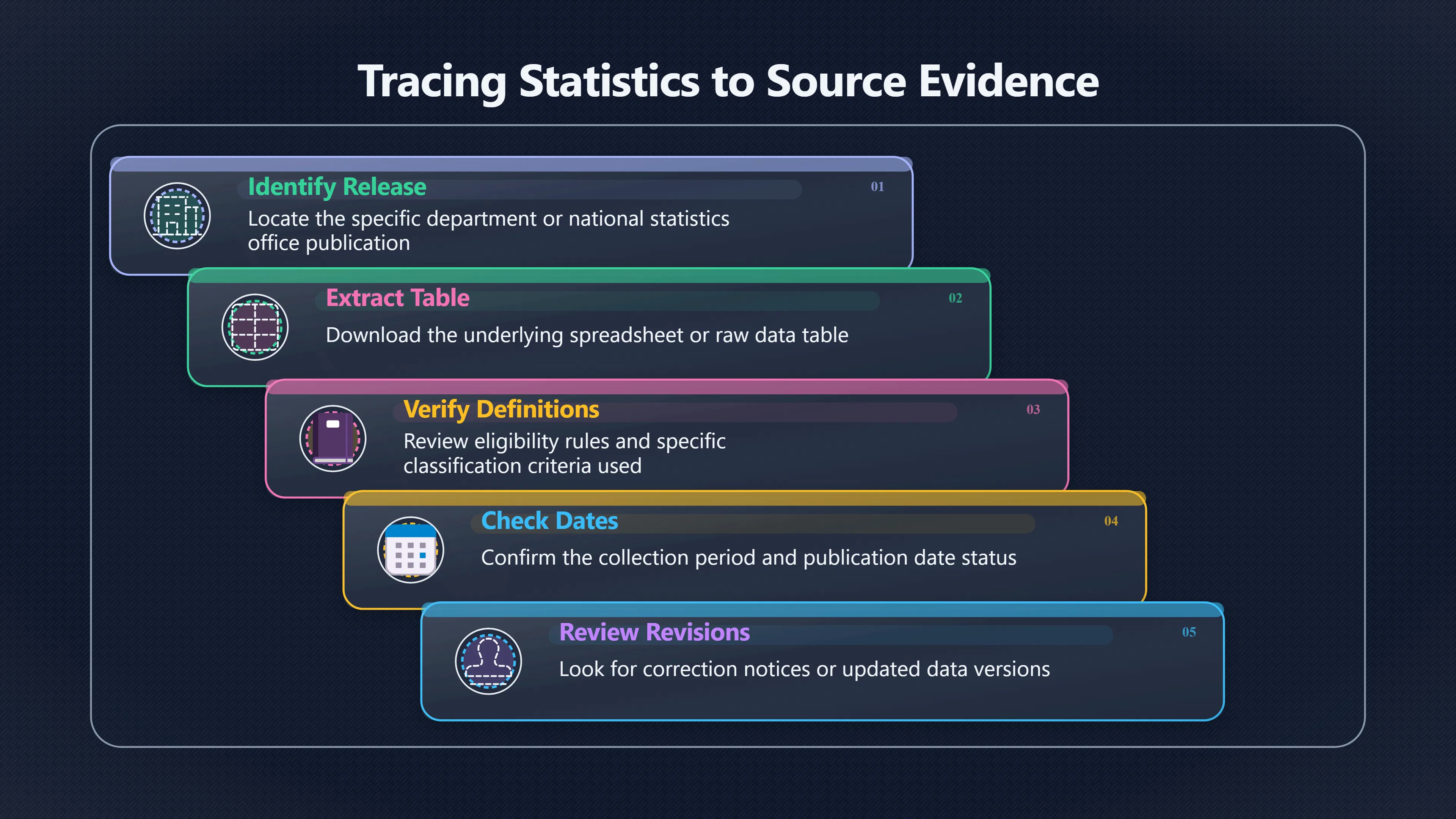
A Checklist for Tracing Statistics Back to Source
When encountering a government number that lacks a public source link, a few practical checks can often reveal whether the claim is well supported.
1. Look for the Original Statistical Release
Search for the exact figure together with the responsible department, agency or national statistics office. Reliable releases usually identify:
- Publication date.
- Responsible organisation.
- Statistical series.
- Contact information.
These features help distinguish official publications from secondary commentary.[GOV.UK]GOV.UKRelease practice policy for official statisticsApril 27, 2018 — 17 Dec 2025 — As part of our commitment to transparency and public accountability, we will: publish all official statist…
2. Find the Supporting Table
Do not stop at the headline release.
Locate the underlying spreadsheet, dataset or data table. Many statistical authorities publish downloadable tables specifically so users can verify calculations and examine trends.[analysisfunction.civilservice.gov.uk]analysisfunction.civilservice.gov.ukreleasing statistics in spreadsheets30 Jun 2021 — This guidance has been created for producers of statistics who need to publish data tables in spreadsheet documents…
3. Check Definitions and Coverage
Ask:
- What exactly is being measured?
- Who or what is included?
- Who or what is excluded?
- Is the statistic estimated or directly counted?
Definitions often explain apparent contradictions between competing claims.
4. Check the Publication Date
Determine whether the figure is current, provisional or historical. A statistic may be accurate for its publication period while being irrelevant to present conditions.
5. Look for Methodology Notes
Most official statistical systems publish explanations of methods, quality measures and limitations. These notes reveal whether a figure comes from surveys, administrative records, modelling or other techniques.[analysisfunction.civilservice.gov.uk]analysisfunction.civilservice.gov.ukInformation on specific statistical methodsThis page provides information about specific methods used in the process to produce statistic…
6. Check for Revisions or Corrections
Many statistical agencies maintain transparent revision policies and correction notices. If a number has changed since publication, later releases may provide the updated figure.[Code of Practice for Statistics]code.statisticsauthority.gov.ukManage data responsibly. 4. Producers…Read more…
What Transparency Looks Like in Practice
The strongest public statistical claims allow readers to move easily from the claim to the evidence.
A transparent presentation typically includes:
- The exact source publication.
- The publication date.
- A direct link to the dataset or table.
- Definitions of key terms.
- Methodological notes.
- Information about revisions or uncertainty.
International transparency and open-data initiatives increasingly treat access to underlying datasets and metadata as part of good public governance, not merely a technical detail. The goal is to make claims reproducible rather than dependent on trust alone.[OECD+2Open Data Watch]oecd.orgtransparency of public information 60a963c4Transparency of public information: Government at a…19 Jun 2025 — The 2025 edition of Government at a Glance offers a comprehensiv…
The Key Question Behind Every Public Number
When a government statistic appears without a source link, the most useful response is not immediate acceptance or rejection. It is a simple question: “Where can I see the original evidence?”
If the answer leads to a dated release, a public table, clear definitions and documented methods, the statistic can be examined on its merits. If those elements are missing, confidence should remain provisional until the number can be traced back to its source.
In an information environment shaped by rapid sharing and AI-generated summaries, the ability to reconnect public numbers with their original evidence is one of the most practical forms of critical thinking.

eBay marketplace picks
Marketplace Samples
Example marketplace items related to this page. Use the search link to explore similar finds on eBay.




Endnotes
1.
Source: osr.statisticsauthority.gov.uk
Title: Office for Statistics Regulation Official Statistics Policy
Link:https://osr.statisticsauthority.gov.uk/policies/official-statistics-policies/official-statistics-policy/
Source snippet
Office for Statistics RegulationOfficial Statistics Policy - Office for Statistics RegulationOfficial statistics provide a factual basis...
2.
Source: code.statisticsauthority.gov.uk
Link:https://code.statisticsauthority.gov.uk/standards-of-the-code-of-practice/standards-for-official-statistics-with-required-practices/
Source snippet
Manage data responsibly. 4. Producers...Read more...
3.
Source: GOV.UK
Title: Release practice policy for official statistics
Link:https://www.gov.uk/government/publications/ofquals-statistics-policies-and-procedures/publication-and-dissemination-policy-for-statistical-outputs
Source snippet
April 27, 2018 — 17 Dec 2025 — As part of our commitment to transparency and public accountability, we will: publish all official statist...
Published: April 27, 2018
4.
Source: analysisfunction.civilservice.gov.uk
Link:https://analysisfunction.civilservice.gov.uk/wp-content/uploads/2018/03/Presentation-and-Publication-of-Official-Statistics-National-Statisticians-Guidance-7.pdf
Source snippet
NATIONAL STATISTICIAN'S GUIDANCE: Presentation and...This document provides guidance to all producers of official statistics on interpre...
5.
Source: gov.wales
Title: quality report contextual information wellbeing wales 2018 19 html
Link:https://www.gov.wales/quality-report-contextual-information-wellbeing-wales-2018-19-html
Source snippet
Quality report for contextual information in Wellbeing of...26 Sept 2019 — The links provide details such as coverage, and strength and...
6.
Source: dataportal.orr.gov.uk
Link:https://dataportal.orr.gov.uk/media/1410/statement-orderly-release-and-revisions-policy-2019.pdf
Source snippet
ORR provides only factual commentary to complement the user's...Read more...
7.
Source: analysisfunction.civilservice.gov.uk
Title: releasing statistics in spreadsheets
Link:https://analysisfunction.civilservice.gov.uk/policy-store/releasing-statistics-in-spreadsheets/
Source snippet
30 Jun 2021 — This guidance has been created for producers of statistics who need to publish data tables in spreadsheet documents...
8.
Source: analysisfunction.civilservice.gov.uk
Link:https://analysisfunction.civilservice.gov.uk/government-statistical-service-and-statistician-group/gss-support/methodology/information-on-specific-methods/
Source snippet
Information on specific statistical methodsThis page provides information about specific methods used in the process to produce statistic...
9.
Source: oecd.org
Title: transparency of public information 60a963c4
Link:https://www.oecd.org/en/publications/2025/06/government-at-a-glance-2025_70e14c6c/full-report/transparency-of-public-information_60a963c4.html
Source snippet
Transparency of public information: Government at a...19 Jun 2025 — The 2025 edition of Government at a Glance offers a comprehensiv...
10.
Source: GOV.UK
Link:https://www.gov.uk/government/publications/independent-review-of-the-uk-statistics-authority-uksa-2023/independent-review-of-the-uk-statistics-authority-by-professor-denise-lievesley-cbe-html
Source snippet
The quality of official statistics matters to us all because decisions and research both inside government and beyond (in businesses...
11.
Source: GOV.UK
Title: local government transparency code 2015
Link:https://www.gov.uk/government/publications/local-government-transparency-code-2015/local-government-transparency-code-2015
Source snippet
ernment transparency code 201529 Jan 2025 — This Code is issued to meet the government's desire to place more power into citizens' han...
12.
Source: stylemanual.gov.au
Link:https://www.stylemanual.gov.au/referencing-and-attribution/author-date
13.
Source: oecd.org
Link:https://www.oecd.org/en/about/directorates/statistics-and-data-directorate.html
Source snippet
Statistics and Data DirectorateSDD compile and produce high-quality statistics and data through innovation, international collaboration a...
14.
Source: opendatawatch.com
Link:https://opendatawatch.com/wp-content/uploads/2021/Publications/Open-Data-for-Official-Statistics-History-Principles-Implementation.pdf
Source snippet
Open data for official statistics: History, principles, and...by S Badiee · Cited by 16 — It discusses the implementation of these stan...
15.
Source: opendatawatch.com
Title: overcoming data graveyards in official statistics
Link:https://opendatawatch.com/publications/overcoming-data-graveyards-in-official-statistics/
Source snippet
Data fall into data graveyards (Custer, 2017) where they go unutilized and prevent evidence-informed policies from being made.Read more...
Additional References
16.
Source: cso.ie
Link:https://www.cso.ie/en/trusttransparency/ourapproachtotransparency/
Source snippet
Our Approach to TransparencyOur methods and sources are clearly published in each release; Transparency builds trust and credibility arou...
17.
Source: unece.org
Link:https://unece.org/sites/default/files/2022-11/ECECESSTAT20226.pdf
Source snippet
Synthetic Data for Official Statistics A Starter GuideThe policy of Statistics New Zealand is to release SURF data with appropriate metad...
18.
Source: hesa.ac.uk
Link:https://www.hesa.ac.uk/data-and-analysis/open-data-strategy
19.
Source: elibrary.imf.org
Link:https://www.elibrary.imf.org/view/journals/001/2004/087/article-A001-en.xml
Source snippet
IMF eLibraryRevisions Policy for Official Statistics: A Matter of Governance in1 May 2004 — This paper proposes a set of good practices f...
Published: May 2004
20.
Source: federalregister.gov
Title: Preventing Access to U.S
Link:https://www.federalregister.gov/documents/2025/01/08/2024-31486/preventing-access-to-us-sensitive-personal-data-and-government-related-data-by-countries-of-concern
Source snippet
Sensitive Personal Data and...8 Jan 2025 — The Department of Justice is issuing a final rule to implement Executive Order 14117 of Febru...
21.
Source: youtube.com
Title: Introducing ‘Trustworthiness’
Link:https://www.youtube.com/watch?v=Jsw3kdZNsa4
Source snippet
4 Introducing 'Quality' - the second pillar of the Code of Practice for Statistics...
22.
Source: ec.europa.eu
Title: European Commission Database
Link:https://ec.europa.eu/eurostat/data/database
Source snippet
European CommissionDatabase - Eurostat - European UnionDetailed datasets contains all data publicly available from Eurostat. They are pre...
23.
Source: Wikipedia
Title: Citing sources
Link:https://en.wikipedia.org/wiki/Wikipedia%3ACiting_sources
Source snippet
Citing sourcesThis page explains how to place and format both parts of the citation. Each article should use one citation me...
24.
Source: unstats.un.org
Title: SUT IOT HB Final Cover
Link:https://unstats.un.org/unsd/nationalaccount/docs/SUT_IOT_HB_Final_Cover.pdf
Source snippet
on Supply and Use Tables and Input-Output Tables...The objective of this Handbook is to provide step-by-step guidance for the compilatio...
25.
Source: youtube.com
Title: Introducing ‘Quality’
Link:https://www.youtube.com/watch?v=yvwLYYBiTF0
Source snippet
5 The Subtle Science of Misleading with Statistics by Dave McAllister...
Topic Tree