Within Accuracy Nudge
Why We Share Claims We Doubt
People often value accuracy but still share false headlines when social rewards, urgency, or group identity take over at the sharing moment.
On this page
- Belief versus sharing intent
- Urgency, identity, and social reward
- How a pre share pause changes the decision
Page outline Jump by section
Introduction
People do not always share false headlines because they believe them. A growing body of research suggests that many users can distinguish between true and false claims reasonably well when asked directly about accuracy, yet become much less discerning when deciding what to repost. The crucial gap is not always a failure of critical thinking at the level of belief; it is a failure to apply accuracy standards at the moment of sharing. Viral content spreads through this gap between noticing a claim and deciding whether to amplify it. Research on social media behaviour suggests that attention shifts from “Is this true?” to questions such as “Will this get engagement?”, “Does this support my group?”, or “Should people see this immediately?”[Nature]nature.comG. Fighting misinformation on social media using crowdsourced judgments of news source quality…. misinformation sharing (x axis).Read…
 Understanding this sharing gap helps explain why accuracy nudges can work. They are designed not to teach people what is true, but to remind them to use standards they often already possess before they click “share”.[Nature]nature.comG. Fighting misinformation on social media using crowdsourced judgments of news source quality…. misinformation sharing (x axis).Read…
Belief Versus Sharing Intent
One of the most important findings in misinformation research is that judging a headline and sharing a headline are different psychological tasks.
In a widely cited series of experiments, Gordon Pennycook and David Rand found that participants’ accuracy judgements strongly reflected whether headlines were true or false. However, those same participants were substantially less selective when reporting whether they would share the headlines online. In other words, people often knew more about accuracy than their sharing behaviour suggested.[Nature]nature.comG. Fighting misinformation on social media using crowdsourced judgments of news source quality…. misinformation sharing (x axis).Read…
This distinction matters because it challenges a common assumption that misinformation spreads mainly because people are fooled. Many users appear capable of recognising warning signs, but accuracy competes with other goals during sharing. Researchers describe this as an attention problem: social media environments draw attention toward engagement, identity expression, entertainment, outrage, or signalling allegiance, leaving accuracy temporarily out of focus.[PMC]pmc.ncbi.nlm.nih.govPMCNudging Social Media toward AccuracyNIHby G Pennycook · 2022 · Cited by 122 — A meaningful portion of online misinformation sharing is likely attributable to Internet…
The pattern has been replicated across multiple studies and different cultural contexts. Replication research examining misinformation sharing found that participants were far less able to distinguish true from false content when considering sharing than when evaluating truthfulness directly.[Nature]nature.com2020) through research on the spread of misinformation about COVID-19 in…Read more…
The result is a paradox: a person may privately doubt a headline while still publicly helping it spread.
Urgency, Identity, and Social Reward
If many people value accuracy, why does sharing still drift away from it?
A key reason is that social media rewards behaviours other than careful verification. Content that is surprising, emotional, identity-relevant, or socially useful often feels worth passing along even when confidence in its accuracy is incomplete. Psychological research has consistently linked misinformation sharing to factors such as emotional reactions, novelty, social norms, and group identity.[American Psychological Association]apa.orghow why misinformation spreadsAmerican Psychological AssociationHow and why does misinformation spread?29 Nov 2023 — People are more likely to share misinformation whe…
Several mechanisms can operate simultaneously:
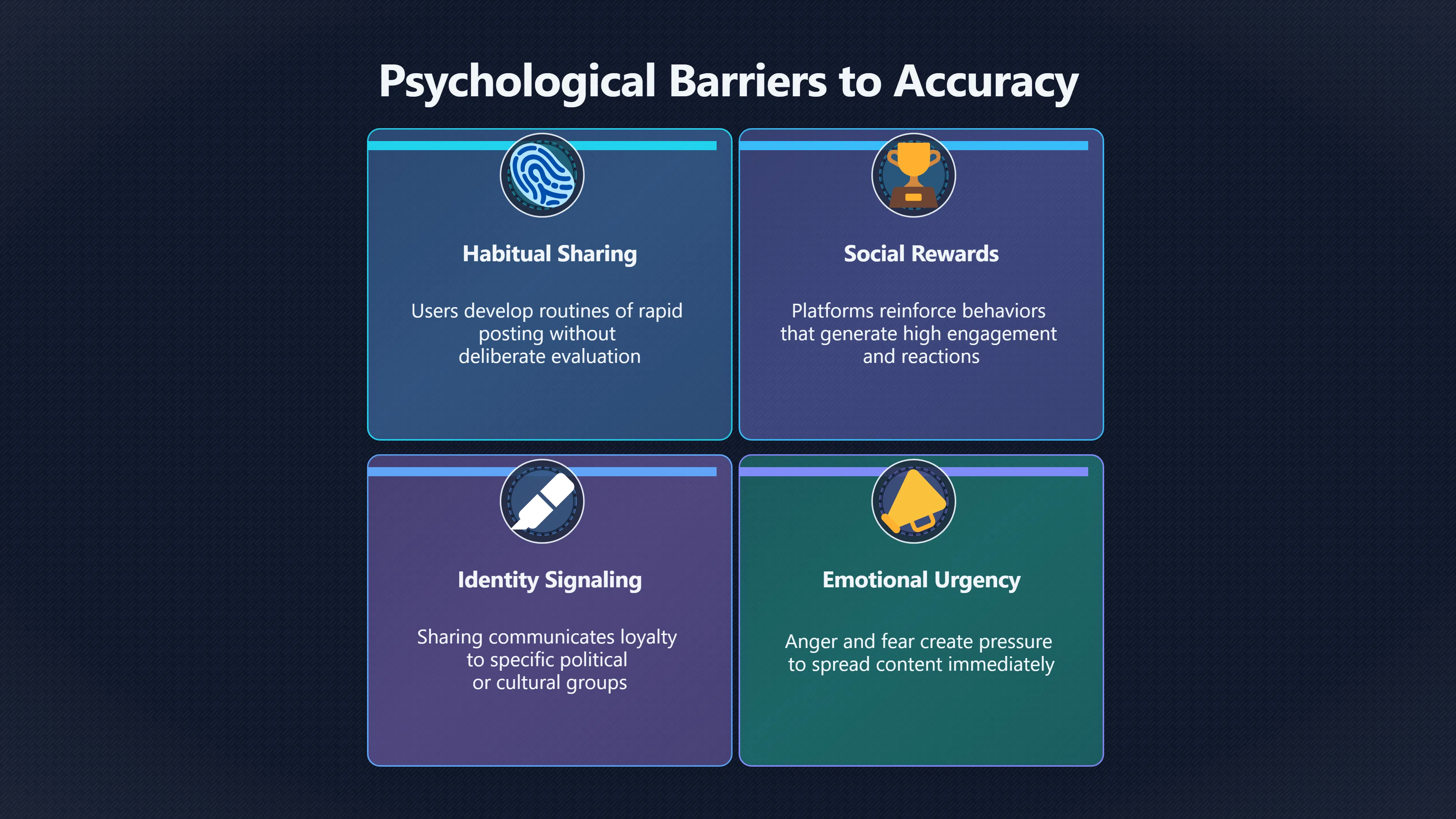
- Urgency: People may feel that a claim is too important to ignore. A warning about a public threat, election rule, health risk, or scandal can create pressure to spread first and verify later.
- Identity signalling: Sharing can communicate loyalty to a political, cultural, or social group. The act of sharing may function as a statement about belonging rather than a statement about factual certainty.[American Psychological Association]apa.orghow why misinformation spreadsAmerican Psychological AssociationHow and why does misinformation spread?29 Nov 2023 — People are more likely to share misinformation whe…
- Emotional reward: Anger, outrage, fear, and moral indignation increase the desire to engage with content and encourage transmission to others. Research on misinformation sharers has found links between sharing behaviour and emotional expression, particularly anger-related language.[arXiv]arxiv.orgWho Shares Fake News? Uncovering Insights from Social Media Users' Post HistoriesMarch 20, 2022…
- Social visibility: Sharing demonstrates activity, awareness, and participation. In fast-moving online conversations, silence can feel like absence, while sharing signals involvement.
Importantly, these motivations do not require wholehearted belief. Someone can think, “This might not be entirely true, but it captures a larger point,” or “People should see this just in case.” Such reasoning lowers the threshold for amplification.
When Sharing Becomes a Habit
Another reason false headlines spread is that sharing itself can become automatic.
Research published in the Proceedings of the National Academy of Sciences argues that misinformation sharing is partly driven by habits formed within social media reward systems. Platforms repeatedly reinforce behaviours that generate reactions, comments, and attention. Over time, users may develop routines of rapid sharing that occur with little deliberate evaluation.[PNAS]pnas.orgSharing of misinformation is habitual, not just lazy or biasedby G Ceylan · 2023 · Cited by 224 — The answer lies in the reward struc…
This helps explain why even individuals with adequate reasoning skills sometimes spread inaccurate information. The issue is not necessarily an inability to recognise falsehoods. Instead, the behaviour becomes routinised. Users learn that posting quickly, frequently, and emotionally attracts engagement, while verification takes time and often produces no immediate reward.[PNAS]pnas.orgSharing of misinformation is habitual, not just lazy or biasedby G Ceylan · 2023 · Cited by 224 — The answer lies in the reward struc…
Heavy social media users appear particularly vulnerable to this dynamic. Research highlighted by Yale and other institutions suggests that frequent platform use is associated with weaker discernment in sharing decisions, even when users remain capable of distinguishing true from false content in other contexts.[Yale Insights]insights.som.yale.eduYale InsightsHow Social Media Rewards Misinformation | Yale Insights31 Mar 2023 — The results showed that, overall, participants shared m…
The practical consequence is that misinformation can spread through ordinary habits rather than deliberate deception.
Why Critical Thinking Often Arrives Too Late
A common misconception is that critical thinking fails because people never question suspicious claims. In reality, questioning often occurs after sharing rather than before it.
Social feeds encourage rapid reactions. Headlines appear among messages from friends, entertainment, advertisements, and personal updates. In that environment, accuracy competes for attention with dozens of other cues. Researchers describing an “inattention to accuracy” account argue that users frequently possess the ability to evaluate truthfulness but fail to bring that ability into the decision process at the relevant moment.[PMC]pmc.ncbi.nlm.nih.govPMCNudging Social Media toward AccuracyNIHby G Pennycook · 2022 · Cited by 122 — A meaningful portion of online misinformation sharing is likely attributable to Internet…
This explains why digital literacy alone does not always translate into better sharing behaviour. Some studies have found that people who make more accurate truth judgements are not necessarily much more selective in what they choose to share. Knowledge helps, but knowledge must be activated during the sharing decision.[Misinformation Review]misinforeview.hks.harvard.eduMisinformation ReviewDigital literacy is associated with more discerning accuracy…by N Sirlin · 2021 · Cited by 157 — In recent years…
The critical thinking problem, therefore, is often not one of capability but one of timing.
How a Pre-Share Pause Changes the Decision
Accuracy nudges target the sharing gap directly.
Instead of attempting to fact-check every post, these interventions briefly redirect attention toward accuracy before a sharing decision. The theory is straightforward: if users already care about truth but are distracted by other motivations, reminding them to consider accuracy should improve sharing choices.[PMC]pmc.ncbi.nlm.nih.govPMCNudging Social Media toward AccuracyNIHby G Pennycook · 2022 · Cited by 122 — A meaningful portion of online misinformation sharing is likely attributable to Internet…
Evidence generally supports this idea. Across multiple experiments involving tens of thousands of participants, simple prompts encouraging users to think about accuracy increased the quality of information they were willing to share and reduced willingness to share false headlines. The effect emerged primarily because participants became less likely to pass along inaccurate content rather than more reluctant to share everything.[Nature+2PMC]nature.com& Rand, D. G. Fighting misinformation on social media using crowdsourced judgments of news source quality. Proc. Natl. Acad …Read more
What makes these findings notable is that the intervention is small. Users are not given a lengthy lesson in media literacy. They are simply encouraged to pause and ask a question that was previously absent from the decision process.
The success of such prompts supports a broader conclusion: many people share false headlines not because they cannot recognise problems with them, but because accuracy temporarily loses the competition for attention. A brief reminder can change behaviour precisely because the underlying concern for truth was there all along.[Nature+2PMC]nature.comG. Fighting misinformation on social media using crowdsourced judgments of news source quality…. misinformation sharing (x axis).Read…
Amazon book picks
Further Reading
Books and field guides related to Why We Share Claims We Doubt. Use these as the next step if you want deeper reading beyond the article.
Foolproof: Why We Fall for Misinformation and How to Build Im...
Directly connected to the gap between belief and sharing.
eBay marketplace picks
Marketplace Samples
Example marketplace items related to this page. Use the search link to explore similar finds on eBay.
Endnotes
1.
Source: nature.com
Link:https://www.nature.com/articles/s41586-021-03344-2
Source snippet
G. Fighting misinformation on social media using crowdsourced judgments of news source quality.... misinformation sharing (x axis).Read...
2.
Source: pmc.ncbi.nlm.nih.gov
Title: PMCNudging Social Media toward Accuracy
Link:https://pmc.ncbi.nlm.nih.gov/articles/PMC9082967/
Source snippet
NIHby G Pennycook · 2022 · Cited by 122 — A meaningful portion of online misinformation sharing is likely attributable to Internet...
3.
Source: pmc.ncbi.nlm.nih.gov
Title: PMCAccuracy prompts are a replicable and generalizable
Link:https://pmc.ncbi.nlm.nih.gov/articles/PMC9051116/
Source snippet
by G Pennycook · 2022 · Cited by 364 — Online misinformation has become a major focus of attention in recent years among academics, te...
4.
Source: nature.com
Link:https://www.nature.com/articles/s41599-025-05233-9
Source snippet
(2020) through research on the spread of misinformation about COVID-19 in...Read more...
5.
Source: arxiv.org
Link:https://arxiv.org/abs/2203.10560
Source snippet
Who Shares Fake News? Uncovering Insights from Social Media Users' Post HistoriesMarch 20, 2022...
Published: March 20, 2022
6.
Source: pnas.org
Link:https://www.pnas.org/doi/10.1073/pnas.2216614120
Source snippet
Sharing of misinformation is habitual, not just lazy or biasedby G Ceylan · 2023 · Cited by 224 — The answer lies in the reward struc...
7.
Source: insights.som.yale.edu
Link:https://insights.som.yale.edu/insights/how-social-media-rewards-misinformation
Source snippet
Yale InsightsHow Social Media Rewards Misinformation | Yale Insights31 Mar 2023 — The results showed that, overall, participants shared m...
8.
Source: nature.com
Link:https://www.nature.com/articles/s41467-022-30073-5
Source snippet
& Rand, D. G. Fighting misinformation on social media using crowdsourced judgments of news source quality. Proc. Natl. Acad...Read more...
9.
Source: nature.com
Link:https://www.nature.com/articles/s41562-024-02086-1
Source snippet
misinformation priming affect truth judgments and sharing intention of partisan news.... Fake news for all: how citizens discern disinfo...
10.
Source: nature.com
Link:https://www.nature.com/articles/s41598-023-34402-6
Source snippet
We document that accidental sharing is much more common than deliberate...Read more...
11.
Source: nature.com
Link:https://www.nature.com/articles/s41598-026-39555-8
Source snippet
AI-supported real-time news evaluation reveals effects of...by S Yury · 2026 — In the literature, the concept of misinformation coexists...
12.
Source: apa.org
Title: how why misinformation spreads
Link:https://www.apa.org/topics/journalism-facts/how-why-misinformation-spreads
Source snippet
American Psychological AssociationHow and why does misinformation spread?29 Nov 2023 — People are more likely to share misinformation whe...
13.
Source: misinforeview.hks.harvard.edu
Link:https://misinforeview.hks.harvard.edu/article/digital-literacy-is-associated-with-more-discerning-accuracy-judgments-but-not-sharing-intentions/
Source snippet
Misinformation ReviewDigital literacy is associated with more discerning accuracy...by N Sirlin · 2021 · Cited by 157 — In recent years...
14.
Source: pubmed.ncbi.nlm.nih.gov
Link:https://pubmed.ncbi.nlm.nih.gov/35484277/
Source snippet
Nat Commun. 2022 Apr 28;13(1):2333.Read more...
15.
Source: pmc.ncbi.nlm.nih.gov
Link:https://pmc.ncbi.nlm.nih.gov/articles/PMC10637098/
Source snippet
by V Capraro · 2022 · Cited by 59 — [Accuracy prompts]({{ 'accuracy-prompts/' | relative_url }}), nudges that make accuracy salient, typically decrease the sharing of fake news...
16.
Source: pmc.ncbi.nlm.nih.gov
Link:https://pmc.ncbi.nlm.nih.gov/articles/PMC9548403/
Source snippet
by C Beauvais · 2022 · Cited by 180 — Research has addressed fake news creation, consumption, sharing, and detection as well as approa...
17.
Source: misinforeview.hks.harvard.edu
Title: developing an accuracy prompt toolkit to reduce covid 19 misinformation online
Link:https://misinforeview.hks.harvard.edu/article/developing-an-accuracy-prompt-toolkit-to-reduce-covid-19-misinformation-online/
Source snippet
an accuracy-prompt toolkit to reduce COVID...by Z Epstein · 2021 · Cited by 137 — The spread of inaccuracies on social media — including...
18.
Source: misinforeview.hks.harvard.edu
Title: To fully understand the spread of misinformation online,
Link:https://misinforeview.hks.harvard.edu/article/who-knowingly-shares-false-political-information-online/
Source snippet
knowingly shares false political information online?by S Littrell · 2023 · Cited by 29 — Some people share misinformation accidentally, b...
Additional References
19.
Source: researchgate.net
Link:https://www.researchgate.net/publication/360253696_Accuracy_prompts_are_a_replicable_and_generalizable_approach_for_reducing_the_spread_of_misinformation
Source snippet
accuracy represent a promising approach for reducing misinformation sharing online... fake news and misinformation. PsyArXiv 1–...
1
- https
20.
Source: researchgate.net
Link:https://www.researchgate.net/publication/362841654_I_Think_This_News_Is_Accurate_Endorsing_Accuracy_Decreases_the_Sharing_of_Fake_News_and_Increases_the_Sharing_of_Real_News
Source snippet
Accuracy Salience. A set of interventions that is... sharing intentions of. fake news between the accuracy endorsement condition and.Rea...
21.
Source: bi.team
Link:https://www.bi.team/press-releases/more-than-half-the-public-think-theyre-good-at-spotting-false-information-online-but-only-a-third-think-other-people-are/
Source snippet
More than half the public think they're good at spotting false...1 Oct 2024 — People believe that while others can't spot false informat...
22.
Source: facebook.com
Title: prompting people to reflect on the accuracy of news headlines increases the qual
Link:https://www.facebook.com/NaturePortfolioJournals/posts/prompting-people-to-reflect-on-the-accuracy-of-news-headlines-increases-the-qual/10158484080983167/
Source snippet
Prompting people to reflect on the accuracy of news...Mar 20, 2021 — Excited to share new Nature paper on misinformation: "Shifting atte...
23.
Source: today.usc.edu
Title: study reveals the key reason why fake news spreads on social media
Link:https://today.usc.edu/usc-study-reveals-the-key-reason-why-fake-news-spreads-on-social-media/
Source snippet
USC TodayStudy reveals key reason why fake news spreads on social...17 Jan 2023 — Surprisingly, the researchers found that users' social...
24.
Source: oecd.org
Link:https://www.oecd.org/content/dam/oecd/en/publications/reports/2022/10/misinformation-and-disinformation_0a88bcef/b7709d4f-en.pdf
Source snippet
and sharing intentions models revealed significant...Read more...
25.
Source: chicagopolicyreview.org
Title: try accuracy prompts to reduce the spread of misinformation online
Link:https://chicagopolicyreview.org/2022/01/04/try-accuracy-prompts-to-reduce-the-spread-of-misinformation-online/
Source snippet
Try Accuracy Prompts to Reduce the Spread of...Jan 4, 2022 — The potential to spread COVID-19 misinformation increases as users neglect...
26.
Source: newyorker.com
Title: dont believe what theyre telling you about misinformation
Link:https://www.newyorker.com/magazine/2024/04/22/dont-believe-what-theyre-telling-you-about-misinformation
Source snippet
His death highlights the depth of conviction held by Flat Earthers, as noted by journalist Kelly Weill. As misinformation spreads rapidly...
27.
Source: researchgate.net
Link:https://www.researchgate.net/publication/362635046_Beyond_fake_news_Analytic_thinking_and_the_detection_of_false_and_hyperpartisan_news_headlines
Source snippet
sharing intentions, higher levels of numeracy 26 were associated with a higher belief in real news, but not with belief in fake news or s...
28.
Source: semanticscholar.org
Link:https://www.semanticscholar.org/paper/Accuracy-prompts-are-a-replicable-and-generalizable-Pennycook-Rand/aa6c54ab0515105d0722a49f20b4997f65a2389b
Source snippet
A Practical Guide to Doing Behavioral Research on Fake News...Read more...
Topic Tree