Within Think Before Sharing
Sceptical Without Becoming Cynical
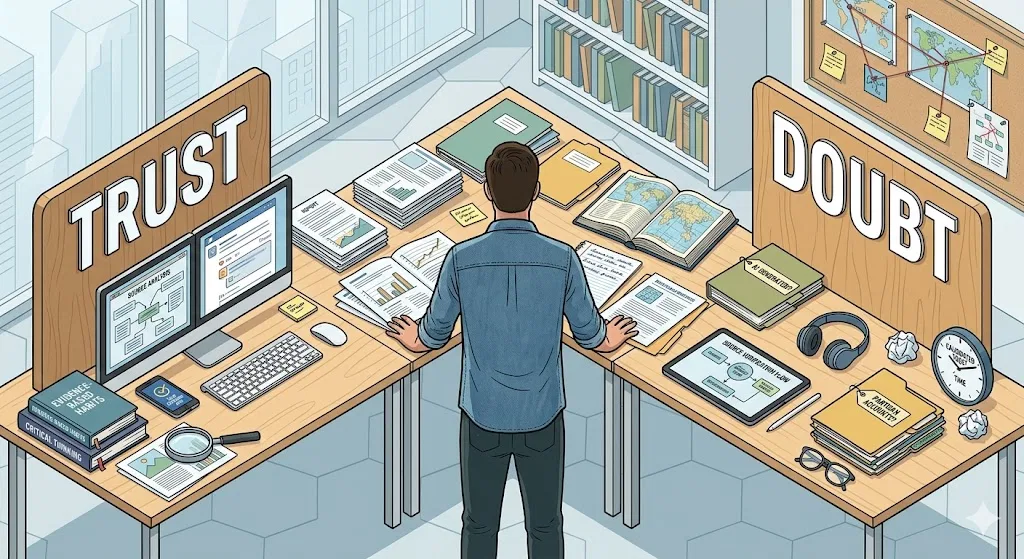
Healthy scepticism asks for evidence and context, while cynicism treats everything as fake and can become another shortcut.
On this page
- Why cynicism feels safe
- What critical thinking adds
- How to keep an open standard
Page outline Jump by section
Introduction
Healthy scepticism is an evidence-seeking habit. Cynicism is a defensive shortcut. Online, the difference matters because social media and AI now surround users with polished claims, confident opinions, synthetic media, screenshots without context and creators who may not verify what they share. The sceptical reader asks, “What would show this is true, false, partial or uncertain?” The cynical reader says, “They are all lying,” and stops looking.
That can feel sophisticated, but it is not the same as critical thinking. Distrusting everything can become as lazy as believing everything when evidence is available. It also creates a trap: people who reject mainstream sources wholesale may still accept rumours, influencers, partisan accounts or AI-generated summaries that fit their mood. The useful standard is not blind trust. It is calibrated trust: demanding evidence, comparing sources, noticing uncertainty and staying open to correction.
Why cynicism feels safe
Cynicism offers emotional protection. In a messy feed, it is tempting to assume every viral claim is manipulated, every institution is hiding something and every correction is propaganda. That stance has a psychological reward: it makes the user feel harder to fool. It also reduces the burden of checking. If everything is fake, there is no need to separate a false rumour from a true investigation, a weak source from a strong one, or a mistake from a deliberate deception.
The problem is that modern misinformation does not only exploit gullibility. It also exploits exhaustion and distrust. The Reuters Institute’s 2025 Digital News Report describes an environment where news consumption is shifting towards social platforms, video networks and influencers, while many audiences find it increasingly difficult to distinguish truth from falsehood online. That is fertile ground for both credulity and blanket suspicion: people may distrust “the media” in general while still relying on familiar personalities, friends, group chats or algorithmic feeds for practical beliefs.[reutersinstitute.politics.ox.ac.uk]reutersinstitute.politics.ox.ac.ukdigital news reportLoad external content The most concerning sources of misinformation | Digital News…Read more…
This is especially risky because many online information intermediaries do not behave like professional editors. UNESCO’s 2024 survey of digital content creators found that 62% did not carry out rigorous and systematic fact-checking before sharing information, while 42% used likes and views as credibility signals. Those figures do not mean creators are malicious; they show why “it has millions of views” is a poor substitute for evidence.[UNESCO]unesco.org2/3 of digital content creators do not check their facts before27 Nov 2024 — A UNESCO survey published today reveals that 62% do no…
Cynicism can also misread the role of correction. A fact-check, context note or journalistic update may be treated as proof that “the story keeps changing”, when in reality responsible knowledge often does change as better evidence arrives. Critical thinking expects revision. Cynicism treats revision as confirmation that nobody can be trusted.

The shortcut that looks like intelligence
Cynicism often masquerades as sharper judgement because it avoids the embarrassment of being fooled. But it is still a shortcut. Instead of asking which source is more reliable on this claim, it collapses different levels of evidence into the same category: official statistics, leaked documents, anonymous screenshots, edited clips, AI summaries, influencer commentary and jokes become equally suspect or equally usable depending on the user’s prior attitude.
Recent research helps explain why this distinction matters. A 2025 study on news scepticism argues that news scepticism, news cynicism and news trust are separate constructs, not points on one simple scale. In that framing, scepticism is closer to careful evaluation, while cynicism is a broad negative orientation towards news and institutions. The practical implication is important: media literacy should not simply teach people to “trust less”, because lower trust is not automatically better judgement.[Taylor & Francis Online]tandfonline.comThis study explores the role of news skepticism in countering misinformation beliefs and skepticism's connection to greater news…Read…
The same pattern appears in intervention research. A 2024 study on media literacy tips found that some anti-misinformation interventions can backfire by increasing scepticism towards true news or reducing trust in generally reliable actors. The more useful approach was not to tell people that everything is suspect, but to promote reliable news practices and help readers distinguish stronger from weaker evidence.[PMC]pmc.ncbi.nlm.nih.govPMCMedia literacy tips promoting reliable news improvePMCMedia literacy tips promoting reliable news improve
This is the core difference:
Online reactionWhat it sounds likeWhat it doesNaive belief“It looks real, so it is probably true.”Accepts claims too quickly.Cynicism“Everything is fake, so checking is pointless.”Rejects standards and may drift towards identity-based belief.Critical thinking“This could be true, but I need source, evidence, context and uncertainty.”Keeps judgement open while evidence is tested.
Critical thinking is not softness. It is stricter than cynicism because it requires work. It asks the reader to notice what kind of claim is being made, what evidence would be appropriate, who is in a position to know, and whether the same claim survives contact with independent sources.
What critical thinking adds
Critical thinking adds a middle layer between impulse and belief. It does not demand that every user become a professional investigator. It asks for a few repeatable moves that slow down the feed’s pressure to react.
One of the strongest findings in misinformation research is that people often share low-quality information not because they have no interest in truth, but because the platform moment pulls their attention elsewhere. Pennycook and colleagues found that subtle prompts directing users’ attention to accuracy improved the quality of news they subsequently shared. Their interpretation is not that users are helplessly irrational, but that social media often distracts people from applying accuracy standards they already care about.[PMC]pmc.ncbi.nlm.nih.govPMCNudging Social Media toward AccuracyPMCNudging Social Media toward Accuracy
Critical thinking therefore adds friction. Before reposting a dramatic claim, it asks: is this original evidence, a reaction to evidence, or a screenshot of someone else’s reaction? Before accepting an AI answer, it asks: does the answer cite checkable sources, and are those sources current and relevant? Before dismissing a correction, it asks: is the correction addressing the claim, or merely attacking the person who shared it?
A practical example is a viral local claim: “The council has secretly changed a rule and nobody is reporting it.” A cynical response says, “Of course they have; local media and officials always hide things.” A naive response says, “This is worrying; share it.” A critical response looks for the council document, meeting minutes, local reporting, archived page, affected date and whether the post has confused a proposal with a decision. That difference matters in the UK context, where recent reporting on local social media groups has highlighted fabricated local authority messages, AI-generated content and misleading council-related claims spreading in areas with weak local news provision.[The Guardian]theguardian.comThe Guardian'Killer of trust': social media groups fuel misinformation in UK, report findsMPs and media advocates warn that unregulated local online groups are eroding trust and influencing public opinion, often more than forma…
Critical thinking also separates doubt from denial. Doubt is provisional: “I do not know yet.” Denial is fixed: “No evidence would persuade me.” Online, this distinction is crucial because bad actors can exploit both belief and disbelief. A manipulated image may persuade one audience that something happened; the mere existence of deepfakes may persuade another audience to dismiss authentic evidence as fake. UK survey research on deepfakes found high concern about their effects on distrust and manipulation, even though reported exposure to harmful deepfakes was lower than general concern. That gap shows why fear of fakery must be paired with verification skills, not turned into a licence to reject inconvenient evidence.[arXiv]arxiv.orgOpen source on arxiv.org.
How cynicism can make misinformation easier to believe
The surprising danger of cynicism is that it can make people more vulnerable, not less. Once a person decides that all institutions, journalists, experts or official sources are equally corrupt, they still need some way to decide what is true. Often the replacement standard becomes emotional fit: who sounds authentic, who confirms my suspicion, who seems independent, who annoys the people I distrust.
This is not careful scepticism. It is trust relocation. The person has not stopped trusting; they have moved trust from visible institutions with at least some accountability to personalities, anonymous accounts, group norms or algorithmic repetition.
Repetition is a particular risk. Research on the illusory truth effect shows that repeated exposure can make claims feel more true because they become easier to process. A 2023 study found that repetition increased perceived accuracy and made people more likely to share misinformation, with the effect observed across health and general knowledge claims.[PMC]pmc.ncbi.nlm.nih.govOpen source on nih.gov.
Cynicism does not automatically protect against that effect. A user may reject a broadcaster’s report as “mainstream spin” while seeing the same unevidenced claim repeated by dozens of accounts in a feed, group chat or comment section. Familiarity then starts to feel like corroboration. The user may say, “Everyone is talking about it,” when the stronger question is, “Are they all pointing to the same original evidence, or just repeating each other?”
Fact-checking systems face a related problem. A 2024 study of perceptions of fact-checking entities found that trust in fact-checking labels varied strongly by users’ political preference, although the presence of a label still appeared to discourage sharing in the studied headlines. The lesson is not that fact-checks are useless. It is that a cynical audience may judge the checker before judging the evidence, which makes transparent sourcing and multiple assessments especially important.[arXiv]arxiv.orgOpen source on arxiv.org.
Sceptical without becoming cynical
The goal is not to become trusting. It is to become proportionate. Different claims deserve different levels of scrutiny. A post about a celebrity rumour, a health treatment, an election result, a local emergency, a war image and a financial scam do not carry the same stakes. Critical thinking adjusts effort to consequence.
A useful open standard has three parts:
Hold belief in stages. Instead of deciding “true” or “fake” immediately, use intermediate labels: unverified, plausible but unsupported, partly true, outdated, missing context, disputed, or well supported. These labels reduce the pressure to make a dramatic judgement before the evidence is ready.
Check outside the frame. Lateral reading means leaving the original post or website to see what other reliable sources say about the source and claim. The Stanford History Education Group, now the Digital Inquiry Group, has emphasised that professional fact-checkers often leave an unfamiliar site quickly and consult the wider web rather than trying to judge credibility from the site’s appearance alone.[UK Parliament Committees]committees.parliament.ukOpen source on parliament.uk.
Trace claims back to origin. The SIFT method — stop, investigate the source, find better coverage, trace claims to the original context — is useful because it turns scepticism into a process rather than a mood. It does not say “never trust”; it says “slow down, identify where this came from, compare coverage, and inspect the original evidence where possible.”[UChicago Library Guides]guides.lib.uchicago.eduLibrary Guides The SIFT MethodLibrary Guides The SIFT Method
This standard is open because it allows evidence to change the judgement. It is also demanding because it refuses easy exits. A cynical person can dismiss a source in one second. A critical thinker may still reject the claim, but the rejection is tied to a reason: no primary source, contradicted by better reporting, image taken from another event, quote not in the transcript, study overstated, AI answer unsupported, or headline not matching the evidence.
The AI twist: fluent uncertainty
AI makes cynicism more tempting because it increases the supply of convincing-looking material. A synthetic image, fabricated quote, auto-generated thread or confident chatbot answer can appear polished enough to bypass ordinary suspicion. But AI also makes blanket cynicism less useful, because “AI could have made this” is not evidence that it did.
The better question is whether the material has a verifiable trail. Does the image appear in earlier contexts? Does the quote exist in a transcript, recording or archived page? Does the AI answer cite sources that actually support the claim? Is the source current enough for a fast-changing topic? Is there independent reporting or documentation?
This matters because AI systems can also be unreliable intermediaries for news. Reuters reported in 2025 on research by the European Broadcasting Union and the BBC finding substantial error rates in AI assistants’ answers to news-related questions, including sourcing problems and outdated or inaccurate information. That does not mean AI answers are always worthless. It means they should be treated as starting points for verification, not as final authorities.[Reuters]reuters.comAI assistants make widespread errors about the news, new research showsWith AI assistants increasingly replacing traditional search engines, the EBU warns this trend could erode public trust and democratic en…
A cynical reaction to AI says, “Nothing can be believed now.” A critical reaction says, “More claims need provenance.” Provenance means a chain back to where the information came from: original document, direct recording, named witness, dataset, court filing, official statement, peer-reviewed paper, reputable reporting, or clearly marked uncertainty. The more consequential the claim, the stronger that chain should be.
Keeping an open standard
The hardest part of online critical thinking is not spotting obviously false posts. It is keeping a standard that is firm enough to resist manipulation and open enough to accept good evidence. Cynicism fails because it protects the ego more than the truth. It lets people feel unfooled while quietly replacing evidence with suspicion.
A better standard uses questions that can actually be answered:
- Who is the original source, and are they in a position to know?
- What evidence is being offered?
- Is the evidence current, complete and in context?
- What do independent sources say?
- What would change my mind?
- What action, if any, should wait until verification is stronger?
These questions do not guarantee certainty. They create discipline. They also preserve the possibility that some institutions are wrong, some journalists make mistakes, some experts overreach, some official statements are incomplete — and yet some documents are genuine, some reporting is careful, some corrections are valid, and some claims really are false.
That is the difference between cynicism and critical thinking online. Cynicism lowers the cost of judgement by flattening everything into distrust. Critical thinking raises the quality of judgement by keeping evidence, context and uncertainty in view. In an information environment shaped by social media incentives and AI-generated fluency, that open but demanding standard is the more resilient one.
Amazon book picks
Further Reading
Books and field guides related to Sceptical Without Becoming Cynical. Use these as the next step if you want deeper reading beyond the article.
The Demon-Haunted World
Models evidence-based skepticism without descending into cynicism.

eBay marketplace picks
Marketplace Samples
Example marketplace items related to this page. Use the search link to explore similar finds on eBay.
Endnotes
1.
Source: reutersinstitute.politics.ox.ac.uk
Title: digital news report
Link:https://reutersinstitute.politics.ox.ac.uk/digital-news-report/2025
Source snippet
Load external content The most concerning sources of misinformation | Digital News...Read more...
2.
Source: reutersinstitute.politics.ox.ac.uk
Title: dnr executive
Link:https://reutersinstitute.politics.ox.ac.uk/digital-news-report/2025/dnr-executive-summary
Source snippet
Report (2025) identified misinformation and disinformation... He has long used the term 'fake news' to vilify media critical of his poli...
3.
Source: unesco.org
Link:https://www.unesco.org/en/articles/2/3-digital-content-creators-do-not-check-their-facts-sharing-want-learn-how-do-so-unesco-survey
Source snippet
2/3 of digital content creators do not check their facts before27 Nov 2024 — A UNESCO survey published today reveals that 62% do no...
4.
Source: unesco.org
Link:https://www.unesco.org/en/digital-content-creators
Source snippet
42%. Use likes and views to judge content credibility. 1/3. Know laws on freedom of expression and...Read more...
5.
Source: pmc.ncbi.nlm.nih.gov
Title: PMCMedia literacy tips promoting reliable news improve
Link:https://pmc.ncbi.nlm.nih.gov/articles/PMC11332023/
6.
Source: pmc.ncbi.nlm.nih.gov
Title: PMCNudging Social Media toward Accuracy
Link:https://pmc.ncbi.nlm.nih.gov/articles/PMC9082967/
7.
Source: arxiv.org
Link:https://arxiv.org/abs/2407.05529
8.
Source: pmc.ncbi.nlm.nih.gov
Link:https://pmc.ncbi.nlm.nih.gov/articles/PMC10636596/
9.
Source: arxiv.org
Link:https://arxiv.org/abs/2410.00866
10.
Source: committees.parliament.uk
Link:https://committees.parliament.uk/writtenevidence/448/html/
11.
Source: guides.lib.uchicago.edu
Title: Library Guides The SIFT Method
Link:https://guides.lib.uchicago.edu/c.php?g=1241077&p=9082322
12.
Source: reuters.com
Title: AI assistants make widespread errors about the news, new research shows
Link:https://www.reuters.com/business/media-telecom/ai-assistants-make-widespread-errors-about-news-new-research-shows-2025-10-21/
Source snippet
With AI assistants increasingly replacing traditional search engines, the EBU warns this trend could erode public trust and democratic en...
13.
Source: unesdoc.unesco.org
Link:https://unesdoc.unesco.org/ark%3A/48223/pf0000392006
14.
Source: reutersinstitute.politics.ox.ac.uk
Title: Digital News Report 2025
Link:https://reutersinstitute.politics.ox.ac.uk/sites/default/files/2025-06/Digital_News-Report_2025.pdf
15.
Source: reutersinstitute.politics.ox.ac.uk
Title: mapping news creators and influencers social and video networks
Link:https://reutersinstitute.politics.ox.ac.uk/news-creators-influencers/2025/mapping-news-creators-and-influencers-social-and-video-networks
16.
Source: commonslibrary.parliament.uk
Title: disinformation and its effects on society
Link:https://commonslibrary.parliament.uk/disinformation-and-its-effects-on-society/
17.
Source: tandfonline.com
Link:https://www.tandfonline.com/doi/full/10.1080/15205436.2025.2534983
Source snippet
This study explores the role of news skepticism in countering misinformation beliefs and skepticism's connection to greater news...Read...
18.
Source: theguardian.com
Link:https://www.theguardian.com/media/2026/jun/08/social-media-groups-fuel-misinfomation-uk-[news-deserts
Source snippet
MPs and media advocates warn that unregulated local online groups are eroding trust and influencing public opinion, often more than forma...
19.
Source: pmc.ncbi.nlm.nih.gov
Link:https://pmc.ncbi.nlm.nih.gov/articles/PMC9910783/
20.
Source: pmc.ncbi.nlm.nih.gov
Link:https://pmc.ncbi.nlm.nih.gov/articles/PMC8224890/
21.
Source: pmc.ncbi.nlm.nih.gov
Link:https://pmc.ncbi.nlm.nih.gov/articles/PMC8354518/
22.
Source: pmc.ncbi.nlm.nih.gov
Link:https://pmc.ncbi.nlm.nih.gov/articles/PMC8869166/
23.
Source: libguides.ucmerced.edu
Title: sift method
Link:https://libguides.ucmerced.edu/news/evaluation/sift-method
24.
Source: leibniz-hbi.de
Title: reuters institute digital news report 2025 findings for germany
Link:https://leibniz-hbi.de/en/hbi-publications/reuters-institute-digital-news-report-2025-findings-for-germany/
25.
Source: theguardian.com
Title: online influencers need urgent fact checking training warns unesco
Link:https://www.theguardian.com/media/2024/nov/26/online-influencers-need-urgent-fact-checking-training-warns-unesco
26.
Source: clark.libguides.com
Link:https://clark.libguides.com/evaluating-information/SIFT
27.
Source: tandfonline.com
Link:https://www.tandfonline.com/doi/full/10.1080/21670811.2025.2556183
28.
Source: tandfonline.com
Link:https://www.tandfonline.com/doi/abs/10.1080/15205436.2025.2534983
29.
Source: tandfonline.com
Link:https://www.tandfonline.com/doi/full/10.1080/08838151.2024.2410783
30.
Source: tandfonline.com
Link:https://www.tandfonline.com/doi/full/10.1080/23743670.2025.2475761
31.
Source: thedecisionlab.com
Title: Illusory truth effect
Link:https://thedecisionlab.com/biases/illusory-truth-effect
32.
Source: guides.lib.wayne.edu
Link:https://guides.lib.wayne.edu/sift
33.
Source: dictionary.cambridge.org
Link:https://dictionary.cambridge.org/dictionary/english/media
34.
Source: scienceofboosting.org
Title: Lateral Reading
Link:https://www.scienceofboosting.org/project/lateral-reading/
35.
Source: werkzeugkasten-ik.ch
Title: The SIFT Method
Link:https://www.werkzeugkasten-ik.ch/en/2025/08/21/the-sift-method/
36.
Source: journalism.co.za
Title: reuters institute digital news report 2025
Link:https://journalism.co.za/reuters-institute-digital-news-report-2025/
37.
Source: annieduke.substack.com
Title: the illusory truth effect
Link:https://annieduke.substack.com/p/the-illusory-truth-effect
38.
Source: eosgmbh.com
Title: the sift method
Link:https://eosgmbh.com/en/the-sift-method/
39.
Source: zora.uzh.ch
Link:https://www.zora.uzh.ch/server/api/core/bitstreams/38fa8b22-7295-4f45-9c39-676046e6eb0f/content
40.
Source: universityworldnews.com
Link:https://www.universityworldnews.com/post.php?story=20250611095921665
41.
Source: dr.ntu.edu.sg
Link:https://dr.ntu.edu.sg/server/api/core/bitstreams/73555724-4ba7-4fd7-a65a-d86053f33708/content
Additional References
42.
Source: researchgate.net
Link:https://www.researchgate.net/publication/394149155_Defining_and_Validating_News_Skepticism_Distinctions_from_News_Trust_and_Cynicism_and_Links_to_News_Literacy_and_Misinformation_Belief
Source snippet
ResearchGate(PDF) Defining and Validating News Skepticism31 Jul 2025 — The increasing presence of fake news and misinformation in the con...
43.
Source: youtube.com
Link:https://www.youtube.com/watch?v=S9KXQaqFaWQ
Source snippet
Why Cynicism Holds Us Back and How to Overcome It with Jamil Zaki...
44.
Source: youtube.com
Title: Why Cynicism Holds Us Back and How to Overcome It with Jamil Zaki
Link:https://www.youtube.com/watch?v=5Au2oaMclXw
Source snippet
The Paradox of Authority in Education: Why “Best Practice” Keeps Failing Students and Teachers...
45.
Source: youtube.com
Title: Jamil Zaki: How to escape the cynicism trap | TED
Link:https://www.youtube.com/watch?v=ABHdTi1If0c
Source snippet
Helping students evaluate information in an AI-driven world | National News Literacy Week 2026...
46.
Source: youtube.com
Title: Cynicism vs. Skepticism: Why One Makes You Easier to Manipulate
Link:https://www.youtube.com/watch?v=3LGM7HAuQe4
Source snippet
Jamil Zaki: How to escape the cynicism trap | TED...
47.
Source: researchgate.net
Link:https://www.researchgate.net/publication/353820585_Constructive_Skepticism_Dysfunctional_Cynicism_Skepticism_and_Cynicism_Differently_Determine_Generalized_Media_Trust
48.
Source: researchgate.net
Link:https://www.researchgate.net/publication/342579856Fighting_COVID-19_Misinformation_on_Social_Media_Experimental_Evidence_for_a_Scalable[Accuracy-Nudge
49.
Source: researchgate.net
Link:https://www.researchgate.net/publication/349535570_Lateral_reading_College_students_learn_to_critically_evaluate_internet_sources_in_an_online_course
50.
Source: researchgate.net
Link:https://www.researchgate.net/publication/383851293_Media_literacy_tips_promoting_reliable_news_improve_discernment_and_enhance_trust_in_traditional_media
51.
Source: merriam-webster.com
Link:https://www.merriam-webster.com/dictionary/critical
Topic Tree
Follow this branch
Parent topic
Think Before SharingRelated pages 24
- Accuracy Nudge Can One Pause Stop a False Share?
- AI Tutors Should You Trust a Chatbot Tutor?
- AI Virality Why AI Misinformation Travels So Easily
- Community Notes Can the Crowd Correct the Feed?
- Corroboration Who Else Can Confirm This Claim?
- Deepfakes How to Check a Voice or Video Claim
- Emotional Posts Why Outrage Is Not Evidence
- Evidence Types Not All Evidence Deserves Equal Weight
- +16 more in sidebar