Within Fake Authority
Pause Before Sharing Emergency Screenshots
Police-like or council-like warnings should be checked through current official channels before they are shared in a crisis.
On this page
- Why public safety posts spread quickly
- Which official channels to check first
- How false warnings can create real world harm
Page outline Jump by section
Introduction
Emergency-style local warnings are among the most powerful forms of online content because they demand immediate action. A screenshot claiming that police have closed a road, a message warning residents to stay indoors, or a post announcing an evacuation can influence where people travel, whether they seek help, and how they react to unfolding events. In the context of authority impersonation, these warnings are especially risky because they often borrow the appearance of police, council, fire-service or emergency-management communications.
 The safest habit is simple: pause before sharing. Even when a warning looks urgent, check whether it appears on current official channels before passing it on. False emergency claims can spread faster than corrections, creating confusion, diverting attention from genuine alerts, and in some cases causing real-world disruption. Research and emergency-management guidance consistently identify misinformation during crises as a public-safety problem, not merely an online nuisance.[Department of Homeland Security]dhs.govDepartment of Homeland SecurityCountering False Information on Social Media in Disasters…Rumors, misinformation and false information…
Why Public-Safety Posts Spread Quickly
Emergency messages exploit a natural human response. People are more likely to share information that appears to protect family members, neighbours or vulnerable groups. A message saying “avoid this area”, “police warning”, or “urgent council notice” often receives immediate attention because the potential cost of ignoring it seems high.
Social media platforms can amplify this effect. During emergencies, users often seek rapid updates outside traditional news channels, creating an environment where screenshots, forwarded messages and copied text can circulate before verification occurs. Studies of disaster communication have found that social media is valuable for distributing alerts, but it also accelerates the spread of rumours and misleading information during fast-moving events.[National Academies+2EveryCRSReport]nationalacademies.orgNational AcademiesPublic Response to Alerts and Warnings Using Social MediaSocial media have proven useful in a crisis both to officials…
The problem becomes more acute in local online groups. Recent UK research found that misinformation is particularly common in local social-media environments where trusted local journalism is weaker, including fabricated local-authority messages and AI-generated material presented as genuine community information.[The Guardian]theguardian.comThe Guardian'Killer of trust': social media groups fuel misinformation in UK, report findsTopics such as immigration and Islamophobia are the most frequent subjects of false claims. The spread intensifies around elections, with…
In practice, many people do not encounter an emergency warning as a standalone document. They see it because a friend, neighbour or community-group administrator has shared it. The social trust attached to the person sharing the message can be mistaken for evidence that the warning itself has been verified.
Which Official Channels to Check First
When a post claims to come from an emergency authority, the first question should be: can the same warning be found directly from the authority it supposedly represents?
For local incidents, the most reliable checks are usually:
- Official police channels – force websites, verified social-media accounts, and official public-alert systems.
- Local council communications – websites, emergency-information pages, and verified accounts.
- Fire and rescue services – particularly during severe weather, wildfires or major incidents.
- Transport operators and highway authorities – for road closures, station evacuations or travel restrictions.
- Emergency-management agencies and official alert systems – where they exist for the relevant region. Emergency-management guidance repeatedly recommends relying on recognised official information sources during disasters and checking dedicated rumour-control resources where available. PMC+2ncdps.gov
A useful warning sign is when a message demands immediate sharing but provides no link to an official announcement. Genuine emergency communications increasingly appear simultaneously across multiple official channels. If a dramatic warning exists only as a screenshot circulating on messaging apps, caution is warranted.
Another practical check is timing. Emergency services frequently update evolving incidents. A screenshot may show an authentic notice from hours or days earlier that no longer reflects the current situation. Verifying directly with the issuing organisation helps determine whether the information remains active.
How False Warnings Can Create Real-World Harm
The harm from a false warning does not depend on whether people fully believe it. Even partial belief can alter behaviour.
Researchers studying emergency communication note that misinformation during disasters can increase confusion, undermine public trust, misdirect resources and interfere with response efforts. False reports about hazards, contamination, shortages or evacuation zones can change how people move and where they seek assistance. PMC+2Department of Homeland Security
One common risk is evacuation confusion. If residents receive incorrect information about which areas are affected, they may travel unnecessarily, ignore genuine instructions, or contribute to congestion that complicates emergency response. Studies examining evacuation alerts have shown that emergency warnings can produce substantial behavioural changes, including movement beyond the intended warning area. arXiv
Another risk is resource diversion. Emergency-management agencies have repeatedly warned that rumours and false claims can consume staff time that would otherwise be spent responding to the incident itself. During major disasters, officials often dedicate personnel specifically to correcting misinformation because inaccurate reports can interfere with aid delivery and public decision-making. ncdps.gov+2Institute for Strategic Dialogue
False warnings also create a longer-term trust problem. If residents repeatedly encounter inaccurate alerts, they may become sceptical of future messages, including genuine ones. Emergency communicators frequently describe this as a serious public-safety concern because warning systems depend on public confidence. Kemecon
When Official-Looking Warnings Turn Out to Be Wrong
Not every misleading emergency warning begins with a malicious fake. Sometimes genuine-looking alerts are circulated out of context, and sometimes official systems themselves make mistakes.
In January 2025, a mistaken evacuation alert was distributed across Los Angeles County during wildfire conditions, reaching millions of people outside the intended warning area. The error generated widespread confusion and anxiety before authorities issued corrections. The incident illustrates how strongly people react to emergency notifications and how disruptive inaccurate warnings can be, even when there is no deliberate deception involved. NBC Bay Area+2Time
Other examples involve fabricated emergency-alert content shared online as if it were genuine. Reuters fact-checkers documented a fictional emergency-alert video that was repeatedly circulated as a real nuclear warning despite having originated as entertainment content. Official authorities confirmed that no such alert had been issued. Reuters
These cases highlight an important lesson: the appearance of an alert is not proof of authenticity. Screenshots, videos and forwarded messages can imitate the visual style of official warning systems surprisingly well.
A Practical Pause-Before-Sharing Test
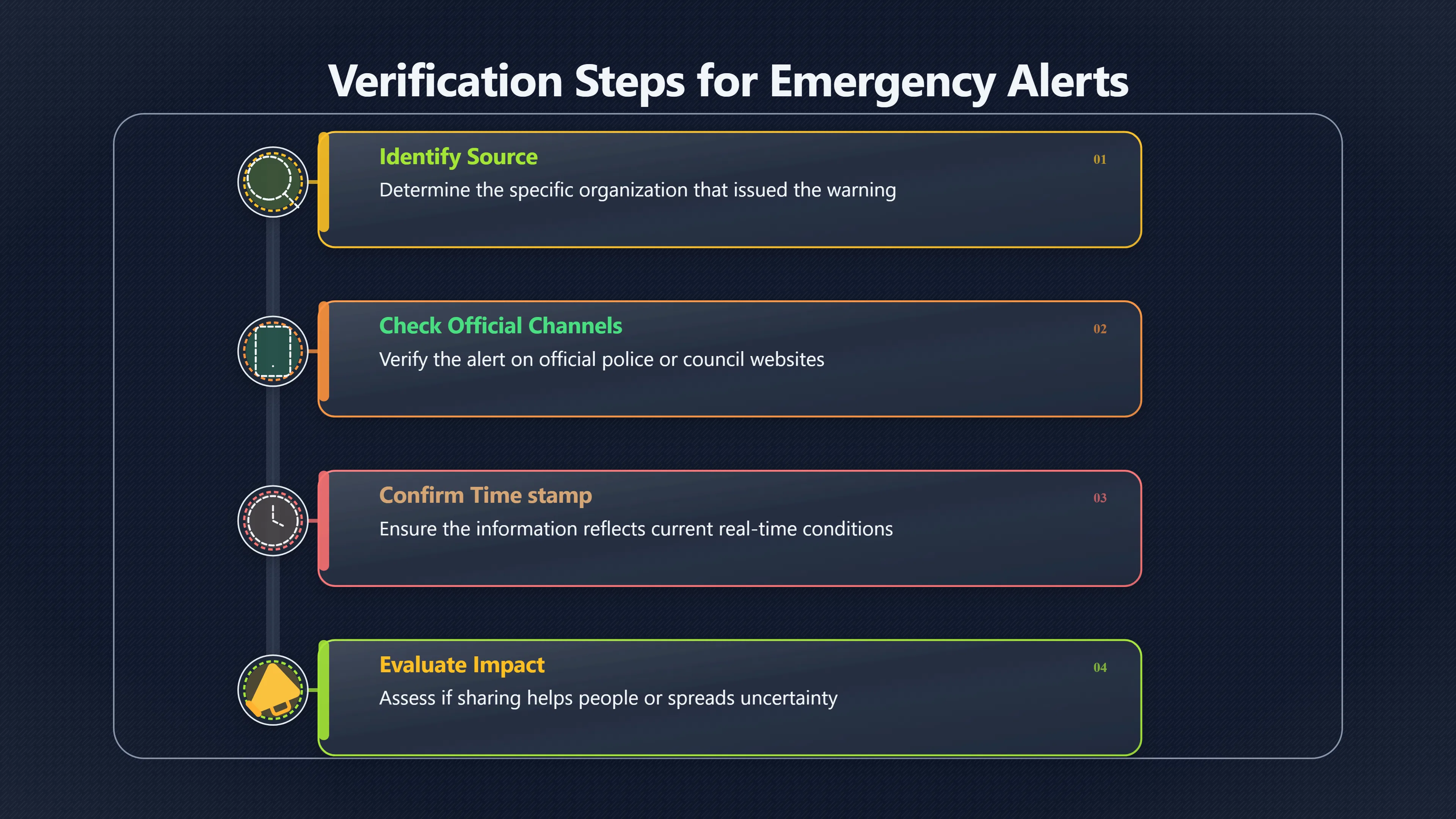
Before forwarding an emergency-style local warning, ask four questions:
- Who originally issued this? Can the source be identified clearly?
- Is it visible on an official channel right now? Check directly rather than relying on a screenshot.
- Is the information current? Look for timestamps and updates.
- Would sharing this help people or merely spread uncertainty?
If the answer to any of these questions is unclear, it is usually better not to share the message until verification is possible.
Police and public-safety organisations increasingly encourage the public to think before sharing unverified claims, particularly during incidents where fear and uncertainty are already high. Official guidance emphasises that rumours and false information can spread rapidly online and that checking trusted sources before reposting is an important part of responsible digital behaviour. Police.uk+2Metropolitan Police
Why Verification Matters More in the AI Era
Artificial intelligence makes it easier to generate convincing graphics, documents and screenshots that resemble official communications. A fabricated warning no longer requires advanced design skills; it can be produced quickly and distributed through local networks before authorities become aware of it.
For that reason, critical thinking increasingly depends on source verification rather than visual judgement alone. The key question is not whether a warning looks official but whether the organisation named in the warning is actually publishing it.
In emergencies, speed matters. Yet accuracy matters too. A brief pause to verify a warning through current official channels can prevent rumours from spreading, reduce confusion during crises, and help ensure that genuine public-safety messages remain trusted when people need them most.

eBay marketplace picks
Marketplace Samples
Example marketplace items related to this page. Use the search link to explore similar finds on eBay.


Endnotes
1.
Source: pmc.ncbi.nlm.nih.gov
Link:https://pmc.ncbi.nlm.nih.gov/articles/PMC12313155/
Source snippet
The Impact of Misinformation on Social Media in the Context of...by S Hilberts · 2025 · Cited by 26 — Misinformation on social media...
2.
Source: everycrsreport.com
Link:https://www.everycrsreport.com/reports/R41987.html
Source snippet
Social Media for Emergencies and DisastersSep 6, 2011 — Social media is used to alert emergency managers and officials to certain situati...
4.
Source: ncdps.gov
Title: guide highlighting trusted information sources
Link:https://www.ncdps.gov/news/press-releases/2024/10/04/guide-highlighting-trusted-information-sources
Source snippet
State Emergency Response Team Publishing Guide...4 Oct 2024 — North Carolina Emergency Management officials are cautioning the public ab...
5.
Source: kemecon.com
Link:https://www.kemecon.com/blog/when-social-media-lies-managing-misinformation-during-an-emergency
Source snippet
When Social Media Lies: Managing Misinformation During...14 Nov 2025 — Evacuation Confusion: During wildfires or storms, fake map...
6.
Source: arxiv.org
Title: arXiv Behavioral response to mobile phone evacuation alerts
Link:https://arxiv.org/abs/2503.21497
Source snippet
Behavioral response to mobile phone evacuation alertsMarch 27, 2025...
Published: March 27, 2025
7.
Source: time.com
Link:https://time.com/7205996/evacuation-alert-error-phones-los-angeles-county-fires/
Source snippet
Cependant, une alerte d'évacuation erronée a été envoyée à tout le comté jeudi soir, créant une panique inutile et des embouteillages, et...
8.
Source: reuters.com
Title: Fictional emergency alert video falsely shared as real nuclear warning
Link:https://www.reuters.com/fact-check/fictional-emergency-alert-video-falsely-shared-real-nuclear-warning-2024-02-21/
Source snippet
states in mid-February. The U.S. agency responsible for the national emergency alert system has not made any such announcements. The vide...
9.
Source: police.uk
Link:https://www.police.uk/advice/advice-and-information/online-safety/online-safety/what-is-sharing-false-information/
Source snippet
Sharing false informationFalse information can sometimes be called 'fake news', 'misinformation' or 'disinformation'. The thing that make...
10.
Source: met.police.uk
Link:https://www.met.police.uk/advice/advice-and-information/online-safety/online-safety/what-is-sharing-false-information/
11.
Source: liverpoolcityregion-ca.gov.uk
Link:https://www.liverpoolcityregion-ca.gov.uk/think-before-you-share
Source snippet
Online rumours are easily spread: Think before you shareIf in doubt, don't share. You could be helping to pass along rumours and misinfor...
12.
Source: dhs.gov
Link:https://www.dhs.gov/sites/default/files/publications/SMWG_Countering-False-Info-Social-Media-Disasters-Emergencies_Mar2018-508.pdf
Source snippet
Department of Homeland SecurityCountering False Information on Social Media in Disasters...Rumors, misinformation and false information...
13.
Source: nationalacademies.org
Link:https://www.nationalacademies.org/read/15853/chapter/2
Source snippet
National AcademiesPublic Response to Alerts and Warnings Using Social MediaSocial media have proven useful in a crisis both to officials...
14.
Source: theguardian.com
Link:https://www.theguardian.com/media/2026/jun/08/social-media-groups-fuel-misinfomation-uk-[news-deserts
Source snippet
Topics such as immigration and Islamophobia are the most frequent subjects of false claims. The spread intensifies around elections, with...
15.
Source: isdglobal.org
Title: hurricane helene brews up storm of online falsehoods and threats
Link:https://www.isdglobal.org/digital-dispatch/hurricane-helene-brews-up-storm-of-online-falsehoods-and-threats/
Source snippet
Institute for Strategic DialogueHurricane Helene brews up storm of online falsehoods and...8 Oct 2024 — Faced with an onslaught of false...
16.
Source: nbcbayarea.com
Link:https://www.nbcbayarea.com/california-3/emergency-evecuation-alerts-error-los-angeles/3757527/
Source snippet
NBC Bay AreaErroneous Los Angeles evacuation alerts: What to know10 Jan 2025 — Millions in Los Angeles County mistakenly received emergen...
17.
Source: theguardian.com
Link:https://www.theguardian.com/media/2026/jun/09/uk-regulator-ofcom-social-media-firms-adopt-measures-stop-viral-illegal-content
Source snippet
UK regulator orders social media firms to adopt measures...5 days ago — Ofcom move follows concerns about misinformation and online clai...
18.
Source: fema.gov
Title: social media
Link:https://www.fema.gov/about/news-multimedia/social-media
Source snippet
29 Apr 2026 — We use social media to engage the public around the FEMA mission of helping people before, during and after disasters...
19.
Source: pmc.ncbi.nlm.nih.gov
Link:https://pmc.ncbi.nlm.nih.gov/articles/PMC9195488/
Source snippet
emergency alert included informational processing, informational sharing, authentication, and emotional reactions.... Federal Emergency...
Additional References
20.
Source: preparecenter.org
Link:https://preparecenter.org/topic/social-media-disasters/
Source snippet
Social Media in DisastersCrisis Phase: Provide accurate and timely information, address rumors or misinformation quickly, set clear commu...
21.
Source: smf.co.uk
Link:https://www.smf.co.uk/publications/social-media-local-misinformation/
Source snippet
The hidden threat of unchecked local misinformation6 days ago — SMF quantifies the scale and nature of 'fake news' in local online spaces...
22.
Source: sfchronicle.com
Link:https://www.sfchronicle.com/california/article/technical-glitch-triggers-mass-evacuation-warning-20025869.php
Source snippet
The message, urging an evacuation warning, was intended for areas affected by the Kenneth Fire near Calabasas and West Hills. Instead, it...
23.
Source: preventionweb.net
Link:https://www.preventionweb.net/news/meta-x-youtube-threaten-public-safety-enabling-and-profiting-false-claims-during-catastrophic
Source snippet
Social media threaten public safety by enabling disaster...22 Jul 2025 — As Texas reels from fatal floods, CCDH reveals how conspiracies...
24.
Source: publications.parliament.uk
Link:https://publications.parliament.uk/pa/cm5901/cmselect/cmsctech/441/report.html
Source snippet
media, misinformation and harmful algorithms“Misinformation” can be defined as verifiably false information that is shared without an int...
25.
Source: floods.org
Title: fema chief decries rumors disinformation about hurricane recovery as worst ever
Link:https://www.floods.org/news-views/fema-news/fema-chief-decries-rumors-disinformation-about-hurricane-recovery-as-worst-ever/
Source snippet
FEMA Chief Decries Rumors, Disinformation About...9 Oct 2024 — The rumors and inaccurate information about FEMA's response and recovery...
26.
Source: facebook.com
Link:https://www.facebook.com/tbsnews.net/posts/police-have-urged-people-to-remain-alert-about-rumours-on-the-coronavirus-pandem/2862878423760088/
Source snippet
Yusuf Hassan. 6y · Public · There is a lot of misinformation; fake news, rumours and lies about the coronavirus in the social media.Read...
27.
Source: youtube.com
Title: How Can You Avoid Misinformation During Hurricane Response?
Link:https://www.youtube.com/watch?v=axKMQreH2I4
Source snippet
Misinformation during disasters emergencies social media How can we stop misinformation during disasters? | UNDRR United Nations Office f...
28.
Source: instagram.com
Link:https://www.instagram.com/p/DVx2riSmkYd/
Source snippet
Fake news and misinformation. Sharing unverified stories that cause public fear or confusion can lead to serious legal consequences. 7.Re...
29.
Source: facebook.com
Title: Don’t let misinformation spread faster than the emergency!
Link:https://www.facebook.com/YavapaiOEM/posts/dont-let-misinformation-spread-faster-than-the-emergency-being-media-literate-is/1210160007823161/
Source snippet
Learn how to spot reliable sources—like your local Emergency Management Agency—and stay alert to rumors or false information. Our safety...
Topic Tree