Within Name Claim
Why the first fact check search fails
Search tools may miss a fact check until the claim is rephrased with clearer names, dates, and technical terms.
On this page
- Compare meme wording with plain language claims
- Add names, dates, terms, and source details
- Use failed searches to refine the claim
Page outline Jump by section
Introduction
A failed fact-check search does not necessarily mean a claim has never been checked. Often, it means the search query does not match the way the claim was indexed, described, or stored. Fact-check databases, search engines, and claim-matching systems work by connecting user queries to previously reviewed claims. Small changes in wording can therefore determine whether a relevant fact check appears immediately or remains hidden.
 This matters in the age of social media and AI because viral claims are frequently packaged as memes, screenshots, slogans, or paraphrases rather than clear factual statements. A reader who searches the meme’s exact wording may find nothing, while a reader who rewrites the same claim using names, dates, places, and specific terms may uncover multiple existing fact checks. Understanding this search problem is an important part of claim naming before fact-checking.
Why the first fact-check search fails
Fact-check databases are built around claims, not necessarily around every version of a claim that circulates online. Many fact-check systems rely on structured descriptions of the claim being checked, often using the ClaimReview standard that records the claim, the review, and the verdict in a machine-readable format. Search tools then try to match user queries against those descriptions.[Google for Developers]developers.google.comGoogle for DevelopersFact Check (ClaimReview) Markup for SearchClaimReview structured data can enable a summarized version of your fact c…
A viral post, however, may not use the same language as the fact check.
Consider the difference between these searches:
- “They don’t want you to know this”
- “Government report suppressed evidence of vaccine side effects”
The first is emotionally framed and vague. The second contains a specific claim that a fact-check database can more easily match against indexed records.
Researchers studying misinformation retrieval describe this as a claim-matching problem: different texts can express the same underlying assertion while sharing few identical words. Fact-checking systems and researchers have devoted significant effort to improving claim matching because simple keyword overlap often misses relevant results.[arXiv+2arXiv]arxiv.orgarXiv Claim Matching Beyond English to Scale Global Fact-CheckingClaim Matching Beyond English to Scale Global Fact-CheckingJune 2, 2021…
Compare meme wording with plain-language claims
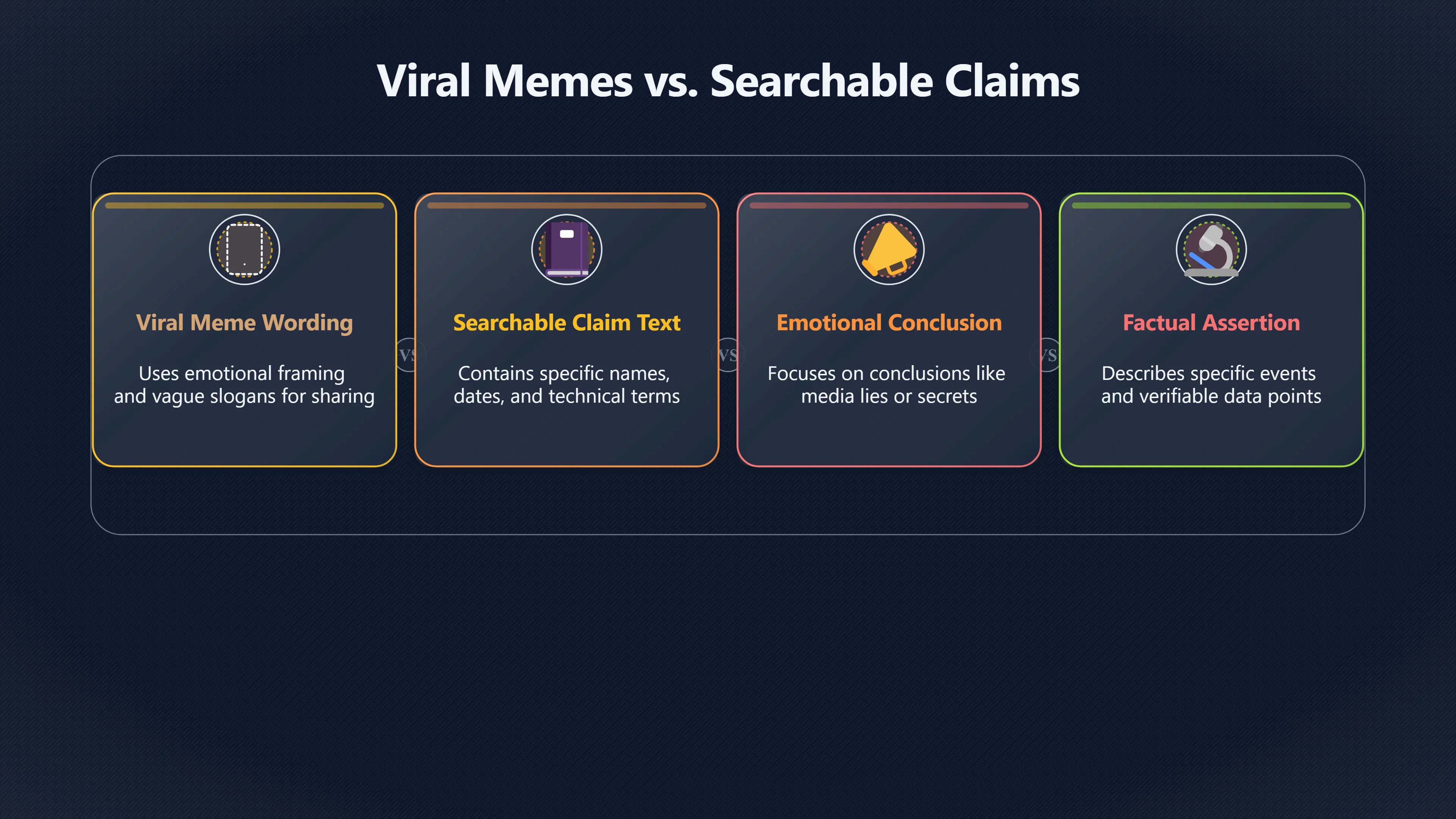
Many viral posts are optimised for sharing rather than for clarity. They may contain jokes, accusations, sarcasm, or dramatic captions. Those features attract attention but often reduce searchability.
A meme might say:
“The media lied again.”
That phrase is not a fact claim. It is a conclusion. A fact-check database cannot easily determine what specific statement is being challenged.
A more searchable version might be:
“News outlets falsely reported that a particular politician was arrested on 12 March 2026.”
The rewritten version contains identifiable elements that can be matched to existing fact checks.
This is why professional fact-checkers often rewrite claims before searching for evidence. Research on query rewriting for misinformation discovery found that reformulating claims can substantially improve retrieval of relevant information because different sources describe the same allegation using different vocabulary.[ACL Anthology]aclanthology.org2023.ijcnlp main.26ACL AnthologyQuery Rewriting for Effective Misinformation Discoveryby A Kazemi · 2023 · Cited by 5 — We propose a novel system to help fa…
The practical lesson is that a viral slogan is often a poor search query. The underlying factual assertion is usually a much better one.
Add names, dates, terms, and source details
When an initial search fails, adding concrete identifiers often produces better results.
Useful additions include:
- Names: people, organisations, agencies, companies, or public figures.
- Dates: the alleged date of an event, publication, speech, or document.
- Locations: countries, cities, institutions, or venues.
- Technical terms: the specific disease, technology, policy, or legal term involved.
- Source details: the publication, report, study, or video being referenced.
For example:
- Weak query: “scientists admit it”
- Better query: “scientists admit climate model error study 2025”
Or:
- Weak query: “secret government document”
- Better query: “Department of Health report 2024 funding allocation document”
Fact-check search tools are designed to search claims, topics, people, and associated evidence. Google’s Fact Check Explorer, for example, allows searches by keywords, phrases, topics, and names connected to a claim.[blog.google+2TCEA TechNotes Blog]blog.googleWhen you search for a topic, you can easily find fact checks4 ways to use Search to check facts, images and sources…2 Apr 2024 — Fact Check Explorer helps journalists and fact-checkers dig deepe…
Adding these identifiers increases the chance that your query overlaps with the wording used by fact-checkers when they indexed the claim.
What claim-matching research shows
The challenge is not merely a user mistake. It is a recognised technical problem.
Researchers describe a recurring issue: many social media posts express an already-debunked claim using different wording. One goal of modern fact-checking systems is therefore to identify claims that are semantically similar even when their wording differs. Studies on claim matching, multilingual fact-check retrieval, and claim clustering all focus on linking differently phrased statements that refer to the same underlying assertion.[arXiv+2arXiv]arxiv.orgarXiv Claim Matching Beyond English to Scale Global Fact-CheckingClaim Matching Beyond English to Scale Global Fact-CheckingJune 2, 2021…
This research highlights an important reality for ordinary readers:
- The same claim may appear in dozens of different forms.
- Fact-check databases may index only one or a few versions.
- Search success depends partly on how closely a query resembles those indexed forms.
In other words, search failure can be a wording problem rather than an evidence problem.
Use failed searches to refine the claim
A failed search is often useful information. Instead of concluding that no fact check exists, treat the failure as feedback.
A practical refinement process is:
- Search the wording exactly as seen.
- Remove emotional language and slogans.
- Rewrite the statement as a plain factual claim.
- Add names, dates, locations, or organisations.
- Replace vague references with technical or official terms.
- Search again using multiple versions.
For example:
- First search: “they’re hiding the truth”
- Second search: “government concealed study”
- Third search: “Health Ministry concealed influenza study 2025”
Each step narrows the claim and increases the likelihood of matching a previously reviewed assertion.
Fact-check tools themselves are built around searchable claim records rather than around every meme variation circulating online. The existence of structured claim databases and claim-search APIs reflects the importance of matching the user’s wording to the stored claim description.[Google for Developers+2Data Commons]developers.google.comGoogle for DevelopersFact Check Tools API25 May 2023 — The Google FactCheck Claim Search API allows users to query fact check results sim…
The key takeaway
When a fact-check search produces no useful results, the most common mistake is treating the viral wording as the claim itself. Memes, captions, and social posts are often poor search queries because they prioritise persuasion, humour, or outrage over precise description.
A clearer approach is to translate the post into a simple factual statement and then enrich it with names, dates, locations, and technical terms. The evidence from fact-check databases, ClaimReview systems, and claim-matching research points in the same direction: successful fact-check searching depends heavily on how the claim is phrased. A different wording may not change the facts, but it can completely change what the search engine finds.[Google for Developers+2arXiv]developers.google.comGoogle for DevelopersFact Check (ClaimReview) Markup for SearchClaimReview structured data can enable a summarized version of your fact c…
Amazon book picks
Further Reading
Books and field guides related to Why the first fact-check search fails. Use these as the next step if you want deeper reading beyond the article.
Thinking, Fast and Slow
Provides the cognitive background for why initial searches and judgments fail.
Factfulness
Encourages precise interpretation of claims rather than reacting to framing.
The Skeptics' Guide to the Universe
Explains how wording, bias, and reasoning errors affect truth-seeking.
eBay marketplace picks
Marketplace Samples
Example marketplace items related to this page. Use the search link to explore similar finds on eBay.
![Listing image for NCT 127 [FACT CHECK] 5th Album CHANDELIER Ver/CD+Photo Book+Photo Card+Poster](/assets/images/marketplace-covers/0ec43911bad3ef719bae.jpg)
Endnotes
1.
Source: developers.google.com
Link:https://developers.google.com/search/docs/appearance/structured-data/factcheck
Source snippet
Google for DevelopersFact Check (ClaimReview) Markup for SearchClaimReview structured data can enable a summarized version of your fact c...
2.
Source: developers.google.com
Link:https://developers.google.com/fact-check/tools/api
Source snippet
Google for DevelopersFact Check Tools API25 May 2023 — The Google FactCheck Claim Search API allows users to query fact check results sim...
Published: May 2023
3.
Source: arxiv.org
Title: arXiv Claim Matching Beyond English to Scale Global Fact-Checking
Link:https://arxiv.org/abs/2106.00853
Source snippet
Claim Matching Beyond English to Scale Global Fact-CheckingJune 2, 2021...
Published: June 2, 2021
4.
Source: arxiv.org
Title: arXiv FACT-GPT: Fact-Checking Augmentation via Claim Matching with LLMs
Link:https://arxiv.org/abs/2402.05904
5.
Source: blog.google
Title: When you search for a topic, you can easily find fact checks
Link:https://blog.google/products-and-platforms/products/search/google-search-fact-checking-resources/
Source snippet
4 ways to use Search to check facts, images and sources...2 Apr 2024 — Fact Check Explorer helps journalists and fact-checkers dig deepe...
6.
Source: blog.tcea.org
Title: verifying information with google fact check explorer
Link:https://blog.tcea.org/verifying-information-with-google-fact-check-explorer/
Source snippet
TCEA TechNotes BlogVerifying Information with Google Fact Check Explorer2 Apr 2026 — Google Fact Check Explorer is a tool that allows use...
7.
Source: arxiv.org
Link:https://arxiv.org/html/2503.22280v1
Source snippet
A Massively Multilingual Dataset of Fact-Checked Claim...28 Mar 2025 — We introduce MultiClaimNet, a collection of three multilingual cl...
8.
Source: toolbox.google.com
Link:https://toolbox.google.com/factcheck/explorer
Source snippet
Check ToolsFact Check Tools. Fact Check Tools. Fact Check Tools · Sign in. Fact Check Tools. Search. Clear search. Close search.Read more...
9.
Source: toolbox.google.com
Link:https://toolbox.google.com/factcheck
Source snippet
Check Tools RecentsExplorer · Markup Tool · APIs · FAQ... Search fact checks about a topic or person Search fact checks. image_search. s...
10.
Source: google.com
Link:https://www.google.com/
Source snippet
Search the world's information, including webpages, images, videos and more. Google has many special features to help you find exac...
11.
Source: toolbox.google.com
Link:https://toolbox.google.com/factcheck/explorer?authuser=0
Source snippet
Check Tools RecentsFact Check Tools. Fact Check Tools. Fact Check Tools. Fact Check Tools. Sign in · Explorer · Markup Tool.Read more...
12.
Source: toolbox.google.com
Link:https://toolbox.google.com/factcheck/about
Source snippet
Fact Check ToolsThis tool allows you to easily browse and search for fact checks. For example, you can search for a politician's statemen...
13.
Source: toolbox.google.com
Link:https://toolbox.google.com/factcheck/markuptool
Source snippet
Check Markup ToolA place for you to add and view your ClaimReview markup, allowing easy access to Google, Bing, Facebook, researchers and...
14.
Source: toolbox.google.com
Link:https://toolbox.google.com/factcheck/apis
Source snippet
Check Tools APIsThe Google FactCheck Claim Search API. Typical use cases. Users can use this API to query the same set of Fact Check resu...
15.
Source: blog.google
Title: new features coming to fact check explorer
Link:https://blog.google/products-and-platforms/products/news/new-features-coming-to-fact-check-explorer/
Source snippet
Fact Check Explorer is a Google tool powered by claim review mark up (which helps Google detect and display a fact check)...Read more...
16.
Source: blog.google
Title: google search new fact checking features
Link:https://blog.google/products-and-platforms/products/search/google-search-new-fact-checking-features/
Source snippet
3 new ways to check images and sources onlineOct 25, 2023 — Powered by claim review mark up (which helps Google detect and display a fact...
17.
Source: aclanthology.org
Title: 2023.ijcnlp main.26
Link:https://aclanthology.org/2023.ijcnlp-main.26.pdf
Source snippet
ACL AnthologyQuery Rewriting for Effective Misinformation Discoveryby A Kazemi · 2023 · Cited by 5 — We propose a novel system to help fa...
18.
Source: datacommons.org
Link:https://datacommons.org/factcheck/download
Source snippet
Fact Checks Download -Fact Check Markup Tool Data Feed. This is a data feed of ClaimReview markups created via the Google Fact Check Mark...
Additional References
19.
Source: github.com
Link:https://github.com/GONZOsint/factcheckexplorer
Source snippet
FactCheckExplorer Python libraryThe FactCheckExplorer library provides an easy-to-use Python interface for querying and fetching fact-che...
20.
Source: linkedin.com
Link:https://www.linkedin.com/top-content/writing/editing-and-proofreading-skills/fact-checking-procedures/
Source snippet
Fact-Checking ProceduresFact-checking procedures are systematic methods used to verify the accuracy of information, especially in context...
21.
Source: gbim.com
Link:https://www.gbim.com/blog/guide-to-fact-check-claimreview-markup-for-seo/
Source snippet
Guide to Fact Check ClaimReview Markup for SEOUse ClaimReview markup to improve SEO. Follow this guide to implement fact-checking strateg...
22.
Source: classwork.com
Link:https://classwork.com/try-fact-check-explorer/
Source snippet
Try the Fact Check ExplorerFact Check Explorer is a free tool from Google that anyone can use to explore the veracity of claims made on t...
23.
Source: claimreviewproject.com
Link:https://www.claimreviewproject.com/the-facts-about-claimreview
Source snippet
The Facts About ClaimReviewThe easiest way to make ClaimReview is to use the Fact Check Markup Tool, a form that instantly alerts search...
24.
Source: factcheckinsights.org
Link:https://www.factcheckinsights.org/
Source snippet
Home — Fact-Check InsightsOur comprehensive global database contains structured fact-checking data for tens of thousands of claims from p...
25.
Source: en.hive-mind.community
Link:https://en.hive-mind.community/blog/2%2Cspotlight-googles-fact-check-explorer-amp-markup-tool
Source snippet
hive-mind.communitySpotlight: Google's Fact Check Explorer & Markup ToolThis tool allows you to easily browse and search for fact checks...
26.
Source: idx.inc
Title: how googles fact check tools and serp features work
Link:https://www.idx.inc/newsroom/how-googles-fact-check-tools-and-serp-features-work
Source snippet
How Google's Fact Check Tools and SERP Features Work4 Apr 2023 — ClaimReview structured data, when implemented correctly, can enable a su...
27.
Source: fullfact.org
Title: the web just got a little harder to trust
Link:https://fullfact.org/technology/the-web-just-got-a-little-harder-to-trust/
Source snippet
26 Jun 2025 — Google Search relies on machine-readable ClaimReview markup on websites to enhance search results for fact-check articles w...
28.
Source: reddit.com
Link:https://www.reddit.com/r/skeptic/comments/19eipp6/how_to_use_googles_fact_check_explorer_to_verify/
Source snippet
FYI - When fact-checking using Google, include -AI at the...Read more...
Topic Tree