Within Deepfakes
Why AI Detectors Are Not Verdicts
Detector results can help triage suspicious media, but new generators, compression and unfamiliar formats can break confidence.
On this page
- What detector scores usually measure
- Why real world clips lower model performance
- How to combine tools with provenance and corroboration
Page outline Jump by section
Introduction
Deepfake detector scores can be useful, but they are not verdicts. A detector may assign a high probability that a video, image or audio clip was generated or manipulated by AI, yet that score reflects how the model interprets patterns it has learned from previous examples. When the media differs from those examples—because of a new generation technique, heavy compression, unusual recording conditions or a different language—the score can become much less reliable.
 This limitation matters in the broader task of critical thinking about social media and AI. Detector outputs are best treated as triage signals that help prioritise investigation, not as final proof that content is genuine or fake. Research repeatedly shows that systems performing extremely well on laboratory benchmarks can suffer substantial declines when confronted with real-world media.[arXiv+2arXiv]arxiv.orgarXiv Why Do Facial Deepfake Detectors Fail?Why Do Facial Deepfake Detectors Fail?February 25, 2023…
What Detector Scores Usually Measure
Most deepfake detectors are classification systems. They examine visual, audio or audiovisual patterns and estimate how closely a piece of media resembles examples of real and synthetic content encountered during training.
A detector score often represents one of three things:
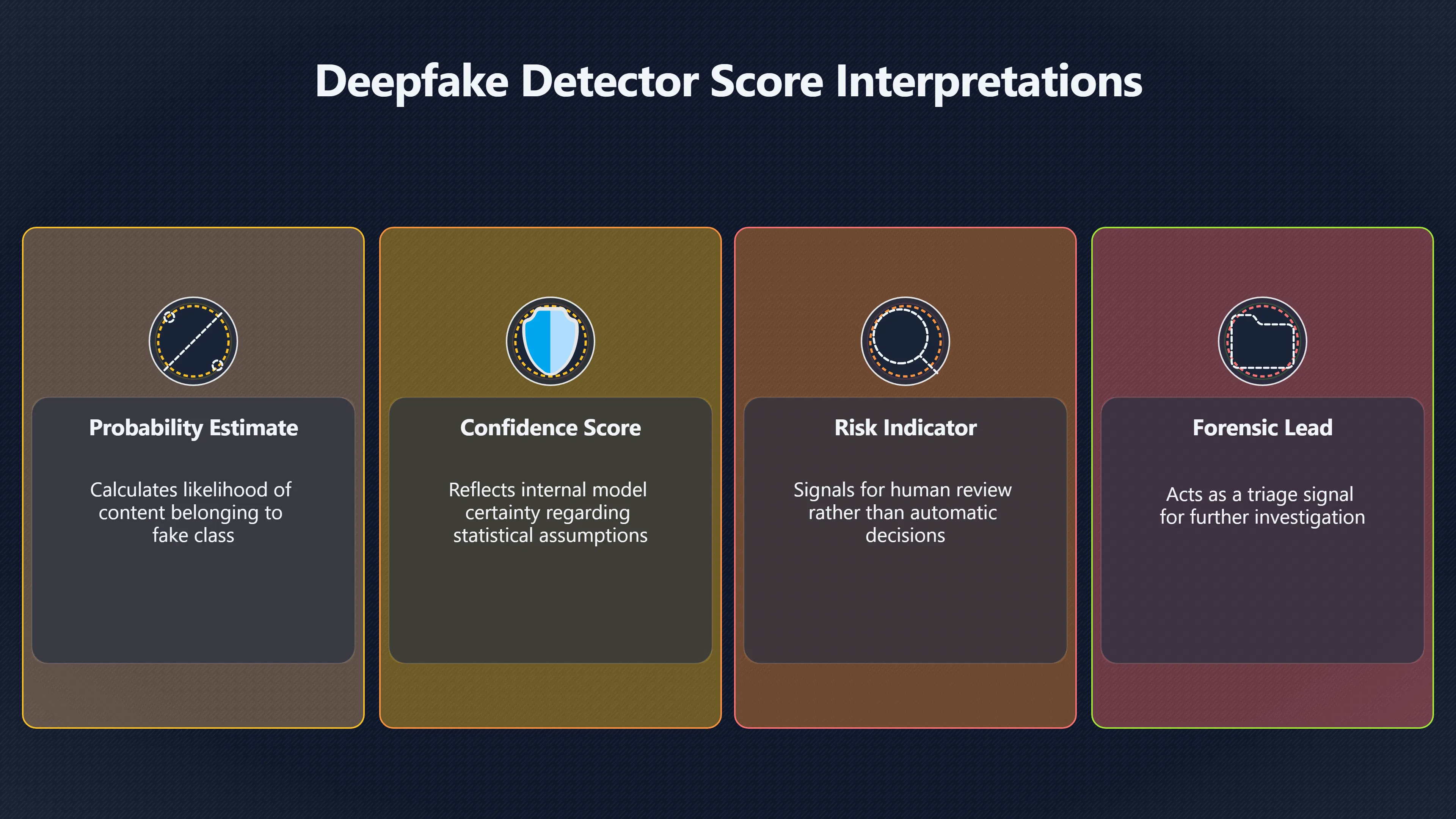
- A probability estimate that the content belongs to the “fake” class.
- A confidence score reflecting the model’s certainty.
- A risk indicator designed for human review rather than automatic decisions.
These scores can be misunderstood. A result of 95% does not necessarily mean there is a 95% chance the clip is fake. It often means the model is highly confident according to its internal statistical assumptions. The distinction matters because confidence and correctness are not the same thing. False positives and false negatives remain possible even when a score appears decisive.[Scam AI]scam.aiDeepfake detection accuracy: what the benchmarks…22 May 2026 — An accuracy of 95.3% means the model correctly classifies 953 out of ev…
Another complication is that different detectors may evaluate the same clip very differently. Researchers and journalists using multi-detector systems have found cases where some algorithms produce extremely high deepfake likelihoods while others assess the same media as likely authentic.[The Guardian]theguardian.comThese tools allow users to upload suspicious media to assess the likelihood it was AI-generated, though results can vary greatly. For ins…
For that reason, a detector score should be read more like a forensic lead than a courtroom judgment.
Why Benchmark Accuracy Can Be Misleading
Many published detection systems report impressive benchmark results. However, benchmark success does not automatically translate into operational reliability.
The central problem is known as generalisation. A detector trained on one set of synthetic media may learn artefacts specific to those generators rather than learning a deeper understanding of authenticity. When new generation systems appear, the detector’s assumptions can break down. Researchers studying facial deepfake detection have identified unseen generators as a major source of detector failure.[arXiv]arxiv.orgarXiv Why Do Facial Deepfake Detectors Fail?Why Do Facial Deepfake Detectors Fail?February 25, 2023…
The history of deepfake detection provides a cautionary example. In the widely discussed Deepfake Detection Challenge, even the winning model achieved only about 65% accuracy on the challenge’s holdout set despite much higher scores often reported on narrower datasets.[Wikipedia]WikipediaOpen source on wikipedia.org.
More recent research describes a “generalisation illusion”: detectors continue to post strong benchmark numbers while performance declines on media encountered outside laboratory conditions.[Help Net Security]helpnetsecurity.comHelp Net Security Deepfake detection is losing ground to generative modelsReal-world detection performance quietly declines. Where attacks get caught. Documented deepfake fraud cases…Read more…
The practical lesson is that benchmark accuracy answers a narrower question than many users assume. It measures performance on a particular test set, not on every future clip circulating online.
Why Real-World Clips Lower Model Performance
Compression and Platform Processing
Social media platforms routinely compress uploaded media. Resolution is reduced, visual details are smoothed and audio quality changes.
Many detection systems rely on tiny artefacts introduced during generation. Compression can erase exactly the clues those systems are looking for. Researchers have repeatedly documented drops in detection performance when videos undergo realistic compression and post-processing.[ResearchGate+2arXiv]researchgate.netDetection of Compressed DeepFake Video Drawbacks and…Jan 7, 2026 — To solve this robustness issue, this paper proposes a D…
This creates a paradox: the content that needs verification most urgently—viral clips repeatedly copied across platforms—is often the content least suited to automated detection.

New Generators and Unseen Techniques
Deepfake detection is an arms race. New image, video and voice models emerge continually.
Several studies have found that detectors trained on one generation method often perform poorly when confronted with synthetic media created by previously unseen systems. Out-of-distribution, or OOD, content remains one of the field’s hardest challenges.[arXiv+2arXiv]arxiv.orgThe first approach is trained to reconstruct the input image.Read moreRobust Out-Of-Distribution strategies for Deepfake DetectionJun 3, 2025 — In this paper, we propose two novel Out-Of-Distribution (O…
A detector may therefore identify yesterday’s deepfakes while missing tomorrow’s.
Language, Region and Device Effects
Real-world media varies enormously. Videos may come from inexpensive smartphones, surveillance cameras, video calls or livestream recordings. Audio may contain background noise, accents, dialects or code-switching.
Detection tools trained primarily on English-language or Western datasets can struggle with media from different linguistic and cultural contexts. Researchers and journalists have highlighted failures involving non-Western content and lower-quality recordings, where both false positives and false negatives become more common.[WIRED]wired.comAI-Fakes Detection Is Failing Voters in the Global SouthSynthetic media detection tools often fall short in accurately identifying AI manipulation for non-Western content, leading to false posi…
These failures are especially important during elections, crises and breaking news events, where authentic recordings may already be noisy or degraded.
Real-World Failure Cases and Lessons
Several recurring failure patterns appear across studies and operational deployments.
Conflicting detector outputs. A media sample may receive dramatically different scores from different systems because each detector focuses on different artefacts and training data. Investigations using multiple detectors have shown that some algorithms can report near-certain fakery while others assign very low probabilities to the same content.[The Guardian]theguardian.comThese tools allow users to upload suspicious media to assess the likelihood it was AI-generated, though results can vary greatly. For ins…
Audio detectors collapsing outside the laboratory. Researchers evaluating speech deepfake systems on more realistic datasets found severe performance degradation compared with benchmark expectations. Some models experienced declines so large that the authors argued the field may have over-optimised for benchmark datasets rather than open-world conditions.[arXiv]arxiv.orgarXiv Does Audio Deepfake Detection Generalize?Does Audio Deepfake Detection Generalize?March 30, 2022…
Commercial systems failing on operational data. Emerging evaluations of commercial tools report preprocessing failures, prediction failures and substantially weaker performance on real-world media than marketing claims might suggest.[ACM Digital Library]dl.acm.orgACM Digital LibraryAnalyzing Commercial Deepfake Detectors on Real-World…by B Moon · 2026 · Cited by 1 — In cases where tools fail to…
Adversarial adaptation. Detection systems can sometimes be evaded through small changes that preserve human perception while reducing detector effectiveness. Research continues to find gaps between robustness in controlled tests and robustness under realistic attack conditions.[arXiv]arxiv.orgDeepfake detectors are DUMB: A benchmark to assess adversarial training robustness under transferability constraintsJanuary 9, 2026…
These examples do not mean detectors are useless. They show why a detector result should be interpreted as one piece of evidence rather than a standalone conclusion.
How to Combine Tools with Provenance and Corroboration
The most reliable credibility assessments combine detector outputs with non-forensic evidence.
A practical workflow is:
- Check provenance first. Where did the media originate? Is there an identifiable source, original upload or recording context?
- Use multiple detectors. Agreement across independent systems can be more informative than a single score, although agreement still does not guarantee correctness.
- Look for corroboration. Can the claimed event be confirmed through independent reporting, witnesses, official records or other recordings?
- Compare versions. Earlier, less-compressed copies may preserve information lost in reposted versions.
- Treat extreme confidence cautiously. Very high detector confidence is not the same as proof.
- Document uncertainty. In many cases the correct conclusion is not “fake” or “real” but “insufficient evidence”.
This approach aligns with the broader principle of critical thinking in the age of AI: credibility comes from converging evidence, not from a single technical score.
The Key Takeaway
Deepfake detectors are valuable screening tools, but they are not truth machines. Their scores depend on training data, assumptions and media quality. New generators, compression, unfamiliar formats, linguistic variation and adversarial adaptation can all reduce reliability. Research across both video and audio domains consistently shows that performance often drops when systems leave controlled benchmarks and encounter the messy conditions of real-world social media.[Help Net Security+3arXiv+3arXiv]arxiv.orgarXiv Why Do Facial Deepfake Detectors Fail?Why Do Facial Deepfake Detectors Fail?February 25, 2023…
For that reason, the strongest credibility check is not a detector score by itself. It is a combination of technical analysis, provenance, corroboration and careful evaluation of the claim the media is being used to support.
Amazon book picks
Further Reading
Books and field guides related to Why AI Detectors Are Not Verdicts. Use these as the next step if you want deeper reading beyond the article.
Weapons of Math Destruction
Shows why model outputs should not be treated as verdicts.
The Skeptics' Guide to the Universe
Reinforces evidence-based evaluation beyond tool scores.
eBay marketplace picks
Marketplace Samples
Example marketplace items related to this page. Use the search link to explore similar finds on eBay.

![Listing image for NCT 127 [FACT CHECK] 5th Album CHANDELIER Ver/CD+Photo Book+Photo Card+Poster](/assets/images/marketplace-covers/0ec43911bad3ef719bae.jpg)

Endnotes
1.
Source: arxiv.org
Title: arXiv Why Do Facial Deepfake Detectors Fail?
Link:https://arxiv.org/abs/2302.13156
Source snippet
Why Do Facial Deepfake Detectors Fail?February 25, 2023...
Published: February 25, 2023
2.
Source: arxiv.org
Link:https://arxiv.org/abs/2411.19537
3.
Source: scam.ai
Link:https://www.scam.ai/en/learn/deepfake-detection-accuracy
Source snippet
Deepfake detection accuracy: what the benchmarks...22 May 2026 — An accuracy of 95.3% means the model correctly classifies 953 out of ev...
Published: May 2026
4.
Source: Wikipedia
Link:https://en.wikipedia.org/wiki/Deepfake
5.
Source: researchgate.net
Link:https://www.researchgate.net/publication/366830930_Detection_of_Compressed_DeepFake_Video_Drawbacks_and_Technical_Developments
Source snippet
Detection of Compressed DeepFake Video Drawbacks and...Jan 7, 2026 — To solve this robustness issue, this paper proposes a D...
6.
Source: arxiv.org
Link:https://arxiv.org/pdf/2303.17247
Source snippet
Impact of Video Processing Operations in Deepfake...by Y Lu · 2023 · Cited by 10 — It is important to remark that FaceForensics++ first...
7.
Source: researchgate.net
Link:https://www.researchgate.net/publication/393985836_Compression-Aware_Hybrid_Framework_for_deep_fake_Detection_in_Low-Quality_Video
Source snippet
Compression-Aware Hybrid Framework for Deep Fake...16 Mar 2026 — Results show that RGB inputs without attention achieve the highest accu...
8.
Source: arxiv.org
Title: The first approach is trained to reconstruct the input image.Read more
Link:https://arxiv.org/html/2506.02857v1
Source snippet
Robust Out-Of-Distribution strategies for Deepfake DetectionJun 3, 2025 — In this paper, we propose two novel Out-Of-Distribution (O...
9.
Source: wired.com
Title: AI-Fakes Detection Is Failing Voters in the Global South
Link:https://www.wired.com/story/generative-ai-detection-gap
Source snippet
Synthetic media detection tools often fall short in accurately identifying AI manipulation for non-Western content, leading to false posi...
10.
Source: arxiv.org
Title: arXiv Does Audio Deepfake Detection Generalize?
Link:https://arxiv.org/abs/2203.16263
Source snippet
Does Audio Deepfake Detection Generalize?March 30, 2022...
Published: March 30, 2022
11.
Source: researchgate.net
Link:https://www.researchgate.net/publication/395848176_Why_Speech_Deepfake_Detectors_Won%27t_Generalize_The_Limits_of_Detection_in_an_Open_World
Source snippet
Deepfake detection techniques. In this survey, we systematically analyze more than 200 papers published up to March 2024. We provide a...
Published: March 2024
12.
Source: dl.acm.org
Link:https://dl.acm.org/doi/10.1145/3803629.3803675
Source snippet
ACM Digital LibraryAnalyzing Commercial Deepfake Detectors on Real-World...by B Moon · 2026 · Cited by 1 — In cases where tools fail to...
13.
Source: arxiv.org
Link:https://arxiv.org/abs/2601.05986
Source snippet
Deepfake detectors are DUMB: A benchmark to assess adversarial training robustness under transferability constraintsJanuary 9, 2026...
Published: January 9, 2026
14.
Source: researchgate.net
Title: 403527896 Deepfake Generation and Detection A Comprehensive Survey
Link:https://www.researchgate.net/publication/403527896_Deepfake_Generation_and_Detection_A_Comprehensive_Survey
Source snippet
Deepfake Generation and Detection: A Comprehensive...Apr 9, 2026 — Unmasking deepfakes: A systematic review of deepfake detection...Rea...
15.
Source: researchgate.net
Link:https://www.researchgate.net/publication/397480285_Performance_Decay_in_Deepfake_Detection_The_Limitations_of_Training_on_Outdated_Data
Source snippet
(PDF) Performance Decay in Deepfake Detection14 Nov 2025 — We show that models trained on this data suffer a recall drop of over 30% when...
16.
Source: researchgate.net
Link:https://www.researchgate.net/publication/395275081_VCF_A_Real-World_Video_Conference_Deepfake_Benchmark_for_Face-Swap_Detection_and_Robustness_Evaluation
Source snippet
resolution shifts, compression artifacts, and diverse generation pipelines.Read more...
17.
Source: arxiv.org
Link:https://arxiv.org/html/2410.07436v1
Source snippet
Toward Robust Real-World Audio Deepfake DetectionIn this paper, we introduce novel explainability methods for state-of-the-art transforme...
18.
Source: helpnetsecurity.com
Title: Help Net Security Deepfake detection is losing ground to generative models
Link:https://www.helpnetsecurity.com/2026/05/15/research-deepfake-detection-limitations/
Source snippet
Real-world detection performance quietly declines. Where attacks get caught. Documented deepfake fraud cases...Read more...
19.
Source: theguardian.com
Link:https://www.theguardian.com/us-news/article/2024/jun/07/how-to-spot-a-deepfake
Source snippet
These tools allow users to upload suspicious media to assess the likelihood it was AI-generated, though results can vary greatly. For ins...
20.
Source: security.virginia.edu
Link:https://security.virginia.edu/deepfakes
Source snippet
the heck is a deepfake? - UVA Information SecurityA deepfake is an artificial image or video (a series of images) generated by a special...
Additional References
21.
Source: gao.gov
Link:https://www.gao.gov/assets/gao-20-379sp.pdf
Source snippet
20-379SP, Science & Tech Spotlight: DeepfakesA deepfake is a video, photo, or audio recording that seems real but has been manipulate...
22.
Source: huggingface.co
Link:https://huggingface.co/papers?q=deepfake
Source snippet
Daily PapersExisting deepfake detection datasets are often limited, relying on outdated generation methods, low realism, or single-face i...
23.
Source: proofpoint.com
Link:https://www.proofpoint.com/us/threat-reference/deepfake
Source snippet
What Is Deepfake? Meaning, Technology, How it WorksDeepfakes are AI-generated synthetic media (video, audio, etc.) intended to convincing...
24.
Source: github.com
Link:https://github.com/flynn-chen/faceforensics_benchmark
Source snippet
flynn-chen/faceforensics_benchmark: DeepFake Detection...We are offering an automated benchmark for facial manipulation detection on the...
25.
Source: openaccess.thecvf.com
Title: Gajewska Audio Deepfake Detectors vs. Real Fraud The Fall of WACVW 2026 paper
Link:https://openaccess.thecvf.com/content/WACV2026W/SAFE-2026/papers/Gajewska_Audio_Deepfake_Detectors_vs.Real_Fraud-_The_Fall_of_WACVW_2026_paper.pdf
Source snippet
real fraud - the fall of benchmarksby J Gajewska · 2026 — In this study, we investigate the performance and general- ization capacity of...
26.
Source: youtu.be
Link:https://youtu.be/nG2_GhNdTek?si=jmf-OAiFwQwwmB9F
Source snippet
Hany Farid is a Professor at the UC Berkeley School of Information. In addition to teaching at UC Berkeley, Hany is Chief Science Officer...
27.
Source: brside.com
Link:https://www.brside.com/blog/why-deepfake-detection-tools-fail-in-real-world-deployment
Source snippet
Brightside AIWhy Deepfake Detection Tools Fail in Real-World...Oct 17, 2025 — State-of-the-art detection systems dropped 45-50% in perfo...
28.
Source: digitalknowledge.cput.ac.za
Link:https://digitalknowledge.cput.ac.za/bitstream/11189/9706/1/Deepfake_Generation_and_Detection.pdf
Source snippet
Generation and Detection: Case Study and...by Y Patel · 2023 · Cited by 237 — However, even with such prolific research in deepfake dete...
29.
Source: reddit.com
Link:https://www.reddit.com/r/digitalforensics/comments/1t8x5y9/why_is_detecting_aigenerated_images_so_hard_on/
Source snippet
newer generators differ from those on which the detectors were...Read more...
30.
Source: scispace.com
Link:https://scispace.com/pdf/why-do-deepfake-detectors-fail-2yz8g070.pdf
Source snippet
sing pipeline of artifacts and (2) the fact that generators.Read more...
Topic Tree