Within Fake Authority
Why Screenshots Make Rumours Look Official
Screenshots strip claims from their source path, making reposted emails, notices and quote cards feel more official than they are.
On this page
- How screenshots hide source paths
- Why repost chains weaken verification
- Better ways to trace the original claim
Page outline Jump by section
Introduction
Screenshots are powerful because they look like evidence. A cropped image of an email, council notice, social media post or message appears to show something that already exists, and many people treat that appearance as proof. In local online groups, where residents exchange practical information about planning applications, road closures, schools or public safety, a screenshot can travel much faster than the original document it supposedly represents.
 The problem is provenance: the chain showing where a claim came from, who published it, and whether it can still be checked. Screenshots often remove that chain. A reader sees the claim, but not the path that would allow verification. As a result, rumours can acquire the appearance of official confirmation, particularly when the screenshot resembles familiar institutional communication. Researchers studying misinformation have found that screenshots frequently function as a form of visual evidence that helps legitimise claims, even when the underlying information is misleading or lacks context.[Sage Journals]journals.sagepub.comSage JournalsThe legitimation of screenshots as visual evidence in social…by O Inwood · Cited by 13 — This study considers the role of…
How Screenshots Hide Source Paths
A normal web page contains clues about origin. There is a URL, an organisation name, navigation links, publication dates and often related documents. When someone takes a screenshot, many of those clues disappear.
A screenshot of a supposed council email, for example, may show only a logo, a subject line and a few paragraphs of text. The recipient list, sender details, timestamps, web address and surrounding context may be cropped away. The reader is left with a claim detached from the evidence needed to assess it.
This creates what verification specialists often describe as a source problem. The crucial question becomes not “What does this screenshot say?” but “Where did this screenshot come from?” Full Fact’s media-literacy guidance encourages readers to begin with exactly that question: where is the information from, and what information is missing?[Full Fact]fullfact.orgFull Fact Getting started with the Misinformation ToolkitUpdated 28 May… Images and videos can be faked. False news stories often contain…Read more…
In local groups, this matters because many claims concern processes that residents cannot personally inspect. A screenshot may claim that a council has approved a controversial development, that a school has adopted a new policy, or that police have issued a warning. The image appears documentary, but without access to the original source, readers cannot easily determine whether the screenshot is genuine, edited, selectively cropped or entirely fabricated.
Why Screenshots Feel More Official Than Links
A paradox of online communication is that screenshots often appear more trustworthy than direct links.
Links lead to websites that can be examined, searched and compared with other sources. Screenshots freeze information into a static image. Because they resemble records rather than conversations, they can acquire an aura of permanence and authority.
Researchers analysing misinformation videos found that screenshots are frequently presented as visual proof supporting a narrative. Rather than encouraging viewers to visit an original source, the screenshot itself becomes the evidence.[Sage Journals]journals.sagepub.comSage JournalsThe legitimation of screenshots as visual evidence in social…by O Inwood · Cited by 13 — This study considers the role of…
This effect is particularly strong when screenshots imitate institutional formats:
- Email layouts associated with councils, schools or public bodies.
- Screenshots of supposed news articles.
- Quote cards carrying official logos.
- Captured social-media posts attributed to public officials.
- Images of notices, forms or planning documents.
The authority comes less from the content than from the familiar visual style. Readers may recognise the format and unconsciously assume the source is authentic.
Why Repost Chains Weaken Verification
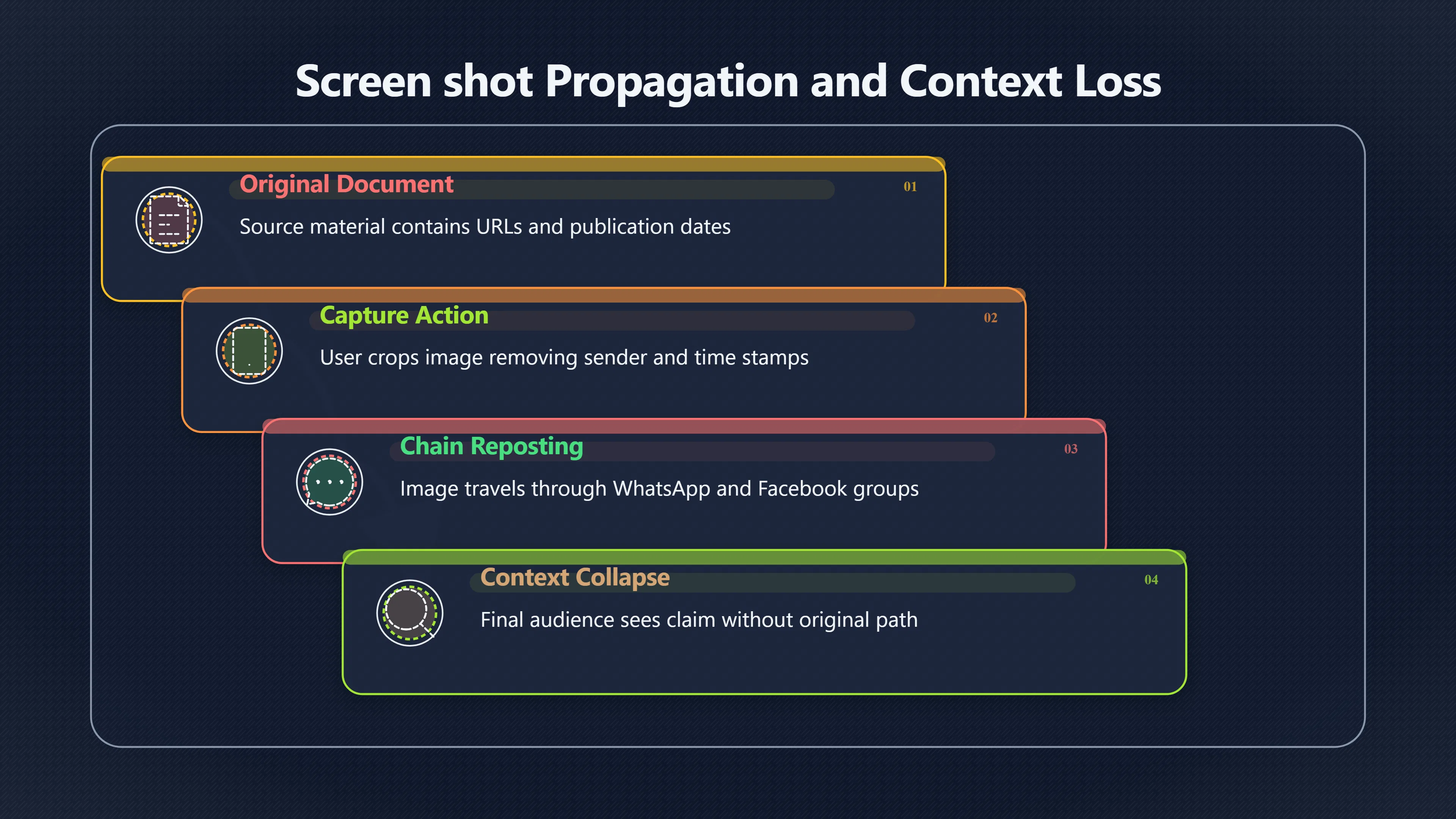
Once a screenshot starts circulating, verification often becomes harder with each repost.
Imagine a resident screenshots a message, posts it to a local Facebook group, another member reposts it to WhatsApp, and a third person shares it to a neighbourhood forum. By the time the image reaches hundreds or thousands of people, the original source may be impossible to identify.
Each step in the chain strips away additional context:
- The original document may no longer be linked.
- Captions and explanations may change.
- Corrections may not travel with the image.
- New audiences encounter the screenshot without knowing its history.
Researchers studying fake social-media screenshots note that users commonly share screenshots without verifying whether the original post ever existed. The widespread use of screenshots therefore creates opportunities for misattribution and fabricated content to spread.[arXiv+2arXiv]arxiv.orgarXiv Web Archives for Verifying Attribution in Twitter ScreenshotsWeb Archives for Verifying Attribution in Twitter ScreenshotsOctober 27, 2025…
This is one reason corrections often struggle to catch up. A council might publish an official clarification on its website, but the clarification travels as a web page while the rumour continues travelling as a highly shareable image.
The Difference Between a Screenshot and a Source
One of the most useful critical-thinking habits is recognising that a screenshot is not a source. It is a claim about a source.
That distinction sounds subtle but changes how evidence is evaluated.
Consider three possibilities:
- A genuine screenshot of a genuine document.
- A genuine screenshot of a real document presented without important context.
- A fabricated screenshot of something that never existed.
All three may look almost identical.
First Draft’s work on information disorder highlights how genuine material can be reframed and redistributed in misleading ways. The content itself may be real, but its presentation creates a false impression.[First Draft]firstdraftnews.orgFirst Draft Understanding Information disorderAt First…
For example, an authentic council email discussing a proposal might be circulated as proof that a decision has already been made. The screenshot is real, yet the interpretation is false. The visual appearance of documentary evidence can therefore conceal both fabrication and contextual distortion.
When Social-Media Screenshots Become False Authority
Screenshots of social-media posts deserve particular caution because they are easy to create and manipulate.
Verification specialists have documented multiple methods for producing convincing fake screenshots, including image editing, fake-post generators and browser-based manipulation of real pages before capture. False screenshots attributed to journalists, public officials and news organisations have repeatedly circulated during major news events.[GIJN]gijn.orgsimple tips for verifying if a tweet screenshot is real or fakeFake tweet screenshots…Read more…
In local contexts, a fabricated screenshot can falsely suggest that:
- A councillor endorsed a controversial position.
- A local journalist reported a story that never appeared.
- A police account issued a warning that was never published.
- A public official made an inflammatory statement.
Because the screenshot appears to bypass intermediaries and show the original post directly, readers may be less likely to seek independent confirmation.
Better Ways to Trace the Original Claim
The most effective response to the provenance trap is to reconstruct the missing chain.
When encountering an official-looking screenshot, several questions are more useful than debating the claim immediately:
Can the original be located?
Search for the quoted text, headline, statement or announcement. If the screenshot is genuine, the original source often exists elsewhere.
Is there an official publication point?
Councils, schools, police forces and local authorities generally publish announcements through websites, verified social-media accounts or formal document repositories. A screenshot without a corresponding original source deserves caution.[Full Fact]fullfact.orgFull Fact Getting started with the Misinformation ToolkitUpdated 28 May… Images and videos can be faked. False news stories often contain…Read more…
What has been cropped out?
Missing dates, sender information, URLs, reply chains and surrounding text can significantly alter interpretation.
Are independent sources reporting the same information?
A major local decision rarely appears only as a screenshot circulating in community groups.
Has the image itself been verified?
Fact-checkers, journalists and researchers increasingly use reverse-image searches, archive searches, source tracing and contextual verification to determine whether screenshots correspond to real content. Recent research has even explored automated methods for verifying the attribution of social-media screenshots through archived records and independent evidence.[arXiv]arxiv.orgarXiv Web Archives for Verifying Attribution in Twitter ScreenshotsWeb Archives for Verifying Attribution in Twitter ScreenshotsOctober 27, 2025…
The Critical-Thinking Lesson
The provenance trap exploits a common shortcut: if something looks like a record, people assume it is evidence. Screenshots are effective because they compress information into a portable visual object while hiding the route by which that information reached the viewer.
In local online discussions, that hidden route is often the most important part of the story. A screenshot can show what appears to be an official statement, but it cannot by itself prove who created it, whether it is complete, whether it has been altered, or whether later corrections exist. Critical thinking begins when attention shifts from the screenshot itself to the missing chain behind it.
The key question is therefore not whether a screenshot looks official. It is whether the original source can still be found, examined and independently verified.[Full Fact]fullfact.orgFull Fact Getting started with the Misinformation ToolkitUpdated 28 May… Images and videos can be faked. False news stories often contain…Read more…

eBay marketplace picks
Marketplace Samples
Example marketplace items related to this page. Use the search link to explore similar finds on eBay.


Endnotes
1.
Source: arxiv.org
Title: arXiv Web Archives for Verifying Attribution in Twitter Screenshots
Link:https://arxiv.org/abs/2510.22939
Source snippet
Web Archives for Verifying Attribution in Twitter ScreenshotsOctober 27, 2025...
Published: October 27, 2025
2.
Source: arxiv.org
Title: arXiv Extracting Information from Twitter Screenshots
Link:https://arxiv.org/abs/2306.08236
3.
Source: arxiv.org
Link:https://arxiv.org/abs/2211.09681
4.
Source: gijn.org
Title: simple tips for verifying if a tweet screenshot is real or fake
Link:https://gijn.org/resource/simple-tips-for-verifying-if-a-tweet-screenshot-is-real-or-fake/
Source snippet
Fake tweet screenshots...Read more...
5.
Source: arxiv.org
Link:https://arxiv.org/abs/2102.07849
Source snippet
Identifying Misinformation from Website Screenshotsby S Abdali · 2021 · Cited by 23 — In this paper, we propose to use a promising, yet n...
6.
Source: journals.sagepub.com
Link:https://journals.sagepub.com/doi/10.1177/14703572241255664
Source snippet
Sage JournalsThe legitimation of screenshots as visual evidence in social...by O Inwood · Cited by 13 — This study considers the role of...
7.
Source: fullfact.org
Title: Full Fact Getting started with the Misinformation Toolkit
Link:https://fullfact.org/toolkit/getting-started-with-the-misinformation-toolkit/
Source snippet
Updated 28 May... Images and videos can be faked. False news stories often contain...Read more...
8.
Source: firstdraftnews.org
Title: First Draft Understanding Information disorder
Link:https://firstdraftnews.org/long-form-article/understanding-information-disorder/
Source snippet
At First...
9.
Source: fullfact.org
Link:https://fullfact.org/
Source snippet
Full FactNot sure what to believe? Full [Fact checks]({{ 'fact-checks/' | relative_url }}) the claims you see online and in the news, helping you spot misinformation and get th...
Additional References
10.
Source: theverge.com
Link:https://www.theverge.com/tech/888303/photo-video-fake-news-verification-nyt-bellingway
Source snippet
While current deepfake detection tools are imperfect, methods such as examining provenance and context remain reliable. Experts warn of r...
11.
Source: dubawa.org
Link:https://dubawa.org/how-to-identify-fake-social-media-screenshots/
Source snippet
How to identify fake social media screenshotsMisinformation and Disinformation have become a social menace in recent... fake social medi...
12.
Source: medium.com
Link:https://medium.com/%40VerifyHQ/how-to-verify-any-screenshot-or-image-online-8d8d0176e4a6
Source snippet
Fake screenshots often use slightly different fonts than the original platform. Look for: Font size inconsistencies...Read more...
13.
Source: medium.com
Title: The Screenshot Fallacy: Why Digital “Receipts” Often Mislead It reshapes meaning
Link:https://medium.com/%40drmozellemartin/the-screenshot-fallacy-why-digital-receipts-often-mislead-5f15b72e66ad
Source snippet
In forensic terms, screenshots suffer from context collapse. A single frame cannot reliably represent a behavioral pattern.Read more...
14.
Source: pbs.org
Title: Students will be able to explain why posts that impersonate people or
Link:https://www.pbs.org/newshour/classroom/lesson-plans/2022/11/lesson-plan-how-to-spot-fake-screenshots-on-social-media
Source snippet
Lesson plan: How to spot fake screenshots on social media17 Nov 2022 — Students will learn four clues that help identify fake social medi...
15.
Source: researchgate.net
Link:https://www.researchgate.net/publication/384716476_The_legitimation_of_screenshots_as_visual_evidence_in_social_media_YouTube_videos_spreading_misinformation_and_disinformation
Source snippet
shots in instances of misinformation and disinformation, highlighting the importance...Read more...
16.
Source: journalistsresource.org
Title: 5 takeaways first draft identifying misinformation course
Link:https://journalistsresource.org/politics-and-government/5-takeaways-first-draft-identifying-misinformation-course/
Source snippet
5 Takeaways from First Draft's identifying misinformation...19 Mar 2018 — A new online course from First Draft introduces cutting-edge t...
17.
Source: reutersinstitute.politics.ox.ac.uk
Title: types sources and claims covid 19 misinformation
Link:https://reutersinstitute.politics.ox.ac.uk/types-sources-and-claims-covid-19-misinformation
Source snippet
ox.ac.ukTypes, sources, and claims of COVID-19 misinformation7 Apr 2020 — In this factsheet we identify some of the main types, sources...
18.
Source: factcheckhub.com
Title: why you should not trust every screenshot
Link:https://factcheckhub.com/why-you-should-not-trust-every-screenshot/
Source snippet
6 Oct 2025 — Tags · Disinformation · Fake Screenshots · information disorder · Manipulated headlines · misinformation · Misinformation an...
19.
Source: researchers-admin.westernsydney.edu.au
Link:https://researchers-admin.westernsydney.edu.au/ws/portalfiles/portal/189854947/The_legitimation_of_screenshots.pdf
Source snippet
It considers their role in YouTube videos that spread.Read more...
Topic Tree