Within Ranking
When Outrage Looks Like Interest
Watching, pausing, commenting or sharing can teach a system that a topic matters, even when your real reaction is rejection.
On this page
- Why attention is easier to measure than motive
- How anger watching can train recommendations
- Better signals to send when content is unwanted
Page outline Jump by section
Introduction
One of the most important weaknesses in social-media ranking systems is that they can often observe attention more easily than intention. A platform can measure whether you watched a video, paused on a post, clicked into a comment thread, or shared a link. What it cannot directly observe is why you did it. If you watched because you were fascinated, horrified, angry, sceptical, or trying to prove someone wrong, the visible behaviour may look similar.
 This creates a critical-thinking problem. A recommendation system may interpret outrage as interest and then respond by showing more of the same content. The result is a feedback loop in which material that people dislike, reject, or argue against can still receive signals that encourage wider distribution. Research on recommendation systems repeatedly highlights this gap between measurable engagement and genuine user preference, while platforms themselves acknowledge that ranking relies heavily on behavioural signals and predictions.[Partnership on AI+2Meta Transparency]partnershiponai.orgPartnership on AIAligning Algorithmic Recommendations With Prosocial GoalsJanuary 21, 2021 — 21 Jan 2021 — Today's recommender systems use many different kinds of user behavior to determine what to show each use…
Why Attention Is Easier to Measure Than Motive
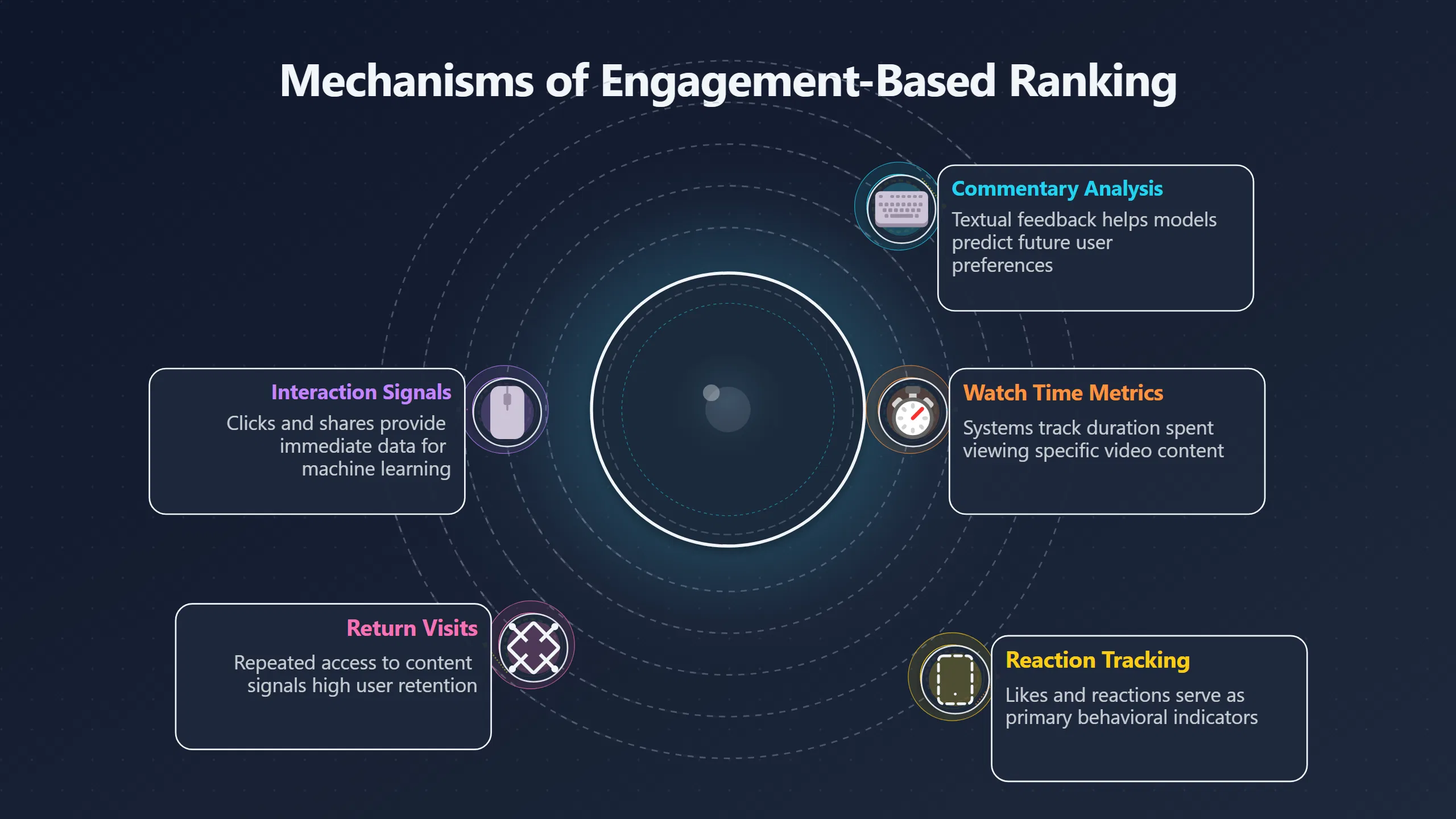
Most recommendation systems rely on observable actions: watch time, clicks, comments, shares, reactions, follows, and other forms of engagement. These actions are abundant, easy to collect, and useful for machine-learning models. What is much harder to measure is whether the user actually valued the experience afterwards.[Partnership on AI+2FAccT Conference]partnershiponai.orgPartnership on AIAligning Algorithmic Recommendations With Prosocial GoalsJanuary 21, 2021 — 21 Jan 2021 — Today's recommender systems use many different kinds of user behavior to determine what to show each use…
This distinction is often described as the difference between revealed preferences and true preferences. Revealed preferences are inferred from behaviour. True preferences reflect what people genuinely want, endorse, or find beneficial. A user may spend five minutes reading a misleading post because it is shocking, not because they approve of it. Yet the system primarily sees five minutes of attention.[OUP Academic]academic.oup.comuser engagement such as clicks, shares, and likesOUP AcademicEngagement, user satisfaction, and the amplification of…by S Milli · 2025 · Cited by 240 — Social media ranking algorithms…
Researchers studying recommendation systems have noted that common signals such as watch time are imperfect measures of interest. People frequently spend time evaluating content they ultimately dislike, reject, or regret consuming. Recent work in video recommendation explicitly identifies “noisy watching” as a source of error because users often need time to decide whether something is worthwhile.[arXiv]arxiv.orgUncovering User Interest from Biased and Noised Watch Time in Video RecommendationAugust 16, 2023…
The challenge is structural rather than accidental. Human motives are private. Behaviour is visible. Ranking systems are therefore built around what can be measured.
How Anger-Watching Can Train Recommendations
Imagine a user encountering a provocative video. They disagree with it strongly but continue watching to understand the argument, gather evidence for a rebuttal, or simply because they are shocked.
Several signals may now be generated:
- Extended watch time.[arxiv.org]arxiv.orgUncovering User Interest from Biased and Noised Watch Time in Video RecommendationAugust 16, 2023…
- A pause while reading comments.
- A comment expressing disagreement.
- A share sent to friends with criticism.
- A return visit to see reactions.
From the system’s perspective, these actions can resemble strong interest. Even when negative sentiment is present, the underlying behaviour still indicates that the content successfully captured attention.[Partnership on AI]partnershiponai.orgPartnership on AIAligning Algorithmic Recommendations With Prosocial GoalsJanuary 21, 2021 — 21 Jan 2021 — Today's recommender systems use many different kinds of user behavior to determine what to show each use…
This is one reason outrage-driven content can perform well online. The content does not need universal approval. It only needs to provoke enough engagement. Researchers have found that emotionally charged material, particularly content expressing anger or hostility towards opposing groups, tends to receive unusually strong engagement signals and sharing behaviour.[Knight First Amendment Institute+2ResearchGate]knightcolumbia.orgKnight First Amendment InstituteEngagement, User Satisfaction, and the Amplification of…by S Milli · Cited by 3 — Our study reveals th…
Importantly, this does not mean platforms deliberately seek to make users angry. A more accurate description is that systems optimised for engagement can inadvertently reward content that reliably generates reactions. If anger is one of the emotions that produces comments, shares, and prolonged attention, engagement-based ranking may end up amplifying it.[Knight First Amendment Institute+2CORDIS]knightcolumbia.orgKnight First Amendment InstituteEngagement, User Satisfaction, and the Amplification of…by S Milli · Cited by 3 — Our study reveals th…
Why Comments and Shares Can Be Misleading Signals
People often assume that a comment or share indicates endorsement. In reality, both actions can communicate many different intentions.
A user might share a post because:
- They agree with it.
- They want to mock it.
- They want to warn others.
- They want to start an argument.
- They want to fact-check it publicly.
Likewise, a comment may express support, ridicule, anger, correction, or disbelief. Yet all of these behaviours increase visible engagement. The ranking system may be able to analyse text sentiment to some degree, but behavioural signals are often simpler and more reliable for prediction models than nuanced human motives.[Partnership on AI]partnershiponai.orgPartnership on AIAligning Algorithmic Recommendations With Prosocial GoalsJanuary 21, 2021 — 21 Jan 2021 — Today's recommender systems use many different kinds of user behavior to determine what to show each use…
This creates a paradox. Content can gain distribution not because people admire it but because they cannot stop reacting to it.

The Difference Between “I Watched It” and “I Wanted More”
A growing body of recommendation-system research focuses on exactly this problem: engagement and satisfaction are not identical.
Studies examining ranking systems have found that algorithms optimised primarily for engagement can favour emotionally intense material even when users later report preferring something different. Researchers investigating social-media ranking have argued that engagement metrics may capture immediate reactions while missing longer-term satisfaction or wellbeing.[PMC+2Knight First Amendment Institute]pmc.ncbi.nlm.nih.govby S Milli · 2025 · Cited by 239 — Keywords: social media, ranking algorithms, stated preferences, user engagement… Overperception…
This helps explain a common experience: finishing a piece of content and immediately wishing you had not spent time on it.
The distinction matters because recommendation systems learn from behaviour. If users repeatedly engage with material that produces irritation, anxiety, or outrage, the system may infer a durable interest where none exists. Some researchers have therefore argued for recommendation approaches that incorporate richer measures of user value rather than relying heavily on engagement alone.[Partnership on AI+2FAccT Conference]partnershiponai.orgPartnership on AIAligning Algorithmic Recommendations With Prosocial GoalsJanuary 21, 2021 — 21 Jan 2021 — Today's recommender systems use many different kinds of user behavior to determine what to show each use…
Better Signals to Send When Content Is Unwanted
Because recommendation systems rely on observable behaviour, users often influence future recommendations more effectively through explicit feedback than through anger-driven engagement.
Many platforms provide mechanisms such as:[arxiv.org]arxiv.orgBeyond Likes: How Normative Feedback Complements…14 May 2025 — Many online platforms incorporate engagement signals—such as likes and…
- “Not interested”.
- “Don’t recommend this channel”.
- Muting topics or accounts.
- Removing items from watch history.
- Managing recommendation settings.
YouTube explicitly states that “Not interested” and related controls are used to tune recommendations.[Google Help]support.google.comGoogle HelpManage your recommendations & search resultsMark content as “Not interested” · Clear the "Top channels you watch" shelf on you…
Research examining YouTube recommendation controls found that explicit “Not interested” feedback substantially reduced unwanted homepage recommendations in experimental testing, often performing better than passive behaviour alone.[arXiv]arxiv.orgarXiv How to Train Your You Tube Recommender to Avoid Unwanted VideosHow to Train Your YouTube Recommender to Avoid Unwanted VideosJuly 27, 2023…
The practical lesson is simple. If your goal is to see less of a topic, prolonged engagement may send mixed signals. Explicit negative feedback communicates your preference more clearly than hate-watching, doom-scrolling, or repeatedly entering arguments.

A Critical-Thinking Habit: Ask What the System Learned
When a recommendation system shows more of something that annoys or upsets you, it does not necessarily mean the platform believes you agree with it. More often, the system has learned that the content successfully captured your attention.
That distinction is easy to miss because humans understand the difference between fascination, disagreement, curiosity, and approval. Algorithms often do not. They work from traces of behaviour, not private judgement.
For critical thinkers, this means treating recommendation feeds as interpretations of behaviour rather than reflections of belief. A platform may not be learning what you think. It may only be learning what you could not stop looking at.


eBay marketplace picks
Marketplace Samples
Example marketplace items related to this page. Use the search link to explore similar finds on eBay.




Endnotes
1.
Source: partnershiponai.org
Title: Partnership on AIAligning Algorithmic Recommendations With Prosocial Goals
Link:https://partnershiponai.org/beyond-engagement-aligning-algorithmic-recommendations-with-prosocial-goals/
Source snippet
January 21, 2021 — 21 Jan 2021 — Today's recommender systems use many different kinds of user behavior to determine what to show each use...
Published: January 21, 2021
2.
Source: transparency.meta.com
Title: ranking and content
Link:https://transparency.meta.com/en-gb/features/ranking-and-content/
Source snippet
The categories of signals...Read more...
3.
Source: academic.oup.com
Title: user engagement such as clicks, shares, and likes
Link:https://academic.oup.com/pnasnexus/article/4/3/pgaf062/8052060
Source snippet
OUP AcademicEngagement, user satisfaction, and the amplification of...by S Milli · 2025 · Cited by 240 — Social media ranking algorithms...
4.
Source: arxiv.org
Link:https://arxiv.org/abs/2308.08120
Source snippet
Uncovering User Interest from Biased and Noised Watch Time in Video RecommendationAugust 16, 2023...
Published: August 16, 2023
5.
Source: arxiv.org
Link:https://arxiv.org/abs/2406.07932
6.
Source: researchgate.net
Link:https://www.researchgate.net/publication/371124077_Twitter%27s_Algorithm_Amplifying_Anger_Animosity_and_Affective_Polarization
Source snippet
Amplifying Anger, Animosity, and Affective Polarization26 May 2023 — Our results indicate that the algorithm amplifies emotional content...
Published: May 2023
7.
Source: pmc.ncbi.nlm.nih.gov
Title: PMCOut-group animosity drives engagement on social media
Link:https://pmc.ncbi.nlm.nih.gov/articles/PMC8256037/
Source snippet
nih.govOut-group animosity drives engagement on social media - PMCby S Rathje · 2021 · Cited by 879 — We report evidence that posts about...
8.
Source: cordis.europa.eu
Link:https://cordis.europa.eu/article/id/430608-trending-science-social-media-making-us-angrier-study-reveals
Source snippet
Social media making us angrier, study reveals | News - CORDISAug 26, 2021 — This was done to test whether social media algorithms t...
9.
Source: pmc.ncbi.nlm.nih.gov
Link:https://pmc.ncbi.nlm.nih.gov/articles/PMC11373151/
Source snippet
Drivers and Algorithmic Mechanisms on Digital Mediaby H Metzler · 2023 · Cited by 295 — Algorithmic mechanisms on digital media are power...
10.
Source: pmc.ncbi.nlm.nih.gov
Link:https://pmc.ncbi.nlm.nih.gov/articles/PMC11894805/
Source snippet
by S Milli · 2025 · Cited by 239 — Keywords: social media, ranking algorithms, stated preferences, user engagement... Overperception...
11.
Source: support.google.com
Link:https://support.google.com/youtube/answer/6342839?hl=en
Source snippet
Google HelpManage your recommendations & search resultsMark content as “Not interested” · Clear the "Top channels you watch" shelf on you...
12.
Source: arxiv.org
Title: arXiv How to Train Your You Tube Recommender to Avoid Unwanted Videos
Link:https://arxiv.org/abs/2307.14551
Source snippet
How to Train Your YouTube Recommender to Avoid Unwanted VideosJuly 27, 2023...
Published: July 27, 2023
13.
Source: researchgate.net
Link:https://www.researchgate.net/publication/397330910_Normalizing_toxicity_the_role_of_recommender_algorithms_for_young_people%27s_mental_health_and_social_wellbeing
Source snippet
Normalizing toxicity: the role of recommender algorithms...6 Nov 2025 — This article explores how social media recommendation systems sh...
14.
Source: researchgate.net
Link:https://www.researchgate.net/publication/401405020_Ranking_for_engagement_How_social_media_algorithms_fuel_misinformation_and_polarization
Source snippet
Ranking for engagement: How social media algorithms fuel...13 Mar 2026 — This paper investigates the dynamic feedback loop between recom...
15.
Source: arxiv.org
Link:https://arxiv.org/html/2307.14551v3
Source snippet
How to Train Your YouTube Recommender to Avoid...2 May 2024 — Many users have found recommendations on video sharing platforms to be per...
Published: May 2024
16.
Source: arxiv.org
Link:https://arxiv.org/html/2505.09583v1
Source snippet
Beyond Likes: How Normative Feedback Complements...14 May 2025 — Many online platforms incorporate engagement signals—such as likes and...
Published: May 2025
17.
Source: youtube.com
Link:https://www.youtube.com/howyoutubeworks/recommendations/
Source snippet
Algorithm-Based Recommendations on YouTubeRecommendations on YouTube help users find new content and creators that match their interests...
18.
Source: youtube.com
Title: We’ve Lost Control of What’s Real vs Fake Online
Link:https://www.youtube.com/watch?v=raZlnWlcMS0
Source snippet
Feedback Loop Dynamics in Collective Reasoning under Algorithmic Mediation | Kristina Lerman...
19.
Source: youtube.com
Link:https://www.youtube.com/watch?v=qyFQTEh5bdM
Source snippet
How Social Media Algorithms Are Amplifying Antisemitism | Imran Ahmed...
20.
Source: youtube.com
Title: How Social Media Algorithms Are Amplifying Antisemitism | Imran Ahmed
Link:https://www.youtube.com/watch?v=Sg1vZJSbu_4
Source snippet
Breaking the Feed: Does the attention economy undermine our democracy?...
21.
Source: youtube.com
Title: Breaking the Feed: Does the attention economy undermine our democracy?
Link:https://www.youtube.com/watch?v=2HRBnHQuFWk
Source snippet
FLAMENGO: THE ENGAGEMENT MANUAL THAT EVERYONE USES BUT NO ONE ADMITS...
22.
Source: youtube.com
Title: FLAMENGO: THE ENGAGEMENT MANUAL THAT EVERYONE USES BUT NO ONE ADMITS
Link:https://www.youtube.com/watch?v=Q09yPL0UOp8
Source snippet
This curated selection features tech policy researchers, platform analysts, and academic experts who directly break down how recommendati...
23.
Source: facctconference.org
Title: facct24 119
Link:https://facctconference.org/static/papers24/facct24-119.pdf
Source snippet
System-2 Recommenders: Disentangling Utility and...by A Agarwal · 2024 · Cited by 14 — Most recommendation platforms use engagement sign...
24.
Source: knightcolumbia.org
Link:https://knightcolumbia.org/content/engagement-user-satisfaction-and-the-amplification-of-divisive-content-on-social-media
Source snippet
Knight First Amendment InstituteEngagement, User Satisfaction, and the Amplification of...by S Milli · Cited by 3 — Our study reveals th...
25.
Source: knightcolumbia.org
Title: understanding social media recommendation algorithms
Link:https://knightcolumbia.org/content/understanding-social-media-recommendation-algorithms
Source snippet
These algorithms are the engine that makes Facebook and YouTube what they are.Read more...
26.
Source: pmc.ncbi.nlm.nih.gov
Link:https://pmc.ncbi.nlm.nih.gov/articles/PMC11604067/
Source snippet
by X Yu · 2024 · Cited by 46 — That is, algorithms create narrow information diets, catering to users' preferences for football, K-pop...
27.
Source: pmc.ncbi.nlm.nih.gov
Link:https://pmc.ncbi.nlm.nih.gov/articles/PMC8363141/
Source snippet
However, evidence to support such claims remains scarce...
Additional References
28.
Source: medium.com
Link:https://medium.com/%40zentrinozen/how-youtubes-recommendation-algorithm-actually-works-the-complete-breakdown-for-creators-6b395be74db2
Source snippet
How YouTube's Recommendation Algorithm Actually WorksYouTube's AI analyzes your watch history... But here's the nuance most creators mis...
29.
Source: medium.com
Link:https://medium.com/%40blazecurrie/the-algorithm-of-outrage-e4795d444684
Source snippet
The Algorithm of OutrageHow social media brings out the worst in us. · The Machine Measures Attention; Anger Gets the Most Attention · Ou...
30.
Source: news.tulane.edu
Title: rage clicks study shows how political outrage fuels social media engagement
Link:https://news.tulane.edu/pr/rage-clicks-study-shows-how-political-outrage-fuels-social-media-engagement
Source snippet
clicks: Study shows how political outrage fuels social...Oct 9, 2024 — A new Tulane University study explains why politically charged co...
31.
Source: reddit.com
Link:https://www.reddit.com/r/youtube/comments/1sru4z2/youtube_now_forcing_users_to_explicitly_turn_on/
Source snippet
And another thing- stop turning off the feature that auto plays thumbnails. If I want it on, I'll...Read more...
32.
Source: socialmediatoday.com
Title: social media algorithms drive division angst algorithmic oversight
Link:https://www.socialmediatoday.com/news/social-media-algorithms-drive-division-angst-algorithmic-oversight/761323/
Source snippet
Engagement-Based Algorithms Are Causing...28 Sept 2025 — Various studies have shown that the emotions that drive the strongest response...
33.
Source: angermanage.co.uk
Title: ntent that triggers fear, outrage, moral disgust, or anxiety. You
Link:https://www.angermanage.co.uk/on-anger-algorithms-and-the-quiet-power-of-resistance/
Source snippet
On Anger, Algorithms, and the Quiet Power of ResistanceSocial media algorithms optimize for engagement, and what consistently grabs atten...
34.
Source: thedailytexan.com
Title: the outrage algorithm social media benefits from division
Link:https://thedailytexan.com/2025/04/01/the-outrage-algorithm-social-media-benefits-from-division/
Source snippet
The outrage algorithm: Social media benefits from divisionApr 1, 2025 — Social media platforms are designed to maximize engagement, and s...
35.
Source: saber.app
Title: Engagement Signals: Definition, Examples & Use Cases
Link:https://www.saber.app/glossary/engagement-signals
Source snippet
18 Jan 2026 — An Engagement Signal is any measurable interaction between prospects or customers and a company's digital touchpoints—...
36.
Source: reddit.com
Link:https://www.reddit.com/r/ask/comments/1ibx9zu/do_social_media_algorithm_want_to_upset_us_on/
Source snippet
like that", but in my experience and my understanding of algorithms...
37.
Source: facebook.com
Link:https://www.facebook.com/G3Conference/posts/social-media-algorithms-are-designed-to-trigger-anger-because-it-keeps-you-scrol/1271637131657149/
Source snippet
ling. This “rage-bait” fuels polarization and trains us to react...
Topic Tree