Within Emotional Posts
Why outrage feels like proof online
Outrage can turn sharing into a loyalty signal before readers have checked whether the claim is true or fair.
On this page
- How outrage narrows the reader's questions
- When sharing becomes a loyalty signal
- Checks that separate anger from evidence
Page outline Jump by section
Introduction
Outrage often makes false claims feel shareable because it changes the question people ask. Instead of asking, “Is this true?”, readers are nudged towards asking, “Whose side am I on?” In social media environments, outrage functions as a powerful social signal. It communicates condemnation, loyalty, solidarity or moral commitment, and those signals can be rewarded with attention, likes and shares even before anyone has checked the underlying facts. Research increasingly suggests that misinformation spreads effectively not because false claims are always convincing on their merits, but because outrage gives people a reason to react first and verify later.[Science]science.orgMisinformation exploits outrage to spread onlineby KL McLoughlin · 2024 · Cited by 108 — We tested a hypothesis that misinformatio…
 This mechanism matters in the age of social media and AI because emotionally charged falsehoods can travel faster than corrections. When anger becomes the dominant response, evidence can become secondary to participation.
How outrage narrows the reader’s questions
Outrage is not simply a strong emotion. It is an emotion with a target. An outraged post usually identifies a villain, a victim and a moral judgement. That structure gives readers a ready-made story and a clear emotional role.
When people encounter such content, attention is often directed towards the alleged wrongdoing rather than the reliability of the claim itself. Researchers studying misinformation have found that false or misleading content frequently generates more moral outrage than trustworthy information, and that higher levels of outrage are associated with greater willingness to share. Importantly, this relationship appears across different platforms and types of misinformation rather than being limited to a single topic.[Science+2Ovid]science.orgMisinformation exploits outrage to spread onlineby KL McLoughlin · 2024 · Cited by 108 — We tested a hypothesis that misinformatio…
This helps explain why obviously incomplete stories can spread widely. A screenshot without context, a cropped video or an unverified accusation may trigger a strong reaction because readers focus on the apparent moral violation. Once anger is activated, questions that would normally arise—Who recorded this? What happened before this clip? Has the claim been verified?—can become less salient.
The result is not necessarily deliberate gullibility. Research on misinformation sharing suggests that many users care about accuracy but often fail to prioritise it at the moment of sharing. Simple prompts that redirect attention towards accuracy can significantly improve the quality of what people choose to share.[Nature+2Nature]nature.comShifting attention to accuracy can reduce misinformation…by G Pennycook · 2021 · Cited by 1500 — The sharing of misinformation o…
When sharing becomes a loyalty signal
One reason outrage is so effective is that sharing serves social purposes beyond distributing information.
In many online communities, reposting an outraged message can signal that a person stands with a group, opposes an enemy or recognises a perceived injustice. Whether the claim is completely accurate may become less important than demonstrating allegiance. Researchers have argued that outrage is highly engaging precisely because it can achieve social and communicative goals without requiring careful verification.[ResearchGate]researchgate.netMisinformation exploits outrage to spread onlineWe tested a hypothesis that misinformation exploits outrage to spread online…
This dynamic is especially visible in political and identity-based discussions. Research published in PNAS found that posts attacking political out-groups attracted substantially more engagement than posts celebrating one’s own side. Expressions of anger, condemnation and hostility were powerful drivers of sharing behaviour.[PNAS]pnas.orgOut-group animosity drives engagement on social mediaby S Rathje · 2021 · Cited by 903 — This research is consistent with prior resea…
The social rewards matter. Studies of online moral outrage suggest that users learn from platform feedback. When expressions of outrage receive likes, shares and positive reactions, people become more likely to produce similar content in the future. Over time, outrage can become a learned strategy for gaining visibility and approval.[YaleNews]news.yale.edulikes and shares teach people express more outrage onlineNews'Likes' and 'shares' teach people to express more outrage onlineAug 13, 2021 — Social media platforms like Twitter amplify expres…
This creates a dangerous shortcut. A false claim that flatters a group’s beliefs or condemns a disliked opponent may be shared because it performs a social function. The act of sharing communicates identity, regardless of whether the claim survives scrutiny.
Why false claims fit outrage particularly well
False claims possess a structural advantage in outrage-driven environments: they are not constrained by reality.
A misleading story can exaggerate numbers, simplify motives, invent villains or remove inconvenient context. These features often make a narrative more emotionally satisfying than a complicated but accurate account. If the goal is to provoke anger, a claim does not need to be fair; it only needs to feel morally clear.
Researchers studying misinformation and outrage argue that outrage is attractive to misinformation producers because outrage itself is engaging. Content that generates anger and disgust can achieve wide circulation even when its factual basis is weak.[Science]science.orgMisinformation exploits outrage to spread onlineby KL McLoughlin · 2024 · Cited by 108 — We tested a hypothesis that misinformatio…
This helps explain why corrections often struggle. A correction may introduce uncertainty, nuance or context. Those are valuable for truth-seeking but less effective at generating immediate emotional engagement. An outraged claim offers certainty and urgency, while verification often introduces complexity.
The imbalance is particularly relevant in AI-generated content. Synthetic images, edited videos and fabricated screenshots can now be created quickly and designed specifically to provoke outrage. The emotional response may occur long before verification efforts catch up.

The feedback loop between outrage and visibility
Social platforms do not necessarily reward truth or falsehood directly. They reward engagement.
When outraged reactions produce comments, reposts and arguments, platforms may interpret that activity as a signal that content is attracting attention. Research on moral-emotional language has found that posts containing moral and emotional expressions are more likely to spread through social networks.[PNAS]pnas.orgEmotion shapes the diffusion of moralized content in social…by WJ Brady · 2017 · Cited by 1984 — JM Salerno, LC Peter-Hagene, The…
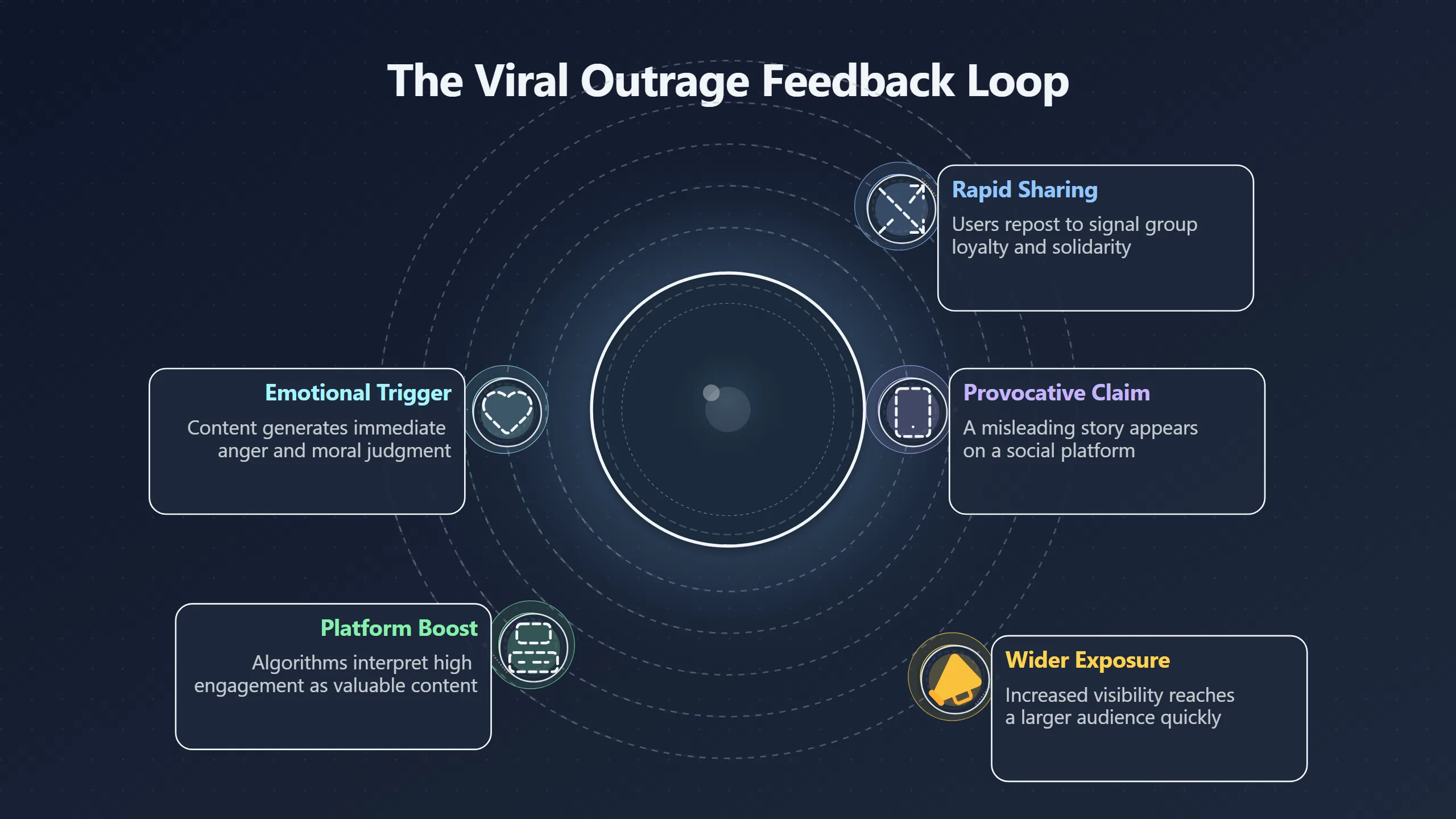
The effect can become self-reinforcing:
- A provocative claim appears.
- The claim triggers outrage.
- Outrage drives sharing and discussion.
- Increased engagement boosts visibility.
- Greater visibility exposes more people to the claim.
- Additional reactions generate further engagement.
At no stage does widespread sharing prove the claim is accurate. The process measures emotional response, not factual reliability.
This distinction is easy to forget because humans often treat popularity as a clue to importance or credibility. Yet a viral post may simply be evidence that it successfully triggered outrage.

Checks that separate anger from evidence
Feeling angry about a claim is not evidence that the claim is true. Outrage can point towards a genuine problem, but it can also be triggered by misleading framing, selective editing or outright fabrication.
Before sharing an outrage-inducing post, several checks help separate emotional force from factual strength:
- Identify the original source. Trace the claim back to the earliest available report, video or document.
- Look for missing context. Short clips and screenshots often omit crucial information.
- Check whether multiple independent sources agree. A claim repeated across social media is not the same as independent verification.
- Separate the event from the interpretation. Even if an incident occurred, explanations and motives may still be disputed.
- Pause before sharing. Research on accuracy prompts suggests that simply making accuracy salient can improve sharing decisions.[Nature+2Nature]nature.comShifting attention to accuracy can reduce misinformation…by G Pennycook · 2021 · Cited by 1500 — The sharing of misinformation o…
The key lesson is not that outrage is always wrong. Many legitimate scandals, abuses and injustices deserve angry responses. The critical-thinking challenge is recognising that outrage is a signal about how a claim feels, not a guarantee of how well it has been proven. In social media environments, especially those amplified by AI-generated content, treating that distinction seriously is one of the most effective defences against sharing falsehoods.


eBay marketplace picks
Marketplace Samples
Example marketplace items related to this page. Use the search link to explore similar finds on eBay.
Endnotes
1.
Source: ovid.com
Title: science.adl2829~misinformation exploits outrage to spread online
Link:https://www.ovid.com/journals/scie/fulltext/10.1126/science.adl2829~misinformation-exploits-outrage-to-spread-online
Source snippet
Misinformation exploits outrage to spread online: Scienceby KL McLoughlin · 2024 · Cited by 115 — We investigated the relationship betwe...
2.
Source: nature.com
Link:https://www.nature.com/articles/s41586-021-03344-2
Source snippet
Shifting attention to accuracy can reduce misinformation...by G Pennycook · 2021 · Cited by 1500 — The sharing of misinformation o...
3.
Source: nature.com
Link:https://www.nature.com/articles/s41467-022-30073-5
Source snippet
Accuracy prompts are a replicable and generalizable...by G Pennycook · 2022 · Cited by 321 — Interventions that shift users attention to...
4.
Source: researchgate.net
Link:https://www.researchgate.net/publication/386219206_Misinformation_exploits_outrage_to_spread_online
Source snippet
Misinformation exploits outrage to spread onlineWe tested a hypothesis that misinformation exploits outrage to spread online...
5.
Source: pnas.org
Link:https://www.pnas.org/doi/10.1073/pnas.2024292118
Source snippet
Out-group animosity drives engagement on social mediaby S Rathje · 2021 · Cited by 903 — This research is consistent with prior resea...
6.
Source: pnas.org
Link:https://www.pnas.org/doi/10.1073/pnas.1618923114
Source snippet
Emotion shapes the diffusion of moralized content in social...by WJ Brady · 2017 · Cited by 1984 — JM Salerno, LC Peter-Hagene, The...
7.
Source: nature.com
Link:https://www.nature.com/nature-index/topics/l4/moral-outrage-dynamics-in-social-media
Source snippet
Moral Outrage Dynamics in Social MediaMoral outrage on social media arises when users perceive violations of ethical norms and respond wi...
8.
Source: nature.com
Link:https://www.nature.com/articles/s41599-025-05233-9
Source snippet
Can shifting attention to accuracy reduce misinformation on...by Z Liu · 2025 · Cited by 3 — Inattention-based theory provides a differe...
9.
Source: nature.com
Link:https://www.nature.com/articles/s41586-024-07942-8
Source snippet
Nature 592, 590–595 (2021). Article ADS CAS PubMed Google Scholar. Mosleh, M...Read more...
10.
Source: nature.com
Link:https://www.nature.com/articles/s41562-025-02205-6
Source snippet
Following news on social media boosts knowledge, belief...by S Altay · 2025 · Cited by 25 — These trends may exacerbate polarization, ra...
11.
Source: ovid.com
Link:https://www.ovid.com/journals/scie/pdf/10.1126/science.adl2829~misinformation-exploits-outrage-to-spread-online
Source snippet
Misinformation exploits outrage to spread onlineWe tested a hypothesis that misinformation exploits outrage to spread online, examining g...
12.
Source: researchgate.net
Title: Springer Nature. Nature Communications.Read more
Link:https://www.researchgate.net/publication/360253696_Accuracy_prompts_are_a_replicable_and_generalizable_approach_for_reducing_the_spread_of_misinformation
Source snippet
Accuracy prompts are a replicable and generalizable...Apr 14, 2022 — Accuracy prompts are a replicable and generalizable approach for re...
13.
Source: researchgate.net
Link:https://www.researchgate.net/publication/317947723_Emotion_shapes_the_diffusion_of_moralized_content_in_social_networks
Source snippet
es substantially increases their diffusion within (and less so between) ideological...Read more...
14.
Source: science.org
Link:https://www.science.org/doi/10.1126/science.adl2829
Source snippet
Misinformation exploits outrage to spread onlineby KL McLoughlin · 2024 · Cited by 108 — We tested a hypothesis that misinformatio...
15.
Source: news.yale.edu
Title: likes and shares teach people express more outrage online
Link:https://news.yale.edu/2021/08/13/likes-and-shares-teach-people-express-more-outrage-online
Source snippet
News'Likes' and 'shares' teach people to express more outrage onlineAug 13, 2021 — Social media platforms like Twitter amplify expres...
16.
Source: static1.squarespace.com
Link:https://static1.squarespace.com/static/538ca3ade4b090f9ef331978/t/674dd16037f5e2577fb7f30d/1733153126728/science.adl2829%5B79930360%5D.pdf
Source snippet
exploits outrage to spread onlineNov 29, 2024 — We tested a hypothesis that misinformation exploits outrage to spread online, examining g...
17.
Source: sciencemediacentre.es
Title: outrage facilitates spread misinformation social networks
Link:https://sciencemediacentre.es/en/outrage-facilitates-spread-misinformation-social-networks
Source snippet
Outrage facilitates the spread of misinformation on social...Nov 28, 2024 — According to a study, social media content containing misinf...
18.
Source: dl.acm.org
Link:https://dl.acm.org/doi/abs/10.1145/3706598.3713909
Source snippet
Science 359, 6380 (2018), 1094–1096. Google... Moral emotions shape the virality of COVID-19 misinformation on social media.Read more...
Additional References
19.
Source: prosocialdesign.org
Link:https://www.prosocialdesign.org/library/accuracy-prompts
Source snippet
Accuracy PromptsBy calling their attention to accuracy, users will be more apt to discern if a news item is misinformation and less likel...
20.
Source: reddit.com
Link:https://www.reddit.com/r/AcademicPsychology/comments/o9zkq2/outgroup_animosity_drives_engagement_on_social/
Source snippet
Out-group animosity drives engagement on social mediaWe investigated whether out-group animosity was particularly successful at generatin...
21.
Source: Tech Policy Press
Link:https://techpolicy.press/researchers-consider-the-relationship-between-misinformation-outrage-and-the-sharing-of-content-on-social-media
Source snippet
Researchers Consider the Relationship Between...The researchers found that misinformation triggered more angry reactions than posts cont...
22.
Source: misinforeview.hks.harvard.edu
Link:https://misinforeview.hks.harvard.edu/article/examining-accuracy-prompt-efficacy-in-combination-with-using-colored-borders-to-differentiate-news-and-social-content-online/
Source snippet
accuracy-prompt efficacy in combination with...by V Bhardwaj · 2023 · Cited by 10 — Recent research suggests that individuals may someti...
23.
Source: publications.parliament.uk
Link:https://publications.parliament.uk/pa/cm5901/cmselect/cmsctech/441/report.html
Source snippet
media, misinformation and harmful algorithmsIn this report, we consider disinformation to be a sub-category of misinformation, and use te...
24.
Source: Wikipedia
Title: Proceedings of the National Academy of Sciences of the United States of America
Link:https://en.wikipedia.org/wiki/Proceedings_of_the_National_Academy_of_Sciences_of_the_United_States_of_America
Source snippet
Proceedings of the National Academy of SciencesIt is the official journal of the National Academy of Sciences, published since 1915, a...
25.
Source: misinforeview.hks.harvard.edu
Title: developing an accuracy prompt toolkit to reduce covid 19 misinformation online
Link:https://misinforeview.hks.harvard.edu/article/developing-an-accuracy-prompt-toolkit-to-reduce-covid-19-misinformation-online/
Source snippet
Misinformation ReviewDeveloping an accuracy-prompt toolkit to reduce COVID...by Z Epstein · 2021 · Cited by 139 — Here we examine the ut...
26.
Source: pmc.ncbi.nlm.nih.gov
Title: PMC“I Think This News Is Accurate”: Endorsing Accuracy
Link:https://pmc.ncbi.nlm.nih.gov/articles/PMC10637098/
Source snippet
by V Capraro · 2022 · Cited by 53 — Accuracy prompts, nudges that make accuracy salient, typically decrease the sharing of fake news...
27.
Source: csmapnyu.org
Title: emotion shapes the diffusion of moralized content in social networks
Link:https://csmapnyu.org/research/academic-research/emotion-shapes-the-diffusion-of-moralized-content-in-social-networks
Source snippet
Emotion Shapes the Diffusion of Moralized Content in...Jul 11, 2017 — We show that the expression of moral emotion is key for the spread...
28.
Source: news-medical.net
Title: Outrage drives the spread of misinformation on social media.aspx
Link:https://www.news-medical.net/news/20241128/Outrage-drives-the-spread-of-misinformation-on-social-media.aspx
Source snippet
Outrage drives the spread of misinformation on social mediaNov 28, 2024 — Social media posts containing misinformation evoke more moral o...
Topic Tree