Within Name Claim
How vague posts become checkable claims
A vague post becomes easier to test when the reader rewrites it as one precise question that evidence could answer.
On this page
- Spot the factual core inside a reaction post
- Rewrite loaded wording as a testable question
- Choose yes, no, partly, unsupported, or misleading as possible outcomes
Page outline Jump by section
Introduction
A vague viral post becomes easier to evaluate when it is rewritten as a single claim that evidence could confirm, reject, or qualify. This step sits between noticing a post and fact-checking it. Instead of reacting to the overall impression, the reader extracts the factual core hidden inside emotion, insinuation, humour, outrage, or speculation.
 This matters because social media posts rarely present information in a clean, testable form. A meme, screenshot, caption, and emotional appeal may all point towards a conclusion without clearly stating it. Professional fact-checkers often begin by identifying exactly what is being asserted before examining evidence. Full Fact describes its first task as understanding what has been said, including underlying assumptions, because even factually correct information can be used in a misleading way.[Full Fact]fullfact.orgFull FactHow we fact check – Full FactFirst we need to understand what has been said or printed. We don't only fact check the evidence us…
The practical goal is simple: transform a post that triggers a reaction into a question that evidence could answer.
Spot the factual core inside a reaction post
Many viral posts are designed to produce a feeling before they produce a clear proposition. The emotional framing is often obvious, while the factual claim remains hidden.
Consider a post that says:
“They don’t want you to see this.”
That sentence alone contains no checkable claim. The reader must identify what specific statement the post is asking them to believe. Is it claiming that a report was removed? That a video was censored? That a government agency concealed information? Each possibility would require different evidence.
A useful technique is to separate the post into layers:
- Observation: What does the post literally show or state?
- Interpretation: What conclusion is the author encouraging?
- Emotion: What reaction is the audience supposed to feel?
- Claim: What factual statement would have to be true for the conclusion to hold?
For example:
- Post: “Look at these empty supermarket shelves. The economy is collapsing.”
- Observation: Shelves appear empty.
- Interpretation: The economy is collapsing.
- Checkable claim: Were these photographs taken recently, in the stated location, and do they represent widespread shortages?
The factual core is often narrower than the post suggests. A dramatic conclusion may rest on a small factual assertion about a date, place, quote, statistic, image, or event.
This distinction matters because evidence can usually test the factual core, while broader interpretations may remain debatable.
Rewrite loaded wording as a testable question
Once the factual core is identified, the next step is to remove emotionally loaded language and convert the statement into a question.
Loaded wording often hides uncertainty. Words such as “exposed”, “proved”, “destroyed”, “caught”, “cover-up”, or “everyone knows” imply a conclusion before evidence has been examined.
For example:
Viral wordingTestable question“Officials are hiding the truth.”Was information withheld from the public, and if so, what evidence shows this?“This video proves the event was staged.”Does the video provide verifiable evidence that the event was staged?“Scientists admit they were wrong.”Did scientists make the specific admission claimed, and in what context?“The media won’t report this.”Have major news organisations reported this event or claim?
Notice how the rewritten versions avoid deciding the answer in advance.
The goal is not to make the claim weaker. The goal is to make it measurable.
A good testable question usually has three characteristics:
- It refers to a specific event, person, document, image, quote, or statistic.
- It can be answered using observable evidence.
- Different investigators could examine the same evidence and discuss the result.
Research into misinformation repeatedly finds that people often share content while focusing on factors other than accuracy. Simply redirecting attention towards whether a claim is true can improve the quality of information people choose to share.[Nature+2Nature]nature.comShifting attention to accuracy can reduce misinformation…by G Pennycook · 2021 · Cited by 1596 — The results show that subtly sh…
Turning a viral statement into a question helps create that shift in attention.
From broad accusations to narrow claims
One of the most useful habits is reducing a large accusation to the smallest claim that supports it.
Consider the statement:
“This proves the election was rigged.”
That accusation is too broad to check directly. A reader should ask:
- What specific event is being cited?
- What evidence supposedly demonstrates manipulation?
- Is the claim about vote counting, registration, equipment, procedure, or reporting?
The result might become:
“Did polling station X report vote totals that differed from the official certified record?”
That question is much narrower, but it can actually be investigated.
The same approach works with AI-generated content.
Suppose a post claims:
“AI revealed what really happened.”
The relevant claim is rarely about AI itself. The checkable question might instead be:
“Does the evidence used by the AI system come from authentic and verifiable sources?”
A broad narrative becomes manageable once reduced to a specific factual proposition.
Choose yes, no, partly, unsupported, or misleading as possible outcomes
A common mistake is assuming every claim must be either completely true or completely false.
Professional fact-checking organisations frequently use more nuanced verdicts because reality is often mixed. A statement may contain an accurate detail while encouraging an incorrect conclusion. Full Fact explicitly notes that correct information can still be used to make a misleading point.[Full Fact]fullfact.orgFull FactHow we fact check – Full FactFirst we need to understand what has been said or printed. We don't only fact check the evidence us…
Before checking evidence, it helps to define the range of possible outcomes:
- Yes: The evidence supports the claim.
- No: The evidence contradicts the claim.
- Partly: Some elements are correct, others are not.
- Unsupported: Insufficient evidence exists to verify the claim.
- Misleading: Individual facts may be accurate, but the overall implication is distorted.
Thinking in these categories prevents premature judgement.
For example, a post may use a genuine photograph from a real event but falsely claim it happened yesterday. The image itself is authentic, yet the post remains misleading because the context is wrong.
Similarly, a statistic can be accurate while being presented in a way that creates a false impression. The checkable claim may therefore receive a “partly” or “misleading” assessment rather than a simple yes or no.

A quick example from start to finish
Imagine a viral post stating:
“Thousands of people are fleeing the city after the government announcement. Share before this gets deleted.”
Rather than immediately searching for evidence, first rewrite it.
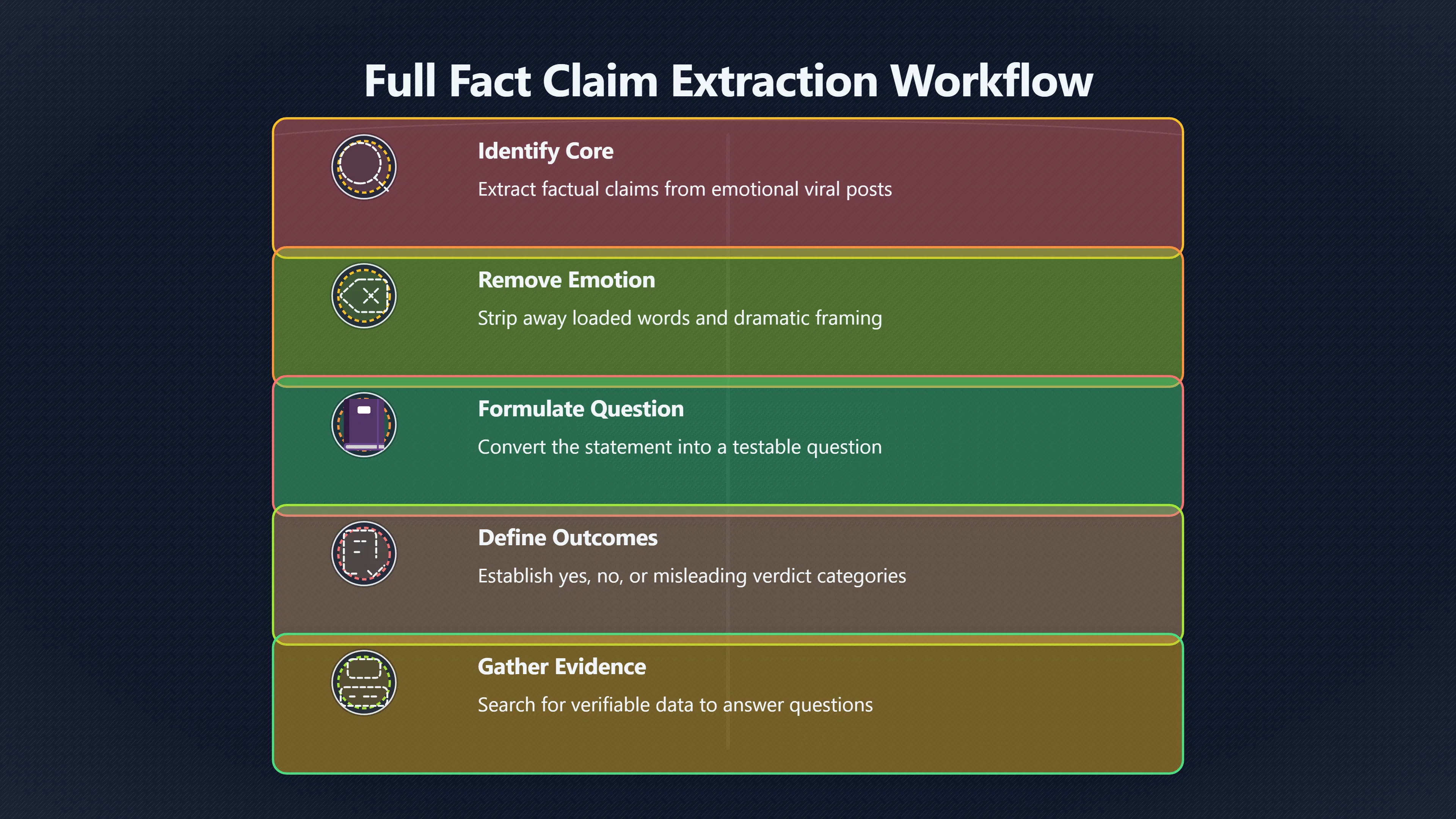
Step 1: Remove emotional language
Ignore “share before this gets deleted”.
Step 2: Find the factual assertion
The post appears to claim that thousands of people are leaving the city because of a government announcement.
Step 3: Make it specific
- Which city?
- Which announcement?
- What evidence shows large-scale departures?
Step 4: Turn it into a question
“Did government announcement X cause a measurable increase in departures from city Y?”
Step 5: Identify possible outcomes
The answer could be yes, no, partly, unsupported, or misleading.
Only after reaching this stage does evidence gathering begin.
Why this small habit matters
Fact-checking is often imagined as a search problem: finding the right article, dataset, or document. In practice, the earlier step of defining the claim is frequently more important. If the claim is vague, the evidence search becomes directionless.
Research on misinformation suggests that people frequently fail to focus on accuracy when engaging with online content. Accuracy-focused prompts can improve discernment and reduce the sharing of false information.[Nature+2PMC]nature.comShifting attention to accuracy can reduce misinformation…by G Pennycook · 2021 · Cited by 1596 — The results show that subtly sh…
Rewriting vague viral posts into precise, answerable questions creates exactly that shift. It forces attention away from the emotional package and towards the factual proposition. Once the claim is clear, evidence has something concrete to test. Without that step, fact-checking often becomes little more than arguing with a feeling.
Amazon book picks
Further Reading
Books and field guides related to How vague posts become checkable claims. Use these as the next step if you want deeper reading beyond the article.
Calling Bullshit
Teaches readers to extract and test claims hidden inside persuasive language.

Critical Thinking
Focuses on turning assertions into questions that evidence can address.
eBay marketplace picks
Marketplace Samples
Example marketplace items related to this page. Use the search link to explore similar finds on eBay.




Endnotes
1.
Source: nature.com
Link:https://www.nature.com/articles/s41586-021-03344-2
Source snippet
Shifting attention to accuracy can reduce misinformation...by G Pennycook · 2021 · Cited by 1596 — The results show that subtly sh...
2.
Source: nature.com
Link:https://www.nature.com/articles/s41467-022-30073-5
Source snippet
Accuracy prompts are a replicable and generalizable...by G Pennycook · 2022 · Cited by 363 — [Accuracy prompts]({{ 'accuracy-prompts/' | relative_url }}) increased the qualit...
3.
Source: pmc.ncbi.nlm.nih.gov
Title: PMCNudging Social Media toward Accuracy
Link:https://pmc.ncbi.nlm.nih.gov/articles/PMC9082967/
Source snippet
Social Media toward Accuracy - PMC - NIHby G Pennycook · 2022 · Cited by 127 — We review research that shows how a simple nudge or prompt...
4.
Source: nature.com
Link:https://www.nature.com/articles/s41599-025-05233-9
Source snippet
(2020) through research on the spread of misinformation about COVID-19 in...Read more...
5.
Source: fullfact.org
Link:https://fullfact.org/about/how-we-fact-check/
Source snippet
Full FactHow we fact check – Full FactFirst we need to understand what has been said or printed. We don't only fact check the evidence us...
Additional References
6.
Source: educateagainsthate.com
Link:https://www.educateagainsthate.com/wp-content/uploads/2025/04/How-to-Fact-Check-Online-Sources.pdf
Source snippet
How to Fact Check Online SourcesUse this guide to get equipped with the tools and knowledge needed to navigate the sea of information and...
7.
Source: GOV.UK
Link:https://www.gov.uk/government/people/matthew-pennycook
Source snippet
Pennycook MPMatthew Pennycook was appointed Minister of State at the Ministry of Housing, Communities and Local Government on 6 July 2024...
Published: July 2024
8.
Source: static.poder360.com.br
Title: pesquisa compartilhamento fake news estudo pennycook universidade regina
Link:https://static.poder360.com.br/2022/03/pesquisa-compartilhamento-fake-news-estudo-pennycook-universidade-regina.pdf
Source snippet
attention to accuracy can reduce misinformation...by G Pennycook · Cited by 1596 — we find that headline veracity has 18 little impact o...
9.
Source: news.cornell.edu
Title: [accuracy nudges]({{ ‘accuracy-nudge/’ | relative_url }}) decrease misinformation sharing left right
Link:https://news.cornell.edu/stories/2024/04/accuracy-nudges-decrease-misinformation-sharing-left-right
Source snippet
'nudges' decrease misinformation-sharing on left, right4 Apr 2024 — Pennycook said the idea for the “adversarial collaboration” – typical...
10.
Source: misinforeview.hks.harvard.edu
Title: fact checking fact checkers a data driven approach
Link:https://misinforeview.hks.harvard.edu/article/fact-checking-fact-checkers-a-data-driven-approach/
Source snippet
harvard.edu“Fact-checking” fact checkers: A data-driven approachby S Lee · 2023 · Cited by 62 — This study examined four fact checkers (S...
11.
Source: researchgate.net
Title: 360387098 Nudging Social Media toward Accuracy
Link:https://www.researchgate.net/publication/360387098_Nudging_Social_Media_toward_Accuracy
Source snippet
(PDF) Nudging Social Media toward Accuracyby G PENNYCOOK · 2022 · Cited by 127 — We review research that shows how a simple nudge or prom...
12.
Source: ide.mit.edu
Title: Pennycook et al Shifting attention to accuracy
Link:https://ide.mit.edu/sites/default/files/publications/Pennycook%20et%20al%20-%20Shifting%20attention%20to%20accuracy.pdf
Source snippet
attention to accuracy can reduce misinformation...by G Pennycook · Cited by 1596 — The accuracy reminder consistently caused a larger de...
13.
Source: chrispennycook.ca
Title: Chris Pennycook: Royal Le Page Dynamic Real
Link:https://chrispennycook.ca/
Source snippet
WinnipegI make myself available at all times. When you are ready to see a listing in person, or just have a simple question, please don't...
14.
Source: members.parliament.uk
Link:https://members.parliament.uk/member/4520/contact
Source snippet
information for Matthew Pennycook - MPs and LordsMatthew Pennycook is the Labour MP for Greenwich and Woolwich, and has been an MP contin...
15.
Source: pubmed.ncbi.nlm.nih.gov
Link:https://pubmed.ncbi.nlm.nih.gov/35558818/
Source snippet
Social Media toward Accuracyby G Pennycook · 2022 · Cited by 127 — We review research that shows how a simple nudge or prompt that shifts...
Topic Tree