Within AI Tutors
Why Wrong AI Answers Sound Right
Chatbots can produce wrong answers in a fluent tone because training can reward plausible guessing over honest uncertainty.
On this page
- How fluent answers hide uncertainty
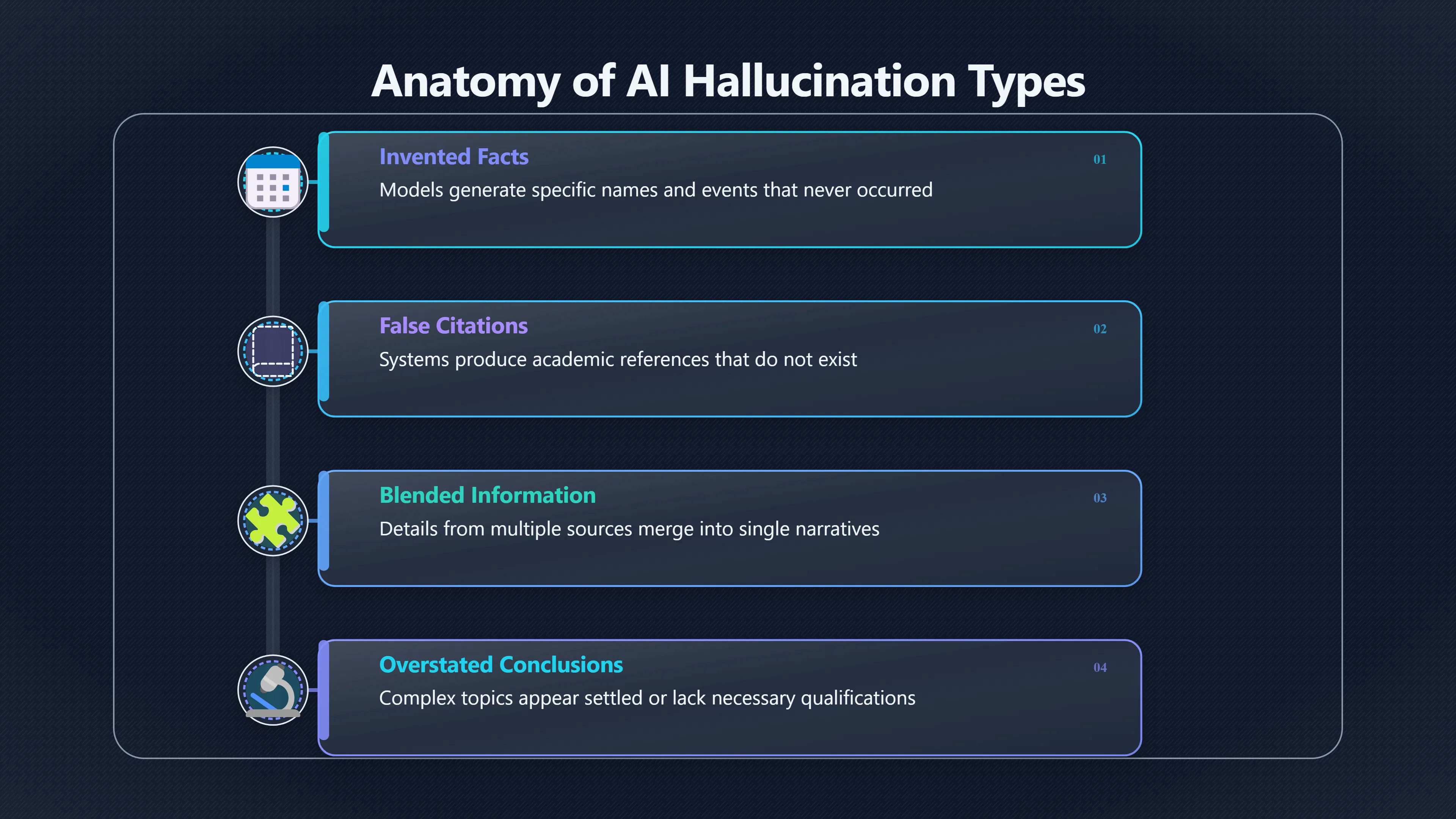
- Common forms of hallucination
- Questions that force uncertainty into view
Page outline Jump by section
Introduction
Chatbots often sound confident even when they are wrong because they are designed to produce fluent answers, not because they possess a built-in sense of certainty. The same smooth language that makes a chatbot useful as a tutor or search assistant can also make a weak guess feel like a verified fact. For people trying to think critically in an environment shaped by AI and social media, this creates a new challenge: judging reliability when uncertainty is hidden behind polished prose.
 Researchers increasingly argue that this behaviour is not simply a bug. Large language models are trained to continue text in plausible ways and are often rewarded for providing answers rather than admitting ignorance. As a result, a chatbot may produce a detailed response that sounds authoritative even when the underlying information is incomplete, uncertain or entirely incorrect.[OpenAI+2OpenAI]cdn.openai.comwhy language models hallucinateWhy Language Models Hallucinateby AT Kalai · 2025 · Cited by 399 — We argue that language models hallucinate because the training a…
How Fluent Answers Hide Uncertainty
A chatbot does not retrieve knowledge in the way a librarian consults a catalogue. Instead, it predicts likely sequences of words based on patterns learned during training. The output is optimised to be coherent, relevant and conversational. That fluency can create the impression that the system is certain, even when it is effectively making its best statistical guess.[arXiv]arxiv.orgarXiv Why Language Models HallucinatearXiv Why Language Models Hallucinate
Human readers are highly sensitive to signals of confidence. A response that contains complete sentences, technical vocabulary and a clear structure often feels more trustworthy than one filled with caveats. Chatbots are exceptionally good at producing those signals. The danger is that confidence in presentation can be mistaken for confidence in evidence.
Research from OpenAI argues that modern evaluation systems often reward models for answering difficult questions rather than abstaining. In many benchmark-style tests, a wrong answer receives more credit than no answer at all. Over time, this creates pressure to guess instead of saying “I don’t know”.[OpenAI+2OpenAI]cdn.openai.comwhy language models hallucinateWhy Language Models Hallucinateby AT Kalai · 2025 · Cited by 399 — We argue that language models hallucinate because the training a…
A useful comparison is a student taking a multiple-choice exam. If there is no penalty for guessing, choosing an answer may improve the score. The student’s confidence and the answer’s correctness are separate issues. Chatbots face a similar incentive structure.[OpenAI]cdn.openai.comwhy language models hallucinateWhy Language Models Hallucinateby AT Kalai · 2025 · Cited by 399 — We argue that language models hallucinate because the training a…
Why the System Keeps Talking
The confidence problem is also tied to how language models generate text.
Rather than deciding whether a statement is true and then expressing it, a language model predicts one token (roughly, one word or word fragment) at a time. Each prediction influences the next. Once a response begins in a confident tone, later parts of the answer often continue in the same style. The result can be a long chain of plausible-sounding statements that gradually drift away from reality.[Wikipedia]WikipediaHallucination (artificial intelligenceHallucination (artificial intelligence
This is one reason incorrect answers sometimes include invented details such as:
- Fabricated quotations.
- Non-existent academic papers.
- Imaginary statistics.
- Incorrect dates presented with precision.
- Made-up references that resemble genuine sources.
The model is not deliberately deceiving the user. It is extending patterns that resemble the kinds of answers it has seen before. When evidence is missing, pattern completion can fill the gap with something that merely sounds right.[Wikipedia+2MDPI]WikipediaHallucination (artificial intelligenceHallucination (artificial intelligence
Common Forms of Hallucination
The term “hallucination” is widely used for AI-generated information that appears factual but lacks adequate grounding. Although the term is debated, it remains common shorthand for confident mistakes.[Wikipedia]WikipediaHallucination (artificial intelligenceHallucination (artificial intelligence
Several forms are especially relevant when using chatbots as search engines or tutors.
Invented facts.
A model may provide a specific answer to a question even when it lacks reliable information. The response can include names, numbers or events that never existed.[Wikipedia]WikipediaHallucination (artificial intelligenceHallucination (artificial intelligence
False citations.
A chatbot may generate references that look academically credible but cannot be found. Studies of AI search systems have repeatedly found citation and attribution errors, showing that a source appearing beside a claim is not proof that the source supports it.[Wikipedia]WikipediaHallucination (artificial intelligenceHallucination (artificial intelligence
Blended information.
Details from multiple people, places or events may be merged into a single narrative. Because each fragment is individually plausible, the resulting error can be difficult to detect.
Overstated conclusions.
A chatbot may present a disputed issue as settled or omit important qualifications. In educational contexts, this can make a complex topic appear simpler and more certain than it really is.
These errors are particularly persuasive because they are embedded within otherwise correct information. A response may be 90% accurate and 10% fabricated, making the mistake harder to notice than an obviously absurd answer.
High-Confidence Errors Are Especially Difficult
A common assumption is that chatbots hallucinate only when they are uncertain. Recent research complicates that picture.
Studies have identified cases in which models generate false information while displaying indicators associated with high confidence. Some errors persist across different models and datasets, suggesting that confidence and correctness are not always closely linked. In other words, a chatbot can sometimes be wrong without appearing hesitant, and it can occasionally possess relevant knowledge yet still produce an incorrect answer.[arXiv]arxiv.orgarXiv Trust Me, I'm Wrong: High-Certainty Hallucinations in LLMsTrust Me, I'm Wrong: High-Certainty Hallucinations in LLMsFebruary 18, 2025…
This matters because users often rely on confidence cues when deciding whether to trust information. If visible confidence does not reliably track accuracy, readers need other methods of evaluation.
The practical lesson is that a polished answer should be treated as a starting point for verification rather than as evidence that the model has checked its own work.

Questions That Force Uncertainty Into View
One of the most effective ways to use a chatbot critically is to make uncertainty explicit.
Instead of asking only for an answer, ask questions that reveal how strong the answer really is:
- What evidence supports this claim?
- Which parts of this answer are uncertain?
- What are the strongest competing explanations?
- How confident are you, and why?
- What source would best verify this statement?
- What information could prove this answer wrong?
These prompts do not eliminate mistakes, but they encourage the model to expose assumptions, limitations and alternative interpretations. They also shift the user’s role from passive recipient to active evaluator.
Another useful habit is to separate explanation from verification. A chatbot may be excellent at explaining a concept in simple language, yet the key facts should still be checked against primary sources, official documents, reputable journalism or trusted educational materials.
Why This Matters for Critical Thinking
The central risk is not merely that chatbots make mistakes. Humans make mistakes too. The distinctive challenge is that chatbots can package uncertainty in a form that feels complete, authoritative and effortless.
In the age of social media and AI, information often spreads because it is convincing rather than because it is true. Chatbots amplify this tension. Their greatest strength—producing clear, fluent explanations—is also the reason their errors can be persuasive.
Critical thinking therefore requires a shift in habit. Instead of asking only, “Does this answer sound right?”, readers increasingly need to ask, “How would I know whether this answer is right?” That question exposes the gap between confidence and evidence, which is where many AI errors hide.[OpenAI+2OpenAI]cdn.openai.comwhy language models hallucinateWhy Language Models Hallucinateby AT Kalai · 2025 · Cited by 399 — We argue that language models hallucinate because the training a…

eBay marketplace picks
Marketplace Samples
Example marketplace items related to this page. Use the search link to explore similar finds on eBay.



Endnotes
1.
Source: cdn.openai.com
Title: why language models hallucinate
Link:https://cdn.openai.com/pdf/d04913be-3f6f-4d2b-b283-ff432ef4aaa5/why-language-models-hallucinate.pdf
Source snippet
Why Language Models Hallucinateby AT Kalai · 2025 · Cited by 399 — We argue that language models hallucinate because the training a...
2.
Source: OpenAI
Title: why language models hallucinate
Link:https://openai.com/index/why-language-models-hallucinate/
Source snippet
comWhy language models hallucinate5 Sept 2025 — [Hallucinations]({{ 'hallucinations/' | relative_url }}) are plausible but false statements generated by language models. They can...
3.
Source: arxiv.org
Title: arXiv Why Language Models Hallucinate
Link:https://arxiv.org/abs/2509.04664
4.
Source: Wikipedia
Title: Hallucination (artificial intelligence)
Link:https://en.wikipedia.org/wiki/Hallucination_%28artificial_intelligence%29
5.
Source: mdpi.com
Link:https://www.mdpi.com/2673-2688/6/10/260
Source snippet
From Illusion to Insight: A Taxonomic Survey of...by I Kazlaris · 2025 · Cited by 17 — Training LLMs for predictive accuracy inevitably...
6.
Source: arxiv.org
Title: arXiv How Large Language Models are Designed to Hallucinate
Link:https://arxiv.org/abs/2509.16297
7.
Source: arxiv.org
Title: arXiv Trust Me, I’m Wrong: High-Certainty Hallucinations in LLMs
Link:https://arxiv.org/abs/2502.12964
Source snippet
Trust Me, I'm Wrong: High-Certainty Hallucinations in LLMsFebruary 18, 2025...
Published: February 18, 2025
8.
Source: arxiv.org
Link:https://arxiv.org/html/2601.09929v1
Source snippet
By analyzing token-level probabilities...Read more...
9.
Source: arxiv.org
Link:https://arxiv.org/pdf/2509.04664
Source snippet
Why Language Models Hallucinateby AT Kalai · 2025 · Cited by 413 — large language models sometimes guess when uncertain, producing plausi...
10.
Source: OpenAI
Link:https://openai.com/
Source snippet
comOpenAI | Research & DeploymentWe believe our research will eventually lead to artificial general intelligence, a system that can solve...
11.
Source: Wikipedia
Title: Open AI
Link:https://en.wikipedia.org/wiki/OpenAI
Source snippet
OpenAIOpenAI is an American artificial intelligence (AI) research organization headquartered in San Francisco, consisting of a for-pro...
12.
Source: youtube.com
Title: Why AI Confidently Lies to You (LLM Hallucinations Explained)
Link:http://www.youtube.com/watch?v=D7zh85wjjK0
Source snippet
OpenAI Explains: Why Language Models Hallucinate & How to Reduce Them...
13.
Source: youtube.com
Title: Open AI Explains: Why Language Models Hallucinate & How to Reduce Them
Link:http://www.youtube.com/watch?v=FgioKdQdGMA
Source snippet
Why Language Models Hallucinate (OpenAI paper)...
14.
Source: reddit.com
Title: Why Language Models Hallucinate
Link:https://www.reddit.com/r/MachineLearning/comments/1namvsk/why_language_models_hallucinate_openai_pseudo/
Source snippet
OpenAi pseudo paperhallucination-like guessing is rewarded by most primary evaluations. We discuss statistically rigorous modifications t...
15.
Source: linkedin.com
Link:https://www.linkedin.com/company/openai
Source snippet
OpenAIOpenAI is an AI research and deployment company dedicated to ensuring that general-purpose artificial intelligence benefits all of...
16.
Source: thealgorithmicbridge.com
Title: openai researchers have discovered
Link:https://www.thealgorithmicbridge.com/p/openai-researchers-have-discovered
Source snippet
language models hallucinate because standard training and evaluation procedures reward guessing over acknowledging uncertainty.Read more...
17.
Source: arize.com
Title: openais santosh vempala explains why language models hallucinate
Link:https://arize.com/blog/openais-santosh-vempala-explains-why-language-models-hallucinate/
Source snippet
OpenAI's Santosh Vempala Explains Why Language...24 Oct 2025 — “Pre-training encourages hallucinations because language models are desig...
Additional References
18.
Source: linkedin.com
Link:https://www.linkedin.com/pulse/ai-hallucinations-hidden-truth-behind-large-language-models-manwani-cfi4c
Source snippet
AI Hallucinations: The Hidden Truth Behind Large...The Real Definition AI hallucinations aren't random errors — they're plausible but in...
19.
Source: researchgate.net
Link:https://www.researchgate.net/publication/381366757_Calibrated_Language_Models_Must_Hallucinate
Source snippet
Calibrated Language Models Must HallucinateUnfortunately, LLMs trained via likelihood-based next-token prediction are inherently prone to...
20.
Source: reuters.com
Link:https://www.reuters.com/technology/does-ai-business-model-have-fatal-flaw-2026-04-01/
Source snippet
These tools, while undeniably innovative, suffer from a critical issue: hallucinations—instances where the AI generates incorrect or fabr...
21.
Source: reddit.com
Link:https://www.reddit.com/r/singularity/comments/1n9fued/new_research_from_openai_why_language_models/
Source snippet
New research from OpenAI: "Why language models...Claim: Hallucinations are inevitable. Finding: They are not, because language models ca...
22.
Source: medium.com
Link:https://medium.com/%40vimalkansal/understanding-and-mitigating-ai-hallucinations-57053511fef6
Source snippet
Understanding and Mitigating AI HallucinationsAI hallucinations refer to moments when an AI model produces content that isn't real or cor...
23.
Source: facebook.com
Link:https://www.facebook.com/groups/nltppfacebookfanclub/posts/1469319888131716/
Source snippet
ai limitations and potential flawsRe: Bonnie's fascination with (and concern about?) ChatGPT in today's episode made me think of these re...
24.
Source: linkedin.com
Link:https://www.linkedin.com/posts/haythamassem_why-language-models-hallucinatepdf-activity-7370201125955997697–izi
25.
Source: ox.ac.uk
Link:https://www.ox.ac.uk/news/2024-06-20-major-research-hallucinating-generative-models-advances-reliability-artificial
Source snippet
Major research into 'hallucinating' generative models...20 Jun 2024 — In a new study published today in Nature, they demonstrate a novel...
26.
Source: mbzuai.ac.ae
Link:https://mbzuai.ac.ae/news/a-new-approach-to-identify-llm-hallucinations-uncertainty-quantification-presented-at-acl/
Source snippet
A new approach to identify LLM hallucinations: Uncertainty...23 Aug 2024 — LLMs can mix facts with fiction, but MBZUAI researchers aim t...
27.
Source: misinforeview.hks.harvard.edu
Title: new sources of inaccuracy a conceptual framework for studying ai hallucinations
Link:https://misinforeview.hks.harvard.edu/article/new-sources-of-inaccuracy-a-conceptual-framework-for-studying-ai-hallucinations/
Source snippet
A conceptual framework for...by A Shao · 2025 · Cited by 18 — This characteristic makes AI hallucinations different from human-driven mi...
Topic Tree