Within Emotional Posts
Why polished AI fakes feel more credible
AI tools can make emotional misinformation look professional, local, and confident even when the underlying evidence is thin.
On this page
- Why production quality is weaker evidence now
- Synthetic images, notices, audio, and explainers
- Source checks that matter more than appearance
Page outline Jump by section
Introduction
Generative AI has changed a subtle but important rule of online credibility: professional-looking content is no longer strong evidence that the underlying claim is trustworthy. A dramatic local warning, a heartfelt testimony, a public notice, a voice message, or a photo-based explainer can now be produced at low cost with polished language, realistic visuals, and confident presentation. The result is that emotional misinformation often arrives wrapped in the same visual and stylistic cues that people traditionally associate with expertise and legitimacy. Research on generative AI and disinformation repeatedly highlights that synthetic text, images, audio, and video are becoming easier to produce, harder to distinguish from authentic material, and increasingly capable of attracting attention and engagement.[MDPI+2EDMO]mdpi.comMapping the Impact of Generative AI on Disinformationby A López-Borrull · 2025 · Cited by 38 — This article presents a scoping review…
 Within the broader problem of emotional posts that bypass scepticism, AI’s distinctive contribution is not simply creating falsehoods. It is lowering the cost of making those falsehoods appear organised, local, emotionally resonant, and professionally presented.
Why production quality is weaker evidence now
For many years, people relied on rough heuristics when judging information online. A post with good spelling, clean design, coherent writing, realistic imagery, and apparent expertise often seemed more credible than a poorly produced alternative.
Generative AI weakens those shortcuts because it can manufacture the appearance of competence at scale. A person no longer needs graphic design skills, video editing expertise, professional photography, or advanced writing ability to produce content that looks as if it came from a newsroom, charity, public authority, or subject specialist. Researchers studying generative AI and disinformation repeatedly identify this reduction in production costs as one of the technology’s most significant effects.[MDPI+2SSRN]mdpi.comMapping the Impact of Generative AI on Disinformationby A López-Borrull · 2025 · Cited by 38 — This article presents a scoping review…
The emotional dimension matters because people often interpret polished presentation as a signal that somebody has done serious work behind the scenes. If a frightening warning is accompanied by realistic photographs, a clean infographic, and a calm explanatory voiceover, viewers may unconsciously transfer trust from the presentation to the claim itself.
This is especially powerful when the content confirms something the audience already fears, hopes, or suspects. In those situations, visual quality can function as a substitute for evidence. The emotional reaction arrives first, while verification is postponed or skipped entirely.
How AI adds authority without adding evidence
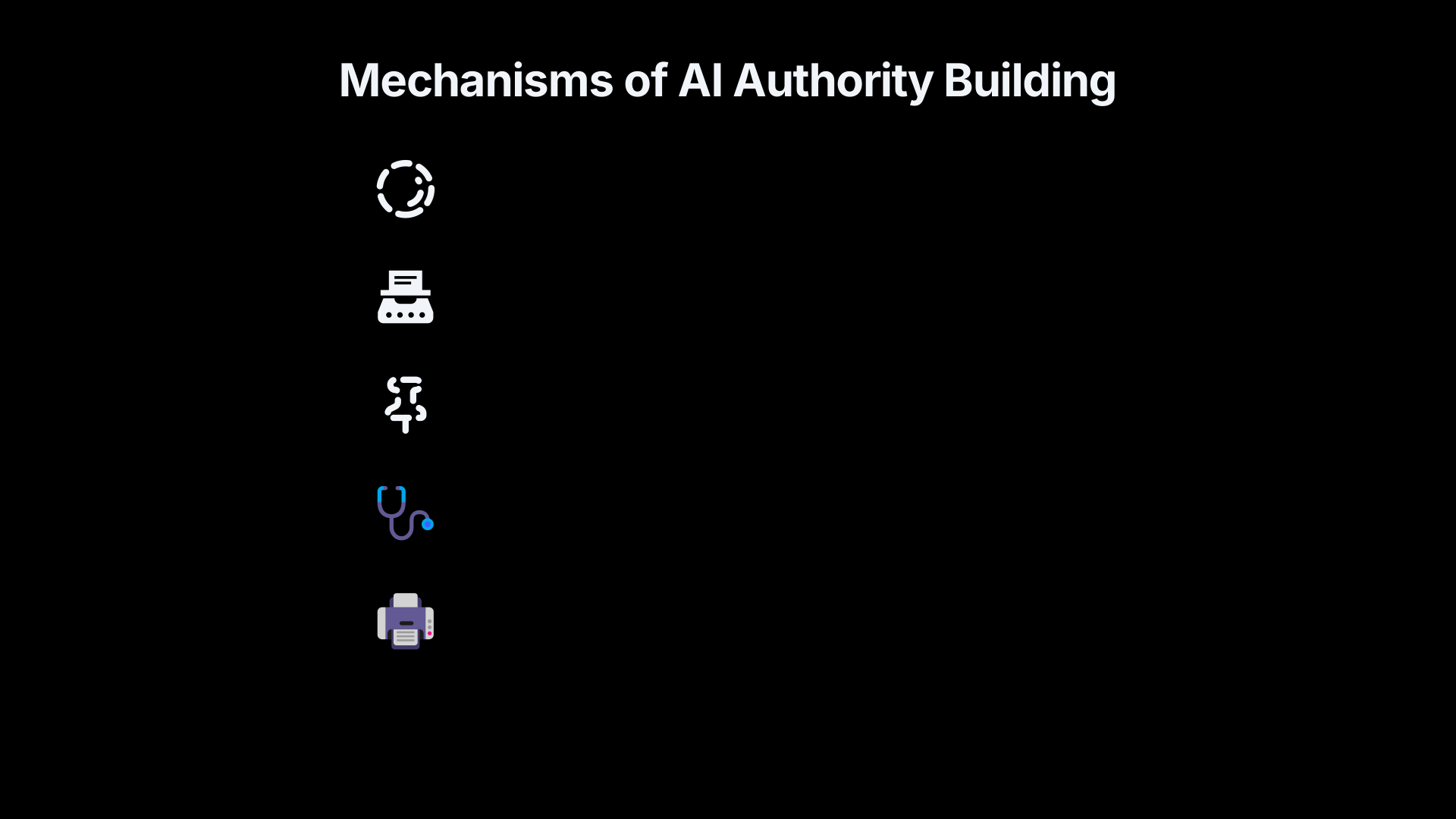
AI-generated emotional misinformation often gains authority through several overlapping mechanisms:
- Visual professionalism: realistic photographs, diagrams, logos, and layouts create the impression of institutional backing.
- Confident language: large language models routinely generate fluent, structured prose that sounds informed even when factual support is weak.
- Local tailoring: the same claim can be rewritten for different towns, professions, political groups, or cultural communities.
- Pseudo-expertise: AI can imitate the style of official reports, medical explainers, educational materials, or news coverage.
- Volume and variation: many versions of the same narrative can be produced quickly, making the claim appear widespread or independently confirmed.[MDPI+2EDMO]mdpi.comMapping the Impact of Generative AI on Disinformationby A López-Borrull · 2025 · Cited by 38 — This article presents a scoping review…
None of these features necessarily indicate deception. Legitimate organisations use the same tools. The problem is that presentation quality and factual quality have become more separable than they once were.
A polished emotional story may still rest on a miscaptioned image, an invented witness account, a fabricated statistic, or a claim with no reliable sourcing.
Synthetic images, notices, audio, and explainers
Images that feel like proof
Photographs have long carried evidential weight because people tend to treat them as records of reality. Advances in image generation have complicated that assumption.
Research on photorealistic AI-generated images shows that modern systems can create highly realistic visuals with professional aesthetics and relatively few obvious signs of artificial production. Many of these images imitate the visual conventions associated with authentic journalism, documentary photography, or eyewitness reporting.[arXiv]arxiv.orgCrafting Synthetic Realities: Examining Visual Realism and Misinformation Potential of Photorealistic AI-Generated ImagesSeptember 2…
When such images accompany emotionally charged claims, they can function as apparent proof even when they document no real event. The persuasive force comes from the combination of emotion and visual plausibility.
Official-looking notices
A particularly effective format is the synthetic public notice. AI tools can generate realistic council announcements, school communications, health alerts, emergency updates, and organisational statements within minutes.
The authority comes less from the text itself than from the familiar design language: logos, formatting, bureaucratic phrasing, and the appearance of administrative routine. Readers may recognise the visual style and assume authenticity before checking the source.
Voice messages and audio authority
Audio carries its own credibility signals. People often trust voices because they seem personal and difficult to fake.
Modern voice-cloning systems can reproduce accents, tone, and speaking style with increasing accuracy, creating recordings that sound as though they come from known individuals. Researchers note that audio deepfakes are becoming increasingly sophisticated, raising concerns for authentication, trust, and public communication.[Springer]link.springer.comIt examines…Read more…
The emotional effect can be powerful. A worried voice, a reassuring expert, or an apparently authentic local resident can create a sense of immediacy that text alone may not achieve.
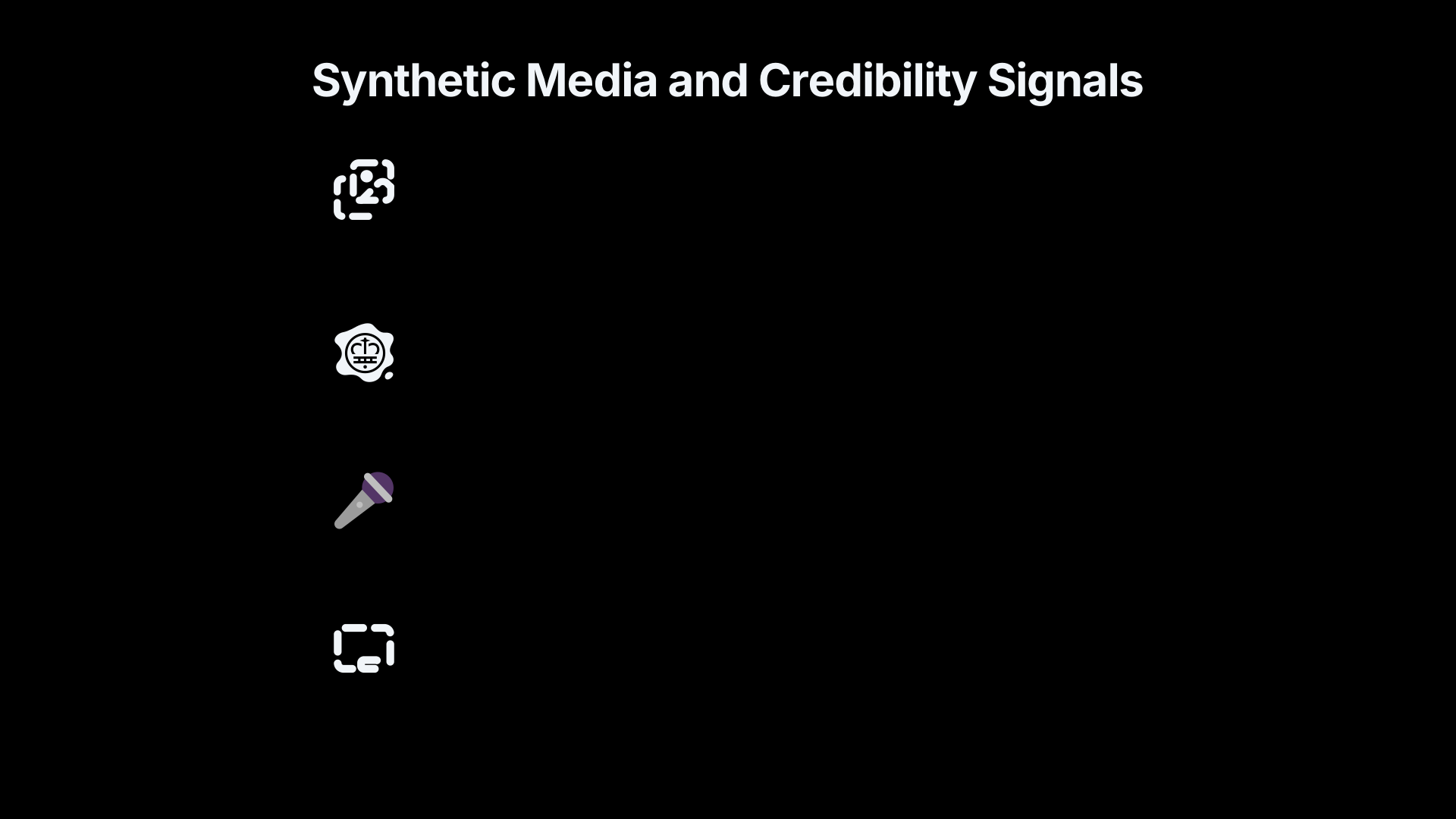
Explainers that sound informed
AI is particularly good at generating explanatory content. A fabricated claim can be packaged as a calm educational thread, a step-by-step video, or a frequently-asked-questions document.
Because the structure resembles genuine teaching, readers may mistake clarity for correctness. A well-organised explanation often feels more trustworthy than a chaotic one, even when both are equally unsupported.
Why personalisation makes emotional fakes more persuasive
One of the most important changes introduced by generative AI is the ability to adapt the same underlying story for different audiences.
A single narrative can be rewritten to appeal to parents, pensioners, healthcare workers, environmental campaigners, religious groups, local residents, or political activists. Researchers and analysts have highlighted concerns that AI may make misinformation easier to customise for specific audiences and communities.[WIRED]wired.comUnlike the human-driven attempts of the past, such as the 2016 Russian interference in the US presidential election, AI tools can profile…
The emotional core remains the same, but the framing changes:
- Fear for one audience.
- Pride for another.
- Anger for a third.
- Sympathy for a fourth.
This flexibility matters because people are often more trusting when a message appears to come from their own community and uses familiar language, concerns, and references.
The content feels local and personal even when it was generated automatically.
The credibility gap between appearance and verification
A common misconception is that the main danger comes from perfectly undetectable deepfakes. In practice, many misleading AI-generated posts do not need to be flawless.
They only need to look convincing long enough to trigger sharing, outrage, alarm, or sympathy.
Some studies suggest AI-generated misinformation can achieve disproportionate virality online, even when it is not necessarily more believable than conventional misinformation. The combination of novelty, accessibility, and professional presentation may help explain part of that advantage.[arXiv]arxiv.orgarXiv Characterizing AI-Generated Misinformation on Social MediaCharacterizing AI-Generated Misinformation on Social MediaMay 15, 2025…
At the same time, researchers continue to find that people struggle to distinguish synthetic content from authentic material. As generative systems improve, visual and textual authenticity become increasingly unreliable indicators of truth.[ijoc.org+2arXiv]ijoc.orgGenerative) AI and Disinformation—IntroductionNovember 11, 2025 — For instance, visual disinformation such as deepfakes have become far more sophisticated (Shoaib, Wang, A…
The practical consequence is that verification often becomes more important precisely when the content looks most convincing.
Source checks that matter more than appearance
In an environment where AI can generate professional-looking emotional content cheaply, credibility has to be earned differently.
Instead of asking whether a post looks authentic, stronger questions include:
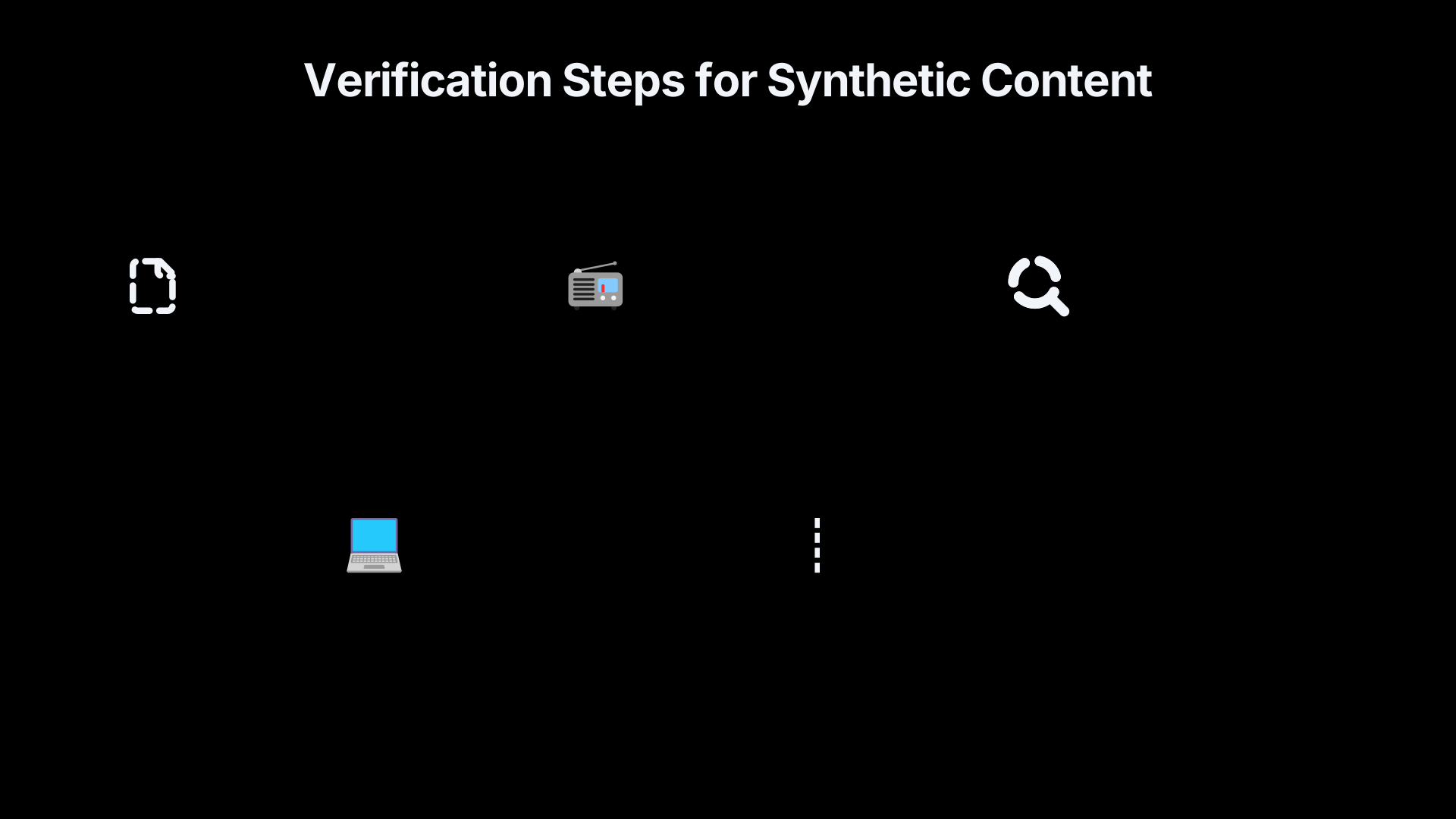
- Who is the original source?
Can the claim be traced to a named organisation, document, witness, or public record?
- Is there independent confirmation?
Are multiple reliable sources reporting the same event, or is the claim circulating mainly through reposts?
- Does the evidence exist outside the content itself?
A convincing image or video should not be the only support for an important claim.
- Can the quoted expert, institution, or speaker be verified?
Authentic authority can often be checked through official websites, statements, or records.
- What would persuade a sceptical observer?
If the answer is only “look at this image” or “listen to this audio”, the evidential basis may be weaker than it appears.
The central lesson is simple: AI has made emotional persuasion easier to package. It has not made evidence less necessary. In the age of synthetic media, professional presentation remains useful, but it is no longer a dependable shortcut to truth.[unesco.org+2cepr.org]unesco.orgdeepfakes and crisis knowingDeepfakes and the crisis of knowing27 Oct 2025 — As deepfakes blur reality, education must go beyond detection, teaching students to navi…
Amazon book picks
Further Reading
Books and field guides related to Why polished AI fakes feel more credible. Use these as the next step if you want deeper reading beyond the article.

The death of expertise
Explains why polished presentation can be mistaken for credibility.
The Constitution of Knowledge
Highlights verification mechanisms over presentation quality.
eBay marketplace picks
Marketplace Samples
Example marketplace items related to this page. Use the search link to explore similar finds on eBay.




Endnotes
1.
Source: mdpi.com
Link:https://www.mdpi.com/2304-6775/13/3/33
Source snippet
Mapping the Impact of Generative AI on Disinformationby A López-Borrull · 2025 · Cited by 38 — This article presents a scoping review...
2.
Source: edmo.eu
Title: Generative AI and Disinformation: Recent Advances
Link:https://edmo.eu/wp-content/uploads/2023/12/Generative-AI-and-Disinformation_-White-Paper-v8.pdf
Source snippet
by K Bontcheva · Cited by 56 — This can lead to the generation of fake content (deepfakes)... Moreover, as new generative AI tools c...
3.
Source: papers.ssrn.com
Link:https://papers.ssrn.com/sol3/Delivery.cfm/5192993.pdf?abstractid=5192993&mirid=1
Source snippet
First, Gen AI can hallucinate and misinformation can be present in the content gen-.Read more...
4.
Source: wired.com
Link:https://www.wired.com/story/generative-ai-custom-disinformation
Source snippet
Unlike the human-driven attempts of the past, such as the 2016 Russian interference in the US presidential election, AI tools can profile...
5.
Source: arxiv.org
Link:https://arxiv.org/abs/2409.17484
Source snippet
Crafting Synthetic Realities: Examining Visual Realism and Misinformation Potential of Photorealistic AI-Generated ImagesSeptember 2...
6.
Source: link.springer.com
Link:https://link.springer.com/article/10.1007/s10791-026-10077-1
Source snippet
It examines...Read more...
7.
Source: arxiv.org
Title: arXiv Characterizing AI-Generated Misinformation on Social Media
Link:https://arxiv.org/abs/2505.10266
Source snippet
Characterizing AI-Generated Misinformation on Social MediaMay 15, 2025...
Published: May 15, 2025
8.
Source: arxiv.org
Link:https://arxiv.org/abs/2604.15372
9.
Source: ijoc.org
Title: (Generative) AI and Disinformation—
Link:https://ijoc.org/index.php/ijoc/article/download/26088/5137/104469
Source snippet
IntroductionNovember 11, 2025 — For instance, visual disinformation such as deepfakes have become far more sophisticated (Shoaib, Wang, A...
Published: November 11, 2025
10.
Source: arxiv.org
Link:https://arxiv.org/html/2405.04097v2
Source snippet
Understanding Human Perception of Audiovisual DeepfakesThis paper aims to evaluate the human ability to discern deepfake videos through a...
11.
Source: unesco.org
Title: deepfakes and crisis knowing
Link:https://www.unesco.org/en/articles/deepfakes-and-crisis-knowing
Source snippet
Deepfakes and the crisis of knowing27 Oct 2025 — As deepfakes blur reality, education must go beyond detection, teaching students to navi...
12.
Source: cepr.org
Title: [ai misinformation]({{ ‘ai-virality/’ | relative_url }}) and value trusted news
Link:https://cepr.org/voxeu/columns/ai-misinformation-and-value-trusted-news
Source snippet
AI misinformation and the value of trusted news16 Sept 2025 — Artificial intelligence tools can now produce highly realistic text, images...
13.
Source: arxiv.org
Link:https://arxiv.org/html/2505.10266v1
Source snippet
Characterizing AI-Generated Misinformation on Social Media15 May 2025 — These patterns suggest that the AI-generated nature of content sh...
Published: May 2025
14.
Source: arxiv.org
Title: Blessing or curse?
Link:https://arxiv.org/html/2404.03021v2
Source snippet
A survey on the Impact of Generative AI...This survey provides a comprehensive examination of the research and practical use of Generati...
Additional References
15.
Source: researchgate.net
Link:https://www.researchgate.net/publication/396009805_Generative_AI_and_misinformation_a_scoping_review_of_the_role_of_generative_AI_in_the_generation_detection_mitigation_and_impact_of_misinformation
Source snippet
(PDF) Generative AI and misinformation: a scoping review...1 Oct 2025 — Analyzing 24 empirical studies, our review suggests that LLMs ca...
16.
Source: techradar.com
Link:https://www.techradar.com/ai-platforms-assistants/i-think-i-can-spot-an-ai-fake-but-the-latest-expert-research-suggests-im-wrong-heres-why
Source snippet
This poses serious risks, from political misinformation and financial scams to non-consensual image-based abuse and corporate fraud, whic...
17.
Source: accessnow.org
Link:https://www.accessnow.org/artificial-intelligence-and-disinformation-our-contribution-at-unescos-mobile-learning-week/
Source snippet
AI and disinformation: our contribution at UNESCO's...6 Mar 2019 — The discussion focused on two main aspects of the relationship betwee...
18.
Source: reutersinstitute.politics.ox.ac.uk
Link:https://reutersinstitute.politics.ox.ac.uk/news/how-ai-generated-disinformation-might-impact-years-elections-and-how-journalists-should-report
Source snippet
AI-generated disinformation might impact this year's...15 Mar 2024 — In a year in which around 2 billion people are eligible to vote in...
19.
Source: oecd.org
Link:https://www.oecd.org/content/dam/oecd/en/publications/reports/2023/09/initial-policy-considerations-for-generative-artificial-intelligence_1a9ab450/fae2d1e6-en.pdf
Source snippet
Initial policy considerations for generative artificial...by P Lorenz · 2023 · Cited by 135 — Overall, research finds that detection alg...
20.
Source: researchgate.net
Link:https://www.researchgate.net/publication/397195733_The_Rise_of_AI-Generated_Realities_Navigating_Truth_in_a_Synthetic_World
Source snippet
The Rise of AI-Generated Realities: Navigating Truth in a...3 Nov 2025 — From the proliferation of fake news and deepfakes to manipulate...
21.
Source: linkedin.com
Link:https://www.linkedin.com/pulse/ai-can-make-mistakes-urgent-need-media-literacy-digital-aleem-nu8tf
Source snippet
Helps citizens make informed decisions. Prevents the spread of fake news. Strengthens...Read more...
22.
Source: researchgate.net
Link:https://www.researchgate.net/publication/406388499_AI-Generated_Fake_News_Affects_People%27s_Trust_in_the_Technology_and_the_Medium
Source snippet
June 2026; Communications in Humanities Research 99(1):193-203.Read more...
Published: June 2026
23.
Source: misinforeview.hks.harvard.edu
Title: Misinformation Review Misinformation reloaded?
Link:https://misinforeview.hks.harvard.edu/article/misinformation-reloaded-fears-about-the-impact-of-generative-ai-on-misinformation-are-overblown/
Source snippet
Fears about the impact of...by FM Simon · 2023 · Cited by 198 — Still, generative AI might be able to improve on the content of already...
24.
Source: stimson.org
Title: ai in the age of fake imagined content
Link:https://www.stimson.org/2026/ai-in-the-age-of-fake-imagined-content/
Source snippet
AI in the Age of Fake (Imagined) Content23 Feb 2026 — AI is fundamentally changing how misinformation and disinformation are developed an...
Topic Tree