Within Influencers
Why Popular Posts Can Feel True
Visible approval signals can make weak or misleading posts look more reliable before readers check the evidence.
On this page
- How platform metrics act as credibility cues
- Why repeated sharing feels like confirmation
- Practical checks before trusting a high engagement claim
Page outline Jump by section
Introduction
On social media, a claim rarely appears on its own. It arrives with visible numbers: likes, reposts, shares, comments, views and follower counts. These signals are meant to show activity, but people often read them as evidence. A post with 50,000 likes can feel more trustworthy than a post with 50 likes, even when both contain exactly the same information.
 This matters for critical thinking because popularity and accuracy are not the same thing. Social platforms place approval signals directly beside claims, encouraging readers to make quick judgements before examining the evidence. Research shows that people frequently use engagement metrics as shortcuts when assessing information, turning social approval into a cue for credibility.[ResearchGate+2arXiv]researchgate.netThey Liked and Shared: Effects of Social Media Virality…This line of research suggests that users infer credibility or soc…
How Platform Metrics Become Credibility Cues
The basic mechanism is known as social proof. When people are uncertain, they often look to the behaviour of others as a guide. If thousands of users appear to approve of a post, the post can seem more reliable simply because many people have interacted with it.[The Decision Lab]thedecisionlab.comThe Decision LabSocial ProofSocial proof is a psychological phenomenon in which people look to the actions of others to determine how to…
On social media, this process happens extremely quickly. Instead of evaluating a claim from scratch, users may unconsciously ask:
- How many people seem to agree with this?
- Has it been widely shared?
- Do others appear to find it convincing?
- Is it attracting attention from influential accounts?
These questions are easier to answer than checking sources, reviewing evidence or comparing competing claims. As a result, engagement metrics can function as mental shortcuts. Studies examining virality metrics have found that users often infer credibility, influence or social desirability from visible popularity indicators.[ResearchGate]researchgate.netThey Liked and Shared: Effects of Social Media Virality…This line of research suggests that users infer credibility or soc…
The effect is particularly powerful because the numbers appear objective. A large like count looks factual and measurable. Yet the number only tells us that people interacted with the content. It does not tell us whether the underlying claim is accurate.
A striking example comes from research on engagement signals and misinformation. Experimental work found that exposure to social engagement metrics increased users’ vulnerability to misinformation, suggesting that popularity indicators can influence credibility judgements even when information quality remains unchanged.[arXiv]arxiv.orgOpen source on arxiv.org.
Why Repeated Sharing Feels Like Confirmation
Likes create a sense of approval, but reposts and shares add a second layer: repetition.
When people encounter the same claim multiple times, it becomes familiar. Familiarity is often mistaken for truth. Psychologists call this the illusory truth effect: repeated statements tend to feel more accurate than unfamiliar ones, regardless of whether they are actually true.[PMC+2PMC]pmc.ncbi.nlm.nih.govThe effects of repetition frequency on the illusory truth effectby A Hassan · 2021 · Cited by 402 — This is known as the illusory trut…
Social media amplifies this effect in several ways.[researchgate.net]researchgate.netSocial Media News Use Amplifies the Illusory Truth Effects…17 Oct 2024 — The illusory truth effect, in which repeated exposure increas…
First, a claim may be reposted by many different accounts. Although the message originates from a single source, it appears repeatedly in different contexts, creating the impression of independent confirmation.
Second, users often encounter screenshots, quote-posts, reaction videos and commentary that repeat the original claim. Even criticism can increase familiarity by exposing more people to the statement.
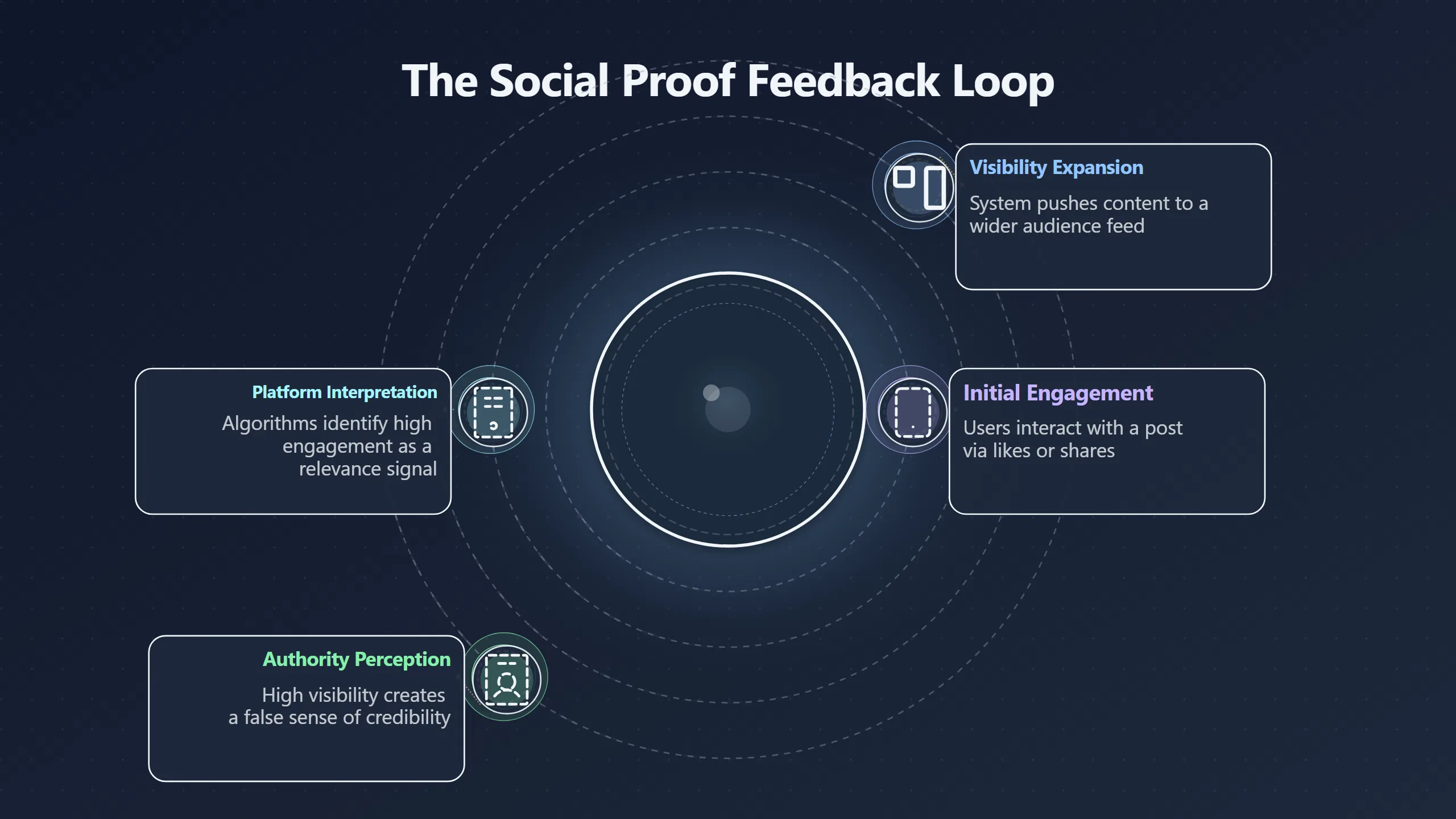
Third, recommendation systems frequently boost content that already receives engagement. This creates a feedback loop in which visibility generates more engagement, which generates more visibility. Research on engagement-driven ranking systems suggests that giving greater weight to likes and shares can increase the spread of misinformation alongside overall engagement.[ifo Institut]ifo.deifo InstitutRanking for Engagement: How Social Media Algorithms…This paper investigates the dynamic feedback loop between recommendati…
Evidence shows that repeated exposure affects sharing behaviour as well as belief. Researchers have found that people become more likely to share information they have seen before because repetition increases perceived accuracy.[PMC]pmc.ncbi.nlm.nih.govThe illusory truth effect leads to the spread of misinformationby V Vellani · 2023 · Cited by 121 — That is, repeated information seem…
The result is a subtle but important shift: repeated visibility begins to feel like verification, even though repetition only proves that a claim has circulated widely.
Why Popularity and Truth Often Diverge
A common mistake is assuming that highly engaged content must have passed some kind of collective fact-check.
In reality, engagement measures attention, not accuracy.
People share content for many reasons:
- Agreement
- Humour
- Anger
- Surprise
- Identity signalling
- Group loyalty
- Curiosity
A misleading post can accumulate enormous engagement because it is emotionally compelling, controversial or entertaining. Research on misinformation consistently shows that false or misleading content can attract substantial engagement and spread widely online.[PMC+2arXiv]pmc.ncbi.nlm.nih.govPMC(Why) Is Misinformation a Problem?by Z Adams · 2023 · Cited by 147 — (2022) showed that news classified as misinformation can garner increased attention, gauged by the…
This is especially relevant in influencer-driven environments. Followers may interpret strong engagement as evidence that a creator is trustworthy. Yet popularity often reflects audience size, community loyalty or platform incentives rather than subject-matter expertise. UNESCO has reported that many online creators do not routinely verify information before sharing it, illustrating how large audiences and accurate information do not automatically go together.[The Guardian]theguardian.comAccording to a survey by Unesco, two-thirds of content creators do not verify the accuracy of their information before sharing, leaving b…
There is also evidence that engagement cues do not always operate in a simple “more likes equals more trust” pattern. Some studies suggest that unusually high engagement can itself appear suspicious under certain conditions. Even so, visible metrics remain powerful signals that shape first impressions of credibility.[IDEAS/RePEc]ideas.repec.orgIDEAS/RePEcWhen more likes is not better: the consequences of high andby ELE De Vries · 2019 · Cited by 138 — The findings indicate that…
The Feedback Loop Between Attention and Authority
One reason popularity becomes confused with credibility is that social media compresses several signals into a single visible package.
A post gains likes.
The platform interprets those likes as a sign of relevance.
The post is shown to more users.
More users engage with it.
The growing engagement then serves as evidence of popularity for future viewers.
Over time, attention itself begins to resemble authority. A claim that repeatedly appears in feeds can feel important simply because it is difficult to avoid. Research on algorithmic ranking systems highlights this feedback loop between engagement signals, recommendation systems and information exposure.[ifo Institut]ifo.deifo InstitutRanking for Engagement: How Social Media Algorithms…This paper investigates the dynamic feedback loop between recommendati…
The danger is not that every popular claim is false. Many widely shared claims are accurate. The problem is that popularity and accuracy become visually intertwined, making it easy to mistake one for the other.
Practical Checks Before Trusting a High-Engagement Claim
High engagement should be treated as a signal that a claim is attracting attention, not as proof that it is correct.
Before accepting a popular post, consider a few simple questions:
Would the claim still seem convincing if the like count were hidden?
Try to focus on the evidence presented rather than the visible reaction.
Is the post linking to verifiable sources?
Look for original documents, data, research or direct reporting rather than screenshots of screenshots.
Are multiple independent sources confirming the claim?
Repeated sharing by different accounts is not the same as independent verification.
What exactly are people endorsing?
Users may be liking a joke, supporting a personality or reacting emotionally rather than endorsing the factual content.
Has the claim been checked elsewhere?
A quick search can reveal whether reputable news organisations, researchers or fact-checkers have examined it.
These checks slow down a process that social media encourages people to perform instantly. The goal is not to ignore popularity entirely but to prevent engagement metrics from replacing evidence.

What Critical Thinkers Should Remember
Likes and reposts are social signals, not truth signals. They can indicate interest, agreement, outrage, entertainment or group identity, but they cannot establish whether a claim is accurate. Research on social proof, engagement metrics and repetition shows that visible approval and repeated exposure can make information feel more credible than it deserves.[PMC+3arXiv+3ResearchGate]arxiv.orgOpen source on arxiv.org.
In an environment where influencers, algorithms and online communities compete for attention, one of the most useful critical-thinking habits is separating a claim’s popularity from its evidence. A post may be everywhere. That does not mean it has been verified.
Amazon book picks
Further Reading
Books and field guides related to Why Popular Posts Can Feel True. Use these as the next step if you want deeper reading beyond the article.

Foolproof: Why We Fall for Misinformation and How to Build Im...
Explains why repeated and popular claims feel true.

eBay marketplace picks
Marketplace Samples
Example marketplace items related to this page. Use the search link to explore similar finds on eBay.




Endnotes
1.
Source: researchgate.net
Link:https://www.researchgate.net/publication/322911633_They_Liked_and_Shared_Effects_of_Social_Media_Virality_Metrics_on_Perceptions_of_Message_Influence_and_Behavioral_Intentions
Source snippet
They Liked and Shared: Effects of Social Media Virality...This line of research suggests that users infer credibility or soc...
2.
Source: arxiv.org
Link:https://arxiv.org/abs/2005.04682
3.
Source: pmc.ncbi.nlm.nih.gov
Link:https://pmc.ncbi.nlm.nih.gov/articles/PMC12451025/
Source snippet
Role of Real‐Time Engagement in Shaping Social Media...by X Lu · 2025 · Cited by 13 — Digital cues like comments, likes, and follower co...
4.
Source: pmc.ncbi.nlm.nih.gov
Link:https://pmc.ncbi.nlm.nih.gov/articles/PMC8116821/
Source snippet
The effects of repetition frequency on the illusory truth effectby A Hassan · 2021 · Cited by 402 — This is known as the illusory trut...
5.
Source: pmc.ncbi.nlm.nih.gov
Link:https://pmc.ncbi.nlm.nih.gov/articles/PMC10636596/
Source snippet
The illusory truth effect leads to the spread of misinformationby V Vellani · 2023 · Cited by 121 — That is, repeated information seem...
6.
Source: ifo.de
Link:https://www.ifo.de/en/cesifo/publications/2026/working-paper/ranking-engagement-how-social-media-algorithms-fuel-misinformation
Source snippet
ifo InstitutRanking for Engagement: How Social Media Algorithms...This paper investigates the dynamic feedback loop between recommendati...
7.
Source: arxiv.org
Link:https://arxiv.org/abs/2302.05443
8.
Source: ideas.repec.org
Link:https://ideas.repec.org/a/kap/mktlet/v30y2019i3d10.1007_s11002-019-09496-6.html
Source snippet
IDEAS/RePEcWhen more likes is not better: the consequences of high andby ELE De Vries · 2019 · Cited by 138 — The findings indicate that...
9.
Source: researchgate.net
Title: 401555600 The Influence of Social Proof on Consumer Trust in New Online Stores
Link:https://www.researchgate.net/publication/401555600_The_Influence_of_Social_Proof_on_Consumer_Trust_in_New_Online_Stores
Source snippet
The Influence of Social Proof on Consumer Trust in New...31 May 2026 — Social Proof has a positive and significant effect on Consumer Tr...
Published: May 2026
10.
Source: researchgate.net
Link:https://www.researchgate.net/publication/381445383_From_Hearts_to_Carts_Understanding_the_Impact_of_Comments_Likes_and_Share_Functions_on_Consumer_Purchase_Intentions_in_a_Social_Media_Landscape
Source snippet
king platforms, such as comments, likes, and shares, impact consumer purchasing...Read more...
11.
Source: researchgate.net
Title: 394592749 Social Media Misinformation and Trustability
Link:https://www.researchgate.net/publication/394592749_Social_Media_Misinformation_and_Trustability
Source snippet
I believe that Instagram is credible. 2.61 High · 2. I believe the information and updates in 2.61 High. Instagram are reliable. · 3.Read...
12.
Source: researchgate.net
Title: 380530016 Decoding Social Proof In Consumer Psychology
Link:https://www.researchgate.net/publication/380530016_Decoding_Social_Proof_In_Consumer_Psychology
Source snippet
(PDF) Decoding Social Proof In Consumer Psychology12 May 2024 — This article investigates the psychological mechanisms underpinning socia...
Published: May 2024
13.
Source: researchgate.net
Title: 369031522 The illusory truth effect leads to the spread of misinformation
Link:https://www.researchgate.net/publication/369031522_The_illusory_truth_effect_leads_to_the_spread_of_misinformation
Source snippet
The illusory truth effect leads to the spread of misinformation23 Apr 2026 — In addition, research has shown that repeated exposure to mi...
14.
Source: researchgate.net
Link:https://www.researchgate.net/publication/401405020_Ranking_for_engagement_How_social_media_algorithms_fuel_misinformation_and_polarization
Source snippet
Ranking for engagement: How social media algorithms fuel...13 Mar 2026 — This paper investigates the dynamic feedback loop between recom...
15.
Source: researchgate.net
Link:https://www.researchgate.net/publication/385037614Social_Media_News_Use_Amplifies_the_Illusory_Truth_Effects_of_Viral[Deepfakes
Source snippet
Social Media News Use Amplifies the Illusory Truth Effects...17 Oct 2024 — The illusory truth effect, in which repeated exposure increas...
16.
Source: researchgate.net
Link:https://www.researchgate.net/publication/332056674_In_likes_we_trust_likes_disclosures_and_firm-serving_motives_on_social_media
Source snippet
(2019) found that a social media ad displayed with a higher number of "likes" is perceived to be more credible, which can then yield...R...
17.
Source: time.com
Title: why false claims seem truer the more you hear them
Link:https://time.com/article/2026/04/27/why-false-claims-seem-truer-the-more-you-hear-them/
Source snippet
Apr 28, 2026 — People in Barber's field refer to this as the “illusory truth effect.” In our era of online misinformation and conspiracy...
18.
Source: ideas.repec.org
Link:https://ideas.repec.org/p/upf/upfgen/1912.html
Source snippet
for engagement: How social media algorithms fuel...by F Germano · 2025 · Cited by 10 — This paper investigates the dynamic feedback loop...
19.
Source: thedecisionlab.com
Link:https://thedecisionlab.com/reference-guide/psychology/social-proof
Source snippet
The Decision LabSocial ProofSocial proof is a psychological phenomenon in which people look to the actions of others to determine how to...
20.
Source: ebsco.com
Link:https://www.ebsco.com/research-starters/psychology/illusory-truth-effect
Source snippet
Illusory truth effect | Psychology | Research StartersThe illusory truth effect is a cognitive phenomenon where repeated exposure to fals...
21.
Source: pmc.ncbi.nlm.nih.gov
Title: PMC(Why) Is Misinformation a Problem?
Link:https://pmc.ncbi.nlm.nih.gov/articles/PMC10623619/
Source snippet
by Z Adams · 2023 · Cited by 147 — (2022) showed that news classified as misinformation can garner increased attention, gauged by the...
22.
Source: theguardian.com
Link:https://www.theguardian.com/media/2024/nov/26/online-influencers-need-urgent-fact-checking-training-warns-unesco
Source snippet
According to a survey by Unesco, two-thirds of content creators do not verify the accuracy of their information before sharing, leaving b...
23.
Source: pmc.ncbi.nlm.nih.gov
Link:https://pmc.ncbi.nlm.nih.gov/articles/PMC10879158/
Source snippet
NIHby CS Traberg · 2024 · Cited by 65 — We find that social cues only impact individual judgements when they influence perceptions...
24.
Source: pubmed.ncbi.nlm.nih.gov
Link:https://pubmed.ncbi.nlm.nih.gov/36871397/
Source snippet
illusory truth effect leads to the spread of misinformationby V Vellani · 2023 · Cited by 121 — The illusory truth effect leads to the sp...
25.
Source: pmc.ncbi.nlm.nih.gov
Link:https://pmc.ncbi.nlm.nih.gov/articles/PMC12723361/
Source snippet
by T Warin · 2025 · Cited by 2 — This study aims to assess the evolution of the WHO's popular legitimacy from 2008 to 2021 by analyzin...
26.
Source: pmc.ncbi.nlm.nih.gov
Link:https://pmc.ncbi.nlm.nih.gov/articles/PMC11803327/
Source snippet
by HY Kuo · 2025 · Cited by 10 — For MOHW posts, the reference keywords included misinformation, false information, clarification, and...
27.
Source: pmc.ncbi.nlm.nih.gov
Link:https://pmc.ncbi.nlm.nih.gov/articles/PMC9188446/
Source snippet
Misinformation by Sharing the Truth: a Study on...by J Li · 2022 · Cited by 106 — In this research, we aim to uncover the key factors th...
28.
Source: pmc.ncbi.nlm.nih.gov
Link:https://pmc.ncbi.nlm.nih.gov/articles/PMC12543200/
Source snippet
by P Ranjith · 2025 · Cited by 5 — Trust in online communities also reduces perceived risk and mediates the relationship between infor...
29.
Source: pmc.ncbi.nlm.nih.gov
Link:https://pmc.ncbi.nlm.nih.gov/articles/PMC11894805/
Source snippet
by S Milli · 2025 · Cited by 216 — Social media ranking algorithms typically optimize for users' revealed preferences, i.e. user engag...
30.
Source: dictionary.cambridge.org
Link:https://dictionary.cambridge.org/dictionary/english/social
Source snippet
related to meeting and spending time with other people for pleasure: He had almost no...Read more...
31.
Source: coursera.org
Title: social proof
Link:https://www.coursera.org/articles/social-proof
Source snippet
What Is Social Proof and How to Use It?23 Oct 2025 — Since people trust social proof, social proof marketing helps establish credibility...
32.
Source: thedecisionlab.com
Title: Illusory truth effect
Link:https://thedecisionlab.com/biases/illusory-truth-effect
Source snippet
The Decision...Fake news and social polarization. Fake News Illusory Truth Effect. The... Prior exposure increases perceived accuracy o...
33.
Source: annieduke.substack.com
Title: the illusory truth effect
Link:https://annieduke.substack.com/p/the-illusory-truth-effect
Source snippet
Illusory Truth Effect - by Annie DukeAmid a flurry of research into the dangers posed by misinformation on social media... illusory trut...
34.
Source: Wikipedia
Title: Illusory truth effect
Link:https://en.wikipedia.org/wiki/Illusory_truth_effect
Source snippet
Illusory truth effectRepetition makes statements easier to process relative to new, unrepeated statements, leading people to believe t...
35.
Source: psychologytoday.com
Title: illusory truth effect
Link:https://www.psychologytoday.com/au/basics/illusory-truth-effect
Source snippet
12 Nov 2025 — Repeated statements, whether they are factually true or false, are easier to process—they create processing fluency, which...
Additional References
36.
Source: psychologicalscience.org
Link:https://www.psychologicalscience.org/news/repeating-misinformation-doesnt-make-it-true-but-does-make-it-more-likely-to-be-believed.html
Source snippet
Repeating Misinformation Doesn't Make It True, But Does...Sep 2, 2020 — According to a 2015 study in the Journal of Experimental Psychol...
37.
Source: ssa.gov
Link:https://www.ssa.gov/
38.
Source: facebook.com
Link:https://www.facebook.com/AmericanPsychologicalAssociation/posts/you-keep-seeing-the-same-claim-made-over-and-over-onlineso-it-must-be-true-right/1290086699819665/
Source snippet
American Psychological AssociationReal-world impact Misinformation and fake news: The illusory truth effect is a key reason why false inf...
39.
Source: wired.com
Link:https://www.wired.com/story/right-wing-fake-news-more-engagement-facebook
Source snippet
The study analyzed 2,973 US news sources categorized by partisanship and accuracy, finding that right-wing misinformation received 65 per...
40.
Source: psychologytoday.com
Link:https://www.psychologytoday.com/us/basics/illusory-truth-effect
Source snippet
Illusory Truth EffectThe illusory truth effect is the tendency for any statement that is repeated frequently—whether it is factually true...
41.
Source: papers.ssrn.com
Link:https://papers.ssrn.com/sol3/papers.cfm?abstract_id=5316506
Source snippet
for Engagement: How Social Media Algorithms...by F Germano · Cited by 11 — This paper investigates the dynamic feedback loop between rec...
42.
Source: tmla.co.uk
Link:https://tmla.co.uk/article/social-proof-in-action/
Source snippet
Social proof in action: How reviews, influencers and UGC...19 Jun 2025 — Social proof builds trust and reduces uncertainty...
43.
Source: business-school.ed.ac.uk
Title: exploration on number of likes and perceived credibility
Link:https://www.business-school.ed.ac.uk/collaborate/dissertation-executive-summaries/exploration-on-number-of-likes-and-perceived-credibility
Source snippet
University of Edinburgh Business SchoolExploration on number of likes and perceived credibility...17 Nov 2022 — This research, therefore...
44.
Source: osf.io
Link:https://osf.io/download/nkpgz/
Source snippet
The illusory truth effect leads to the spread of misinformationby V Vellani · Cited by 121 — Keywords: Information-sharing, Illusory t...
45.
Source: committees.parliament.uk
Link:https://committees.parliament.uk/writtenevidence/132995/pdf/
Source snippet
media, misinformation and harmful algorithms.Engagement Drives Harm: Social media platforms use algorithms to prioritise engagement...
Topic Tree