Within Mixed Feeds
Why popularity can look like proof
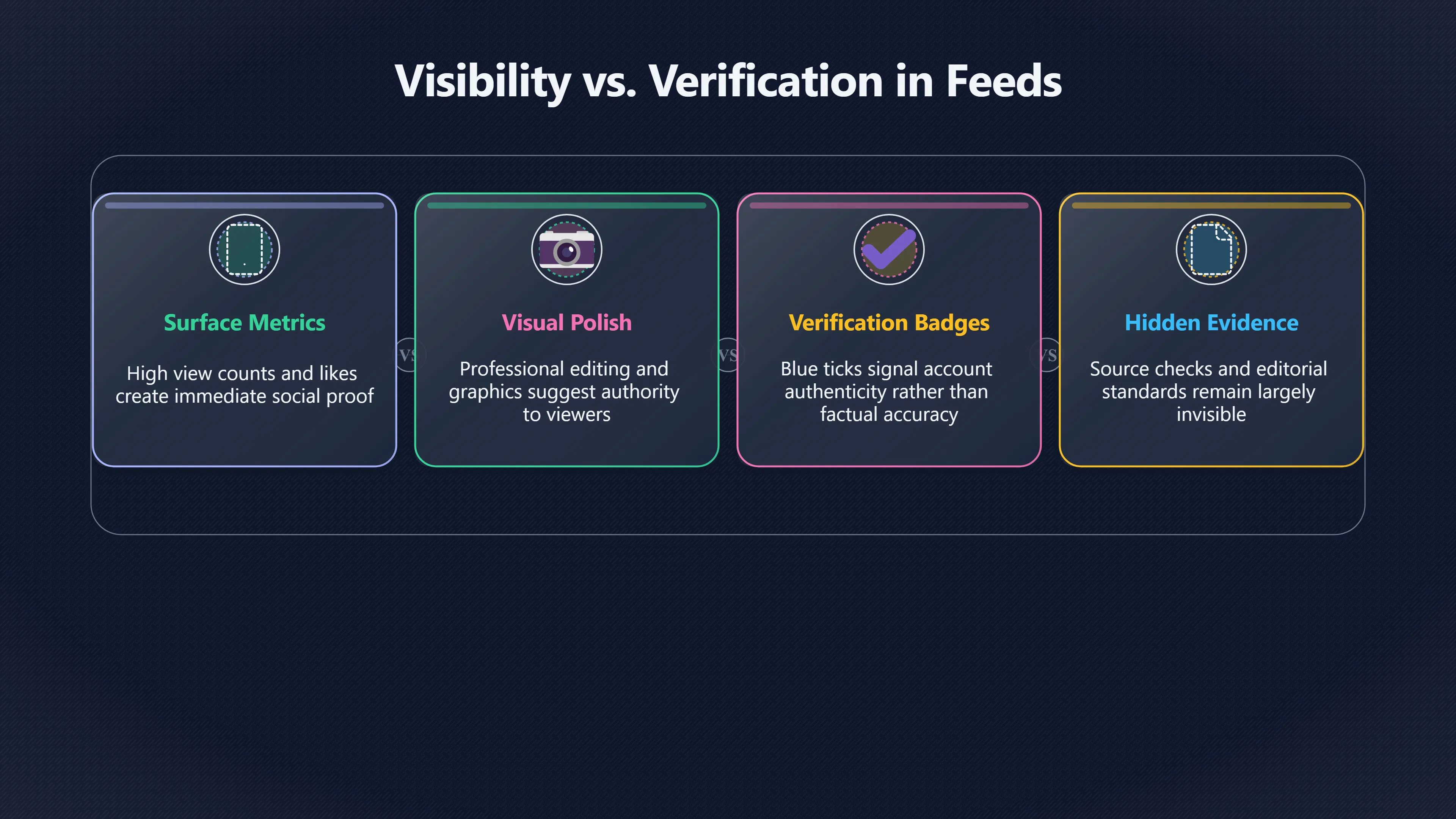
Verification badges, view counts, avatars and polished video formats can feel like trust signals even when they only show visibility.
On this page
- The feed features readers often mistake for credibility
- How standardised post design flattens different source types
- A checklist for separating visibility from verification
Page outline Jump by section
Introduction
In mixed social feeds, credibility is often inferred before it is evaluated. A post may look trustworthy not because readers have checked its evidence, source, or accuracy, but because the platform surrounds it with signals that resemble authority. Verification badges, view counts, follower numbers, professional-looking video formats, and polished account profiles can create an impression of reliability even when they mainly indicate visibility, identity confirmation, or popularity rather than truthfulness. This matters because social platforms place journalism, advertising, opinion, entertainment, activism, and AI-generated content inside nearly identical visual containers. As a result, readers can mistake attention signals for evidence and familiarity for verification. Research on social media credibility, source attribution, and platform design shows that these cues shape trust judgments, sometimes independently of the underlying quality of the information.[PMC+2reutersinstitute.politics.ox.ac.uk]pmc.ncbi.nlm.nih.govthis paper proposed to empowerVirtual lab coats: The effects of verified source information on…by J Geels · 2024 · Cited by 22 — this paper aims to explore how v…

The feed features readers often mistake for credibility
The most influential credibility cues on social platforms are often not evidence-related cues at all. They are shortcuts that help users make rapid decisions in environments overloaded with information.
A verification badge is a useful example. Originally, badges were designed to help distinguish authentic accounts from impersonators. They indicate that an account has met platform-specific verification requirements, not that every post from that account is accurate. Yet studies have found that verification markers can increase trust and encourage sharing because users interpret the badge as a broader signal of credibility and authority.[Emerald+2ResearchGate]emerald.comDoes the verified badge of social media matter? The…13 Dec 2023 — This research aims to investigate the impact of verified badg…
Engagement metrics operate in a similar way. Large numbers of likes, shares, comments, views, or followers can function as forms of social proof. People often assume that if many others have engaged with content, it must have value or legitimacy. Research on virality metrics has shown that high engagement can affect perceptions of influence and importance, even when the engagement itself says little about factual accuracy.[ResearchGate]researchgate.netThey Liked and Shared: Effects of Social Media Virality…Social Media Virality Metrics: High shares of a posting on Faceboo…
Other weak cues include:
- Professional production quality: Clear audio, strong editing, graphics, and confident presentation can make unsupported claims seem more persuasive.
- Large follower counts: Audience size is frequently interpreted as expertise despite measuring popularity rather than knowledge.
- Frequent posting and visibility: Repeated exposure can create familiarity, which people may unconsciously interpret as trustworthiness.
- Recognisable profile design: Logos, branded imagery, and consistent visual identity can create an institutional appearance even when little accountability exists behind the account.
The key issue is that these cues are not meaningless. Verification can help identify authentic accounts. Follower counts do indicate audience size. High-quality production can reflect effort. The problem arises when readers unconsciously treat these signals as evidence of truth.
Why social proof feels persuasive
Humans rarely evaluate every claim from first principles. In uncertain situations, people often look to the behaviour of others as a guide. Psychologists refer to this tendency as social proof.
Social platforms are built around displaying social proof continuously. Every post arrives accompanied by visible metrics showing what other people have watched, liked, shared, or discussed. These numbers create an impression that collective attention itself carries informational value.[Bristol Creative Industries]bristolcreativeindustries.comBristol Creative Industries Social Proof: the psychology behind marketingBristol Creative Industries Social Proof: the psychology behind marketing
In practice, however, attention and accuracy are different things. A dramatic rumour may attract enormous engagement because it is surprising. An emotional video may spread because it provokes outrage. A misleading claim may accumulate shares because people are arguing about it rather than endorsing it. Engagement measures activity, not verification.
The design challenge is that engagement metrics are highly visible while verification processes are often hidden. Readers see the share count immediately. They usually do not see the source checks, editorial standards, evidence trail, or fact-checking history that would allow a more informed judgement.
How standardised post design flattens different source types
One of the most important design features of modern feeds is standardisation. Posts from radically different sources are presented using nearly identical visual structures.
A report from a major newsroom, a government announcement, a parody account, an influencer opinion, a sponsored promotion, and an AI-generated video may all appear with the same profile image format, text layout, interaction buttons, and recommendation system. The platform’s design language creates visual equivalence even when the underlying sources differ greatly in expertise, accountability, and editorial oversight.
Research from the Reuters Institute shows that people are significantly less likely to correctly identify the originating news organisation when they encounter stories through social media or search rather than directly. In distributed environments, source attribution weakens because platform presentation becomes more prominent than publisher identity. reutersinstitute.politics.ox.ac.uk+2reutersinstitute.politics.ox.ac.uk[reutersinstitute.politics.ox.ac.uk]reutersinstitute.politics.ox.ac.uka news brand if they accessed it directly rather than via search or social.Read more…
This creates a subtle but important shift. Instead of asking, “Who produced this information?”, readers may first encounter signals such as:
- How many views does it have?
- Is the account verified?
- Do people seem to agree with it?
- Does it look professional?
- Has it appeared repeatedly in my feed?
These questions are easier to answer than evaluating evidence, but they are often much weaker indicators of reliability.
When visibility outruns verification
Platform incentives can amplify this problem because recommendation systems generally reward engagement before information has been thoroughly assessed.
A post can become highly visible because it triggers strong emotional reactions, matches audience interests, or benefits from network effects. None of these mechanisms requires the information to be accurate. Visibility is therefore often a measure of successful distribution rather than successful verification.
This distinction becomes especially important during breaking news events. Early reports frequently circulate before journalists, officials, or experts have gathered complete information. During these moments, posts can accumulate millions of views while still containing uncertainty, speculation, or errors.
The design of the feed can make visibility appear like validation. Readers may interpret widespread circulation as proof that claims have already been checked, when in reality the opposite may be true: the information is spreading faster than verification can occur.

A checklist for separating visibility from verification
When evaluating information in a mixed social feed, it helps to deliberately separate popularity signals from evidence signals.
Ask the following questions:
- What does this cue actually measure? A view count measures exposure. A follower count measures audience size. A verification badge usually measures account authenticity. None automatically measures accuracy.
- Can I identify the original source? Look beyond reposts, screenshots, and cropped clips. Find the originating publisher, organisation, document, or speaker.
- What evidence is being presented? Are there documents, data, witnesses, links, or named experts? Or is the claim relying mainly on presentation and confidence?
- Would the claim seem persuasive without the metrics? Imagine the post with no likes, shares, or follower counts visible. Does the underlying argument remain convincing?
- Is attention being confused with agreement? High engagement may indicate controversy, criticism, or curiosity rather than endorsement.
- Who is accountable if the information is wrong? Established institutions, journalists, and official bodies usually have clearer correction processes than anonymous or loosely organised accounts.
The core mechanism
The central mechanism is not that users are irrational. It is that platform design encourages fast judgements using highly visible signals. Verification badges, engagement counts, follower numbers, and polished presentation are easy to process in a fraction of a second. Evidence quality, sourcing, and verification standards require more effort to evaluate.
In mixed social feeds, these two forms of information often compete. The platform foregrounds visibility cues because they are simple, measurable, and engaging. Credibility cues tied to evidence are frequently less prominent. Critical thinking therefore begins with recognising that popularity, reach, and professional appearance may explain why content is visible, but they do not by themselves explain why it should be believed.[PMC+2reutersinstitute.politics.ox.ac.uk]pmc.ncbi.nlm.nih.govthis paper proposed to empowerVirtual lab coats: The effects of verified source information on…by J Geels · 2024 · Cited by 22 — this paper aims to explore how v…
Amazon book picks
Further Reading
Books and field guides related to Why popularity can look like proof. Use these as the next step if you want deeper reading beyond the article.

The art of thinking clearly
Covers cognitive biases that affect credibility assessments.

eBay marketplace picks
Marketplace Samples
Example marketplace items related to this page. Use the search link to explore similar finds on eBay.


Endnotes
1.
Source: pmc.ncbi.nlm.nih.gov
Title: this paper proposed to empower
Link:https://pmc.ncbi.nlm.nih.gov/articles/PMC11135712/
Source snippet
Virtual lab coats: The effects of verified source information on...by J Geels · 2024 · Cited by 22 — this paper aims to explore how v...
2.
Source: reutersinstitute.politics.ox.ac.uk
Link:https://reutersinstitute.politics.ox.ac.uk/our-research/news-brand-attribution-distributed-environments-do-people-know-where-they-get-their
Source snippet
a news brand if they accessed it directly rather than via search or social.Read more...
3.
Source: reutersinstitute.politics.ox.ac.uk
Link:https://reutersinstitute.politics.ox.ac.uk/our-research/i-saw-news-facebook-brand-attribution-when-accessing-news-distributed-environments
Source snippet
cular story when coming from search engines or social media.Read more...
4.
Source: emerald.com
Link:https://www.emerald.com/jrim/article/18/6/1017/1235205/Does-the-verified-badge-of-social-media-matter-The
Source snippet
Does the verified badge of social media matter? The...13 Dec 2023 — This research aims to investigate the impact of verified badg...
5.
Source: researchgate.net
Link:https://www.researchgate.net/publication/385212979_Does_the_verified_badge_of_social_media_matter_The_perspective_of_trust_transfer_theory
Source snippet
Does the verified badge of social media matter...Platform signals reinstate thresholds: verification badges boost trust and...
6.
Source: researchgate.net
Link:https://www.researchgate.net/publication/322911633_They_Liked_and_Shared_Effects_of_Social_Media_Virality_Metrics_on_Perceptions_of_Message_Influence_and_Behavioral_Intentions
Source snippet
They Liked and Shared: Effects of Social Media Virality...Social Media Virality Metrics: High shares of a posting on Faceboo...
7.
Source: pmc.ncbi.nlm.nih.gov
Link:https://pmc.ncbi.nlm.nih.gov/articles/PMC12451025/
Source snippet
Role of Real‐Time Engagement in Shaping Social Media...by X Lu · 2025 · Cited by 4 — This study extends ELM by linking information credi...
8.
Source: reutersinstitute.politics.ox.ac.uk
Link:https://reutersinstitute.politics.ox.ac.uk/sites/default/files/2017-07/Brand%20attributions%20report.pdf
Source snippet
This compares with an attribution rate of 81% for users who arrived directly from...Read more...
9.
Source: researchgate.net
Title: 313737416 Social proof in social media shopping An experimental design research
Link:https://www.researchgate.net/publication/313737416_Social_proof_in_social_media_shopping_An_experimental_design_research
Source snippet
Social proof in social media shopping: An experimental...29 Apr 2026 — This study empirically compares the effect of number of followers...
10.
Source: researchgate.net
Link:https://www.researchgate.net/publication/331625988_The_Blue_Check_of_Credibility_Does_Account_Verification_Matter_When_Evaluating_News_on_Twitter
Source snippet
ion and account credibility among news organizations.Read more...
11.
Source: researchgate.net
Link:https://www.researchgate.net/publication/327942993_News_brand_attribution_in_distributed_environments_Do_people_know_where_they_get_their_news
Source snippet
News brand attribution in distributed environmentsWe call this “news brand attribution.” Based on a unique combination of passive trackin...
12.
Source: reutersinstitute.politics.ox.ac.uk
Link:https://reutersinstitute.politics.ox.ac.uk/sites/default/files/research/files/Brand%2520and%2520trust%2520in%2520a%2520fragmented%2520news%2520environment.pdf
Source snippet
and trust in a fragmented news environmentThe qualitative study explored issues of brand and trust in an increasingly fragmented news env...
13.
Source: bristolcreativeindustries.com
Title: Bristol Creative Industries Social Proof: the psychology behind marketing
Link:https://bristolcreativeindustries.com/social-proof-the-psychology-behind-marketing/
14.
Source: pmc.ncbi.nlm.nih.gov
Link:https://pmc.ncbi.nlm.nih.gov/articles/PMC12543200/
Source snippet
by P Ranjith · 2025 · Cited by 7 — Firstly, the study aims to evaluate the impact of source credibility on perceived risk. Secondly, i...
15.
Source: dictionary.cambridge.org
Link:https://dictionary.cambridge.org/dictionary/english/social
Source snippet
related to meeting and spending time with other people for pleasure: He had almost no...Read more...
Additional References
16.
Source: reutersagency.com
Link:https://reutersagency.com/brand-attribution-guidelines/
Source snippet
Reuters Brand Attribution Guidelines ExplainedThe Reuters Brand Attribution Guidelines are part of your Agreement with Reuters and protec...
17.
Source: mediareform.org.uk
Link:https://www.mediareform.org.uk/wp-content/uploads/2015/12/Reuters_Handbook_of_Journalism.pdf
Source snippet
Reuters Handbook of Journalism Standards and ValuesReuters will publish news from a single, anonymous source in exceptional cases, when i...
18.
Source: socialfinance.org.uk
Link:https://www.socialfinance.org.uk/
Source snippet
Social Finance | We are here for goodBringing people, ideas, and money together, we tackle society's toughest challenges and help improve...
19.
Source: thesocial.com
Link:https://www.thesocial.com/
Source snippet
The Social LondonOfficial Website for The Social London. Find all Upcoming Events with Lineups and set times, latest news and announcemen...
20.
Source: thesocial.com
Link:https://www.thesocial.com/events/
Source snippet
The Social London | EventsFind all Upcoming Events at The Social London. Find full event information including, lineups, set times, entry...
21.
Source: merriam-webster.com
Link:https://www.merriam-webster.com/dictionary/social
Source snippet
SOCIAL Definition & MeaningThe meaning of SOCIAL is marked by or passed in pleasant companionship with friends or associates. How to use...
22.
Source: wavesdigitalmarketing.co.uk
Link:https://www.wavesdigitalmarketing.co.uk/blogs/the-blue-tick
23.
Source: wadedigital.co.uk
Title: using social proof to build trust and credibility on your website
Link:https://wadedigital.co.uk/advice/using-social-proof-to-build-trust-and-credibility-on-your-website/
Source snippet
Showcase Customer Testimonials and Reviews · 2. Use Case Studies to Tell Stories That Sell · 3. Display Client Logos and Media Mentions ·...
24.
Source: copelandsocial.com
Link:https://copelandsocial.com/
Source snippet
t of Peckham's local creative talent, serving coffee by day and top-notch cocktails by...Read more...
25.
Source: wsiworld.com
Title: Learn how brands can build trust and visibility without chasing
Link:https://www.wsiworld.com/blog/the-new-role-of-social-media-what-builds-trust-and-credibility-now
Source snippet
The New Role of Social Media: What Builds Trust and...Jan 20, 2026 — Social media now rewards credibility, community, and real human voices...
Topic Tree