Within AI Virality
Why AI detection keeps getting harder
As synthetic media improves, detection tools can become less reliable, making reader habits more important.

On this page
- Why model improvements weaken old tells
- What detector limits mean for X posts
- Verification habits that do not depend on detectors
Page outline Jump by section
Introduction
AI detectors promise a simple solution to a difficult problem: identify whether a post, image, video or piece of text was generated by artificial intelligence. In practice, however, AI detection is a moving target. As generative models improve, many of the clues that detectors rely on become weaker, disappear entirely, or are replaced by new patterns. This creates a continuing cycle in which generation systems become more convincing, detectors adapt, and newer generation systems learn to avoid the latest detection methods. Researchers and standards bodies often describe this dynamic as an arms race.[NIST AI Resource Center]airc.nist.govNIST AI Resource CenterReducing Risks Posed by Synthetic ContentApr 15, 2024 — leading to an “arms race” to develop new detection methods…
 For readers encountering fast-moving content on X, the key implication is that detection tools can be useful signals but should not be treated as definitive proof. The more realistic synthetic media becomes, the more important it is to evaluate claims, sources and context rather than relying on a detector score alone.[NIST AI Challenge Problems]ai-challenges.nist.govNIST AI Challenge ProblemsGenAI: Deepfakes 2026 - NIST AI ChallengesWith modern generative AI, a photograph can be harvested from social…
Why model improvements weaken old tells
Early generations of AI-generated content often left visible fingerprints. Images might contain distorted hands, impossible reflections or inconsistent text. Synthetic writing sometimes displayed repetitive phrasing or unusual predictability. Detection systems were trained to recognise these recurring artefacts.
The problem is that generative models do not stand still. Newer image systems produce more realistic anatomy, lighting and textures, while modern language models generate text that better matches human variation. As generation quality improves, detectors trained on yesterday’s weaknesses become less effective. Researchers reviewing synthetic media detection have repeatedly found that models which perform well on known generators often struggle when confronted with content from newer or previously unseen systems.[arXiv+2arXiv]arxiv.orgarXiv Toward Generalized Detection of Synthetic MediaEach study was examined individually to identify its contributions and weaknesses.Read more…
A useful way to think about the issue is that many detectors do not identify “AI” in a general sense. Instead, they often identify statistical traces left by specific families of models. When the underlying generation process changes, those traces may no longer exist. This means a detector can appear highly accurate in laboratory testing yet lose effectiveness as the ecosystem evolves.[arXiv]arxiv.orgOpen source on arxiv.org.
The challenge becomes even greater when content is modified after generation. Cropping, compression, resizing, filtering, screenshotting or reposting can remove clues that a detector expects to find. Researchers have identified adversarial modifications and routine editing as major reasons why detection systems perform worse in real-world environments than in controlled benchmarks.[arXiv]arxiv.orgUnmasking Synthetic Realities in Generative AI: A Comprehensive Review of Adversarially Robust Deepfake Detection SystemsJuly 24, 2025…
What detector limits mean for X posts
The speed of X amplifies the moving target problem. A synthetic image or video can be reposted, cropped, compressed and re-uploaded many times before fact-checkers, researchers or automated systems have assessed it.
This creates several practical limitations:
- Different detectors may disagree. The same image can receive very different confidence scores from different detection systems because they rely on different assumptions and training data.[The Guardian]theguardian.comThese tools allow users to upload suspicious media to assess the likelihood it was AI-generated, though results can vary greatly. For ins…
- False positives occur. Human-created content can sometimes be flagged as AI-generated, particularly when it contains unusual stylistic features or heavy editing. Studies evaluating detector performance continue to find reliability concerns and classification errors.[Springer]link.springer.comEvaluating the accuracy and reliability of AI content detectors…by M Hadra · 2026 · Cited by 8 — This study evaluates the reli…
- False negatives occur. High-quality synthetic content may pass through detectors undetected, especially if it comes from newer models or has been altered after generation.[arXiv]arxiv.orgOpen source on arxiv.org.
- Platform velocity matters. By the time reliable verification emerges, a post may already have accumulated millions of views and numerous reposts.
One of the clearest public examples of these limitations came from OpenAI itself. The company launched an AI text classifier intended to identify AI-written content, then withdrew it in 2023 because of its low accuracy. OpenAI stated that the classifier was no longer available due to its limited reliability.[OpenAI+2Search Engine Journal]OpenAInew ai classifier for indicating ai written textNew AI classifier for indicating AI-written text31 Jan 2023 — As of July 20, 2023, the AI classifier is no longer available due to its lo…
That episode highlighted a broader reality: if even the creators of advanced language models struggle to reliably identify all AI-generated text, users should be cautious about treating any detector as an infallible authority.

The arms race between generation and detection
The phrase “arms race” appears frequently in research and policy discussions because improvements on one side often trigger responses on the other. As detectors become better at recognising a particular pattern, model developers learn how to reduce or eliminate that pattern. New detection methods then emerge to identify the updated outputs.[NIST AI Resource Center]airc.nist.govNIST AI Resource CenterReducing Risks Posed by Synthetic ContentApr 15, 2024 — leading to an “arms race” to develop new detection methods…
This cycle has several consequences.
First, detector performance can age quickly. A benchmark result published today may not reflect performance against next year’s generation models.
Second, success against one modality does not guarantee success against another. A detector that performs well on images may be ineffective against synthetic audio, while a text detector may reveal little about a manipulated video. Researchers increasingly argue that future systems must analyse multiple forms of evidence rather than relying on a single signal.[arXiv]arxiv.orgOpen source on arxiv.org.
Third, some researchers question whether detection alone can ever solve the problem. Recent theoretical work argues that as synthetic content approaches the statistical properties of authentic content, distinguishing between them becomes fundamentally harder. While practical detection remains valuable, the long-term trend points towards diminishing certainty rather than perfect identification.[arXiv]arxiv.orgarXiv The Unwinnable Arms Race of AI Image DetectionThe Unwinnable Arms Race of AI Image DetectionSeptember 25, 2025 — by T Aczel · 2025 — Formal proof of the inherent challenge of det…
Why provenance may matter more than detection
Because detectors face persistent limitations, many organisations have shifted attention toward provenance: documenting where content came from and how it was created.
Instead of asking only whether a photo looks synthetic, provenance systems attempt to preserve information about its origin, editing history and creation process. This approach does not eliminate deception, but it changes the question from pattern recognition to evidence of origin. Industry and policy discussions increasingly emphasise provenance and content credentials as a complementary approach to detection.[Axios+2Search Engine Journal]axios.comThis detection gap creates new vulnerabilities for governments and businesses, exposing them to targeted malicious operations and widespr…
The distinction matters for social media users. A detector typically produces a probability estimate. Provenance, when available, provides a chain of information about how the content reached the viewer.
Verification habits that do not depend on detectors
Because AI detection remains uncertain, critical thinking habits become more valuable as synthetic media improves.
When encountering a viral X post:
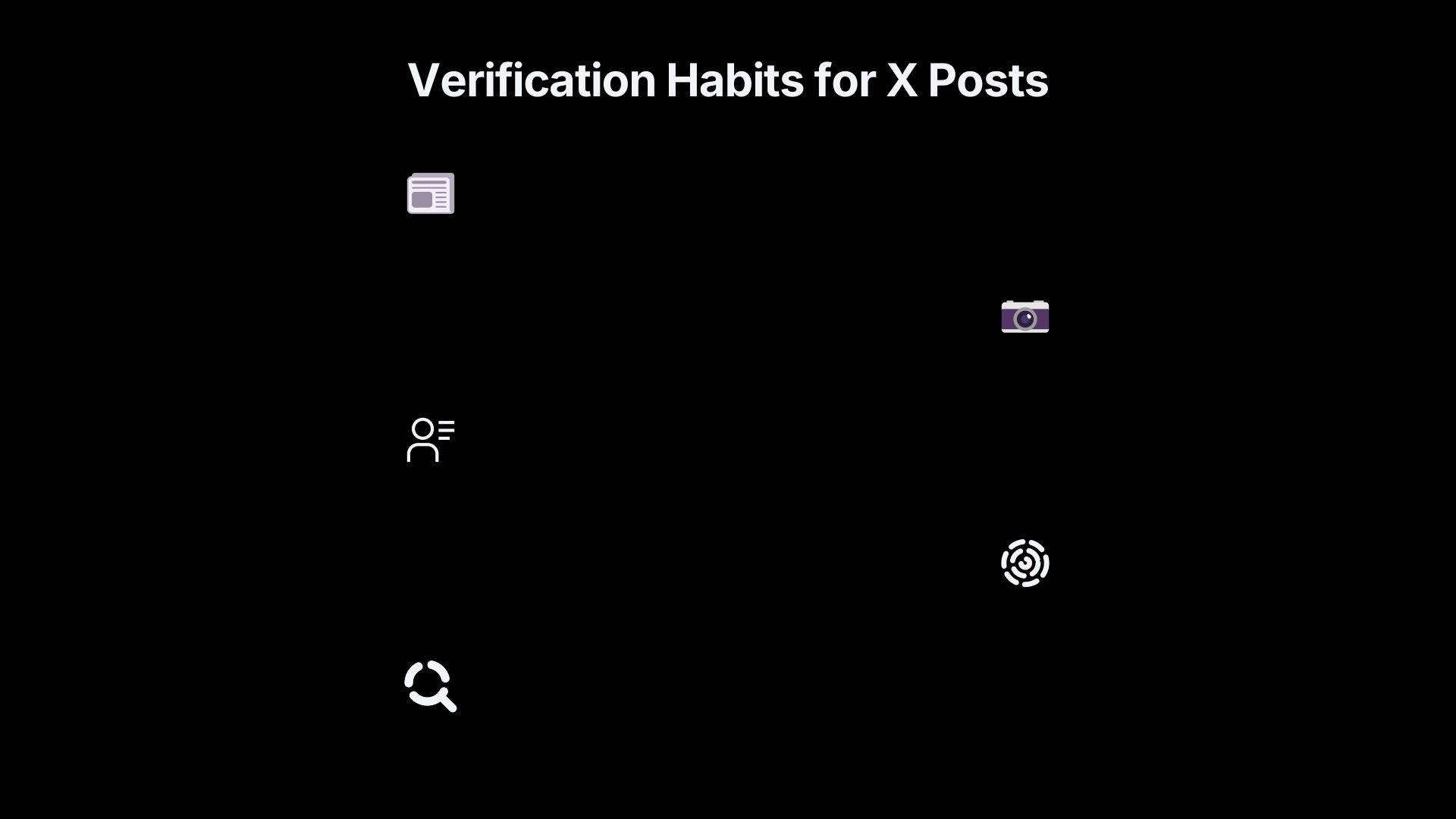
- Check whether credible news organisations, official agencies or primary sources independently confirm the claim.
- Look for the earliest known version of the image, video or quote rather than relying on reposts.
- Examine whether the account sharing the content has a history of accuracy or sensationalism.
- Separate the authenticity of the media from the truth of the accompanying claim. A real image can support a false narrative, and a synthetic image can accompany an otherwise true story.
- Treat detector results as one clue among many rather than a final verdict.
These habits remain useful regardless of how generation technology changes. If detectors become stronger, they add another layer of evidence. If generators become harder to detect, the same verification practices still apply.
In the context of AI-generated misinformation on X, that is the central lesson of the moving target problem. Detection technology can help, but it cannot replace judgement. As synthetic media becomes more sophisticated, the most durable defence is not finding a perfect detector; it is building verification habits that continue to work even when detectors disagree, fail or cannot keep up.
Amazon book picks
Further Reading
Books and field guides related to Why AI detection keeps getting harder. Use these as the next step if you want deeper reading beyond the article.
Artificial Intelligence
Explains why AI capabilities and limitations evolve over time.
eBay marketplace picks
Marketplace Samples
Example marketplace items related to this page. Use the search link to explore similar finds on eBay.




Endnotes
1.
Source: airc.nist.gov
Link:https://airc.nist.gov/docs/NIST.AI.100-4.SyntheticContent.ipd.pdf
Source snippet
NIST AI Resource CenterReducing Risks Posed by Synthetic ContentApr 15, 2024 — leading to an “arms race” to develop new detection methods...
2.
Source: arxiv.org
Title: arXiv Why Do Facial Deepfake Detectors Fail?
Link:https://arxiv.org/abs/2302.13156
3.
Source: ai-challenges.nist.gov
Link:https://ai-challenges.nist.gov/forensics
Source snippet
NIST AI Challenge ProblemsGenAI: [Deepfakes]({{ 'deepfakes/' | relative_url }}) 2026 - NIST AI ChallengesWith modern generative AI, a photograph can be harvested from social...
4.
Source: axios.com
Link:https://www.axios.com/2024/10/07/ai-detection-tools-reliability-labeling
Source snippet
This detection gap creates new vulnerabilities for governments and businesses, exposing them to targeted malicious operations and widespr...
5.
Source: arxiv.org
Title: arXiv Toward Generalized Detection of Synthetic Media
Link:https://arxiv.org/pdf/2511.11116
Source snippet
Each study was examined individually to identify its contributions and weaknesses.Read more...
6.
Source: arxiv.org
Link:https://arxiv.org/abs/2511.11116
7.
Source: arxiv.org
Link:https://arxiv.org/abs/2507.21157
Source snippet
Unmasking Synthetic Realities in Generative AI: A Comprehensive Review of Adversarially Robust Deepfake Detection SystemsJuly 24, 2025...
Published: July 24, 2025
8.
Source: link.springer.com
Link:https://link.springer.com/article/10.1007/s40979-026-00213-1
Source snippet
Evaluating the accuracy and reliability of AI content detectors...by M Hadra · 2026 · Cited by 8 — This study evaluates the reli...
9.
Source: OpenAI
Title: new ai classifier for indicating ai written text
Link:https://openai.com/index/new-ai-classifier-for-indicating-ai-written-text/
Source snippet
New AI classifier for indicating AI-written text31 Jan 2023 — As of July 20, 2023, the AI classifier is no longer available due to its lo...
Published: July 20, 2023
10.
Source: arxiv.org
Title: arXiv The Unwinnable Arms Race of AI Image Detection
Link:https://arxiv.org/pdf/2509.21135
Source snippet
The Unwinnable Arms Race of AI Image DetectionSeptember 25, 2025 — by T Aczel · 2025 — Formal proof of the inherent challenge of det...
Published: September 25, 2025
11.
Source: arxiv.org
Link:https://arxiv.org/abs/2007.08457
12.
Source: nist.gov
Title: 2024 nist genai pilot study text text evaluation overview and results
Link:https://www.nist.gov/publications/2024-nist-genai-pilot-study-text-text-evaluation-overview-and-results
Source snippet
2024 NIST GenAI (Pilot Study): Text-to-Text Evaluation...by H Iyer · 2025 — The 2024 NIST Generative AI (GenAI) Pilot Study focuses on e...
13.
Source: nist.gov
Link:https://www.nist.gov/
Source snippet
National Institute of Standards and TechnologyNIST promotes U.S. innovation and industrial competitiveness by advancing measurement scien...
14.
Source: ai-challenges.nist.gov
Link:https://ai-challenges.nist.gov/genai
Source snippet
Evaluating Generative AI - NIST AI ChallengesNIST GenAI is a new evaluation program administered by the NIST Information Technology Labor...
15.
Source: nist.gov
Link:https://www.nist.gov/publications/guardians-forensic-evidence-evaluating-analytic-systems-against-ai-generated-deepfakes
Source snippet
Guardians of Forensic Evidence: Evaluating Analytic...by H Guan · 2025 — Guardians of Forensic Evidence: Evaluating Analytic Systems Aga...
16.
Source: theguardian.com
Link:https://www.theguardian.com/us-news/article/2024/jun/07/how-to-spot-a-deepfake
Source snippet
These tools allow users to upload suspicious media to assess the likelihood it was AI-generated, though results can vary greatly. For ins...
17.
Source: searchenginejournal.com
Link:https://www.searchenginejournal.com/openai-shuts-down-flawed-ai-detector/492565/
Source snippet
Search Engine JournalOpenAI Shuts Down Flawed AI Detector25 Jul 2023 — OpenAI's announcement reads: “As of July 20, 2023, the AI classifi...
Published: July 20, 2023
18.
Source: reddit.com
Title: This decision was made due to the tool’s low accuracy rate.Read more
Link:https://www.reddit.com/r/ArtificialInteligence/comments/159emcv/openai_quietly_shuts_down_its_ai_detection_tool/
Source snippet
OpenAI quietly shuts down its AI detection tool due to poor...OpenAI has quietly shut down its AI Classifier, a tool intended to identif...
19.
Source: reddit.com
Link:https://www.reddit.com/r/ChatGPT/comments/159j8rc/openai_quietly_kills_its_own_ai_classifier_citing/
Source snippet
OpenAI quietly kills its own AI Classifier, citing "low rate of..."As of July 20, 2023, the AI classifier is no longer available due to...
Published: July 20, 2023
20.
Source: cobusgreyling.medium.com
Link:https://cobusgreyling.medium.com/openai-discontinued-their-ai-classifier-for-identifying-ai-written-text-7133a927ee7b
Source snippet
A while ago I took human & AI generated text from various sources...Read more...
21.
Source: ponoko.com
Link:https://www.ponoko.com/blog/ponoko/openai-shuts-down-ai-detector-due-to-low-accuracy/
Source snippet
OpenAI Shuts Down AI Detector Due To Low Accuracy28 Jul 2023 — However, the company has acknowledged its shortcomings, leading to its dec...
22.
Source: observer.com
Title: openai shut ai classifier
Link:https://observer.com/2023/07/openai-shut-ai-classifier/
Source snippet
OpenAI Shuts Down ChatGPT Plagiarism Detector Because It...26 Jul 2023 — As of July 20, OpenAI has quietly pulled the plug on their AI d...
23.
Source: humanfirst.ai
Title: openai discontinued their ai classifier for identifying ai written text
Link:https://www.humanfirst.ai/blog/openai-discontinued-their-ai-classifier-for-identifying-ai-written-text
Source snippet
The model was supposed to...Read more...
24.
Source: synthedia.substack.com
Title: openai shuts down ai written text
Link:https://synthedia.substack.com/p/openai-shuts-down-ai-written-text
Source snippet
Why Should We...As of July 20, 2023, the AI classifier is no longer available due to its low rate of accuracy. We are working to incorpo...
Published: July 20, 2023
25.
Source: techcrunch.com
Title: openai scuttles ai written text detector over low rate of accuracy
Link:https://techcrunch.com/2023/07/25/openai-scuttles-ai-written-text-detector-over-low-rate-of-accuracy/
Source snippet
OpenAI scuttles AI-written text detector over 'low rate of...25 Jul 2023 — Many perhaps unwisely relied on the tool to catch low-effort...
26.
Source: originality.ai
Link:https://originality.ai/blog/openai-text-classifier-review
Source snippet
OpenAI Text Classifier: ChatGPT's Own AI Detection Review11 Dec 2025 — OpenAI has made the tough call to discontinue their text classifie...
Additional References
27.
Source: researchgate.net
Link:https://www.researchgate.net/publication/378165235_The_Limits_of_AI_Content_Detectors
28.
Source: medium.com
Link:https://medium.com/%40mikhael.love/ai-detection-accuracy-why-current-tools-keep-failing-6266786b7063
Source snippet
AI Detection Accuracy: Why Current Tools Keep FailingOpenAI's own classifier could only identify 26% of AI-written text correctly. The to...
29.
Source: visua.com
Link:https://visua.com/the-deepfake-detection-arms-race
Source snippet
The Deepfake Detection Arms RaceArtificial intelligence has powered the phenomenon of falsified videos, which is slowly creeping into mai...
30.
Source: what-makes-good-video.github.io
Link:https://what-makes-good-video.github.io/assets/9The_Unwinnable_Arms_Race_of.pdf
Source snippet
The Unwinnable Arms Race of AI Image Detectionby TALVA Plesner — Formal proof of the inherent challenge of detection: We show that distin...
31.
Source: brandeis.edu
Link:https://www.brandeis.edu/ai-steering-council/ai-literacy/ai-teaching-learning/detection-tools.html
Source snippet
Studies have demonstrated that AI-generated text is not always easy to identify, even by experienced faculty, and that AI...Read more...
32.
Source: haystackid.com
Title: inside the deepfake arms race can digital forensics investigators keep up
Link:https://haystackid.com/inside-the-deepfake-arms-race-can-digital-forensics-investigators-keep-up/
Source snippet
Inside the Deepfake Arms Race: Can Digital Forensics...Aug 25, 2025 — Deepfakes are reshaping trust in digital evidence. Learn the risks...
33.
Source: netarx.com
Title: navigating the new nist deepfake standards protecting against social
Link:https://www.netarx.com/blog/navigating-the-new-nist-deepfake-standards-protecting-against-social
Source snippet
Navigating the New NIST Deepfake StandardsFeb 18, 2026 —... deepfakes and synthetic media. Attackers may try to “inject... Describes a...
34.
Source: pmc.ncbi.nlm.nih.gov
Link:https://pmc.ncbi.nlm.nih.gov/articles/PMC11943306/
Source snippet
Media Forensics: Status and Future Challengesby I Amerini · 2025 · Cited by 77 — As deepfake generation techniques evolve, so do detectio...
35.
Source: scworld.com
Title: emerging threat from deepfakes leads to cybersecurity arms race
Link:https://www.scworld.com/feature/emerging-threat-from-deepfakes-leads-to-cybersecurity-arms-race
Source snippet
Emerging threat from deepfakes leads to cybersecurity...Nov 21, 2025 — Deepfakes fuel a surge in high-impact fraud, forcing orgs to adop...
36.
Source: optica-opn.org
Title: generating and detecting deepfakes a 21st century arms race
Link:https://www.optica-opn.org/home/articles/volume_36/february_2025/features/generating_and_detecting_deepfakes_a_21st-century_arms_race/
Source snippet
Generating and Detecting Deepfakes: A 21st-Century Arms...Feb 1, 2025 — As AI tools get better at creating realistic images and videos...
Topic Tree