Within Missing Context
Why Fluent AI Summaries Still Need Dates
AI-written explanations can sound fluent while losing the dates, limitations, and uncertainty that keep a claim honest.
On this page
- How summaries lose source context
- Why changing facts create temporal conflicts
- Checks to add before sharing AI assisted claims
Page outline Jump by section
Introduction
AI-generated summaries often fail in a specific and important way: they make information easier to read while removing the dates, limitations, uncertainty, and conditions that made the original claim accurate. In the context of social media and AI-assisted information sharing, this matters because a statement can remain technically plausible while becoming misleading once its time frame or caveats disappear.
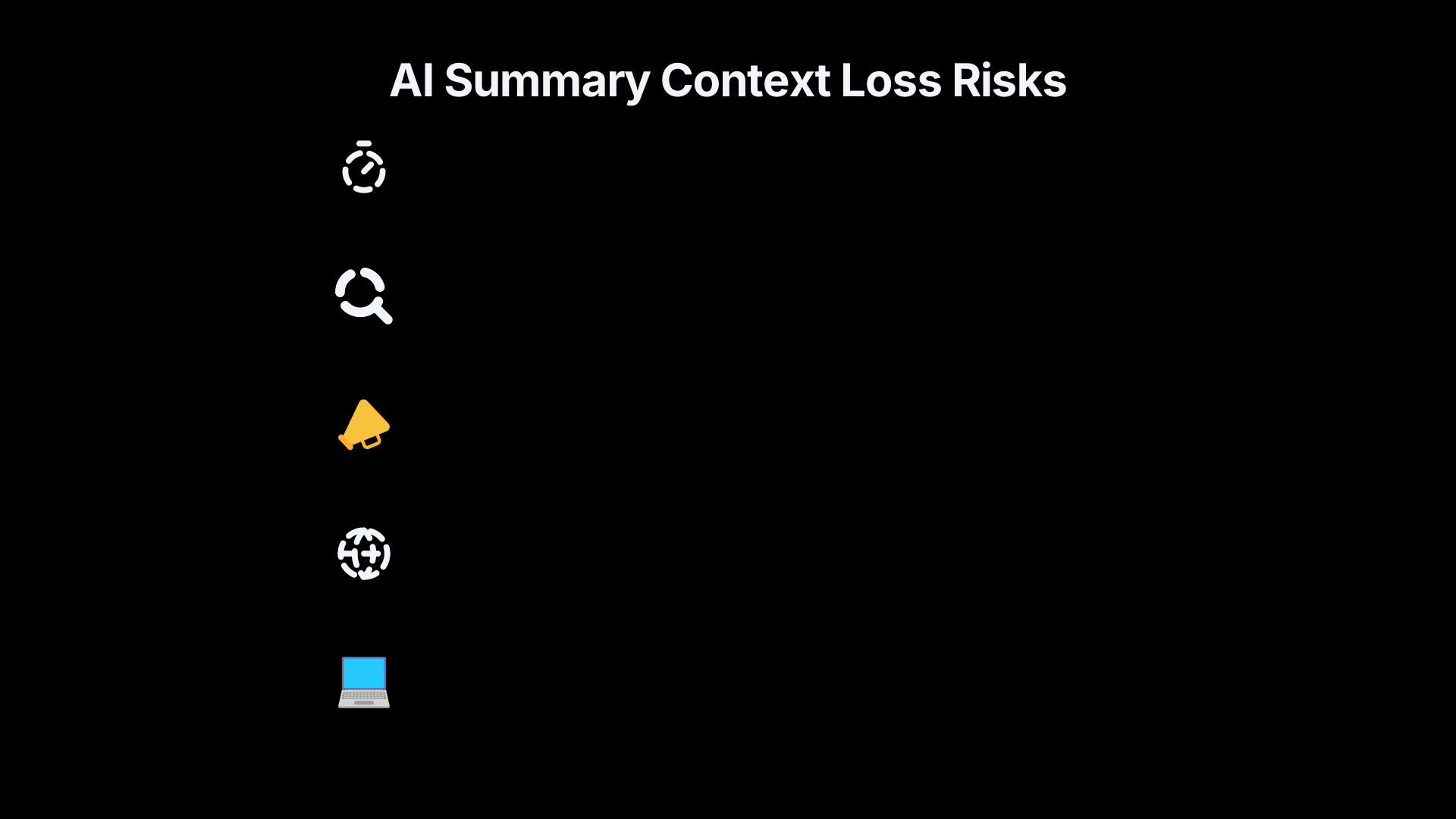 The risk is not always outright fabrication. More often, the summary compresses a complex source into a confident-sounding conclusion. A study conducted in a specific year becomes a timeless fact. A result that applied only to a limited population becomes a general rule. A preliminary finding becomes settled knowledge. Researchers, journalists, and technology auditors have repeatedly found that AI-generated summaries can omit context, overstate conclusions, and weaken signals of uncertainty, even when the underlying source was more careful.[Inside Higher Ed+2Tom's Guide]insidehighered.comInside Higher Ed AI Research Summaries “Exaggerate Findings,” Study WarnsInside Higher EdAI Research Summaries “Exaggerate Findings,” Study WarnsApril 24, 2025 — 24 Apr 2025 — AI tools overhype research finding…
How Summaries Lose Source Context
Summarisation is a compression process. Every summary leaves something out. The problem arises when the omitted material includes the information that tells readers how strongly a claim should be believed.
Large language models are optimised to produce coherent text rather than preserve every qualification from a source. As a result, details that seem secondary from a language perspective—dates, confidence intervals, study limitations, exceptions, and unresolved disagreements—may be removed even though they are essential for interpretation. Researchers studying AI summarisation have identified this as a recurring challenge: summarised outputs can misquote sources, overstate confidence, or remove uncertainty while preserving a fluent narrative.[GoTranscript]gotranscript.comai summarization in research prevent hallucinations rules qa checklistAI Summarization in Research: Prevent Hallucinations…4 Mar 2026 — AI summarization can speed up research, but it can also…
A common pattern looks like this:
- Original source: “A small 2022 study found evidence suggesting X, but larger studies are needed.”
- AI summary: “Research shows X.”
The second sentence is shorter and easier to share, yet it fundamentally changes the strength of the claim. The date, sample size, and cautionary language have disappeared.
Studies examining AI summaries of scientific research have found that language models frequently overgeneralise findings and present conclusions more strongly than the original authors intended. In some evaluations, AI-generated research summaries exaggerated results more often than human-written summaries.[Inside Higher Ed]insidehighered.comInside Higher Ed AI Research Summaries “Exaggerate Findings,” Study WarnsInside Higher EdAI Research Summaries “Exaggerate Findings,” Study WarnsApril 24, 2025 — 24 Apr 2025 — AI tools overhype research finding…
This creates a paradox: the more readable a summary becomes, the more vulnerable it may be to losing the context that made the source trustworthy.
Why Caveats Are Often the First Thing Removed
Caveats tend to be linguistically inefficient. Phrases such as “under these conditions”, “the evidence remains mixed”, “as of 2023”, or “the result may not generalise” consume space without advancing a simple narrative.
Human readers already have a tendency to prefer certainty over ambiguity. AI systems can unintentionally amplify this preference because concise summaries often reward direct conclusions. The result is what some researchers describe as a confidence illusion: uncertainty in the underlying evidence is transformed into confidence in the generated explanation.[Marketscience]market.sciencescienceGenerative AI and Decision Making: The Confidence IllusionMarch 30, 2026 — 30 Mar 2026 — Generative AI introduces a meaningf…
This matters because many important claims are only accurate when their limitations remain attached. Medical guidance, economic forecasts, educational research, polling data, and scientific findings all depend heavily on scope conditions that determine where and when a conclusion applies.
Why Changing Facts Create Temporal Conflicts
Dates are not merely background information. They determine whether a claim is still current.
Many facts change over time:
- Scientific consensus evolves.
- Government policies change.
- Product features are updated.
- Company ownership shifts.
- Court cases reach new stages.
- Economic indicators fluctuate.
When a summary drops temporal markers, readers may unknowingly apply old information to a new situation.
Researchers studying long-document summarisation and temporal reasoning have identified a recurring problem: compression can weaken temporal ordering and remove cues about when events occurred. Once those signals disappear, readers may struggle to distinguish current facts from historical facts.[arXiv]arxiv.orgInfini Memory: Maintainable Topic Documents for Long…4 days ago — When long histories are compressed into summaries, temporal ord…
Consider a summary stating that a company “is under investigation”. Without a date, readers cannot tell whether the investigation is ongoing, concluded years ago, or resulted in exoneration. The omission transforms a time-bound statement into a seemingly permanent characteristic.
This issue becomes particularly important on social media, where AI-generated explanations are often detached from their original sources and redistributed independently. A summary may continue circulating long after the evidence on which it was based has changed.
The Problem of Outdated Knowledge
AI systems can also rely on outdated source material or incomplete evidence. Audits of AI-generated search summaries have found cases where important context was missing, sources were outdated, or conclusions were presented without sufficient qualification.[Tom's Guide+2The Guardian]tomsguide.comTom's Guide Can you trust AI Overviews?Recent studies suggest they may not be as accurate as you thinkRecent research has raised concerns about the reliability of Google's AI O…
The danger is not always that the summary is false. It may accurately reflect what was believed at one point in time while failing to indicate that newer evidence exists.
For readers, this distinction is crucial. A statement that was reasonable in 2021 may be misleading in 2026 if major developments occurred in the intervening years.
When Fluent Language Hides Missing Information
One reason these failures are difficult to detect is that fluency itself acts as a credibility signal.
People often use writing quality as a shortcut for judging reliability. A clear, confident explanation feels more trustworthy than a fragmented or uncertain one. Modern AI systems are exceptionally good at producing polished prose, which can mask omissions that would be easier to notice in a rougher draft.
Recent investigations into AI-generated content have repeatedly shown that persuasive presentation does not guarantee faithful representation of sources. News audits have found significant rates of distortion, missing context, or factual errors in AI-generated article summaries. Independent evaluations have likewise documented fabricated citations, inaccurate sourcing, and misleading paraphrases that appeared highly professional on first reading.[TV Tech+2The Verge]tvtechnology.comTV Tech Major Study Finds Many Mistakes in AI-Generated News SummariesThe research, one of the largest of its kind, involved over 3,000 AI-generated responses evaluated by journalists across 22 public servic…
The challenge for readers is that missing caveats rarely announce themselves. A fabricated statistic may be caught because it looks suspicious. A missing date is harder to spot because nothing visibly appears wrong.
The result is a subtle form of misinformation: not a false statement, but an incomplete one that encourages the wrong conclusion.
Checks to Add Before Sharing AI-Assisted Claims
The most effective defence is not rejecting AI summaries outright. It is restoring the context that summarisation tends to remove.
Before sharing an AI-generated explanation, ask three simple questions:
What Is the Date?
Look for:
- When the source was published.
- Whether the information describes current conditions.
- Whether newer evidence exists.
If the date cannot be identified, the reliability of the claim is reduced.
What Limitations Were Removed?
Check whether the original source contained phrases such as:
- “In this sample”
- “Preliminary evidence”
- “May indicate”
- “Further research is needed”
- “Applies only to”
If those qualifications disappeared in the summary, the meaning may have shifted.
How Certain Is the Evidence?
Distinguish between:
- Established findings.
- Expert interpretation.
- Early research.
- Correlation rather than causation.
- Ongoing debates.
AI-generated summaries often compress these distinctions into a single statement of apparent fact. Studies of research summarisation suggest that models can overstate confidence and exaggerate conclusions, particularly when presenting scientific findings to non-specialists. Inside Higher Ed+2The Times of India[insidehighered.com]insidehighered.comInside Higher Ed AI Research Summaries “Exaggerate Findings,” Study WarnsInside Higher EdAI Research Summaries “Exaggerate Findings,” Study WarnsApril 24, 2025 — 24 Apr 2025 — AI tools overhype research finding…
Can the Claim Be Traced Back?
A trustworthy summary should allow a reader to locate the underlying source and verify the original wording.
If a summary cannot be connected to a source, or if the source does not support the conclusion being presented, the summary should be treated as an unverified interpretation rather than evidence.
Why This Matters for Critical Thinking
The central challenge is not that AI always invents information. It is that AI can remove the very details that help people judge information properly.
Dates tell readers whether a claim is current. Caveats reveal how strong the evidence is. Uncertainty communicates what remains unknown. When those elements disappear, information becomes easier to consume but harder to evaluate.
In an environment where social media rewards speed and simplicity, AI-generated summaries can accelerate the spread of incomplete claims. Critical thinking therefore requires looking beyond the fluency of the summary and asking what context was lost during compression. A claim should not be judged only by how clearly it is written, but also by whether it still contains the dates, limitations, and uncertainty that made it honest in the first place.

eBay marketplace picks
Marketplace Samples
Example marketplace items related to this page. Use the search link to explore similar finds on eBay.




Endnotes
1.
Source: gotranscript.com
Title: ai summarization in research prevent [hallucinations]({{ ‘hallucinations/’ | relative_url }}) rules qa checklist
Link:https://gotranscript.com/en/blog/ai-summarization-in-research-prevent-hallucinations-rules-qa-checklist
Source snippet
AI Summarization in Research: Prevent Hallucinations...4 Mar 2026 — AI summarization can speed up research, but it can also...
2.
Source: arxiv.org
Link:https://arxiv.org/html/2606.10677v1
Source snippet
Infini Memory: Maintainable Topic Documents for Long...4 days ago — When long histories are compressed into summaries, temporal ord...
3.
Source: arxiv.org
Link:https://arxiv.org/abs/2605.27392
4.
Source: arxiv.org
Link:https://arxiv.org/html/2601.07468v1
Source snippet
Temporal Semantic Memory for Personalized LLM Agents12 Jan 2026 — LLM agents are increasingly equipped with long-term memory that grows a...
5.
Source: arxiv.org
Link:https://arxiv.org/html/2310.17721v2
Source snippet
irm-level risks at a relatively low cost. The generated risk...Read more...
6.
Source: insidehighered.com
Title: Inside Higher Ed AI Research Summaries “Exaggerate Findings,” Study Warns
Link:https://www.insidehighered.com/news/tech-innovation/artificial-intelligence/2025/04/24/ai-research-summaries-exaggerate-findings
Source snippet
Inside Higher EdAI Research Summaries “Exaggerate Findings,” Study WarnsApril 24, 2025 — 24 Apr 2025 — AI tools overhype research finding...
Published: April 24, 2025
7.
Source: tomsguide.com
Title: Tom’s Guide Can you trust AI Overviews?
Link:https://www.tomsguide.com/ai/can-you-trust-ai-overviews-recent-studies-suggest-they-may-not-be-as-accurate-as-you-think
Source snippet
Recent studies suggest they may not be as accurate as you thinkRecent research has raised concerns about the reliability of Google's AI O...
8.
Source: theverge.com
Link:https://www.theverge.com/news/610006/ai-chatbots-distorting-news-bbc-study
Source snippet
Analysis of summaries for 100 BBC articles showed that 51% of AI-generated outputs had significant issues, with 19% containing incorrect...
9.
Source: timesofindia.indiatimes.com
Link:https://timesofindia.indiatimes.com/technology/tech-news/ai-models-like-chatgpt-and-deepseek-frequently-exaggerate-scientific-findings-study-reveals/articleshow/121189880.cms
Source snippet
Researchers Uwe Peters and Benjamin Chin-Yee evaluated 4,900 AI-generated summaries from ten top LLMs and discovered that up to 73% of th...
10.
Source: market.science
Link:https://market.science/generative-ai-confidence-illusion/
Source snippet
scienceGenerative AI and Decision Making: The Confidence IllusionMarch 30, 2026 — 30 Mar 2026 — Generative AI introduces a meaningf...
Published: March 30, 2026
11.
Source: theguardian.com
Title: google ai overviews health guardian investigation
Link:https://www.theguardian.com/technology/2026/jan/11/google-ai-overviews-health-guardian-investigation
Source snippet
'Dangerous and alarming': Google removes some of its AI...11 Jan 2026 — Guardian investigation finds AI Overviews provided inaccurate an...
12.
Source: theguardian.com
Link:https://www.theguardian.com/technology/2026/feb/16/google-puts-users-at-risk-downplaying-disclaimers-ai-overviews
Source snippet
While Google claims these summaries encourage users to seek professional advice, the disclaimers only appear after users click "Show more...
13.
Source: tvtechnology.com
Title: TV Tech Major Study Finds Many Mistakes in AI-Generated News Summaries
Link:https://www.tvtechnology.com/news/major-study-finds-high-levels-of-mistakes-in-ai-generated-news-summaries
Source snippet
The research, one of the largest of its kind, involved over 3,000 AI-generated responses evaluated by journalists across 22 public servic...
Additional References
14.
Source: intuitionlabs.ai
Link:https://intuitionlabs.ai/articles/ai-hallucinations-drug-discovery
Source snippet
AI Hallucinations in Drug Discovery: Examples & Detection4 days ago — Hallucinations in AI are analogous to a clinician confidently apply...
15.
Source: medium.com
Link:https://medium.com/blueprint-for-disaster/ai-summaries-are-a-threat-to-our-cognitive-sovereignty-917afc37692f
Source snippet
Do AI summaries hurt critical thinking? | Blueprint for DisasterAI-generated summaries promise efficiency but erode comprehension, critic...
16.
Source: techradar.com
Link:https://www.techradar.com/pro/a-major-kpmg-report-on-ai-was-found-to-be-chock-full-of-ai-hallucinations
Source snippet
The report contained 45 citations, with only five found to be accurate; the rest were either fabricated, distorted, or misleading. GPTZer...
17.
Source: cs.cit.tum.de
Link:https://www.cs.cit.tum.de/fileadmin/w00cfj/sebis/thesis/250224_Magg_Thesis.pdf
Source snippet
the Effectiveness of Longer Context Windows in...by C Magg — LLM summarizers and question-answering systems have been demonstrated to be...
18.
Source: reutersinstitute.politics.ox.ac.uk
Link:https://reutersinstitute.politics.ox.ac.uk/generative-ai-and-news-report-2025-how-people-think-about-ais-role-journalism-and-society
Source snippet
AI and news report 2025: How people think about...7 Oct 2025 — The public widely perceives generative AI as already prevalent across sec...
19.
Source: euractiv.com
Title: rise of ai summaries risks weakening news brands warns reuters institute
Link:https://www.euractiv.com/news/rise-of-ai-summaries-risks-weakening-news-brands-warns-reuters-institute/
Source snippet
Rise of AI summaries risks weakening news brands, warns...22 Jan 2026 — Traditional search traffic is declining sharply as 'answer engin...
20.
Source: tue.nl
Title: 24 02 2026 are ai generated summaries suitable for studying and research
Link:https://www.tue.nl/en/our-university/library/library-news/24-02-2026-are-ai-generated-summaries-suitable-for-studying-and-research
Source snippet
Are AI-generated summaries suitable for studying and...24 Feb 2026 — However, the quality of AI-generated summaries is insufficient for...
21.
Source: suprmind.ai
Link:https://suprmind.ai/hub/insights/ai-summary-generator-how-to-extract-what-matters-without-losing-what/
Source snippet
AI Summary Generator: How to Extract What Matters...15 Feb 2026 — This guide breaks down how AI summary generators actually work, when t...
22.
Source: workwithai.expert
Link:https://workwithai.expert/read/ai-summaries-when-they-help-and-mislead
Source snippet
Learn when AI summaries help, when they mislead, and how to use them without losing context or accuracy...
23.
Source: layer6.ai
Title: reliable llm document summarization with conformal prediction
Link:https://layer6.ai/reliable-llm-document-summarization-with-conformal-prediction/
Source snippet
A New Framework for Reliable LLM Summarization3 Feb 2026 — Conformal prediction applied to LLMs can make document summarization more reli...
Topic Tree