Within Think Before Sharing
Why News Feels Harder to Sort
When journalism, entertainment, activism, advertising, and synthetic content appear together, readers need stronger sorting habits.
On this page
- How feeds mix information types
- Trust cues that break down
- Sorting journalism from persuasion
Page outline Jump by section
Introduction
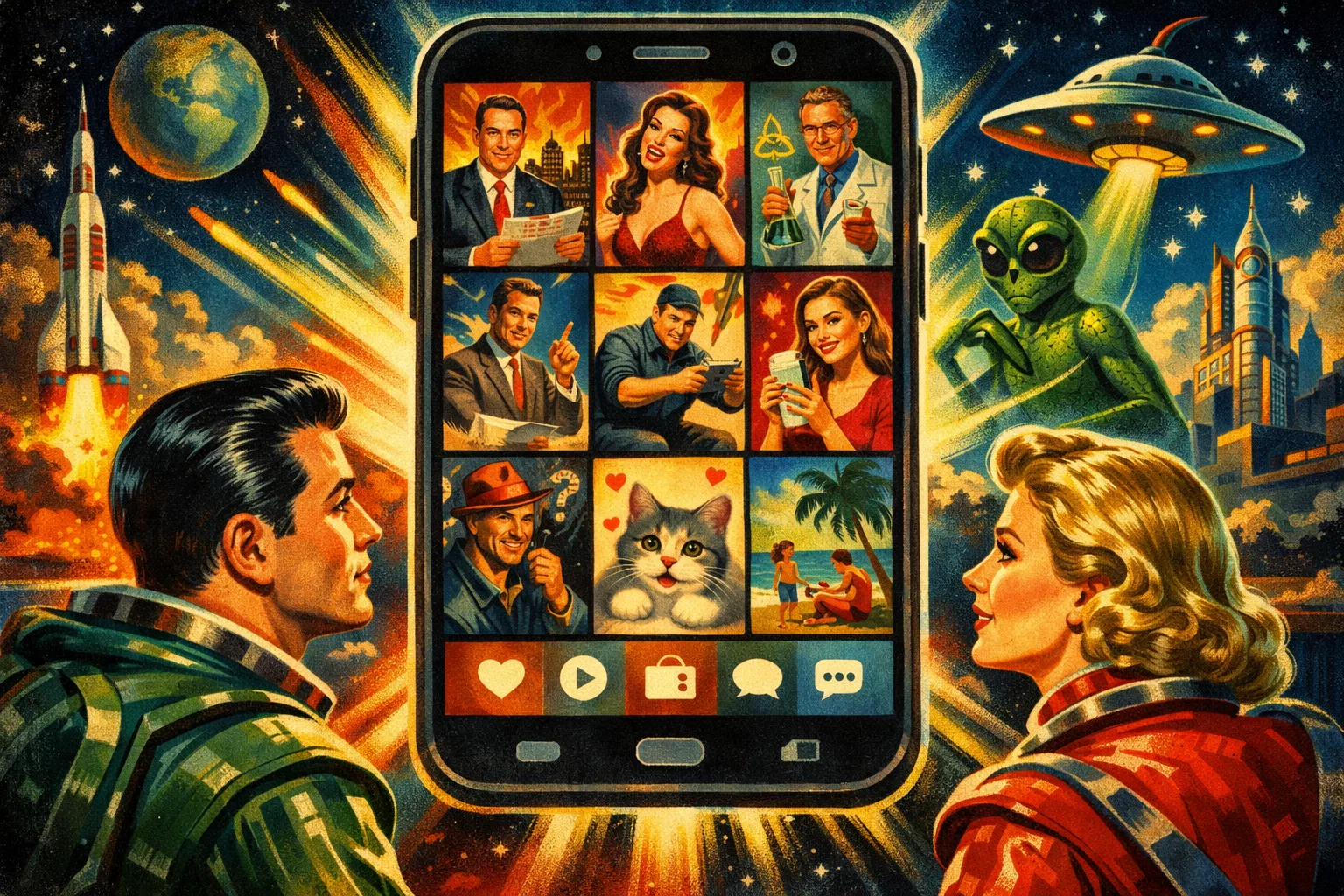
News feels harder to sort because it now reaches many people inside feeds that do not behave like news products. A public-health warning, a journalist’s investigation, a comedian’s sketch, a campaign post, a paid influencer endorsement, a local rumour and an AI-generated image can all appear in the same scroll, with similar fonts, buttons and emotional force. The problem is not only falsehood. It is category confusion: readers must work out what kind of information they are seeing before they can judge whether to trust it.
This is a historical change in the way public affairs information is packaged. Newspapers, bulletins and news websites used to make source, format and editorial responsibility more visible. Mixed social feeds weaken those signals. Research from the Reuters Institute shows that people are less likely to correctly remember which news brand produced a story when they reached it through social media or search rather than directly, which matters because source memory is one of the basic cues people use when deciding what to trust.[reutersinstitute.politics.ox.ac.uk]reutersinstitute.politics.ox.ac.uka news brand if they accessed it directly rather than via search or social.Read more…
How feeds mix information types
The social feed is not organised around journalism’s old boundaries. It is organised around attention. A post can become prominent because it is new, funny, enraging, visually striking, paid for, algorithmically recommended, shared by a friend, stitched by an influencer or attached to a breaking event. None of those signals tells the reader whether the content has been reported, checked, sponsored, advocated, satirised or fabricated.
That is why mixed feeds are different from simply “getting news online”. The Reuters Institute’s 2025 Digital News Report describes a continuing fall in engagement with traditional media sources such as television, print and news websites, alongside growing dependence on social media, video platforms and online aggregators. Overall trust in news was reported as stable at 40%, but the report also highlights the rise of an alternative media ecosystem of YouTubers, podcasters, personalities and influencers competing with professional news organisations for attention.[Ordine Dei Giornalisti]odg.itREUTERS Digital News Report 2025 compressedOrdine Dei GiornalistiReuters Institute Digital News Report 2025June 17, 2025 — Our findings point to a continuing fall in engagement wit…
The United States offers a clear example of the shift. Pew Research Center’s 2025 social media news fact sheet found that about a fifth or more of American adults regularly get news on Facebook, YouTube, Instagram and TikTok. Pew’s separate 2024 work showed that even where people do not say they regularly use a platform for news, large majorities still encounter news there in some form. In other words, many people meet public affairs information not because they opened a news app, but because news-like content appeared between other posts.[Pew Research Center]pewresearch.orgsocial media and news fact sheetPew Research CenterSocial Media and News Fact Sheet25 Sept 2025 — Many Americans use social media for news: About a fifth or more regular…[Pew Research Center]pewresearch.orgRead morePew Research CenterHow Americans Get News on TikTok, X, Facebook and…12 Jun 2024 — A 2023 Pew Research Center survey found that Facebo…
This matters because intention changes judgement. A person who goes directly to a newspaper, broadcaster or official source is already in a news-checking frame. A person scrolling during a commute or lunch break is often in a mixed frame: entertainment, social belonging, identity, curiosity and distraction all compete with accuracy. The same claim may be processed differently depending on whether it appears as a headline, a friend’s repost, a creator’s monologue, a meme or a dramatic clip.
Trust cues that break down
Trust in news has always depended on cues. Some are explicit: bylines, mastheads, corrections policies, named experts, transparent evidence, links to documents and visible dates. Others are social: reputation, familiarity, professional style and the sense that “this looks like news”. Mixed feeds weaken both sets of cues.
The Reuters Institute’s study of news brand attribution found that people were far more likely to correctly attribute a story to a news brand when they accessed it directly than when they reached it through search or social media. That finding is important because a story can travel far from the context that gave it credibility. A careful investigation may be reduced to a screenshot; a partisan claim may borrow the appearance of a news headline; a post may circulate with the original source cropped away.[reutersinstitute.politics.ox.ac.uk]reutersinstitute.politics.ox.ac.uka news brand if they accessed it directly rather than via search or social.Read more…
Brand familiarity can also become a misleading shortcut. In a feed, the visual treatment of posts is partly standardised by the platform: the same avatar size, share button, comment field and engagement metrics surround very different kinds of content. A verified-looking account, high view count or confident delivery can feel like evidence even when it is only a sign of visibility. Conversely, strong journalism from an unfamiliar local or specialist outlet may look less trustworthy than a polished but poorly sourced creator video.
The result is not that people are helpless. It is that the work of sorting has moved from the publisher’s front page to the reader’s moment-by-moment judgement. A useful first question is therefore not “Do I agree?” but “What is this?” The answer may be reported journalism, first-hand testimony, expert explanation, activism, opinion, satire, advertising, propaganda, rumour, synthetic media or some blend of these.
Why influencers complicate news trust
Influencers and creators are not automatically less trustworthy than journalists. Some bring expertise, lived experience, speed, clarity and access to audiences that traditional newsrooms have failed to reach. The trust problem is that creator content often blends personality, commentary, entertainment, community identity and income generation in ways that are not always visible to the viewer.
Pew’s 2025 news influencers fact sheet found that 21% of US adults regularly get news from news influencers on social media. Among those regular consumers, 69% said they mostly get news from influencers because they happen to come across it, rather than because they are actively looking for it. That is a mixed-feed problem: people may be politically informed, persuaded or misled through accidental exposure in entertainment-led spaces.[Pew Research Center]pewresearch.orgnews influencers fact sheetPew Research CenterNews Influencers Fact Sheet4 Nov 2025 — About one-in-five U.S. adults (21%) say they regularly get news from news infl…
UNESCO has raised a related concern about creator practices. Its work on media and information literacy notes that journalists now share the information ecosystem with social media influencers and digital content creators, making training and verification norms more urgent. Reporting on UNESCO’s global study of digital content creators highlighted that many creators rely on personal experience, informal online research or source popularity, and that only around half of surveyed creators clearly disclosed sponsorships.[UNESCO]unesco.orgstrengthens global push media and information literacy mediaUNESCO Strengthens Global Push to Media and…12 May 2025 — With journalists now sharing the information ecosystem with social med…[The Guardian]theguardian.comAccording to a survey by Unesco, two-thirds of content creators do not verify the accuracy of their information before sharing, leaving b…
This creates a trust puzzle for readers. A creator may be sincere but under-verified; entertaining but politically persuasive; independent but commercially sponsored; expert in one area but overconfident in another. The old question “Is this a news source?” is no longer enough. Better questions include: What is the creator’s expertise? Are they showing evidence or only reacting to it? Are they correcting errors? Are they being paid, affiliated or rewarded by engagement? Are they separating reporting from opinion?
Advertising and persuasion often look like ordinary posts
Mixed feeds also blur the boundary between information and promotion. Native advertising and influencer marketing are designed to fit the surrounding content rather than interrupt it. That can make advertising feel more like recommendation, commentary or personal testimony.
Research on affiliate marketing disclosures found that only about one tenth of affiliate content on YouTube and Pinterest contained any disclosure, and that users often failed to understand short, non-explanatory disclosure wording. The study is older than the current AI wave, but it remains directly relevant because the basic design problem persists: when commercial content is embedded in ordinary posts, readers may not recognise the persuasion context.[arXiv]arxiv.orgOpen source on arxiv.org.
More recent research on native advertising describes a “disclosure dilemma”: ad cues may either blend into rapid-scroll environments unnoticed or stand out enough to trigger disengagement. For news trust, both outcomes matter. If the label is missed, persuasion can be mistaken for independent information. If users become broadly suspicious of everything that looks polished, legitimate journalism can also suffer from the general decline in confidence.[PMC]pmc.ncbi.nlm.nih.govOpen source on nih.gov.
The practical distinction is simple but often hidden: journalism should be judged by evidence, independence, verification and accountability; advertising should be judged as persuasion, even when it contains true claims. A sponsored climate explainer, a campaign-funded crime post or an influencer’s political product endorsement may contain facts, but the reader still needs to know who benefits from the message being believed or shared.
Synthetic content raises the cost of quick judgement
AI-generated text, images, audio and video add another layer to mixed-feed confusion. Synthetic content does not have to be perfect to damage trust. It only has to be plausible enough to make people hesitate, share too quickly or become cynical about real evidence.
The Reuters Institute’s 2025 report notes that trusted news brands and official sources remain among the places people say they go when checking whether something online is true or false. That suggests professional and institutional sources still have a verification role, even as feeds weaken their direct relationship with audiences.[reutersinstitute.politics.ox.ac.uk]reutersinstitute.politics.ox.ac.ukdnr executivednr executive
Technical provenance systems are one proposed response. The Coalition for Content Provenance and Authenticity describes Content Credentials as a way to help tackle the challenge of trusting media when creation and editing tools are rapidly evolving. These systems can record information about how media was created or altered, but they are not a complete solution: absence of a credential does not prove a post is fake, and presence of a credential still requires careful interpretation.[C2PA Specification]spec.c2pa.orgOpen source on c2pa.org.
The deeper problem is social rather than purely technical. A fake image of a protest, a synthetic local-news clip or an AI voice imitating a public figure may circulate alongside jokes, real footage and partisan commentary. By the time a correction appears, the original post may already have shaped impressions. In mixed feeds, the safest habit is to slow down when a piece of media is both emotionally intense and weakly sourced, especially during breaking events.

Sorting journalism from persuasion
The most useful sorting habit is to classify before trusting. Instead of treating every post as a claim to be believed or rejected, first identify what kind of communication it is. That reduces the risk of judging a campaign post as if it were reporting, or dismissing a verified news story because it resembles the noise around it.
A practical sorting sequence looks like this:
- Identify the original source. Look beyond the repost, screenshot or stitch. Is there a named newsroom, official body, document, court record, data source, expert organisation or eyewitness? If the claim depends on a cropped image or second-hand caption, treat it as incomplete.
- Separate reporting from reaction. Reporting gathers and checks information. Reaction interprets, mocks, condemns or celebrates it. Both can be useful, but they should not be trusted in the same way.
- Look for accountability signals. Strong journalism usually makes it possible to ask: who produced this, when, using what evidence, and how would they correct it if wrong? Weak persuasion often makes those questions hard to answer.
- Check the incentive. A post may be chasing votes, donations, sales, subscriptions, attention, status or ideological loyalty. Incentives do not automatically make content false, but they shape what is emphasised, omitted or emotionally amplified.
- Compare outside the feed. For important claims, leave the platform. Search for coverage from a trusted news organisation, a primary document, an official statement, a specialist fact-checker or a subject-matter expert with a public track record.
This is not a call to trust only legacy media. It is a call to use different standards for different information types. A local resident’s video may be strong evidence that something happened in a place, but weak evidence for why it happened. A journalist’s article may be strong on verified facts but still open to challenge on framing. An activist thread may explain stakes vividly but select facts strategically. A creator’s explainer may be clear and useful but still need source checking.
Local feeds are especially vulnerable
Local news trust is a useful test case because the cues are often thin. In many areas, local newspapers have shrunk or closed, while Facebook groups, neighbourhood apps and local influencer pages have become major spaces for community information. These spaces can spread useful warnings and mutual aid, but they can also circulate rumours faster than local institutions or journalists can correct them.
Recent UK reporting on Social Market Foundation research described misinformation as more prevalent in “news deserts”, areas with weaker local journalism. The reported analysis of more than 125,000 posts across platforms such as Facebook, X and Nextdoor found misinformation nearly three times more common in those areas, with spikes around elections and recurring false claims involving immigration and local authority messages.[The Guardian]theguardian.comMPs and media advocates warn that unregulated local online groups are eroding trust and influencing public opinion, often more than forma…
The local setting makes mixed-feed sorting harder because trust often comes through social proximity. A post from someone who lives nearby, uses familiar place names or claims to know “what really happened” can feel more credible than a distant institution. But proximity is not the same as verification. Local rumours can be especially persuasive precisely because they feel concrete and personally relevant.
For readers, the key distinction is between local presence and local evidence. A person may be close to an event without knowing the full story. Stronger local information usually includes named authorities, direct documentation, multiple independent witnesses, on-the-record reporting or clear limits on what is known.
Trust should be calibrated, not switched on or off
The danger of mixed feeds is not only gullibility. It is also blanket distrust. When journalism, advertising, activism, entertainment and synthetic material all look similar, some readers respond by assuming that everything is manipulated. That reaction feels protective, but it can make people easier to influence by whichever source best flatters their existing beliefs.
Academic work on changing news use and trust across 46 countries found a small overall decline in trust in news since 2015, but also substantial variation by country and media system. That is a reminder that trust is not a single global mood; it is shaped by institutions, habits, politics, platform use and local media conditions.[OUP Academic]academic.oup.comOpen source on oup.com.
Better critical thinking means calibrated trust. A reader can trust a weather warning for immediate practical purposes, remain cautious about early claims during a violent incident, trust a named expert more within their field than outside it, and treat a viral clip as evidence needing context rather than as a full account. This is more demanding than cynicism, but it is also more useful.
The mixed-feed era rewards people who can hold several judgements at once: this may be real but incomplete; this may be sincere but sponsored; this may be funny but misleading; this may be journalism but still needs comparison; this may be AI-generated but not necessarily false; this may be true but framed to make me angry. News trust now depends less on finding one perfect source and more on building the habit of sorting the feed before the feed sorts the world for you.
Amazon book picks
Further Reading
Books and field guides related to Why News Feels Harder to Sort. Use these as the next step if you want deeper reading beyond the article.
Thinking, Fast and Slow
Helps readers understand the cognitive shortcuts used when scrolling mixed feeds.

This Is Not Propaganda
Illustrates how persuasion and manipulation operate across digital channels.


The death of expertise
Explores why judging trustworthy information has become more difficult.
eBay marketplace picks
Marketplace Samples
Example marketplace items related to this page. Use the search link to explore similar finds on eBay.




Endnotes
1.
Source: reutersinstitute.politics.ox.ac.uk
Link:https://reutersinstitute.politics.ox.ac.uk/our-research/news-brand-attribution-distributed-environments-do-people-know-where-they-get-their
Source snippet
a news brand if they accessed it directly rather than via search or social.Read more...
2.
Source: unesco.org
Title: strengthens global push media and information literacy media
Link:https://www.unesco.org/en/articles/unesco-strengthens-global-push-media-and-information-literacy-media
Source snippet
UNESCO Strengthens Global Push to Media and...12 May 2025 — With journalists now sharing the information ecosystem with social med...
Published: May 2025
3.
Source: arxiv.org
Link:https://arxiv.org/abs/1809.00620
4.
Source: pmc.ncbi.nlm.nih.gov
Link:https://pmc.ncbi.nlm.nih.gov/articles/PMC12380683/
5.
Source: reutersinstitute.politics.ox.ac.uk
Title: dnr executive
Link:https://reutersinstitute.politics.ox.ac.uk/digital-news-report/2025/dnr-executive-summary
6.
Source: spec.c2pa.org
Link:https://spec.c2pa.org/specifications/specifications/2.4/explainer/Explainer.html
7.
Source: academic.oup.com
Link:https://academic.oup.com/joc/article/75/1/1/7907139
8.
Source: reutersinstitute.politics.ox.ac.uk
Title: digital news report
Link:https://reutersinstitute.politics.ox.ac.uk/digital-news-report/2025
9.
Source: reutersinstitute.politics.ox.ac.uk
Title: Digital News Report 2025
Link:https://reutersinstitute.politics.ox.ac.uk/sites/default/files/2025-06/Digital_News-Report_2025.pdf
10.
Source: reutersinstitute.politics.ox.ac.uk
Title: mapping news creators and influencers social and video networks
Link:https://reutersinstitute.politics.ox.ac.uk/news-creators-influencers/2025/mapping-news-creators-and-influencers-social-and-video-networks
11.
Source: reutersinstitute.politics.ox.ac.uk
Title: how public checks information it thinks might be wrong
Link:https://reutersinstitute.politics.ox.ac.uk/digital-news-report/2025/how-public-checks-information-it-thinks-might-be-wrong
12.
Source: reutersinstitute.politics.ox.ac.uk
Title: digital news report
Link:https://reutersinstitute.politics.ox.ac.uk/digital-news-report/2024
13.
Source: reutersinstitute.politics.ox.ac.uk
Link:https://reutersinstitute.politics.ox.ac.uk/sites/default/files/research/files/Brand%2520and%2520trust%2520in%2520a%2520fragmented%2520news%2520environment.pdf
14.
Source: reutersinstitute.politics.ox.ac.uk
Title: news creators influencers
Link:https://reutersinstitute.politics.ox.ac.uk/news-creators-influencers/2025
15.
Source: unesco.org
Link:https://www.unesco.org/en/articles/shared-frontlines-unesco-bridges-gap-between-journalists-and-content-creators-age-doubt
16.
Source: unesdoc.unesco.org
Link:https://unesdoc.unesco.org/ark%3A/48223/pf0000395766
17.
Source: unesco.org
Title: world media trends
Link:https://www.unesco.org/en/world-media-trends
18.
Source: pew.org
Link:https://www.pew.org/en/
19.
Source: unesco.at
Title: 2025 World Trends Freedom of Expression and Media Development
Link:https://www.unesco.at/fileadmin/user_upload/2025_World_Trends_Freedom_of_Expression_and_Media_Development.pdf
20.
Source: c2pa.ai
Title: for Journalists
Link:https://c2pa.ai/for-journalists
21.
Source: facebook.com
Title: the 2025 digital news report is here and it signals major shifts in how people
Link:https://www.facebook.com/GlobalInvestigativeJournalismNetwork/posts/-the-2025-digital-news-report-is-here-and-it-signals-major-shifts-in-how-people-/1119966693505764/
22.
Source: facebook.com
Link:https://www.facebook.com/pewresearch/posts/for-the-first-time-pew-research-center-went-deeper-into-comparing-teens-experien/1327827459213311/
23.
Source: facebook.com
Link:https://www.facebook.com/ofcom/photos/-how-do-you-get-your-newsour-latest-research-shows-that-70-of-uk-adults-now-get-/1188018723357100/
24.
Source: facebook.com
Link:https://www.facebook.com/groups/671022767060782/posts/1935367443959635/
25.
Source: instagram.com
Title: DLABNUZow Gb
Link:https://www.instagram.com/p/DLABNUZowGb/?hl=en
26.
Source: youtube.com
Link:https://www.youtube.com/watch?v=fd4tnA7osX4
27.
Source: youtube.com
Title: How algorithms shape what you see on social media
Link:http://www.youtube.com/watch?v=KWt_IL3JViY
Source snippet
Algorithms are breaking how we think...
28.
Source: youtube.com
Title: Algorithms are breaking how we think
Link:http://www.youtube.com/watch?v=QEJpZjg8GuA
Source snippet
Breaking the News: Trust in the Age of Digital Media...
29.
Source: youtube.com
Title: Breaking the News: Trust in the Age of Digital Media
Link:http://www.youtube.com/watch?v=2S6MgdPFCYI
Source snippet
The danger of social media algorithms | Isaiah Burks | TEDxGeorgiaCollege...
30.
Source: youtube.com
Title: The danger of social media algorithms | Isaiah Burks | TEDx Georgia College
Link:http://www.youtube.com/watch?v=HxGHJLt4O0E
Source snippet
Changing the hive mind -- How social media manipulation affects everything: Tim Weninger at TEDxUND...
31.
Source: youtube.com
Link:http://www.youtube.com/watch?v=IVsz5xFd3qU
Source snippet
Reuters Institute Digital News Report social media feeds news trust India's Changing News Consumption Habits - 2023 Digital News Report E...
32.
Source: odg.it
Title: REUTERS Digital News Report 2025 compressed
Link:https://www.odg.it/wp-content/uploads/2025/06/REUTERS-Digital_News-Report_2025_compressed.pdf
Source snippet
Ordine Dei GiornalistiReuters Institute Digital News Report 2025June 17, 2025 — Our findings point to a continuing fall in engagement wit...
Published: June 17, 2025
33.
Source: pewresearch.org
Title: social media and news fact sheet
Link:https://www.pewresearch.org/journalism/fact-sheet/social-media-and-news-fact-sheet/
Source snippet
Pew Research CenterSocial Media and News Fact Sheet25 Sept 2025 — Many Americans use social media for news: About a fifth or more regular...
34.
Source: pewresearch.org
Title: Read more
Link:https://www.pewresearch.org/journalism/2024/06/12/how-americans-get-news-on-tiktok-x-facebook-and-instagram/
Source snippet
Pew Research CenterHow Americans Get News on TikTok, X, Facebook and...12 Jun 2024 — A 2023 Pew Research Center survey found that Facebo...
35.
Source: pewresearch.org
Title: news influencers fact sheet
Link:https://www.pewresearch.org/journalism/fact-sheet/news-influencers-fact-sheet/
Source snippet
Pew Research CenterNews Influencers Fact Sheet4 Nov 2025 — About one-in-five U.S. adults (21%) say they regularly get news from news infl...
36.
Source: theguardian.com
Link:https://www.theguardian.com/media/2024/nov/26/online-influencers-need-urgent-fact-checking-training-warns-unesco
Source snippet
According to a survey by Unesco, two-thirds of content creators do not verify the accuracy of their information before sharing, leaving b...
37.
Source: theguardian.com
Link:https://www.theguardian.com/media/2026/jun/08/social-media-groups-fuel-misinfomation-uk-news-deserts-report
Source snippet
MPs and media advocates warn that unregulated local online groups are eroding trust and influencing public opinion, often more than forma...
38.
Source: pewresearch.org
Title: americans social media use
Link:https://www.pewresearch.org/internet/2024/01/31/americans-social-media-use/
39.
Source: pewresearch.org
Link:https://www.pewresearch.org/topic/internet-technology/platforms-services/social-media/youtube/
40.
Source: pewresearch.org
Title: social media
Link:https://www.pewresearch.org/topic/internet-technology/platforms-services/social-media/
41.
Source: pewresearch.org
Title: social media
Link:https://www.pewresearch.org/internet/fact-sheet/social-media/
42.
Source: pewresearch.org
Title: teens social media and technology 2024
Link:https://www.pewresearch.org/internet/2024/12/12/teens-social-media-and-technology-2024/
43.
Source: pewresearch.org
Title: young adults and the future of news
Link:https://www.pewresearch.org/journalism/2025/12/03/young-adults-and-the-future-of-news/
44.
Source: pewresearch.org
Link:https://www.pewresearch.org/
45.
Source: pewresearch.org
Link:https://www.pewresearch.org/topic/internet-technology/platforms-services/social-media/instagram/
46.
Source: pewresearch.org
Link:https://www.pewresearch.org/topic/internet-technology/platforms-services/social-media/tiktok/
47.
Source: pmc.ncbi.nlm.nih.gov
Link:https://pmc.ncbi.nlm.nih.gov/articles/PMC8869166/
48.
Source: europeanjournalists.org
Link:https://europeanjournalists.org/blog/2024/12/06/unesco-report-highlights-urgent-need-for-media-literacy-training-for-digital-content-creators-who-report-the-news/
49.
Source: linkedin.com
Link:https://www.linkedin.com/posts/pew-research-center_teens-social-media-and-technology-2024pdf-activity-7273382762210856963-mKMU
50.
Source: GOV.UK
Title: www.gov.uk News Consumption Survey
Link:https://www.gov.uk/[government/statistics
51.
Source: GOV.UK
Title: value of bbc news
Link:https://www.gov.uk/government/publications/value-of-bbc-news/value-of-bbc-news
52.
Source: GOV.UK
Link:https://www.gov.uk/government/statistics/announcements/news-consumption-survey-teens-data–3
Additional References
53.
Source: researchgate.net
Link:https://www.researchgate.net/publication/394587897_Blending_in_or_standing_out_The_disclosure_dilemma_of_ad_cues_of_social_media_native_advertising
54.
Source: ofcom.org.uk
Link:https://www.ofcom.org.uk/media-use-and-attitudes/attitudes-to-news
55.
Source: dco.org
Link:https://dco.org/wp-content/uploads/2024/10/From-Social-Media-to-Truth-Countering-Misinformation-for-a-Thriving-Digital-Economy.pdf
56.
Source: researchgate.net
Link:https://www.researchgate.net/publication/327942993_News_brand_attribution_in_distributed_environments_Do_people_know_where_they_get_their_news
57.
Source: ofcom.org.uk
Link:https://www.ofcom.org.uk/media-use-and-attitudes/media-habits-adults/passive-social-media-use-ai-companionship-and-online-side-hustles-uk-adults-media-and-online-lives-revealed
58.
Source: linkedin.com
Link:https://www.linkedin.com/posts/charleshemann_americans-social-media-use-2025-activity-7401672506061086720-NhRl
59.
Source: informs.org
Link:https://www.informs.org/News-Room/INFORMS-Releases/News-Releases/Researchers-Find-that-Native-Advertising-Builds-Credibility-Not-Perceived-as-Tricking-Visitors
60.
Source: cidob.org
Link:https://www.cidob.org/sites/default/files/2025-10/REGROUP%20focus%20paper%20no.%208.pdf
61.
Source: retresco.de
Link:https://www.retresco.de/en/encyclopedia/trusted-ai/
62.
Source: linkedin.com
Link:https://www.linkedin.com/posts/ofcom_our-research-shows-that-70-of-uk-adults-activity-7360623905922818049-MXgL
Topic Tree
Follow this branch
Parent topic
Think Before SharingRelated pages 24
- Accuracy Nudge Can One Pause Stop a False Share?
- AI Tutors Should You Trust a Chatbot Tutor?
- AI Virality Why AI Misinformation Travels So Easily
- Community Notes Can the Crowd Correct the Feed?
- Corroboration Who Else Can Confirm This Claim?
- Deepfakes How to Check a Voice or Video Claim
- Emotional Posts Why Outrage Is Not Evidence
- Evidence Types Not All Evidence Deserves Equal Weight
- +16 more in sidebar
- Influencers When influencers become accidental news sources
- News or opinion Is this reporting or just a reaction?
- Platform cues Why popularity can look like proof
- Source memory Why you forget where a story came from
- Sponsored posts When an ad does not look like an ad
- Synthetic media Can you trust what looks real?