Within Name Claim
What exactly does this image claim?
Images and clips need claims about place, date, source, and context before reverse searches or archives can help.
On this page
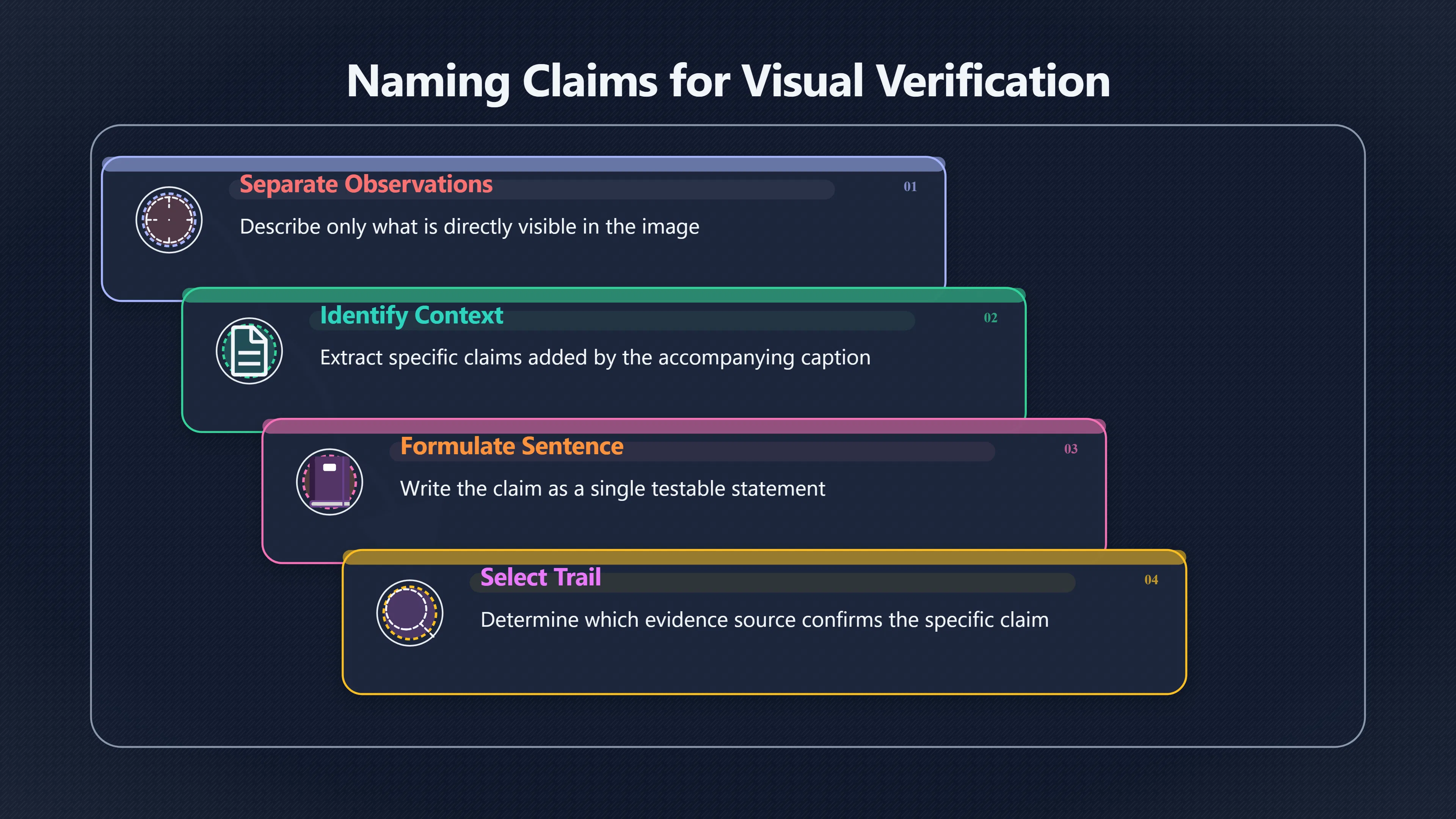
- Identify the place and date claim
- Separate what is visible from what the caption asserts
- Decide which source trail can confirm the context
Page outline Jump by section
Introduction
A viral image or video is rarely the claim by itself. The claim is usually the story attached to it: where it was taken, when it was recorded, who created it, what it shows, and why it supposedly matters. Before reverse-image searches, archive checks, or geolocation can help, you need to name that claim precisely.
 This step matters because many misleading posts use genuine visual material. The photo or clip may be real, but the caption can attach the wrong event, date, location, person, or motive. Researchers studying visual misinformation describe this as “out-of-context” use of authentic media, one of the most common forms of visual deception online.[arXiv]arxiv.orgOpen-Domain, Content-based, Multi-modal Fact-checking of Out-of-Context Images via Online ResourcesNovember 30, 2021…
The goal is not to ask whether an image is real. The goal is to identify exactly what the post is asking you to believe about that image.
Separate What Is Visible from What the Caption Asserts
The fastest way to name a claim is to split the post into two parts.
First, describe only what can be directly observed.
For example:
- A crowd is standing outside a building.
- Smoke is visible in the distance.
- Several police vehicles are parked nearby.
These observations come from the image itself.
Second, identify what the caption adds.
The caption might say:
- This happened yesterday.
- This is in Manchester.
- The crowd is protesting a specific government decision.
- The police are responding to a particular incident.
Those statements are not visible facts. They are claims about context.
This distinction is central because visual misinformation often depends on context rather than image manipulation. Fact-checkers frequently discover that an authentic photograph has been attached to a false narrative about where or when it was taken. AFP Fact Check notes that images are often misleading because they are presented out of context, making recovery of the original source and circumstances a key verification task.[AFP Fact Check]factcheck.afp.comAFP Fact CheckHow we workFor example, if we believe an image has been manipulated or presented out of context, we search for the original…
A useful formula is:
Visible content + claimed context = the claim to be checked.
Identify the Place and Date Claim
Most viral visual posts can be reduced to a small number of factual questions. The most important are usually place and date.
Ask:
- Where does the post claim this happened?
- When does the post claim it happened?
- Does the image itself provide clues that support or contradict those claims?
A post that says “Chaos in London today” actually contains at least two separate assertions:
- The footage was recorded in London.
- The footage was recorded today.
Either one can be wrong.
Many high-profile misinformation cases involve old material being recirculated as new. Reuters has repeatedly documented images that were genuine but falsely described as recent events. In one example, a photograph was shared as showing French President Emmanuel Macron running away from protesting farmers in 2024, when the image was actually taken in 2023 and showed him running to greet people at an agricultural fair. The visual was real; the date and interpretation were not.[Reuters]reuters.comimage does not show macron running away farmersThe photo, taken at the 59th edition of the International Agriculture Fair in Paris, depicts Macron running to greet attendees. Contrary…
When naming the claim, write it as a complete sentence:
“This image shows Macron fleeing farmers during protests in February 2024.”
That statement can later be tested against evidence.
Turn a Broad Viral Story into a Specific Checkable Claim
Viral posts often bundle several claims together.
Consider a caption such as:
“Mainstream media won’t show this. Thousands are fleeing the city after the disaster.”
The image may contain only a road and vehicles. The caption adds several separate assertions:
- The location is a specific city.
- A disaster occurred.
- The vehicles are people fleeing.
- Traditional news organisations are ignoring the event.
Trying to verify all of that at once usually leads to confusion.
Instead, extract the most concrete visual claim:
“This video shows residents leaving City X after Disaster Y.”
That narrower statement gives you something that can eventually be confirmed or disproved through source material, archives, local reporting, or geolocation.
Decide Which Source Trail Can Confirm the Context
Once the claim has been named, it becomes clearer what evidence would matter.
Different claims require different source trails:
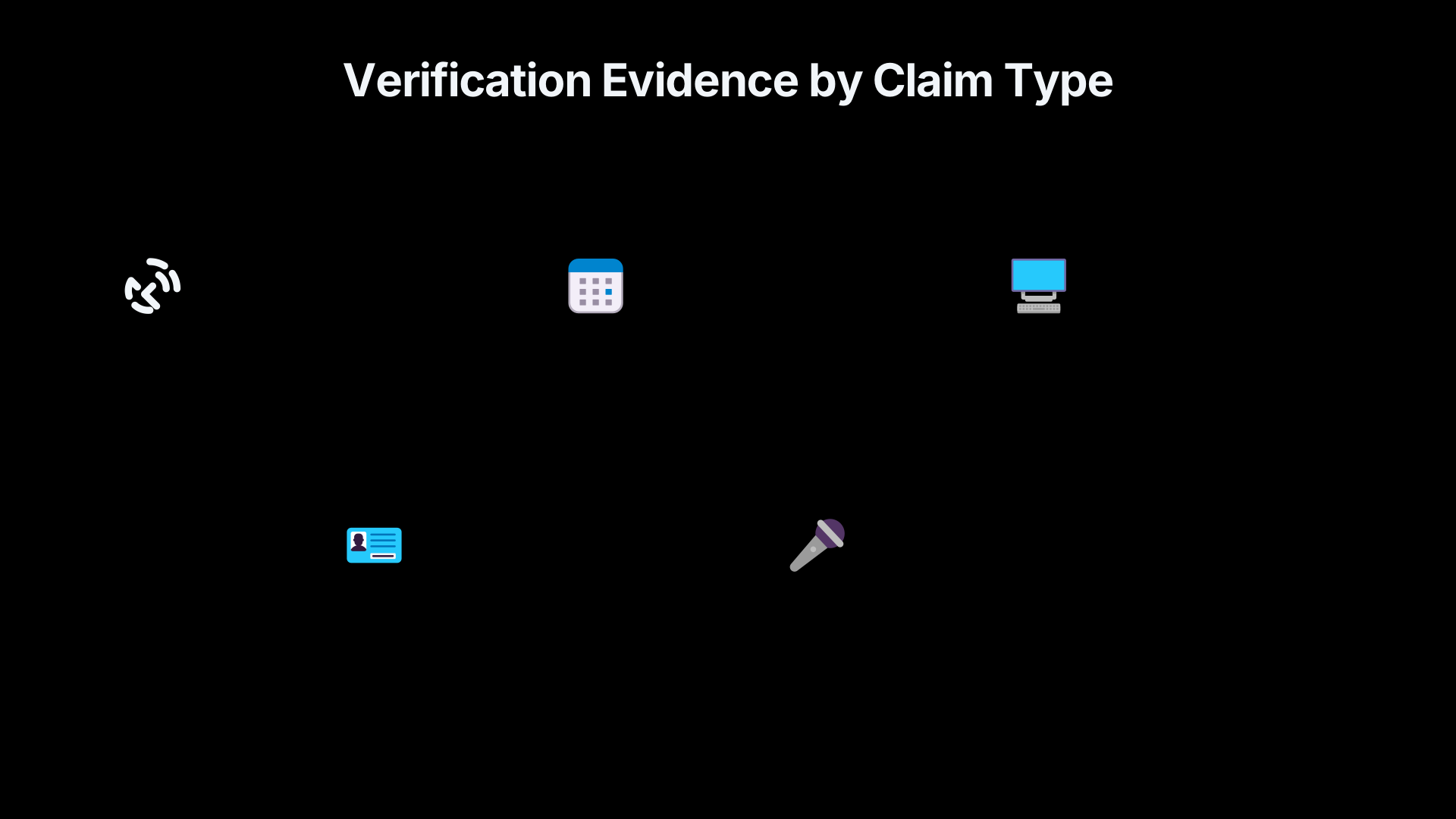
Claim typeLikely evidence trailLocation claimMaps, landmarks, street views, satellite imageryDate claimOriginal uploads, news archives, photographer recordsSource claimCreator account, agency records, metadata, publication historyEvent claimLocal reporting, official statements, eyewitness materialIdentity claimOriginal photographer, agency captions, corroborating images
Professional verification organisations routinely work backwards from the context claim to the original source. First Draft’s visual verification guidance emphasises tracing source and provenance—who posted the material, where it came from, and how it travelled online. Reuters and AFP similarly describe verification processes that focus on origin tracing, geolocation, captions, and primary-source confirmation. AFP Fact Check+3First Draft+3Reuters Agency[firstdraftnews.org]firstdraftnews.orgFirst DraftTips and tricks for verifying images and videos, and a look at…Tips and tricks for verifying images and videos, and a look…
Naming the claim correctly helps determine which trail is relevant. A reverse-image search cannot directly prove a motive, but it may help establish the original publication date. A map cannot prove intent, but it can help confirm location.
A Real Image Can Still Support a False Story
One of the most common mistakes is assuming that finding a genuine image proves a viral claim.
In reality, the image may be authentic while the attached story is wrong.
Reuters documented a widely shared photograph that was described online as showing Israeli settlers attempting to tear apart a Palestinian child. The image itself was genuine, but the original caption and photographer confirmed it actually showed settlers trying to prevent the arrest of another settler during a 2009 confrontation with police. The misleading element was not the image; it was the contextual claim attached to it.[Reuters]reuters.comImage does not show settlers trying to 'tear a Palestinian child apartMislabeled captions have circulated since at least 2013. The Reuters Fact Check team confirms the Getty caption's accuracy, confirming th…
Another Reuters investigation found a video montage about aid deliveries to Gaza that included authentic footage from Moldova showing facilities for Ukrainian refugees. The footage was real, but its use within the montage created a misleading impression about what viewers were seeing.[Reuters]reuters.comVideo compilation about Gaza aid contains stock footage from MoldovaThis footage, meant for illustrative purposes, was acknowledged after being highlighted by users and the BBC journalist on social media…
These examples illustrate why claim naming comes before verification. If the claim is wrongly defined as “Is this image fake?”, the actual problem may never be discovered. The real question might be:
“Does this image show the event the caption says it shows?”

Write the Claim as a Single Testable Sentence
Before opening a search engine, try writing the claim in one sentence.
Good examples:
- “This video shows flooding in Birmingham on 14 June 2026.”
- “This photograph was taken during the protest described in the caption.”
- “The person shown is the individual named in the post.”
- “This footage was recorded at the location claimed by the uploader.”
Less useful formulations include:
- “Is this real?”
- “What is going on here?”
- “Can this be trusted?”
The first set can be answered with evidence. The second set is too broad to guide an investigation.
Fact-checkers consistently begin by identifying the precise factual proposition before gathering evidence. Naming the claim transforms a viral image or video from an emotional social-media object into a concrete statement that can be tested.[IFCN Code of Principles+2Reuters]ifcncodeofprinciples.poynter.orgIFCN Code of Principles ReutersIFCN Code of PrinciplesReuters - IFCN Code of Principles - PoynterReuters uses primary sources in most cases in their fact checks - often…
The Key Question to Ask
When a photo or video goes viral, the most productive first question is not whether it is genuine.
It is:
“What exactly is this image being used to claim?”
Once that sentence is written clearly, questions about location, date, source, and context become much easier to investigate. Without that step, even the best verification tools can end up answering the wrong question.
Amazon book picks
Further Reading
Books and field guides related to What exactly does this image claim?. Use these as the next step if you want deeper reading beyond the article.
The Skeptics' Guide to the Universe
Helps separate observation from interpretation and assumption.

The art of thinking clearly
First published 2013. Subjects: nonfiction, psychology, Errors, Développement d'aptitudes, Prise de décision (Relations humaines).
eBay marketplace picks
Marketplace Samples
Example marketplace items related to this page. Use the search link to explore similar finds on eBay.
Endnotes
1.
Source: arxiv.org
Link:https://arxiv.org/abs/2112.00061
Source snippet
Open-Domain, Content-based, Multi-modal Fact-checking of Out-of-Context Images via Online ResourcesNovember 30, 2021...
Published: November 30, 2021
2.
Source: arxiv.org
Link:https://arxiv.org/abs/2408.09939
3.
Source: factcheck.afp.com
Link:https://factcheck.afp.com/How-we-work
Source snippet
AFP Fact CheckHow we workFor example, if we believe an image has been manipulated or presented out of context, we search for the original...
4.
Source: reuters.com
Title: image does not show macron running away farmers 2024 2024 02 29
Link:https://www.reuters.com/fact-check/image-does-not-show-macron-running-away-farmers-2024-2024-02-29/
Source snippet
The photo, taken at the 59th edition of the International Agriculture Fair in Paris, depicts Macron running to greet attendees. Contrary...
5.
Source: reuters.com
Title: Image does not show settlers trying to ‘tear a Palestinian child apart’
Link:https://www.reuters.com/fact-check/image-does-not-show-settlers-trying-tear-palestinian-child-apart-2024-06-28/
Source snippet
Mislabeled captions have circulated since at least 2013. The Reuters Fact Check team confirms the Getty caption's accuracy, confirming th...
6.
Source: reuters.com
Title: Video compilation about Gaza aid contains stock footage from Moldova
Link:https://www.reuters.com/fact-check/video-compilation-about-gaza-aid-contains-stock-footage-moldova-2024-02-22/
Source snippet
This footage, meant for illustrative purposes, was acknowledged after being highlighted by users and the BBC journalist on social media...
7.
Source: reuters.com
Link:https://www.reuters.com/fact-check/
Source snippet
Reuters Fact CheckReuters Fact Check addresses online misinformation with coverage that maintains accuracy, integrity and impartiality. T...
8.
Source: reuters.com
Link:https://www.reuters.com/fact-check/about/
Source snippet
About Reuters Fact CheckReuters only [fact-checks]({{ 'fact-checks/' | relative_url }}) claims under the categories of general news, politics, health and science, and environme...
9.
Source: reuters.com
Link:https://www.reuters.com/
Source snippet
Breaking International News & ViewsFind latest news from every corner of the globe at Reuters.com, your online source for break...
10.
Source: reuters.com
Title: single photo malta tidal baths is not proof sea level rises are hoax 2024 07 17
Link:https://www.reuters.com/fact-check/single-photo-malta-tidal-baths-is-not-proof-sea-level-rises-are-hoax-2024-07-17/
Source snippet
Single photo of Malta tidal baths is not proof sea level rises...17 Jul 2024 — Fact Check: Single photo of Malta tidal baths is not proo...
11.
Source: factcheck.afp.com
Link:https://factcheck.afp.com/
Source snippet
CheckAFP Fact Check is a department within Agence France-Presse (AFP), a multi-lingual, multicultural news agency whose mission is to pro...
12.
Source: firstdraftnews.org
Link:https://firstdraftnews.org/wp-content/uploads/2021/03/First-Draft-Vaccine-Insights-Flexible-Learning-Course-6.pdf
Source snippet
First DraftTips and tricks for verifying images and videos, and a look at...Tips and tricks for verifying images and videos, and a look...
13.
Source: reutersagency.com
Link:https://reutersagency.com/solutions/verification-services/
Source snippet
Verification & Fact Checking Services24/7 global monitoring to source and verify content, leveraging Open Source Intelligence Techniques...
14.
Source: ifcncodeofprinciples.poynter.org
Title: IFCN Code of Principles Reuters
Link:https://ifcncodeofprinciples.poynter.org/application/public/reuters/661a8b09ba7689d481421d7f
Source snippet
IFCN Code of PrinciplesReuters - IFCN Code of Principles - PoynterReuters uses [primary sources]({{ 'primary-sources/' | relative_url }}) in most cases in their fact checks - often...
15.
Source: thomsonreuters.com
Title: reuters launches fact checking initiative to identify misinformation
Link:https://www.thomsonreuters.com/en/press-releases/2020/february/reuters-launches-fact-checking-initiative-to-identify-misinformation
Source snippet
Reuters launches fact-checking initiative to identify...12 Feb 2020 — The newly created fact-checking unit at Reuters will verify conten...
16.
Source: camera.org
Title: Reuters Photos the Picture of Bias
Link:https://www.camera.org/article/reuters-photos-the-picture-of-bias/
Source snippet
3, 2001 — The captions under photos of the bombings did identify the victim as an Israeli, although the terrorist here too was labeled “a...
17.
Source: reutersagency.com
Link:https://reutersagency.com/about/standards-values/
18.
Source: reutersinstitute.politics.ox.ac.uk
Title: how public checks information it thinks might be wrong
Link:https://reutersinstitute.politics.ox.ac.uk/digital-news-report/2025/how-public-checks-information-it-thinks-might-be-wrong
Source snippet
the public checks information it thinks might be wrong17 Jun 2025 — This year's survey provides important insight into where respondents...
19.
Source: reutersinstitute.politics.ox.ac.uk
Link:https://reutersinstitute.politics.ox.ac.uk/news-powerful-and-privileged-how-misrepresentation-and-underrepresentation-disadvantaged
Source snippet
for the powerful and privileged: how misrepresentation...Apr 18, 2023 — Misrepresentation and underrepresentation of disadvantaged commu...
20.
Source: journals.sagepub.com
Link:https://journals.sagepub.com/doi/10.1177/1077695819831098
Source snippet
First Draft offers video modules in each of these categories as part...Read more...
21.
Source: guides.library.ontariotechu.ca
Title: visual verification
Link:https://guides.library.ontariotechu.ca/fakenews/visual-verification
Source snippet
It allows users to magnify, view available information about image and video such as location...Read more...
Additional References
22.
Source: researchgate.net
Link:https://www.researchgate.net/publication/367190999_Visual_User-Generated_Content_Verification_in_Journalism_An_Overview
Source snippet
Visual User-Generated Content Verification in JournalismThe aim of this study is to present a forward-looking perspective on how visual U...
23.
Source: openculture.agency
Link:https://openculture.agency/wp-content/uploads/2019/11/03_Chapter-3_FakeNews_online.pdf
Source snippet
Verifying pictures and video content. • Location: Check the location of the source of the information.Read more...
24.
Source: journalistsresource.org
Title: 5 takeaways first draft identifying misinformation course
Link:https://journalistsresource.org/politics-and-government/5-takeaways-first-draft-identifying-misinformation-course/
Source snippet
5 Takeaways from First Draft's identifying misinformation...19 Mar 2018 — A new online course from First Draft helps journalists use fre...
25.
Source: facebook.com
Title: Fake news spreads fast, especially during times of crisis
Link:https://www.facebook.com/UnitedNationsIndia/posts/fake-news-spreads-fast-especially-during-times-of-crisis-dont-let-fake-news-expl/1356566363165087/
Source snippet
Don't...🛠️ DIY Tip: Use fact-checking sites like Snopes, Africa Check, or Google Fact Check. Search headlines on Google News to see if t...
26.
Source: theguardian.com
Title: A photo of Iran’s bombed schoolgirl graveyard went viral
Link:https://www.theguardian.com/global-development/2026/mar/17/atrocity-ai-slop-verify-facts-iran-minab-graves
Source snippet
Mar 17, 2026 — Researchers have cross referenced the photo of the site with satellite images that confirm its location, and it can be cro...
27.
Source: aap.com.au
Title: How do you fact-check real photographs and videos?
Link:https://www.aap.com.au/factcheck/factcheck-resources/how-do-you-fact-check-an-image/
Source snippet
26 Jan 2024 — In this article we provide some strategies to boost your media literacy so you can identify when a photograph may have b...
28.
Source: lab.imedd.org
Title: reporters guide to detecting ai generated content
Link:https://lab.imedd.org/en/reporters-guide-to-detecting-ai-generated-content/
Source snippet
imedd.orgReporter's guide to detecting AI-generated content14 Nov 2025 — A practical guide from GIJN for journalists, aimed at combating...
29.
Source: mastersincommunications.org
Title: Browser extensions like News Guard rate source
Link:https://www.mastersincommunications.org/author/mark/page/3/
Source snippet
How to Spot Fake News: A Step-by-Step Detection Guide...Google Reverse Image Search and TinEye help verify whether photos have been mani...
30.
Source: gijn.org
Title: guide detecting ai generated content
Link:https://gijn.org/resource/guide-detecting-ai-generated-content/
Source snippet
Reporter's Guide to Detecting AI-Generated Content1 Sept 2025 — This guide teaches journalists how to try to identify AI-generated conten...
31.
Source: factcheckhub.com
Title: how to fact check images online
Link:https://factcheckhub.com/how-to-fact-check-images-online/
Source snippet
How to fact-check images online10 Oct 2020 — You might be able to verify it with the aid of tools for image fact-checking such as are Goo...
Topic Tree