Within Community Notes
How to read the source behind a note
A helpful note is only as strong as the source trail it gives readers for checking the original claim.
On this page
- When a cited source actually resolves the claim
- Why authority signals can mislead
- A practical checklist for note sources
Page outline Jump by section
Introduction
A Community Note can look persuasive simply because it appears beneath a viral post. Yet the real value of a note does not come from the note itself. It comes from the evidence trail that allows readers to check whether the correction actually resolves the original claim. Community Notes were designed around this principle: notes should stand on their sources rather than on the reputation of the contributor who wrote them. Researchers and the platform’s own guidance consistently find that notes with supporting sources are more likely to be judged helpful, while unsupported assertions, speculation and weak references are common reasons for notes being rejected.[X (formerly Twitter)+2X (formerly Twitter)]communitynotes.x.comX (formerly Twitter)Examples and note-writing tipsHelpful notes steer clear of all of these unhelpful attributes: Sources not included or…
 For critical thinkers, the key question is not “Does this note sound convincing?” but “Do the cited sources directly establish the point the note is making?” That distinction matters because a note can be widely shared, highly rated and still rely on evidence that is incomplete, outdated or irrelevant.
When a cited source actually resolves the claim
The strongest Community Note sources do more than look authoritative. They directly answer the question raised by the post.
Imagine a post claiming that a photograph shows an event that happened today. A useful note would ideally link to the original image source, a reputable archive or a publication showing that the same image appeared years earlier. The source resolves the claim because it addresses the exact factual dispute. By contrast, a source discussing the broader topic without identifying the image would not settle the question.
This principle is reflected in Community Notes guidance. Notes are considered unhelpful when sources are missing, unreliable, or fail to support the note’s argument. A source is valuable only if readers can follow it and independently verify the correction being offered.[X (formerly Twitter)]communitynotes.x.comX (formerly Twitter)Examples and note-writing tipsHelpful notes steer clear of all of these unhelpful attributes: Sources not included or…
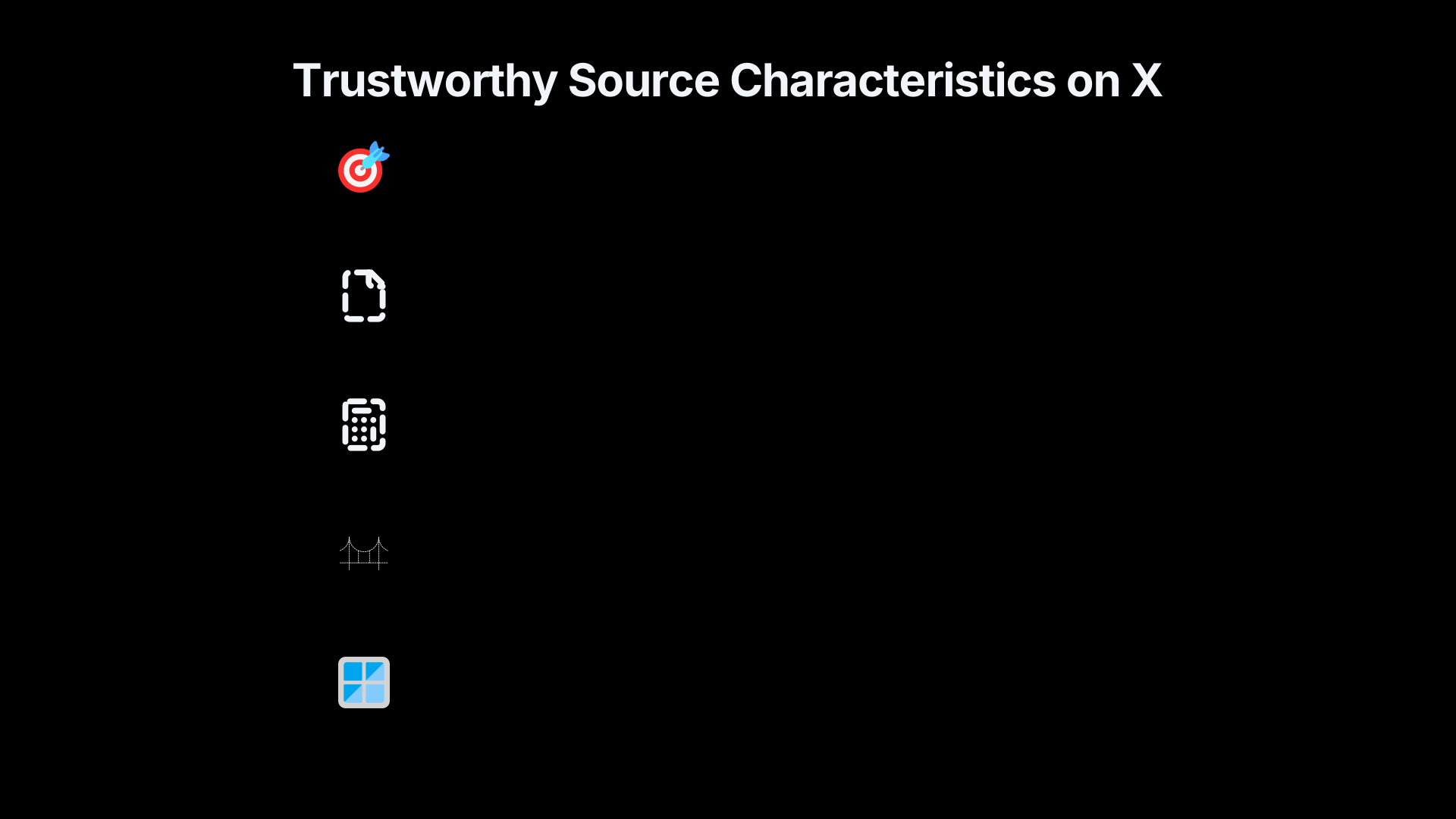
Several characteristics tend to make a source more trustworthy in this context:
- Direct relevance: it addresses the specific claim, image, video, quotation or statistic in question.
- Traceability: readers can inspect the original evidence rather than relying on a summary.
- Specificity: it provides dates, documents, datasets, transcripts or primary records.
- Transparency: the source shows how its conclusions were reached.
- Independence: it is not merely repeating the claim from another unsourced outlet.
Research on Community Notes suggests that external references are one of the strongest predictors of whether users judge a note as helpful. Notes linking to supporting evidence are substantially more likely to gain positive ratings than notes without sources.[arXiv]arxiv.orgReferences to unbiased sources increase the helpfulness of community fact-checksMarch 13, 2025…
Primary sources versus secondary sources
When available, primary sources usually deserve the closest attention.
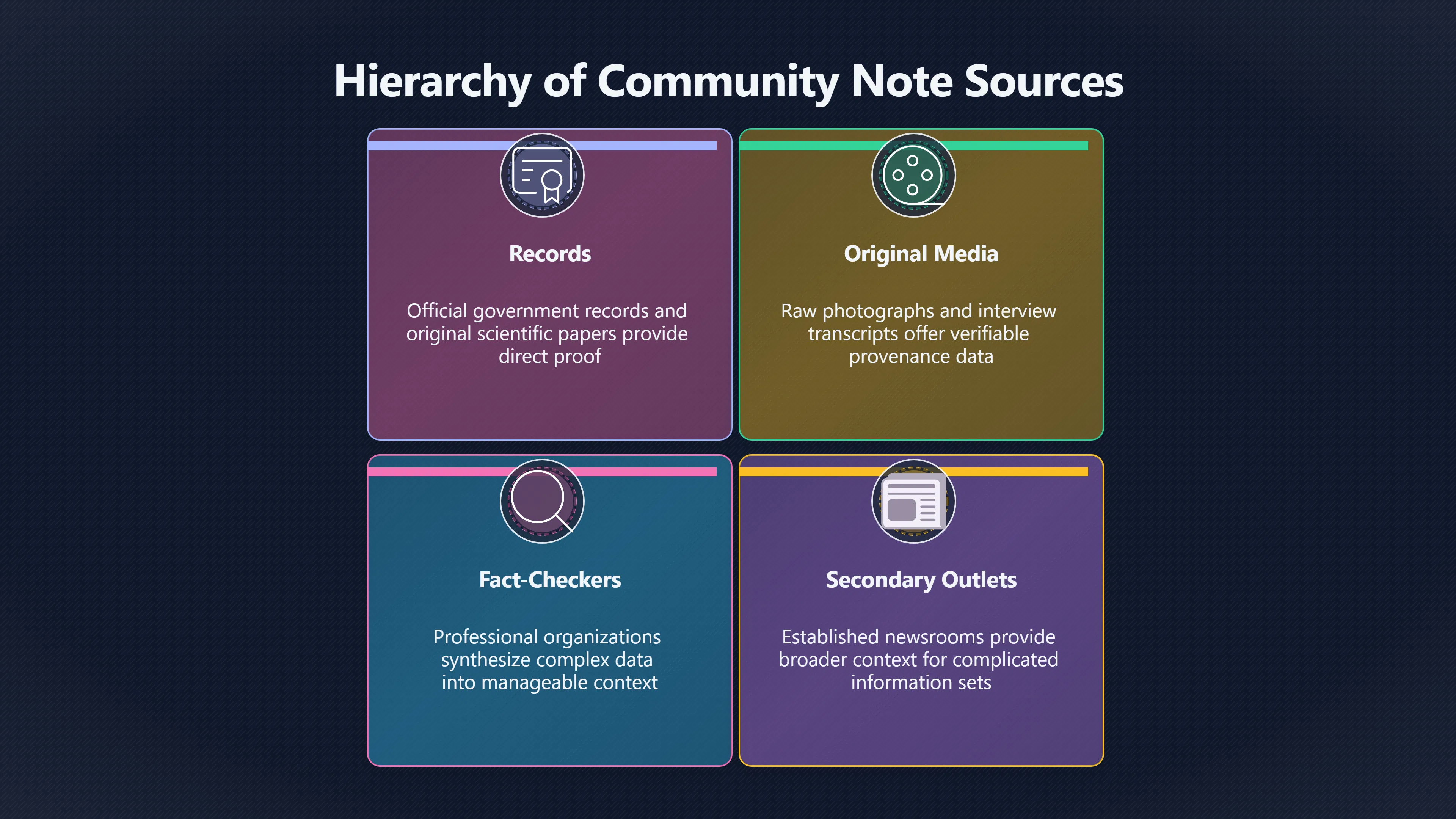
Examples include:
- Official reports and government records.
- Original datasets.
- Court documents.
- Scientific papers.
- Full speeches or interview transcripts.
- Original photographs or videos with verifiable provenance.
Secondary sources can still be valuable, especially when they synthesise complicated information. Professional fact-checking organisations, established newsrooms and specialist research institutes often provide useful context that most readers would struggle to assemble on their own. In fact, analyses of Community Notes have found that fact-checking organisations are among the most commonly cited source types and that notes drawing on them are often rated highly.[EDMO]edmo.euThe Role of Fact-Checkers in X's Community Notes - EDMO13 Feb 2025 — Fact-checking organizations are the third most frequently cited…
The best notes often combine both: a clear explanation plus links that allow readers to inspect the underlying evidence.
Why authority signals can mislead
One of the easiest mistakes is confusing authority signals with proof.
A source may appear trustworthy because it has:
- A familiar brand.
- A verified account.
- Professional design.
- Technical language.
- A large audience.
None of those features guarantees that the source actually supports the correction.
For example, a note may cite a respected news organisation, but the linked article might discuss a related issue rather than the specific claim being corrected. Alternatively, a source may contain a quotation taken out of context or a statistic that does not match the conclusion presented in the note.
This is why experienced fact-checkers often ask a simple question: if the source were removed, would the note still be making the same unsupported assertion? If the answer is yes, the source may be functioning as decoration rather than evidence.
Community Notes was deliberately designed around the idea that evidence should matter more than identity. Contributors and researchers involved in the project have argued that notes are most useful when readers can evaluate the cited material themselves instead of trusting a particular author or faction.[Asterisk]asteriskmag.comAsteriskThe Making of Community Notes - Asterisk MagazineYou should be able to read the note, and it should give you the information and…
Biased sources are not always false, but they require caution
Political, ideological and advocacy sources can contain accurate information. The issue is not that they are automatically wrong. The issue is that they may select facts, frame evidence or omit context in ways that favour a particular conclusion.
Recent research examining Community Notes found that references to less politically biased sources were associated with higher perceptions of helpfulness, while links to highly partisan sources were viewed less favourably. This suggests that contributors and raters often reward evidence seen as broadly credible across different viewpoints.[arXiv]arxiv.orgReferences to unbiased sources increase the helpfulness of community fact-checksMarch 13, 2025…
For readers, the practical lesson is straightforward: when a note relies heavily on a source with a clear political or commercial stake, it is worth checking whether independent sources reach the same conclusion.
A practical checklist for note sources
A quick source check can often be completed in less than a minute.
Before accepting a Community Note, ask:
- Does the source directly address the claim? Or is it merely related to the topic?
- Can I identify the original evidence? Is there a document, dataset, image archive, transcript or primary record?
- Is the source current enough? A correct source from several years ago may not resolve a claim about a recent event.
- Does the note accurately represent what the source says? Open the source and compare it with the note’s wording.
- Would multiple independent sources reach the same conclusion? Especially important for controversial or politically charged claims.
- What is missing? Sometimes a source proves one part of a correction while leaving another part unresolved.
- Could a reasonable reader verify the claim from the source alone? If not, the evidence may be weaker than it appears.
These questions matter because Community Notes are correction infrastructure, not final verdicts. Research suggests that notes can reduce the spread of misleading content and are often trusted by users, but the effectiveness of the system still depends on the quality of the evidence behind individual notes.[Justus-Liebig-Universität Gießen+2OSF]uni-giessen.deHowever, notes often appear too late to prevent the…Read more…

The most useful habit: follow the link
The strongest signal that a Community Note deserves trust is not who wrote it, how many people rated it helpful, or how confidently it is phrased. It is whether the cited sources allow an ordinary reader to verify the correction independently.
A well-written note should make that verification easier, not replace it. The note provides the summary; the sources provide the proof. When readers take the extra step of checking those sources, Community Notes become more than a crowdsourced annotation system. They become a practical tool for critical thinking in an information environment increasingly shaped by viral content, algorithmic amplification and AI-generated material.[Asterisk+2X (formerly Twitter)]asteriskmag.comAsteriskThe Making of Community Notes - Asterisk MagazineYou should be able to read the note, and it should give you the information and…
Amazon book picks
Further Reading
Books and field guides related to How to read the source behind a note. Use these as the next step if you want deeper reading beyond the article.
The Skeptics' Guide to the Universe
Offers practical tools for evaluating sources and claims.
A field guide to lies
First published 2016. Subjects: Critical thinking, Fallacies (Logic), Reasoning, Statistics, Social aspects.
eBay marketplace picks
Marketplace Samples
Example marketplace items related to this page. Use the search link to explore similar finds on eBay.
![Listing image for NCT 127 [FACT CHECK] 5th Album CHANDELIER Ver/CD+Photo Book+Photo Card+Poster](/assets/images/marketplace-covers/0ec43911bad3ef719bae.jpg)

Endnotes
1.
Source: arxiv.org
Link:https://arxiv.org/abs/2503.10560
Source snippet
References to unbiased sources increase the helpfulness of community fact-checksMarch 13, 2025...
Published: March 13, 2025
2.
Source: edmo.eu
Link:https://edmo.eu/publications/the-role-of-fact-checkers-in-xs-community-notes-faster-trusted-and-more-effective/
Source snippet
The Role of Fact-Checkers in X's Community Notes - EDMO13 Feb 2025 — Fact-checking organizations are the third most frequently cited...
3.
Source: osf.io
Link:https://osf.io/preprints/osf/3a4fe
Source snippet
ced the spread of misleading posts by, on average, 61.4%.Read more...
4.
Source: arxiv.org
Link:https://arxiv.org/html/2509.09956v1
Source snippet
How the Request Function Shapes X's Community Notes...12 Sept 2025 — Since contributors are required to cite external sources when writi...
5.
Source: arxiv.org
Link:https://arxiv.org/html/2502.13322v1
Source snippet
Community Notes Moderate Engagement With and...18 Feb 2025 — We find that attaching fact-checking notes significantly reduces the engage...
6.
Source: communitynotes.x.com
Link:https://communitynotes.x.com/guide/en/contributing/examples
Source snippet
X (formerly Twitter)Examples and note-writing tipsHelpful notes steer clear of all of these unhelpful attributes: Sources not included or...
7.
Source: x.com
Link:https://x.com/CommunityNotes/status/1714409083036643549
Source snippet
X (formerly Twitter)Community NotesNotes that cite sources have a much higher likelihood of earning a 'Helpful' status. This is not surpr...
8.
Source: asteriskmag.com
Link:https://asteriskmag.com/issues/08/the-making-of-community-notes
Source snippet
AsteriskThe Making of Community Notes - Asterisk MagazineYou should be able to read the note, and it should give you the information and...
9.
Source: communitynotes.x.com
Link:https://communitynotes.x.com/guide/en/about/introduction
Source snippet
X (formerly Twitter)Community NotesCommunity Notes aims to create a better-informed world, by empowering people on X to collaboratively a...
10.
Source: uni-giessen.de
Link:https://www.uni-giessen.de/de/fbz/fb02/fb/professuren/bwl/data-science-digitalisierung/featured-research-trust-community-notes
Source snippet
However, notes often appear too late to prevent the...Read more...
11.
Source: Wikipedia
Title: Community Notes
Link:https://en.wikipedia.org/wiki/Community_Notes
Source snippet
Community NotesCommunity Notes (formerly known as Birdwatch) is a feature on X where contributors can add context such as [fact-checks]({{ 'fact-checks/' | relative_url }})...
12.
Source: x.com
Link:https://x.com/?lang=en
Source snippet
X. See what's happeningFrom breaking news and entertainment to sports and politics, get the full story with all the live commentary. Avai...
13.
Source: help.x.com
Title: community notes
Link:https://help.x.com/en/using-x/community-notes
Source snippet
on XCommunity Notes aim to create a better informed world by empowering people on X to collaboratively add context to potentially mislead...
14.
Source: communitynotes.x.com
Link:https://communitynotes.x.com/guide/en/contributing/values
Source snippet
Notes aims to help all people better understand issues discussed in posts, including people who may hold different viewpoints. Contribute...
15.
Source: communitynotes.x.com
Title: [ranking]({{ ‘ranking/’ | relative_url }}) notes
Link:https://communitynotes.x.com/guide/en/under-the-hood/ranking-notes
Source snippet
ranking algorithmCommunity Notes are submitted and rated by contributors. Ratings are used to determine note statuses (“Helpful”, “Not He...
16.
Source: jlupub.ub.uni-giessen.de
Link:https://jlupub.ub.uni-giessen.de/server/api/core/bitstreams/cee932ab-fe77-4a4a-b842-b9345d2a14aa/content
Source snippet
notes increase trust in fact-checking on social...by CP Drolsbach · 2024 · Cited by 95 — Our objective is to understand whether people a...
17.
Source: orbilu.uni.lu
Link:https://orbilu.uni.lu/bitstream/10993/59462/1/3686967.pdf
Source snippet
the Roll-Out of Community Notes Reduce Engagement...by Y CHUAI · 2024 · Cited by 102 — Community Notes is a crowdsourced fact-checking a...
Additional References
18.
Source: carnegieendowment.org
Title: countering disinformation effectively an evidence based policy guide
Link:https://carnegieendowment.org/russia-eurasia/research/2024/01/countering-disinformation-effectively-an-evidence-based-policy-guide
Source snippet
A large body of research indicates that fact-checking can be an effective way to correct false beliefs about specific claims...Read more...
19.
Source: acma.gov.au
Link:https://www.acma.gov.au/sites/default/files/2020-06/Misinformation%20and%20news%20quality%20position%20paper.pdf
Source snippet
alicious actors with the intent to cause harm to individual users and the broader...Read more...
20.
Source: socialmediatoday.com
Title: x adds new source reference requirement community notes
Link:https://www.socialmediatoday.com/news/x-adds-new-source-reference-requirement-community-notes/697131/
Source snippet
X Adds New Source Reference Requirement for...18 Oct 2023 — Community Notes creators will now be prompted to add a source, in order to h...
21.
Source: poynter.org
Title: fact checkers contribute improve community notes x
Link:https://www.poynter.org/ifcn/2025/fact-checkers-contribute-improve-community-notes-x/
Source snippet
Fact-checkers are among the top sources for X's...20 Feb 2025 — The study, conducted by Spanish fact-checking site Maldita, ranked profe...
22.
Source: youtube.com
Link:https://www.youtube.com/watch?v=Shen8Pxmauw
Source snippet
TikTok trials its own take on X-style 'community notes' against misinformation • FRANCE 24 English...
23.
Source: hal.science
Title: Bouchaud Ramaciotti 2026 Community Notes v2
Link:https://hal.science/hal-05116614v2/file/Bouchaud%20Ramaciotti%202026%20Community%20Notes%20v2.pdf
Source snippet
Community Notes undermoderate polarizing content by...by P Bouchaud · 2025 · Cited by 10 — On the other hand, research has shown that cr...
24.
Source: verfassungsblog.de
Link:https://verfassungsblog.de/putting-xs-community-notes-to-the-test/
Source snippet
Putting X's Community Notes to the Test8 Jan 2024 — Helpful Notes can be rated positively, unhelpful Notes negatively...
25.
Source: youtube.com
Title: Can Community Notes clean up your feed?
Link:https://www.youtube.com/watch?v=OpZMccSrbe4
Source snippet
How Meta's new community notes program might work as fact-checking ends for Facebook, Instagram...
26.
Source: blogs.lse.ac.uk
Title: lse.ac.uk Do Community Notes work?
Link:https://blogs.lse.ac.uk/impactofsocialsciences/2025/01/14/do-community-notes-work/
Source snippet
LSE Impact14 Jan 2025 — Community Notes is a crowd-sourcing system. Users opt-in to submit notes on content which is posted on the platfo...
27.
Source: techxplore.com
Link:https://techxplore.com/news/2025-01-community-meta.html
Source snippet
X's 'Community Notes': a model for Meta?7 Jan 2025 — X, formerly Twitter, has relied on 'community notes' to alert to false or misleading...
Topic Tree