Within Think Before Sharing
When Trust in People Replaces Evidence
People often judge claims through social identity and familiar messengers, which can blur the line between trust and evidence.
On this page
- Why familiar messengers persuade
- Identity and group approval
- Checking claims without attacking people
Page outline Jump by section
Introduction
Online credibility is often shaped by a deceptively simple shortcut: who shared the claim. A familiar creator, a trusted community figure, a relatable parent, a favourite podcaster or someone who “sounds like us” can make a claim feel more believable before the evidence has been examined. In the age of social media and AI, this matters because persuasive messengers can now package uncertain, false or incomplete information in highly personal forms: short videos, live reactions, screenshots, voice notes, AI-polished explainers and emotionally intimate posts.
The problem is not that trusting people is irrational. Human beings have always relied on social trust to navigate too much information. The risk is that identity-based trust cues can quietly replace evidence-based judgement. Studies of social media credibility show that people often use source cues, social ties, endorsement signals and prior beliefs when judging posts, sometimes more than the quality of the evidence itself.[Nature+2arXiv]nature.comThe persuasive effects of social cues and source effects on…by CS Traberg · 2024 · Cited by 74 — To test whether social cues onl…
Why familiar messengers persuade
Influencers persuade partly because they do not always feel like institutions. They appear in everyday spaces: kitchens, bedrooms, cars, gym mirrors, livestream chats and podcasts. Their authority may come less from formal expertise than from continuity, tone and perceived authenticity. Followers see the same person repeatedly, learn their habits, recognise their jokes and begin to treat them as a stable point of reference.
This is often described through parasocial relationships: one-sided emotional connections with public figures, media personalities or influencers. The concept is not new, but social platforms intensify it because creators can respond to comments, share personal struggles, use informal language and make audiences feel addressed as insiders. Research on influencers has linked parasocial interaction and perceived credibility to stronger engagement, trust and persuasion in commercial contexts, showing how “I know this person” can become “I trust what they recommend”.[PMC+2PMC]pmc.ncbi.nlm.nih.govPMCAn in-depth analysis of fashion and beauty influencersby X Zhou · 2024 · Cited by 17 — This study focuses on beauty and fashion influencers on Instagram and examines how changes in the cat…
That same mechanism can carry over from products to public claims. A creator who begins with skincare, fitness, parenting, politics, comedy or lifestyle advice may later comment on vaccines, elections, war, crime, migration, finance or AI. The audience does not encounter the claim in isolation. It arrives wrapped in an already established relationship: familiar face, familiar cadence, familiar moral stance.
The Reuters Institute’s 2025 Digital News Report describes a wider shift towards an alternative media ecosystem of YouTubers, TikTokers, podcasters and online personalities, while traditional news organisations struggle with engagement and trust.[reutersinstitute.politics.ox.ac.uk]reutersinstitute.politics.ox.ac.ukdnr executivednr executive Pew Research similarly found that about one in five US adults regularly get news from news influencers, rising to well over a third among adults aged 18 to 29.[Pew Research Center]pewresearch.orgPew Research Center America's News InfluencersPew Research Center America's News Influencers These figures do not prove that influencer news is inherently bad. They do show that public knowledge is increasingly mediated by personalities whose credibility may be built through intimacy rather than editorial process.
When trust moves from evidence to identity
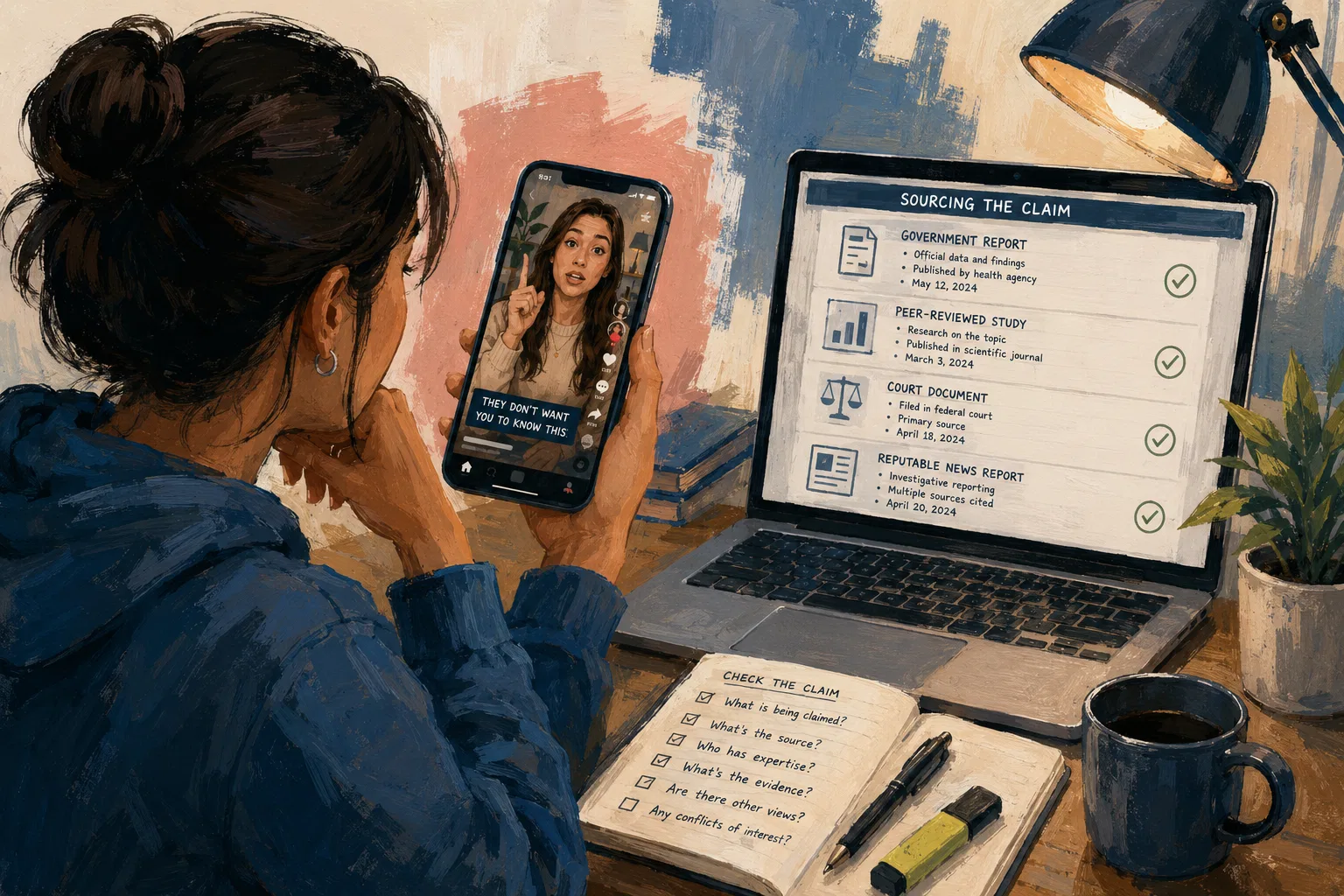
Identity-based trust cues work because they answer social questions before factual ones. Is this person on my side? Do they understand people like me? Are they brave enough to say what others will not? Do people in my group approve of them? Those questions can feel more urgent than “What is the evidence?”
This does not only happen in politics. It can appear in wellness communities, fandoms, parenting groups, financial advice channels, local Facebook groups and AI-focused creator circles. A person may trust a claim because it comes from a fellow patient, a small-business owner, a parent, a veteran, a teacher, a dissident, a religious figure, a local resident or a creator who shares their cultural references. Shared identity can provide useful context, especially when institutions have ignored or mistreated a community. But it can also make weak claims feel protected from scrutiny.
Research on credibility evaluation supports this concern. In a study of health-related social media posts, adult readers’ credibility ratings were strongly affected by whether claims fitted their prior beliefs and by the source’s perceived expertise, while evidence quality mattered comparatively little.[arXiv]arxiv.orgOpen source on arxiv.org. A separate study in Scientific Reports found that endorsement cues increased susceptibility to misinformation, suggesting that visible social approval can make misleading headlines feel more reliable.[Nature]nature.comThe persuasive effects of social cues and source effects on…by CS Traberg · 2024 · Cited by 74 — To test whether social cues onl…
The key point is not that identity corrupts judgement. Identity is often part of how people decide whose experience deserves attention. The danger comes when identity becomes a substitute for testing the claim. “She seems genuine” is not the same as “the claim is supported”. “He has been right before” is not the same as “this post shows enough evidence”. “People like us are sharing it” is not the same as “it is true”.
Group approval can make claims feel safer than they are
A claim shared by one influencer may persuade. A claim repeated across a group can feel almost confirmed. Likes, reposts, stitches, comments, quote posts, follower counts, blue ticks, community jokes and reaction videos all act as social reference cues. They tell the viewer that other people have already paid attention, approved, laughed, worried or become angry.
This is powerful because social media platforms display popularity beside content. A weak claim can arrive with strong social proof. A misleading clip can look important because thousands of people are reacting to it. A rumour can gain credibility when several creators in the same identity network repeat it in slightly different language.
The American Press Institute and AP-NORC found in earlier research that who shares an article on Facebook can have a major influence on whether people trust it.[American Press Institute]americanpressinstitute.orgtrust social mediaAmerican Press InstituteHow Americans decide what news to trust on social media20 Mar 2017 — The study demonstrates that who shares an ar… More recent experimental work on misinformation sharing has also found that social cues referencing a user’s personal network, when combined with misinformation flags, can reduce sharing of misleading COVID-19 content, which underlines how much social context affects whether people pass claims on.[PubMed]pubmed.ncbi.nlm.nih.govOpen source on nih.gov.
Local communities show a related risk. In 2026, reporting on Social Market Foundation analysis found that misinformation was nearly three times more common in UK areas with little or no recognised local journalism, based on more than 125,000 posts across local Facebook groups, X searches and Nextdoor communities.[The Guardian]theguardian.comThe Guardian'Killer of trust': social media groups fuel misinformation in UK, report findsMPs and media advocates warn that unregulated local online groups are eroding trust and influencing public opinion, often more than forma… In those environments, a familiar neighbourhood group or local voice may become a substitute for verified local reporting. The trust cue is not celebrity; it is proximity.

Influencers are not all the same
It is tempting to treat “influencer” as a warning label. That is too crude. Some creators are careful explainers who link sources, correct errors, separate fact from opinion and bring neglected expertise to wider audiences. Others are entertainers who sometimes drift into topics they do not understand. Some are political operators, brand partners, activists, community organisers or entrepreneurs. Many are hybrids.
The credibility question is therefore not “Is this person an influencer?” but “What trust cues are being used, and are they matched by evidence?” A creator may be trustworthy on one topic and unreliable on another. A doctor may be credible on medicine but not geopolitics. A financial educator may be useful on budgeting but weak on public health. A journalist may be strong on documented reporting but poor when speculating outside their beat. A relatable lived-experience account may be valuable testimony without being a complete explanation of a wider pattern.
UNESCO’s 2024 work on digital content creators illustrates the gap between influence and verification. Reporting on its survey found that many creators did not routinely verify information before sharing and often relied on personal experience, informal research or source popularity rather than official documents or expert sources.[The Guardian]theguardian.comOpen source on theguardian.com. That does not make creators uniquely careless; it shows that influencer communication often runs on different norms from journalism, academic research or official evidence review.
The most useful standard is proportional trust. A creator can earn attention through authenticity, but stronger claims require stronger checking. Personal honesty does not guarantee factual accuracy. Good intentions do not prevent cherry-picking. Lived experience can reveal what institutions miss, but it cannot by itself prove a causal claim, a statistic or a broad allegation.
AI makes identity cues easier to imitate
Generative AI adds a new layer to identity-based trust. It can help genuine creators draft scripts, translate posts, summarise documents and make complex topics accessible. It can also help bad actors imitate credibility: polished captions, synthetic images, cloned voices, fake screenshots, fabricated “local” notices and plausible-looking explainers.
This matters because identity cues are often visual and stylistic. A profile picture, accent, slogan, community language, editing style or “ordinary person” tone may make content feel authentic. AI can reproduce parts of that surface. A post can now sound like a concerned parent, a local resident, a medical insider or a small creator exposing a hidden truth without that identity being real or the evidence existing.
Research on credibility in the social web has long noted that credibility is perceived rather than simply present: users judge believability through signals that may or may not correspond to reliability.[arXiv]arxiv.orgOpen source on arxiv.org. The AI era sharpens this distinction. A claim may look human, intimate and community-specific while being machine-generated, coordinated or copied across accounts.
This does not mean every polished post is suspect. It means the old cue “this feels authentic” is weaker than it used to be. Authentic style is now cheap to produce. Evidence, traceable sourcing, transparent correction and accountable expertise matter more.
Checking claims without attacking people
A practical response should avoid turning critical thinking into social combat. People often share claims because they trust someone, identify with a community or fear being misled by institutions. Directly insulting the messenger can make the claim more identity-protective: rejecting the claim then feels like rejecting the group.
A better approach separates the person from the proposition. The question is not “Is this influencer good or bad?” but “What would make this claim reliable?”
Useful checks include:
- Identify the claim, not the vibe. Reduce the post to one sentence: “This person is claiming that X caused Y,” or “This post says this event happened in this place on this date.”
- Look for the original source. A screenshot of a headline, chart or quote is not enough. Find the report, video, court document, dataset, public statement or full article.
- Check topic fit. Ask whether the messenger has relevant expertise or direct evidence for this specific claim, not just general trust with the audience.
- Separate testimony from proof. A personal story can be important evidence of experience, but it may not establish scale, cause or general risk.
- Watch for identity pressure. Phrases such as “they do not want people like us to know”, “real ones understand”, or “if you question this, you are part of the problem” can discourage scrutiny.
- Check whether corrections are welcome. Credible messengers can make mistakes. The stronger signal is whether they correct clearly, link better evidence and avoid punishing followers who ask fair questions.
This preserves the social value of trust while refusing to let it replace evidence. It also makes correction less personal. “I like this creator, but I cannot verify this claim” is a stronger critical-thinking habit than “I trust them, so it must be true” or “they are an influencer, so it must be false”.
The critical habit that matters most
The central skill is to notice when trust has moved from the claim to the claimant. Social media encourages that movement because people, faces and group signals are easier to process than documents, methods and uncertainty. AI intensifies the problem by making persuasive identity cues easier to manufacture at scale.
A good rule is to treat familiar messengers as starting points, not endpoints. They can alert people to neglected issues, translate expert debates, build community and make public information easier to care about. But when the claim concerns health, safety, elections, conflict, finance, crime, science or another high-stakes topic, identity-based trust should trigger a second step: evidence checking.
The healthiest form of online trust is not blind loyalty to institutions or personalities. It is conditional trust: warm enough to listen, careful enough to verify, and flexible enough to change when the evidence changes.
Amazon book picks
Further Reading
Books and field guides related to When Trust in People Replaces Evidence. Use these as the next step if you want deeper reading beyond the article.
Foolproof: Why We Fall for Misinformation and How to Build Im...
Explains why trusted messengers can bypass skepticism.


eBay marketplace picks
Marketplace Samples
Example marketplace items related to this page. Use the search link to explore similar finds on eBay.


Endnotes
1.
Source: nature.com
Link:https://www.nature.com/articles/s41598-024-54030-y
Source snippet
The persuasive effects of social cues and source effects on...by CS Traberg · 2024 · Cited by 74 — To test whether social cues onl...
2.
Source: arxiv.org
Link:https://arxiv.org/abs/2303.09656
3.
Source: pmc.ncbi.nlm.nih.gov
Title: PMCAn in-depth analysis of fashion and beauty influencers
Link:https://pmc.ncbi.nlm.nih.gov/articles/PMC11550666/
Source snippet
by X Zhou · 2024 · Cited by 17 — This study focuses on beauty and fashion influencers on Instagram and examines how changes in the cat...
4.
Source: pmc.ncbi.nlm.nih.gov
Title: PMCFancying the New Rich and Famous?
Link:https://pmc.ncbi.nlm.nih.gov/articles/PMC6872518/
Source snippet
Explicating the Roles of...by C Lou · 2019 · Cited by 699 — This study proposed and tested a comprehensive conceptual model that account...
5.
Source: reutersinstitute.politics.ox.ac.uk
Title: dnr executive
Link:https://reutersinstitute.politics.ox.ac.uk/digital-news-report/2025/dnr-executive-summary
6.
Source: reutersinstitute.politics.ox.ac.uk
Title: digital news report
Link:https://reutersinstitute.politics.ox.ac.uk/digital-news-report/2025
7.
Source: pmc.ncbi.nlm.nih.gov
Link:https://pmc.ncbi.nlm.nih.gov/articles/PMC10485706/
8.
Source: arxiv.org
Link:https://arxiv.org/abs/2001.09473
9.
Source: reutersinstitute.politics.ox.ac.uk
Link:https://reutersinstitute.politics.ox.ac.uk/news/trust-misinformation-and-declining-use-social-media-news-digital-news-report-2018
10.
Source: reutersinstitute.politics.ox.ac.uk
Title: mapping news creators and influencers social and video networks
Link:https://reutersinstitute.politics.ox.ac.uk/news-creators-influencers/2025/mapping-news-creators-and-influencers-social-and-video-networks
11.
Source: reutersinstitute.politics.ox.ac.uk
Title: Digital News Report 2025
Link:https://reutersinstitute.politics.ox.ac.uk/sites/default/files/2025-06/Digital_News-Report_2025.pdf
12.
Source: nature.com
Link:https://www.nature.com/articles/s41562-025-02205-6
13.
Source: nature.com
Link:https://www.nature.com/articles/s41599-023-02512-1
14.
Source: nature.com
Link:https://www.nature.com/articles/s41598-026-42329-x
15.
Source: nature.com
Link:https://www.nature.com/articles/s41598-024-57560-7
16.
Source: facebook.com
Link:https://www.facebook.com/ofcom/photos/-how-do-you-get-your-newsour-latest-research-shows-that-70-of-uk-adults-now-get-/1188018723357100/
17.
Source: americanpressinstitute.org
Title: trust social media
Link:https://americanpressinstitute.org/trust-social-media/
Source snippet
American Press InstituteHow Americans decide what news to trust on social media20 Mar 2017 — The study demonstrates that who shares an ar...
18.
Source: pewresearch.org
Title: Pew Research Center America’s News Influencers
Link:https://www.pewresearch.org/journalism/2024/11/18/americas-news-influencers/
19.
Source: pewresearch.org
Title: news influencers fact sheet
Link:https://www.pewresearch.org/journalism/fact-sheet/news-influencers-fact-sheet/
20.
Source: pubmed.ncbi.nlm.nih.gov
Link:https://pubmed.ncbi.nlm.nih.gov/37616030/
21.
Source: theguardian.com
Link:https://www.theguardian.com/media/2026/jun/08/social-media-groups-fuel-misinfomation-uk-[news-deserts
Source snippet
MPs and media advocates warn that unregulated local online groups are eroding trust and influencing public opinion, often more than forma...
22.
Source: theguardian.com
Link:https://www.theguardian.com/media/2024/nov/26/online-influencers-need-urgent-fact-checking-training-warns-unesco
23.
Source: pmc.ncbi.nlm.nih.gov
Link:https://pmc.ncbi.nlm.nih.gov/articles/PMC8869166/
24.
Source: pmc.ncbi.nlm.nih.gov
Link:https://pmc.ncbi.nlm.nih.gov/articles/PMC9887568/
25.
Source: pmc.ncbi.nlm.nih.gov
Link:https://pmc.ncbi.nlm.nih.gov/articles/PMC10879158/
26.
Source: pmc.ncbi.nlm.nih.gov
Link:https://pmc.ncbi.nlm.nih.gov/articles/PMC11345350/
27.
Source: pewresearch.org
Title: young adults and the future of news
Link:https://www.pewresearch.org/journalism/2025/12/03/young-adults-and-the-future-of-news/
28.
Source: pewresearch.org
Title: social media and news fact sheet
Link:https://www.pewresearch.org/journalism/fact-sheet/social-media-and-news-fact-sheet/
29.
Source: pewresearch.org
Link:https://www.pewresearch.org/short-reads/2025/10/29/how-americans-trust-in-information-from-news-organizations-and-social-media-sites-has-changed-over-time/
30.
Source: pewresearch.org
Link:https://www.pewresearch.org/short-reads/2025/02/19/no-consensus-on-who-comes-to-mind-when-americans-are-asked-to-name-a-news-influencer/
31.
Source: pewresearch.org
Title: americans experiences with social media news influencers
Link:https://www.pewresearch.org/journalism/2024/11/18/americans-experiences-with-social-media-news-influencers/
32.
Source: pewresearch.org
Title: 1 in 5 americans now regularly get news on tiktok up sharply from 2020
Link:https://www.pewresearch.org/short-reads/2025/09/25/1-in-5-americans-now-regularly-get-news-on-tiktok-up-sharply-from-2020/
33.
Source: pewresearch.org
Link:https://www.pewresearch.org/topic/news-habits-media/news-media-trends/news-platforms-sources/digital-news-landscape-1/social-media-news/
34.
Source: pewresearch.org
Title: news platform fact sheet
Link:https://www.pewresearch.org/journalism/fact-sheet/news-platform-fact-sheet/
35.
Source: ouci.dntb.gov.ua
Link:https://ouci.dntb.gov.ua/en/works/lDdd6Z8q/
Additional References
36.
Source: youtube.com
Title: What Is The Psychology Behind Influencer Trust In Social Media Marketing?
Link:https://www.youtube.com/watch?v=kfjI-fQWaiE
Source snippet
Psychology behind parasocial relationships influencer trust Why We Trust Influencers More Than Brands| Parasocial Relationships Explained...
37.
Source: youtube.com
Link:https://www.youtube.com/watch?v=22yoaiLYb7M
Source snippet
Why We Trust Influencers More Than Brands| Parasocial Relationships Explained | Marketing Psychology...
38.
Source: youtube.com
Link:https://www.youtube.com/watch?v=PBfwY6vD7d4
Source snippet
The Psychological Trick That Makes You Trust Influencers...
39.
Source: youtube.com
Title: Influencer Marketing, Authenticity and Parasocial Relationships
Link:https://www.youtube.com/watch?v=vlAROv-sKTY
Source snippet
What Is The Psychology Behind Influencer Trust In Social Media Marketing?...
40.
Source: youtube.com
Title: The Psychological Trick That Makes You Trust Influencers
Link:https://www.youtube.com/watch?v=XVduNXq-rIA
Source snippet
Influencer Marketing, Authenticity and Parasocial Relationships...
41.
Source: mdpi.com
Link:https://www.mdpi.com/2071-1050/14/19/12323
Source snippet
The Influence of the Credibility of Social Media...by H Mabkhot · 2022 · Cited by 142 — The findings indicate that a significant lin...
42.
Source: researchgate.net
Link:https://www.researchgate.net/publication/374779022_Original_Paper_Impact_of_Social_Reference_Cues_on_Misinformation_Sharing_on_Social_Media_Series_of_Experimental_Studies
43.
Source: researchgate.net
Link:https://www.researchgate.net/publication/387359523_Increasing_Social_Media_Stickiness_Through_Parasocial_Interaction_and_Influencer_Source_Credibility
44.
Source: researchgate.net
Link:https://www.researchgate.net/publication/397371489_Influence_of_Source_Credibility_Dimensions_of_Social_Media_Influencers_on_Purchase_Intention_Mediating_Role_of_Parasocial_Relationship
45.
Source: researchgate.net
Link:https://www.researchgate.net/publication/399535883_From_Expertise_to_Trust_How_Parasocial_Relationships_and_Influencer_Popularity_Shape_New_Energy_Vehicle_Purchase_Intention_in_China
Topic Tree
Follow this branch
Parent topic
Think Before SharingRelated pages 24
- Accuracy Nudge Can One Pause Stop a False Share?
- AI Tutors Should You Trust a Chatbot Tutor?
- AI Virality Why AI Misinformation Travels So Easily
- Community Notes Can the Crowd Correct the Feed?
- Corroboration Who Else Can Confirm This Claim?
- Deepfakes How to Check a Voice or Video Claim
- Emotional Posts Why Outrage Is Not Evidence
- Evidence Types Not All Evidence Deserves Equal Weight
- +16 more in sidebar
- AI Impersonation Can AI Fake Trustworthy Messengers?
- Local Groups When Local Trust Replaces Local Reporting
- News Influencers When Personalities Become the News Source
- Parasocial Trust Why Familiar Creators Feel So Trustworthy
- Shared Identity When 'People Like US' Becomes Proof
- Social Proof Why Popular Posts Can Feel True