Within Think Before Sharing
When Seeing Is No Longer Enough
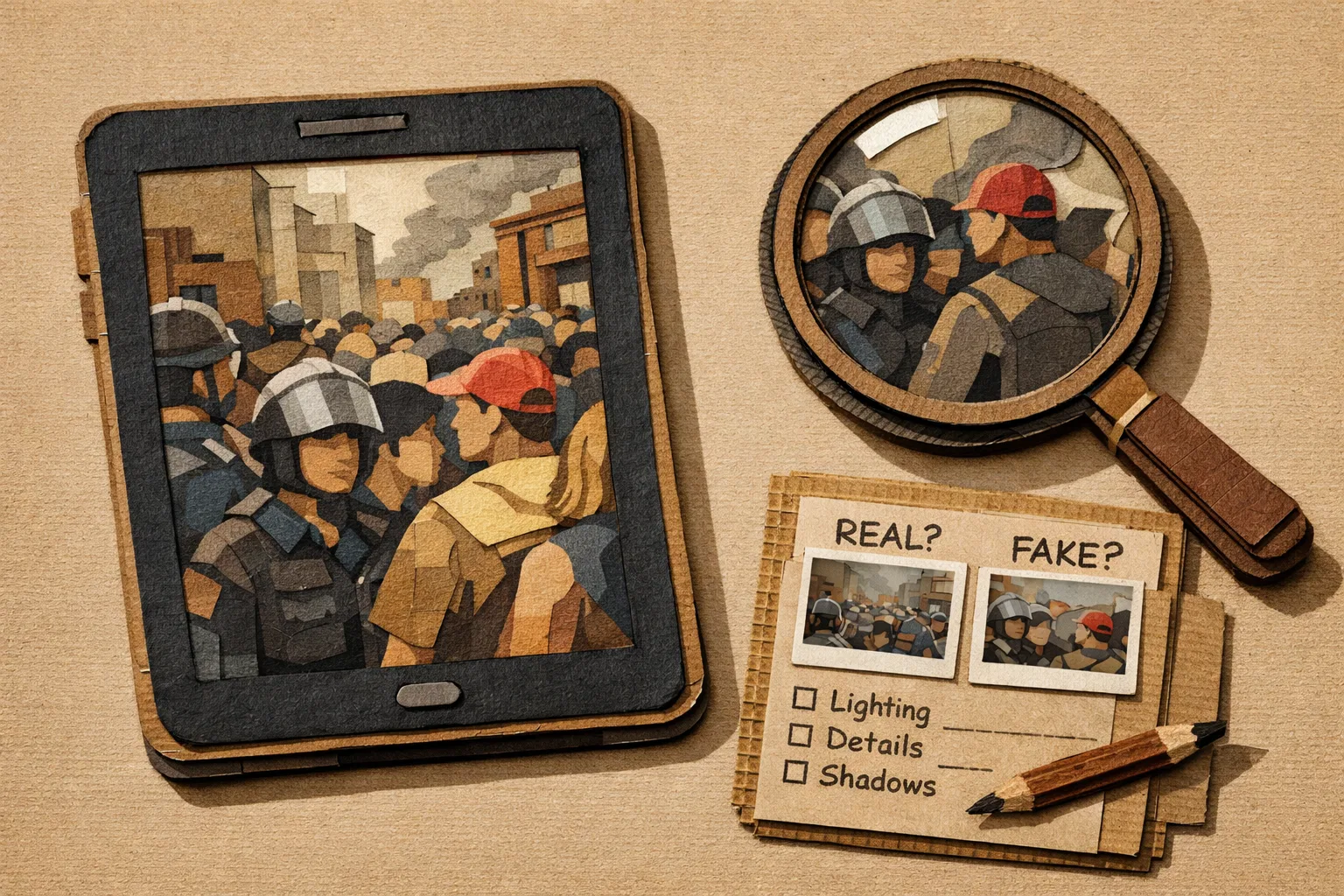
Realistic AI images make visual plausibility a weaker shortcut for deciding whether an event, quote, or document is genuine.
On this page
- Why realism persuades
- Image checks that still help
- What visual proof cannot show
Page outline Jump by section
Introduction
Synthetic images weaken one of the oldest shortcuts for judging online claims: the “looks-real test”. A photograph used to feel like hard evidence because it appeared to show a specific moment, place and body in front of a camera. Generative image systems now make that shortcut unreliable. They can produce a fire at an airport, a politician being arrested, a religious leader in unexpected clothing, or a fake local emergency with enough texture and lighting to feel concrete even when the event never happened.
The critical thinking shift is simple but uncomfortable: visual realism is no longer the same thing as evidential strength. A realistic image can still be useful, funny, artistic or illustrative, but it cannot, by itself, prove that an event occurred, that a quote was said, that a document is genuine, or that a person was physically present. The better question is not “Does this look like a photo?” but “What independent evidence connects this image to the real world?”
Why realism persuades
Realistic images persuade because they answer the brain’s first question too quickly. They supply faces, weather, shadows, clothes, architecture and emotion in one glance. In a social feed, that concreteness can make a claim feel verified before the viewer has asked where the image came from. This is especially powerful when the picture fits something the viewer already finds plausible: a disliked politician in trouble, a celebrity behaving oddly, a disaster unfolding in a tense region, or a dramatic scene during breaking news.
The viral fake image of Pope Francis in a white puffer jacket showed how low-stakes plausibility can still fool people. Reuters and AFP both identified the image as AI-generated, and AFP reported confirmation from the Vatican photographic service that it was fake. The image worked not because it proved anything important, but because it combined a recognisable public figure with a visually coherent style that many viewers found amusing and believable enough to share.[Reuters]reuters.comImage of Pope Francis wearing oversized white puffer coatImage of Pope Francis wearing oversized white puffer coat…March 29, 2023 — 29 Mar 2023 — An image showing Pope Francis wearing…
The same mechanism becomes more serious when synthetic images attach themselves to live events. In March 2023, fabricated images of Donald Trump being arrested circulated online before any such arrest had happened; the Associated Press reported that the creator confirmed they were made with Midjourney and first posted as parody. The images did not need to survive careful inspection to influence attention. They only needed to travel fast enough, with enough recognisable visual cues, to make people pause, react and repost.[AP News]apnews.comThe images are fabricated and Trump has not been arrested. The person who created many of the images circulating on social media…
A still more consequential example came in May 2023, when an apparently AI-generated image of an explosion near the Pentagon spread through social media, including via verified accounts, and briefly coincided with market movement before the claim was debunked. The episode showed that a synthetic image can matter even when it is exposed quickly: the damage window is the short period when the image looks plausible, the source appears official enough, and the audience has not yet found corroboration.[The Guardian]theguardian.comThe Guardian Fake AI-generated image of explosion near PentagonThe GuardianFake AI-generated image of explosion near Pentagon…May 22, 2023 — 22 May 2023 — An AI-generated image that appeared to sho…
Research is catching up with this everyday experience. A 2024 study of more than 30,000 photorealistic AI-generated images from Instagram and Twitter found that such images often used human figures, celebrities and politicians, with professional-looking aesthetics and few obvious signals of AI production. That matters because the older advice to “look for weird hands” or “check the background” is less dependable when synthetic images are deliberately made to resemble polished photography.[arXiv]arxiv.orgCrafting Synthetic Realities: Examining Visual Realism and Misinformation Potential of Photorealistic AI-Generated ImagesSeptember 2…
The fading looks-real test
The fading looks-real test does not mean every image should be treated as fake. It means the image’s visual quality should no longer be treated as the main reason to believe it. Before widely available generative tools, a convincing fake photograph usually required source material, editing skill and time. Now a prompt can produce an invented scene from scratch, and image-to-image tools can alter real photographs while preserving enough photographic texture to remain persuasive.
This changes the role of visual inspection. A viewer may still catch errors: distorted fingers, impossible reflections, garbled text, inconsistent shadows, mismatched jewellery, strange teeth, repeated background objects, or a face that looks too smooth. But these are weak signals, not verdicts. Their absence does not prove authenticity, and their presence does not always prove AI generation; compression, motion blur, low light and ordinary camera artefacts can also make real images look strange.
Human performance studies underline the point. One 2025 experiment using real images and Midjourney-generated counterparts found that participants averaged 54% accuracy when classifying images as real or AI-generated, only slightly above random guessing. Another line of research on AI-generated faces has found that even people with strong face-recognition ability can struggle, with short training improving performance but not making unaided judgement reliable.[arXiv]arxiv.orgarXiv We are not able to identify AI-generated imagesarXiv We are not able to identify AI-generated images
Detection tools are helpful but not a cure. Some image classifiers perform well in controlled tests, but real social media conditions add compression, cropping, screenshots, filters, adversarial edits and reposting. A 2024 study on AI-generated image detectors found that forensic classifiers can be attacked in realistic settings, including scenarios involving social-media-style post-processing, reducing accuracy enough that over-reliance on detectors may become risky.[arXiv]arxiv.orgOpen source on arxiv.org.
The critical thinking lesson is that “real-looking” and “detected as real” are both incomplete. A synthetic image can pass a casual visual check. A real image can be falsely flagged. A manipulated image can be based on a real photo. A screenshot can strip away provenance. The trust question has to move from the surface of the image to the chain around it: who captured it, when, where, with what corroboration, and why it is appearing in front of you now.
Image checks that still help
Image checks still matter, but they work best as triage, not as proof. They help decide whether to slow down, look for corroboration, or avoid sharing. The strongest checks combine close looking with outside verification.
A useful first move is to separate three questions that often get blurred together:
- Is the image synthetic or manipulated? This asks whether pixels were generated or altered.
- Is the caption true? A real image can be attached to the wrong place, date or event.
- Does the image prove the claim being made? Even an authentic image may not show what the post says it shows.
Reverse image search remains useful because many misleading visuals are old images recirculated with new captions. The News Literacy Project describes reverse image search as one of several practical verification tools, alongside geolocation and lateral reading. But it has limits with newly generated images: there may be no earlier copy to find, and search results may be thin or noisy when a false image first appears.[newslit.org]newslit.orgreverse image searchreverse image search
Close visual inspection works better when it targets relationships rather than isolated oddities. Instead of asking only whether a hand looks strange, check whether the scene behaves like a real scene:
- Objects and bodies: Do hands grip objects naturally? Do glasses, badges, straps, signs or tools connect physically to the people using them?
- Light and weather: Do shadows point in compatible directions? Does the claimed time or weather match the lighting?
- Text and symbols: Are signs, uniforms, number plates, logos or document details legible and consistent?
- Background logic: Do buildings, road markings, landmarks or interiors match the alleged location?
- Source chain: Is the image posted by someone plausibly present, or only by accounts repeating a dramatic claim?
Traditional verification guides still matter because many core questions have not changed. First Draft’s visual verification guidance emphasises checking the original uploader, the first appearance of the image, the uploader’s wider activity and corroboration from other sources. Those checks are even more important with synthetic images because the pixels alone may be more convincing than the surrounding evidence.[First Draft]firstdraftnews.orgFirst Draft VISUAL VERIFICATION GUIDE PHOTOS | First Draft NewsFirst Draft VISUAL VERIFICATION GUIDE PHOTOS | First Draft News
Professional fact-checking often combines these methods. Reuters, for example, debunked AI-generated images of aircraft landing near a flaming Beirut airport by using expert analysis and visual inconsistencies, while also noting that the original account later clarified the images had been generated with Midjourney. The key was not a single “AI tell”, but the combination of source context, technical review and comparison with verified information about the event.[Reuters]reuters.comImages of aircraft landings into flaming Beirut airport are AI-generatedImages of aircraft landings into flaming Beirut airport are AI-generated

What provenance can and cannot prove
Because visual inspection is weakening, many organisations are turning to provenance: technical information about how a piece of media was created, edited and published. The Coalition for Content Provenance and Authenticity, known as C2PA, provides an open standard for recording the origin and edits of digital content. Content Credentials, built on that standard, are often described as a kind of label that can show whether content was captured by a camera, generated by AI, or edited in software.[C2PA]c2pa.orgOpen source on c2pa.org.
This is a meaningful shift. Provenance moves the trust question from “Can I spot the fake?” to “Can this file show a verifiable history?” A camera, newsroom or editing tool can attach signed information to a file. A viewer or platform can then inspect that information to see what claims the file makes about its origin and editing history. The Content Authenticity Initiative describes Content Credentials as tamper-evident and persistent across editing steps, although persistence depends on the wider ecosystem preserving and displaying that data.[contentauthenticity.org]contentauthenticity.orgOpen source on contentauthenticity.org.
Watermarking is a related but different approach. Google’s SynthID, for example, is designed to embed imperceptible markers into AI-generated content so that it can later be identified by a detector. Research on SynthID-Image frames consistency across generated content as central to the value of watermarking: the system is most useful if a provider can reliably mark content from its own models.[arXiv]arxiv.orgOpen source on arxiv.org.
The limitation is that provenance and watermarking are not the same as truth. They can help answer “Where did this file come from?” or “Was this generated by a particular system?” They cannot, by themselves, prove that the caption is accurate, that the scene is complete, that the image has not been re-uploaded without metadata, or that all relevant platforms will display the signal. A signed image can still be misleadingly framed; an unsigned image can still be real.
Independent scrutiny has also raised caution about relying on provenance standards too quickly for high-stakes decisions. A 2026 security analysis of C2PA argued that the current specifications fall short of claimed security goals and should not yet be relied upon alone for uses such as journalism, financial disclosures or legal evidence. That does not make provenance useless; it means provenance should be treated as one layer in a verification process, not a replacement for judgement.[arXiv]arxiv.orgOpen source on arxiv.org.
The practical takeaway is balanced: provenance is valuable when present, verifiable and preserved, but absence of credentials is not proof of fakery, and presence of credentials is not proof of the broader claim. A cautious reader treats provenance as a strong clue about the media object, then still checks the event, source and context.
What visual proof cannot show
A realistic image can show a scene, but it cannot show the full claim attached to it. This is where many online mistakes happen. A post may use an image to imply causation, timing, intent or identity that the image itself cannot establish.
A crowd image cannot prove why people gathered. A damaged building cannot prove who caused the damage. A politician standing beside someone cannot prove endorsement. A screenshot of a document cannot prove the document was officially issued. A realistic image of an emergency cannot prove that emergency happened today, in the place named by the caption, or at all.
This distinction matters because synthetic images often enter feeds during moments of uncertainty: elections, wars, protests, disasters, scandals and fast-moving rumours. The image supplies emotional certainty at exactly the moment when the factual record is least settled. The Reuters Institute has warned that AI-generated disinformation around elections includes satire, scams and political manipulation, and that public figures with large archives of real images and videos are especially easy targets for synthetic likenesses.[reutersinstitute.politics.ox.ac.uk]reutersinstitute.politics.ox.ac.ukOpen source on ox.ac.uk.
The risk is not only that people believe one fake picture. It is that repeated exposure trains people into two unhelpful habits. One is gullibility: accepting any realistic image that matches their expectations. The other is blanket dismissal: rejecting inconvenient evidence by saying “that could be AI”. Both habits weaken public reasoning. The answer is not to trust images less in every case, but to trust them differently.
A stronger visual-evidence habit asks:
- What is the claim? Identify the exact thing the image is being used to prove.
- What would corroborate it? Look for independent reporting, official statements, eyewitnesses, satellite or weather data, other angles, live streams, local records or credible archives.
- Who benefits from speed? Be more cautious when a post pressures you to share before verification.
- What is missing? Ask whether the image lacks a source, date, location, original file, photographer, publisher or supporting evidence.
- What would change your mind? Decide in advance what kind of evidence would make the claim stronger or weaker.
The new standard for seeing online
The looks-real test is fading because realism has become cheap. That does not mean seeing is worthless. Images still matter deeply: they document harm, reveal abuses, record public events, support journalism and help people understand distant realities. The change is that a single image’s persuasive power must be separated from its evidential power.
For everyday users, the new standard is not expert forensic analysis. It is a pause. Do not share a dramatic image just because it looks like a photograph. Check whether credible sources are reporting the same event. Search for earlier appearances. Inspect the source chain. Look for location and time evidence. Treat AI detectors, watermarks and content credentials as aids rather than final judges.
For journalists, educators and platforms, the standard is higher. Visual verification needs to become visible to audiences: not just “this is verified”, but how it was verified. Trusting News has argued that, in the AI era, newsrooms should explain visual verification more clearly, including how false images are compared with verified scenes and other context clues. That kind of transparency helps readers learn the difference between a realistic-looking image and a well-supported claim.[Trusting News]trustingnews.orgTrusting News In AI age, explain how you verify visualsTrusting News In AI age, explain how you verify visuals
The central critical thinking skill is therefore not suspicion of images; it is disciplined interpretation. A synthetic image can look concrete without being connected to reality. A real image can be used to mislead. A verified image can still be overclaimed. In the age of social media and AI, seeing is still part of believing, but it is no longer enough.
Amazon book picks
Further Reading
Books and field guides related to When Seeing Is No Longer Enough. Use these as the next step if you want deeper reading beyond the article.
Calling Bullshit
Teaches evidence evaluation and skepticism when appearances feel convincing.

eBay marketplace picks
Marketplace Samples
Example marketplace items related to this page. Use the search link to explore similar finds on eBay.



Endnotes
1.
Source: reuters.com
Title: Image of Pope Francis wearing oversized white puffer coat
Link:https://www.reuters.com/article/fact-check/image-of-pope-francis-wearing-oversized-white-puffer-coat-is-ai-generated-idUSL1N36120G/
Source snippet
Image of Pope Francis wearing oversized white puffer coat...March 29, 2023 — 29 Mar 2023 — An image showing Pope Francis wearing...
Published: March 29, 2023
2.
Source: factcheck.afp.com
Link:https://factcheck.afp.com/doc.afp.com.33C66F3
Source snippet
Twitter users fooled by AI images of Pope in street fashion28 Mar 2023 — But Edmondo Lilli, a spokesman for the Vatican phot...
3.
Source: arxiv.org
Link:https://arxiv.org/abs/2409.17484
Source snippet
Crafting Synthetic Realities: Examining Visual Realism and Misinformation Potential of Photorealistic AI-Generated ImagesSeptember 2...
4.
Source: arxiv.org
Title: arXiv We are not able to identify AI-generated images
Link:https://arxiv.org/abs/2512.22236
5.
Source: arxiv.org
Link:https://arxiv.org/abs/2410.01574
6.
Source: newslit.org
Title: reverse image search
Link:https://newslit.org/news-and-research/reverse-image-search/
7.
Source: arxiv.org
Link:https://arxiv.org/abs/2603.09130
8.
Source: reuters.com
Title: Images of aircraft landings into flaming Beirut airport are AI-generated
Link:https://www.reuters.com/fact-check/images-aircraft-landings-into-flaming-beirut-airport-are-ai-generated-2024-10-29/
9.
Source: c2pa.org
Link:https://c2pa.org/
10.
Source: contentauthenticity.org
Link:https://contentauthenticity.org/how-it-works
11.
Source: arxiv.org
Link:https://arxiv.org/html/2510.09263v1
12.
Source: arxiv.org
Link:https://arxiv.org/abs/2604.24890
13.
Source: reutersinstitute.politics.ox.ac.uk
Link:https://reutersinstitute.politics.ox.ac.uk/news/how-ai-generated-disinformation-might-impact-years-elections-and-how-journalists-should-report
14.
Source: factcheck.afp.com
Link:https://factcheck.afp.com/doc.afp.com.33BY6R4
15.
Source: newslit.org
Link:https://newslit.org/checkology-resources/
16.
Source: arxiv.org
Link:https://arxiv.org/html/2504.06517v1
17.
Source: arxiv.org
Link:https://arxiv.org/html/2404.03021v2
18.
Source: arxiv.org
Link:https://arxiv.org/html/2604.24890v1
19.
Source: arxiv.org
Link:https://arxiv.org/html/2604.24197v1
20.
Source: arxiv.org
Link:https://arxiv.org/html/2512.22236v1
21.
Source: contentauthenticity.org
Link:https://contentauthenticity.org/
22.
Source: instagram.com
Link:https://www.instagram.com/p/DNN7Tx3IBiY/
23.
Source: instagram.com
Link:https://www.instagram.com/reel/DYPIcxgtX7O/
24.
Source: instagram.com
Link:https://www.instagram.com/reel/DRw2KRajaj2/
25.
Source: ai.google.dev
Link:https://ai.google.dev/responsible/docs/safeguards/synthid
26.
Source: reutersinstitute.politics.ox.ac.uk
Link:https://reutersinstitute.politics.ox.ac.uk/generative-ai-and-news-report-2025-how-people-think-about-ais-role-journalism-and-society
27.
Source: apnews.com
Link:https://apnews.com/article/fact-check-trump-NYPD-stormy-daniels-539393517762
Source snippet
The images are fabricated and Trump has not been arrested. The person who created many of the images circulating on social media...
28.
Source: theguardian.com
Title: The Guardian Fake AI-generated image of explosion near Pentagon
Link:https://www.theguardian.com/technology/2023/may/22/pentagon-ai-generated-image-explosion
Source snippet
The GuardianFake AI-generated image of explosion near Pentagon...May 22, 2023 — 22 May 2023 — An AI-generated image that appeared to sho...
Published: May 22, 2023
29.
Source: firstdraftnews.org
Title: First Draft VISUAL VERIFICATION GUIDE PHOTOS | First Draft News
Link:https://firstdraftnews.org/wp-content/uploads/2017/03/FDN_verificationguide_photos.pdf
30.
Source: trustingnews.org
Title: Trusting News In AI age, explain how you verify visuals
Link:https://trustingnews.org/in-ai-age-explain-how-you-verify-visuals/
31.
Source: dictionary.cambridge.org
Link:https://dictionary.cambridge.org/dictionary/english/realistic
32.
Source: contentcredentials.org
Link:https://contentcredentials.org/
33.
Source: glyndewis.com
Title: content credentials
Link:https://glyndewis.com/blog/content-credentials
34.
Source: theguardian.com
Link:https://www.theguardian.com/us-news/2026/may/01/may-day-strong-economic-protests
35.
Source: theguardian.com
Title: pope coat ai image baby boomers
Link:https://www.theguardian.com/commentisfree/2023/mar/27/pope-coat-ai-image-baby-boomers
36.
Source: findskill.ai
Link:https://findskill.ai/learn/synthid/
37.
Source: frontiersin.org
Link:https://www.frontiersin.org/journals/communication/articles/10.3389/fcomm.2024.1490798/full
38.
Source: journaliststoolbox.ai
Link:https://journaliststoolbox.ai/ai-fact-checking-tools/
39.
Source: mediahelpingmedia.org
Title: lateral reading
Link:https://mediahelpingmedia.org/basics/lateral-reading/
Additional References
40.
Source: livescience.com
Title: Live Science AI is getting better and better at generating faces
Link:https://www.livescience.com/health/psychology/ai-is-getting-better-and-better-at-generating-faces-but-you-can-train-to-spot-the-fakes
Source snippet
However, a brief five-minute training that highlighted common AI-rendering errors—such as unnatural textures or a central tooth—significa...
41.
Source: youtube.com
Link:https://www.youtube.com/watch?v=h_YzuXQlIXI
Source snippet
The AI-generated content that caused real world violence in the UK | LSE Research...
42.
Source: washingtonpost.com
Title: [pentagon explosion]({{ ‘pentagon-fake/’ | relative_url }}) ai image hoax
Link:https://www.washingtonpost.com/technology/2023/05/22/pentagon-explosion-ai-image-hoax/
Source snippet
The Washington PostPentagon explosion tweet was a hoax. Still, it went viral.22 May 2023 — An apparently AI-generated image sparked a bri...
Published: May 2023
43.
Source: youtube.com
Link:https://www.youtube.com/watch?v=54r2rIaVMzo
Source snippet
Real vs. fake: Can you spot AI generated images?...
44.
Source: youtube.com
Title: How to Spot Fake AI Photos | Hany Farid | TED
Link:https://www.youtube.com/watch?v=q5_PrTvNypY
Source snippet
AI-Generated Fakes: How to spot them, how they're made and how they have been used to mislead...
45.
Source: youtube.com
Title: Real vs. fake: Can you spot AI generated images?
Link:https://www.youtube.com/watch?v=i8cohl2In-M
Source snippet
Why this elderly French protester 'beaten' by police is AI generated • FRANCE 24 English...
46.
Source: researchgate.net
Link:https://www.researchgate.net/publication/393379906_Specific_media_literacy_tips_improve_AI-generated_visual_misinformation_discernment
47.
Source: researchgate.net
Link:https://www.researchgate.net/publication/395878869_Detection_of_Images_Generated_by_Artificial_Intelligence_Literacy_Visual_and_Disinformation
48.
Source: reddit.com
Link:https://www.reddit.com/r/news/comments/122ua4t/ai_image_of_pope_in_a_puffer_jacket_fooled_the/
49.
Source: oecd.ai
Link:https://oecd.ai/en/incidents/2023-05-22-b5f3
Topic Tree
Follow this branch
Parent topic
Think Before SharingRelated pages 24
- Accuracy Nudge Can One Pause Stop a False Share?
- AI Tutors Should You Trust a Chatbot Tutor?
- AI Virality Why AI Misinformation Travels So Easily
- Community Notes Can the Crowd Correct the Feed?
- Corroboration Who Else Can Confirm This Claim?
- Deepfakes How to Check a Voice or Video Claim
- Emotional Posts Why Outrage Is Not Evidence
- Evidence Types Not All Evidence Deserves Equal Weight
- +16 more in sidebar
- Inspection Limits Why spotting weird hands is not enough
- Pentagon Fake How one fake explosion image moved attention fast
- Pope Puffer Why the Pope puffer fooled so many people
- Realism Trap Why fake images feel true at first glance
- Reverse Search When reverse image search helps and fails
- Source Chain What proves a viral image came from reality