Within Emotional Posts
When checking facts feels socially risky
Some posts make asking for evidence seem immoral, which is why scepticism needs to separate truth, framing, and action.
On this page
- Phrases that punish scepticism
- Truth, framing, and action as separate questions
- How to ask for sources without excusing harm
Page outline Jump by section
Introduction
In emotionally charged online discussions, asking for evidence can sometimes be treated as a moral failure rather than a normal part of finding out what is true. A person who requests a source may be accused of defending a wrongdoer, minimising suffering, delaying action, or siding with the opposition. This dynamic is one reason emotional posts can bypass scepticism: the social cost of checking claims becomes part of the message itself.
 The challenge for critical thinking is not deciding whether a situation is serious. It is recognising that seriousness does not remove the need for verification. In fact, the more morally important a claim is, the more important it becomes to know whether the claim is accurate, complete, and fairly represented before acting on it. Research on misinformation, social identity, motivated reasoning, and group conformity helps explain why verification can feel like betrayal even when it serves the interests of truth.[Nature]nature.comThe psychological drivers of misinformation belief and its…by UKH Ecker · 2022 · Cited by 1941 — In this Review, we describe the…
Phrases that punish scepticism
Many emotional posts contain explicit or implicit messages that make questioning socially costly. The language varies, but the mechanism is similar.
Common examples include:
- “If you need evidence, you are part of the problem.”
- “Silence is violence.”
- “Why are you defending them?”
- “Believe people.”
- “This is not the time to ask questions.”
- “The facts are obvious.”
These phrases do not necessarily mean the underlying claim is false. The problem is that they shift attention away from evidence and towards loyalty. The discussion stops being about whether a statement is accurate and becomes a test of whether someone belongs to the morally acceptable group.
Psychological research suggests that people often process information partly through the lens of social identity. Information that appears threatening to an important group identity can trigger defensive reactions, making scrutiny feel less like investigation and more like an attack. Motivated reasoning research finds that people are often influenced by whether information supports or threatens their existing commitments and affiliations.[American Psychological Association+2Cambridge Repository]apa.orgMore than two decades…
This helps explain why requests for evidence can provoke hostility. The request is interpreted not as “Is this true?” but as “Are you challenging our side?”
Why moral urgency changes the meaning of questions
In fast-moving online events, people frequently encounter claims attached to stories of injustice, danger, discrimination, violence, or victimisation. Because the stakes appear high, some users begin treating verification as a delay tactic.
A request for proof can then be reinterpreted as a refusal to care. The person asking for evidence may be seen as obstructing solidarity rather than seeking accuracy.
This reaction becomes especially strong when people believe immediate action is required. If a post frames the situation as an emergency, fact-checking can appear emotionally out of place. The social expectation becomes action first, verification later.
Yet real-world examples repeatedly show why this instinct can be dangerous. During major breaking news events, false identifications, fabricated screenshots, and misleading claims often spread before reliable information becomes available. Following the 2024 Bondi Junction attack in Australia, social media users rapidly circulated incorrect claims about the attacker’s identity and motives before authorities had established the facts. Innocent people were wrongly identified and inflammatory narratives spread widely.[The Guardian]theguardian.comDespite the police stating there was no evidence the attack was ideologically driven, rumors about religious and political motivations sp…
The lesson is not that concern was misplaced. The lesson is that concern alone could not determine what was true.
Truth, framing, and action are separate questions
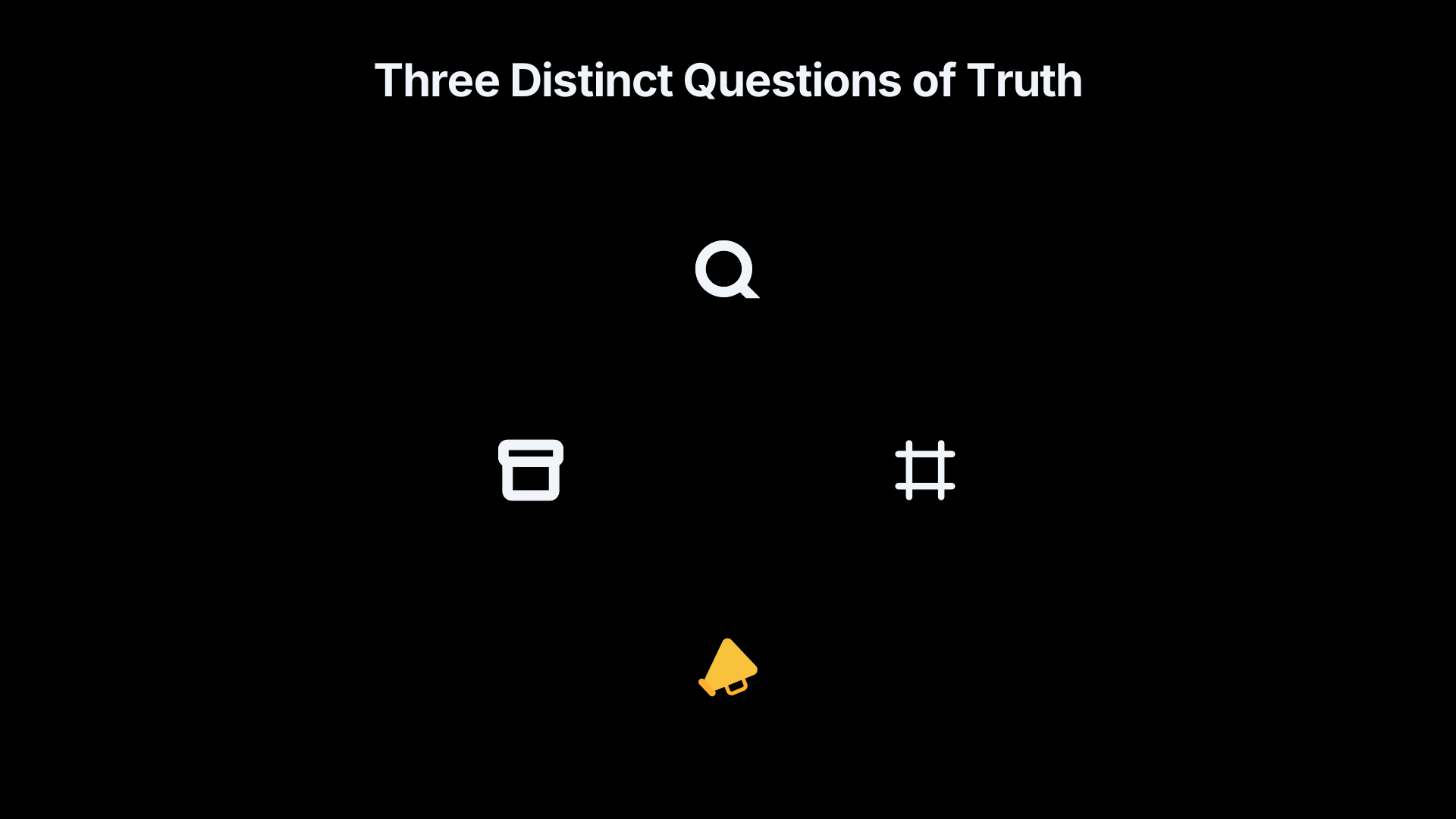
One reason verification feels uncomfortable is that people often merge three distinct questions into one.
Is the claim true?
This concerns facts. Did the event happen? Is the photograph genuine? Was the quotation actually said? Is the statistic accurate?
Is the framing fair?
Even when a claim is factually correct, the presentation may be selective, exaggerated, or missing crucial context. A real event can be attached to a misleading narrative.
What action should follow?
Even after facts and framing are established, people may reasonably disagree about the appropriate response.
These questions are often collapsed together in emotional discussions. Someone who asks whether a claim is true can be treated as if they are rejecting the framing. Someone who questions the framing can be treated as if they oppose action. Someone who debates a proposed response can be accused of denying the facts.
Separating these questions reduces confusion. A person can simultaneously believe that a problem is serious, insist on accurate evidence, and support action. Verification does not automatically imply opposition. It simply addresses a different question.
The role of perceived group norms
Another reason verification can feel socially risky is that people often overestimate how much certainty exists around them.
Research on pluralistic ignorance describes situations where individuals misjudge what others really think. People may privately have doubts or unanswered questions while assuming everyone else is completely convinced. As a result, they stay silent to avoid appearing deviant, which reinforces the illusion that no doubts exist.[Frontiers+2Stanford Graduate School of Business]frontiersin.orgFrontiers A century of pluralistic ignorance: what we have learnedFrontiersA century of pluralistic ignorance: what we have learned…October 16, 2023 — by DT Miller · 2023 · Cited by 88 — Pluralistic i…
In online environments, visible signals such as likes, reposts, supportive comments, and outrage can intensify this effect. A user may see thousands of people endorsing a claim and conclude that asking for evidence would be socially unacceptable.
The result is a feedback loop:
- People assume scepticism is unpopular.
- They suppress questions.
- Fewer questions become visible.
- The appearance of unanimous certainty grows stronger.
The social penalty may therefore be partly perceived rather than real. Many observers may privately share the same concerns but remain silent because they think they are alone.[Frontiers+2arXiv]frontiersin.orgFrontiers A century of pluralistic ignorance: what we have learnedFrontiersA century of pluralistic ignorance: what we have learned…October 16, 2023 — by DT Miller · 2023 · Cited by 88 — Pluralistic i…
Why platforms amplify the problem
Social media systems reward engagement, visibility, and emotional intensity more than careful verification. Content that creates a strong reaction often receives more attention than content that expresses uncertainty or asks for additional evidence.
This does not mean platforms intentionally promote falsehoods. It means that emotionally satisfying responses are often easier to produce and easier to reward than cautious ones.
In such environments, public displays of certainty can generate social approval, while requests for clarification may appear disruptive. Research on information sharing and verification behaviour suggests that social motivations, trust relationships, and conformity pressures influence how people evaluate and spread information.[PMC+2PMC]pmc.ncbi.nlm.nih.govTrust, Media Credibility, Social Ties, and the Intention to Share…by P Majerczak · 2022 · Cited by 186 — This study expands on the…
When a community strongly values solidarity, verification may be interpreted as disloyalty. When a community strongly values opposition to a perceived enemy, fact-checking may be interpreted as helping that enemy. The emotional incentives push people towards signalling commitment rather than testing claims.
How to ask for sources without excusing harm
Because verification can be socially sensitive, the way questions are asked matters.
A useful approach is to separate concern from certainty.
Instead of:
- “I don’t believe this.”
Try:
- “This is important. Do we have a reliable source for it?”
Instead of:
- “That sounds fake.”
Try:
- “I want to make sure we’re working from accurate information.”
Instead of arguing immediately about conclusions, focus first on the evidence behind the specific claim. This keeps the discussion centred on facts rather than identities.
It can also help to acknowledge what is already known. For example:
- “If this happened, it is serious. I’m trying to verify the details.”
- “I’m not disputing that harm matters. I’m checking whether this particular account is accurate.”
These responses make it harder for others to frame verification as indifference.
The goal is not to neutralise moral concern. The goal is to prevent moral concern from becoming a substitute for verification.
The key distinction
Verification feels like betrayal when group loyalty, moral urgency, and public identity become intertwined with factual claims. In that situation, asking for evidence can look like crossing sides rather than checking reality.
Critical thinking requires resisting that pressure. A claim does not become true because questioning it is socially costly. Nor does a concern become unimportant because someone asks for sources.
The most reliable approach is to keep three questions separate: What is true? How is it being framed? What should be done about it? When those questions remain distinct, scepticism becomes a tool for understanding rather than a signal of disloyalty.
Amazon book picks
Further Reading
Books and field guides related to When checking facts feels socially risky. Use these as the next step if you want deeper reading beyond the article.


Mistakes Were Made (but Not by Me) Third Edition
Renowned social psychologists Carol Tavris and Elliot Aronson take a compelling look into how the brain is wired for self-justification....
eBay marketplace picks
Marketplace Samples
Example marketplace items related to this page. Use the search link to explore similar finds on eBay.

![Listing image for NCT 127 [FACT CHECK] 5th Album EXHIBIT JUNGWOO Ver/CD+4 Post Card+Card+Sticker](/assets/images/marketplace-covers/56882ab3f02073dbc060.jpg)
Endnotes
1.
Source: nature.com
Link:https://www.nature.com/articles/s44159-021-00006-y
Source snippet
The psychological drivers of misinformation belief and its...by UKH Ecker · 2022 · Cited by 1941 — In this Review, we describe the...
2.
Source: arxiv.org
Link:https://arxiv.org/abs/2012.01663
3.
Source: gsb.stanford.edu
Link:https://www.gsb.stanford.edu/faculty-research/publications/pluralistic-ignorance-perpetuation-social-norms-unwitting-actors
Source snippet
Stanford Graduate School of BusinessPluralistic Ignorance and the Perpetuation of Social Norms by...Pluralistic ignorance begins with a...
4.
Source: arxiv.org
Link:https://arxiv.org/html/2403.00195v1
Source snippet
The evolution of pluralistic ignorance29 Feb 2024 — Pluralistic ignorance refers to a social phenomenon where individuals privately hold...
5.
Source: pmc.ncbi.nlm.nih.gov
Link:https://pmc.ncbi.nlm.nih.gov/articles/PMC8869166/
Source snippet
Trust, Media Credibility, Social Ties, and the Intention to Share...by P Majerczak · 2022 · Cited by 186 — This study expands on the...
6.
Source: pmc.ncbi.nlm.nih.gov
Link:https://pmc.ncbi.nlm.nih.gov/articles/PMC12101777/
Source snippet
motivation and consequence of fact-checking behaviorby V Bodishtianu · 2025 · Cited by 3 — We tested three competing theories for fact-ch...
7.
Source: arxiv.org
Link:https://arxiv.org/html/2503.10445v1
Source snippet
Than Just Warnings: Exploring the Ways of Communicating...13 Mar 2025 — AI-based fact verification systems offer a promising solution by...
8.
Source: repository.cam.ac.uk
Link:https://www.repository.cam.ac.uk/items/fa35a87e-595f-4b64-aa44-3e9f2e8fdd76
Source snippet
bridge RepositoryAccuracy and Social Motivations Shape Judgements of (Mis...by S Rathje · 2022 · Cited by 174 — Some theories focus o...
9.
Source: apa.org
Link:https://www.apa.org/monitor/2017/05/alternative-facts
Source snippet
More than two decades...
10.
Source: theguardian.com
Link:https://www.theguardian.com/australia-news/2024/apr/15/false-claims-started-spreading-about-the-bondi-junction-stabbing-attack-as-soon-as-it-happened
Source snippet
Despite the police stating there was no evidence the attack was ideologically driven, rumors about religious and political motivations sp...
11.
Source: frontiersin.org
Title: Frontiers A century of pluralistic ignorance: what we have learned
Link:https://www.frontiersin.org/journals/social-psychology/articles/10.3389/frsps.2023.1260896/full
Source snippet
FrontiersA century of pluralistic ignorance: what we have learned...October 16, 2023 — by DT Miller · 2023 · Cited by 88 — Pluralistic i...
Published: October 16, 2023
12.
Source: thedecisionlab.com
Title: The Decision Lab Pluralistic Ignorance
Link:https://thedecisionlab.com/biases/pluralistic-ignorance
Source snippet
Pluralistic Ignorance - The Decision...Pluralistic ignorance is when we believe that our private views are different from those of the m...
13.
Source: ebsco.com
Link:https://www.ebsco.com/research-starters/psychology/pluralistic-ignorance
Source snippet
Pluralistic ignorance | Psychology | Research StartersPluralistic ignorance is a psychological and sociological phenomenon where individu...
14.
Source: pmc.ncbi.nlm.nih.gov
Link:https://pmc.ncbi.nlm.nih.gov/articles/PMC6216292/
Source snippet
sense of social influence: pluralistic ignorance in climate...by EM Kjeldahl · 2018 · Cited by 43 — Research shows that individuals tend...
15.
Source: psychologyfanatic.com
Title: pluralistic ignorance
Link:https://psychologyfanatic.com/pluralistic-ignorance/
Source snippet
The Silent Agreement That Shapes...17 Jun 2024 — Pluralistic ignorance exists where there is a silent agreement among individuals based...
16.
Source: db.arabpsychology.com
Title: pluralistic ignorance
Link:https://db.arabpsychology.com/pluralistic-ignorance/
Source snippet
Ignorance: Social Psychology ExplainedPluralistic ignorance is a fundamental concept within social psychology that describes a profound d...
Additional References
17.
Source: researchgate.net
Link:https://www.researchgate.net/publication/373896277_Trust_but_verify_the_effect_of_religiosity_and_social_conformity_on_verification_of_content_shared_via_social_media
Source snippet
(PDF) Trust but verify: the effect of religiosity and social...30 Apr 2026 — Purpose This study aims to understand the patterns of conte...
18.
Source: researchgate.net
Link:https://www.researchgate.net/publication/314394810_Pluralistic_Ignorance_Through_Media
Source snippet
Pluralistic Ignorance Through MediaPluralistic ignorance denotes a highly prevalent false belief about ideas, feelings, and actions of ma...
19.
Source: research-information.bris.ac.uk
Link:https://research-information.bris.ac.uk/files/298563464/Ecker_v4_TSshorten_UE_clean.pdf
20.
Source: carnegieendowment.org
Title: countering disinformation effectively an evidence based policy guide
Link:https://carnegieendowment.org/russia-eurasia/research/2024/01/countering-disinformation-effectively-an-evidence-based-policy-guide
Source snippet
Countering Disinformation Effectively: An Evidence-Based...31 Jan 2024 — A high-level, evidence-informed guide to some of the major prop...
21.
Source: ore.exeter.ac.uk
Title: exeter.ac.uk Taking [Fact-checks]({{ ‘fact-checks/’ | relative_url }}) Literally But Not Seriously?
Link:https://ore.exeter.ac.uk/articles/journal_contribution/Taking_Fact-Checks_Literally_But_Not_Seriously_The_Effects_of_Journalistic_Fact-Checking_on_Factual_Beliefs_and_Candidate_Favorability/29753936/1/files/56778089.pdf
Source snippet
The Effects...by B Nyhan · 2019 · Cited by 580 — By contrast, other studies find that fact-checking and other types of factual informati...
22.
Source: instagram.com
Link:https://www.instagram.com/reel/DLchgjTpvKW/
Source snippet
Here's why simple fact-checking often backfires and what that tells us about belief and...
23.
Source: instagram.com
Link:https://www.instagram.com/reel/DYlBMcag5hG/
Source snippet
We should never allow fear, censorship, or social pressure to...
24.
Source: instagram.com
Title: Most of you have never heard this story
Link:https://www.instagram.com/reel/DYiVvDFS99m/
Source snippet
It is not the case...NOT WAITING FOR CERTAINTY DECISIONS SHAPE OUTCOMES CERTAINTY NOT TESTS EVIDENCE DOES NOT LEAD CHANGE. Between polit...
25.
Source: youtube.com
Link:https://www.youtube.com/watch?v=VqzQLCeHa40
Source snippet
Dannagal G. Young - Info Wars: The Battle Against Misinformation | STM Podcast #191...
26.
Source: youtube.com
Title: Why People Believe Misinformation: The Psychology of Fear | Beyond the Books
Link:https://www.youtube.com/watch?v=_7otmig_7Co
Source snippet
How Our Own Reasoning Can Deceive Us in Everyday Life | Paz Garcia-Blanch Echeverria | TEDxASM Youth...
Topic Tree