Within Source Tracing
Does the cited source actually exist?
A citation only helps when the reader can open it, identify it, and confirm that it is not invented or dead.
On this page
- What a real citation should let you inspect
- Dead links, invented URLs, and fake bibliographies
- Simple checks before trusting a cited answer
Page outline Jump by section
Introduction
A citation is only useful if it leads somewhere real. In the context of AI-assisted answers, one of the quickest and most valuable critical-thinking checks is to ask whether the cited source actually exists. Large language models can generate references that look convincing: realistic author names, plausible article titles, reputable journals, and even working-looking URLs. Yet research has repeatedly found that AI systems sometimes invent citations, distort real ones, or attach references that do not support the claim being made.[Nature]nature.comFabrication and errors in the bibliographic citations…by WH Walters · 2023 · Cited by 523 — This study investigates one particul…
 The good news is that checking whether a citation exists is usually much easier than verifying an entire argument. A few minutes of source tracing can often reveal whether an AI answer rests on a genuine source trail or on a fabricated one.
What a real citation should let you inspect
A genuine citation creates a path from a claim to evidence. Whether the source is a journal article, news report, government document, company report, or webpage, a reader should be able to locate it and inspect the underlying material.
A real citation normally allows you to confirm several things:
- The source can be found through a search engine, library catalogue, publisher website, or archive.
- The title, author, publication, and date match each other.
- The document contains the information the AI claims it contains.
- The source has not been confused with a different document that has a similar title.
When a citation fails at the first step—because the article cannot be found anywhere or the URL does not resolve—the verification process stops immediately. Researchers studying citation URLs generated by AI systems found that a meaningful share were likely hallucinated, meaning there was no evidence the URLs had ever existed at all.[arXiv]arxiv.orgDetecting and Correcting Reference Hallucinations in…3 Apr 2026 — We find that 3–13% of citation URLs are hallucinated—they have…
This matters because people often treat the presence of citations as proof of reliability. Experiments on user trust have shown that readers tend to trust AI-generated answers more when citations are present, even when those citations are random or irrelevant. Trust drops when users actually inspect the references.[arXiv]arxiv.orgarXiv:2501.01303v1 [cs.CL] 2 Jan 2025January 3, 2025 — by Y Ding · 2025 · Cited by 53 — We found a significant increase in trust whe…
Dead links, invented URLs, and fake bibliographies
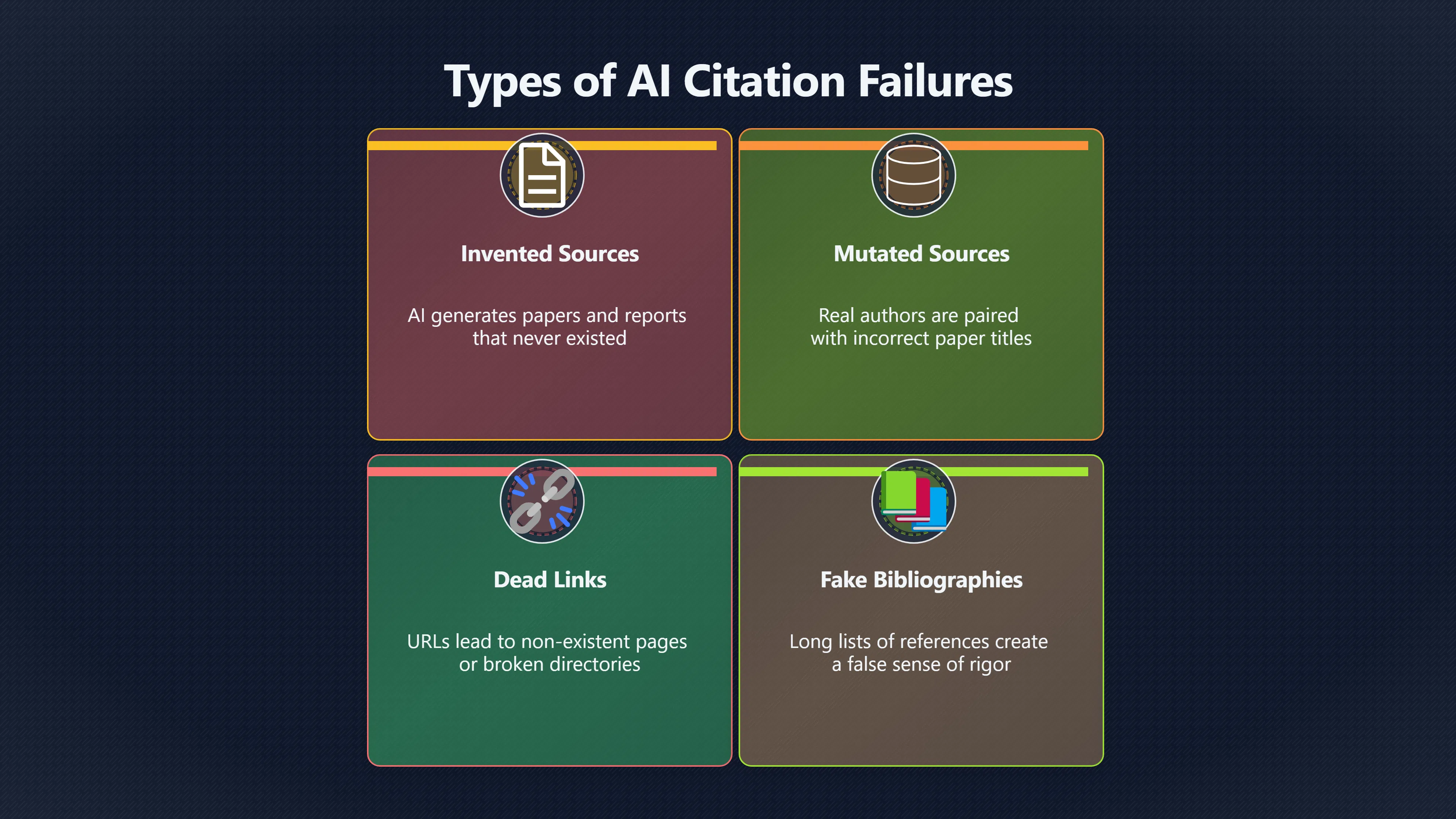
Not all citation failures look the same. Learning to recognise the common patterns makes source tracing much faster.
The invented source
This is the simplest failure mode. The AI produces a paper, report, or article that does not exist.
A well-known study examining citations generated by GPT models found substantial numbers of fabricated scholarly references. Some cited works looked highly plausible but could not be found in any publication database because they had never existed.[Nature]nature.comFabrication and errors in the bibliographic citations…by WH Walters · 2023 · Cited by 523 — This study investigates one particul…
Warning signs include:
- Titles that seem unusually generic.
- Author combinations that appear plausible but cannot be verified.
- Journals or publishers that cannot be found.
- Citations that produce no results in Google Scholar or ordinary web searches.
The mutated source
Sometimes the source exists, but the citation details have been altered.
The AI may combine a real author’s name with a different paper title, change the publication year, merge two separate articles, or paraphrase the title so heavily that it becomes difficult to locate. Investigations of AI-generated references have repeatedly documented these hybrid or distorted citations.[The Times]thetimes.comThe Times Publisher under fire after 'fake' citations found in AI ethics guideThe book, marketed as an authoritative exploration of AI ethics, is under scrutiny after investigations revealed that several chapters us…
These are particularly deceptive because parts of the citation appear authentic.
The dead-link problem
A URL may look legitimate while leading nowhere.
Recent analysis of AI-generated citation URLs found both non-resolving links and URLs that likely never existed. Some links contain subtle mistakes such as incorrect page identifiers, invented file names, or fabricated directory structures.[arXiv]arxiv.orgDetecting and Correcting Reference Hallucinations in…3 Apr 2026 — We find that 3–13% of citation URLs are hallucinated—they have…
If a link fails:
- Remove tracking parameters and retry.
- Search for the title separately.
- Search the publisher’s site directly.
- Check whether the page exists in a web archive.
A dead link does not automatically mean the source is fake, but it does mean the citation requires additional verification before it can be trusted.

The fake bibliography effect
An AI answer may include a long bibliography that creates an impression of rigour while containing substantial errors.
Recent investigations have uncovered examples of reports and publications containing large numbers of incorrect or fabricated references. In one widely reported case, investigators found that only a small fraction of cited sources in an AI-related report accurately matched real sources, while many others were distorted or fabricated.[TechRadar]techradar.comThe report contained 45 citations, with only five found to be accurate; the rest were either fabricated, distorted, or misleading. GPTZer…
Length is therefore not evidence. Ten references can be less trustworthy than one carefully verified source.
Simple checks before trusting a cited answer
The goal is not to conduct a formal academic review. It is to determine whether the citation trail survives basic inspection.
Check the title directly
Copy the exact title into a search engine.
A real article, report, or paper should usually appear in search results, library databases, publisher catalogues, or archives. If nothing appears except copies of the AI-generated answer itself, that is a strong warning sign.
Verify the author-source combination
Look for consistency.
If a citation claims that a particular author wrote a paper in a specific journal or organisation, confirm that the author’s name appears on the source. Fabricated citations often mix real authors with non-existent publications or real publications with incorrect authors.
Search independent databases
For academic claims, use sources such as:
- Google Scholar
- Crossref
- PubMed
- Publisher websites
- University repositories
If a supposedly important scholarly paper cannot be found in any major database, suspicion is warranted.

Open the source and search for the claim
The existence of a source is only the first hurdle.
After opening the document, search for the statistic, quotation, date, or conclusion cited by the AI. A common failure mode is that the source is real but does not support the specific statement attributed to it.
Check whether multiple sources repeat the same citation
A fabricated citation can spread surprisingly quickly.
Researchers studying AI-generated references have found evidence that hallucinated citations are increasingly appearing in published papers and online material, creating the risk that future systems will repeat and amplify them.[arXiv]arxiv.orgLLM hallucinations in the wild: Large-scale evidence from non-existent citationsMay 8, 2026…
If several websites repeat exactly the same citation but none link to the original document, they may all be copying the same error.
A quick practical test
When confronted with an AI-generated citation, ask four questions:
- Can I find the source?
- Do the title, author, and publication details match?
- Does the source contain the claimed information?
- Would I still trust this claim if the citation were removed?
If the answer fails any of the first three questions, the citation should be treated as unverified. If it fails all three, it is likely fabricated or unusable.
In source tracing, a citation is not evidence by itself. It is a promise that evidence exists. Critical thinking begins by checking whether that promise has been kept.
Amazon book picks
Further Reading
Books and field guides related to Does the cited source actually exist?. Use these as the next step if you want deeper reading beyond the article.
The Skeptics' Guide to the Universe
Provides methods for evaluating evidence and citations.

eBay marketplace picks
Marketplace Samples
Example marketplace items related to this page. Use the search link to explore similar finds on eBay.

Endnotes
1.
Source: nature.com
Link:https://www.nature.com/articles/s41598-023-41032-5
Source snippet
Fabrication and errors in the bibliographic citations...by WH Walters · 2023 · Cited by 523 — This study investigates one particul...
2.
Source: arxiv.org
Link:https://arxiv.org/html/2604.03173v1
Source snippet
Detecting and Correcting Reference [Hallucinations]({{ 'hallucinations/' | relative_url }}) in...3 Apr 2026 — We find that 3–13% of citation URLs are hallucinated—they have...
3.
Source: arxiv.org
Link:https://arxiv.org/pdf/2501.01303
Source snippet
arXiv:2501.01303v1 [cs.CL] 2 Jan 2025January 3, 2025 — by Y Ding · 2025 · Cited by 53 — We found a significant increase in trust whe...
Published: January 3, 2025
4.
Source: arxiv.org
Title: arXiv Citations and Trust in LLM Generated Responses
Link:https://arxiv.org/abs/2501.01303
Source snippet
Citations and Trust in LLM Generated Responsesby Y Ding · 2025 · Cited by 53 — We found a significant increase in trust when citations we...
5.
Source: techradar.com
Link:https://www.techradar.com/pro/a-major-kpmg-report-on-ai-was-found-to-be-chock-full-of-ai-hallucinations
Source snippet
The report contained 45 citations, with only five found to be accurate; the rest were either fabricated, distorted, or misleading. GPTZer...
6.
Source: arxiv.org
Link:https://arxiv.org/abs/2605.07723
Source snippet
LLM hallucinations in the wild: Large-scale evidence from non-existent citationsMay 8, 2026...
Published: May 8, 2026
7.
Source: arxiv.org
Link:https://arxiv.org/html/2602.06718v1
Source snippet
GhostCite: A Large-Scale Analysis of Citation Validity in the...6 Feb 2026 — We benchmark 13 state-of-the-art LLMs on citation generatio...
8.
Source: arxiv.org
Link:https://arxiv.org/abs/2604.03173
Source snippet
Detecting and Correcting Reference Hallucinations in...by D Rao · 2026 · Cited by 3 — We find that 3--13\% of citation URLs are hallucin...
9.
Source: arxiv.org
Link:https://arxiv.org/html/2511.16198v1
Source snippet
lignments, functional classifications, semantic annotations, and...
10.
Source: thetimes.com
Title: The Times Publisher under fire after ‘fake’ citations found in AI ethics guide
Link:https://www.thetimes.com/uk/science/article/ai-ethics-guide-citations-nsnjmz25b
Source snippet
The book, marketed as an authoritative exploration of AI ethics, is under scrutiny after investigations revealed that several chapters us...
11.
Source: spylab.ai
Link:https://spylab.ai/blog/hallucinations/
Source snippet
Trends in LLM-Generated Citations on arXiv3 Aug 2025 — It also has a large number of hallucinated references with wrong authors and arXiv...
12.
Source: assets.kpmg.com
Title: trust attitudes and use of ai global report.pdf.coredownload.inline
Link:https://assets.kpmg.com/content/dam/kpmgsites/xx/pdf/2025/05/trust-attitudes-and-use-of-ai-global-report.pdf.coredownload.inline.pdf
Source snippet
kpmg.comTrust, attitudes and use of artificial intelligence(2025). Trust, attitudes and use of artificial intelligence: A global study 20...
Additional References
13.
Source: reddit.com
Link:https://www.reddit.com/r/AskAcademia/comments/1ticdeq/researchers_who_hallucinate_citations_are_banned/
Source snippet
Researchers who hallucinate citations are banned from arXivNew arXiv policy banning researchers who hallucinate citations. On one hand, w...
14.
Source: misinforeview.hks.harvard.edu
Link:https://misinforeview.hks.harvard.edu/article/gpt-fabricated-scientific-papers-on-google-scholar-key-features-spread-and-implications-for-preempting-evidence-manipulation/
Source snippet
harvard.eduGPT-fabricated scientific papers on Google Scholarby J Haider · 2024 · Cited by 61 — Our analysis of a selection of questionab...
15.
Source: statmodeling.stat.columbia.edu
Link:https://statmodeling.stat.columbia.edu/2026/01/26/machine-learning-research-is-not-serious-research-and-therefore-hallucinated-references-are-not-necessarily-a-big-deal-agrees-a-prestigious-group-of-machine-learning-researchers/
Source snippet
learning research is not serious research and...26 Jan 2026 — To make things concrete, consider a hallucinated reference to be a citatio...
16.
Source: linkedin.com
Link:https://www.linkedin.com/posts/markrussinovich_github-markrussinovichrefchecker-iclr2026-activity-7452772756531875840-le9P
Source snippet
ICLR 2026 Paper Hallucinations: Workflow Failures Not...You ask it a research question. It answers, and it cites real papers from inside...
17.
Source: pmc.ncbi.nlm.nih.gov
Title: PMCFabrication and errors in the bibliographic citations generated
Link:https://pmc.ncbi.nlm.nih.gov/articles/PMC10484980/
Source snippet
Only 18% are fabricated. Even with GPT-4, however, 70% of the cited book chapters are fabricated. Both GPT-3.5 and GPT-4 seem to have...
18.
Source: retractionwatch.com
Link:https://retractionwatch.com/2026/05/07/one-in-277-pubmed-indexed-papers-in-2026-shows-fabricated-references-says-analysis/
Source snippet
One in 277 PubMed-indexed papers in 2026 shows...May 7, 2026 — Fabricated citations in the biomedical literature have increased 12-fold...
Published: May 7, 2026
19.
Source: pmc.ncbi.nlm.nih.gov
Link:https://pmc.ncbi.nlm.nih.gov/articles/PMC10277170/
Source snippet
by M Bhattacharyya · 2023 · Cited by 318 — Athaluri et al. [6] reported that 16% of the references cited within ChatGPT-generated medi...
20.
Source: youtube.com
Link:https://www.youtube.com/watch?v=g1Oehw0t4yo
Source snippet
Warning: ChatGPT Might Fabricate References for Your PaperThis professor basically generated uh the references for his paper using AI and...
21.
Source: cidrap.umn.edu
Title: review uncovers rising rate [fake references]({{ ‘fake-references/’ | relative_url }}) published biomedical papers
Link:https://www.cidrap.umn.edu/anti-science/review-uncovers-rising-rate-fake-references-published-biomedical-papers
Source snippet
uncovers rising rate of fake references in published...May 8, 2026 — Of 97.1 million verified references, 4,046 in 2,810 papers were fab...
Published: May 8, 2026
22.
Source: cureus.com
Title: High Rates of Fabricated and Inaccurate References in Chat GPT
Link:https://www.cureus.com/articles/158289-high-rates-of-fabricated-and-inaccurate-references-in-chatgpt-generated-medical-content
Source snippet
High Rates of Fabricated and Inaccurate References in ChatGPT...May 19, 2023 — This observational study investigated the authenticity an...
Published: May 19, 2023
Topic Tree