Within Not Cynicism
Trust less is not enough
Teaching people to distrust everything can backfire unless it also helps them separate stronger evidence from weaker claims.
On this page
- The difference between scepticism, cynicism and trust
- How anti misinformation tips can backfire
- What calibrated trust teaches instead
Page outline Jump by section
Introduction
Media literacy is often presented as a defence against misinformation, but there is an important distinction between teaching people to trust less and teaching people to judge better. Those are not the same thing. A person who becomes more suspicious of everything online may reject false claims more often, but they may also dismiss accurate reporting, expert guidance and legitimate corrections. In the long run, that can leave them less informed rather than more informed.
 Research increasingly suggests that effective media literacy is not about driving trust as low as possible. Instead, it is about improving what researchers call truth discernment: the ability to distinguish stronger evidence from weaker claims and more reliable sources from less reliable ones. The goal is not blanket distrust. It is calibrated trust.[Taylor & Francis Online]tandfonline.comThis study explores the role of news skepticism in countering misinformation beliefs and skepticism's connection to greater news…Read…
Within the broader challenge of critical thinking in the age of social media and AI, this matters because misinformation thrives not only when people believe too much, but also when they stop evaluating evidence altogether.
The difference between scepticism, cynicism and trust
One reason media literacy programmes sometimes produce confusing results is that they often treat trust and scepticism as opposite ends of a single scale. In reality, they are different concepts.
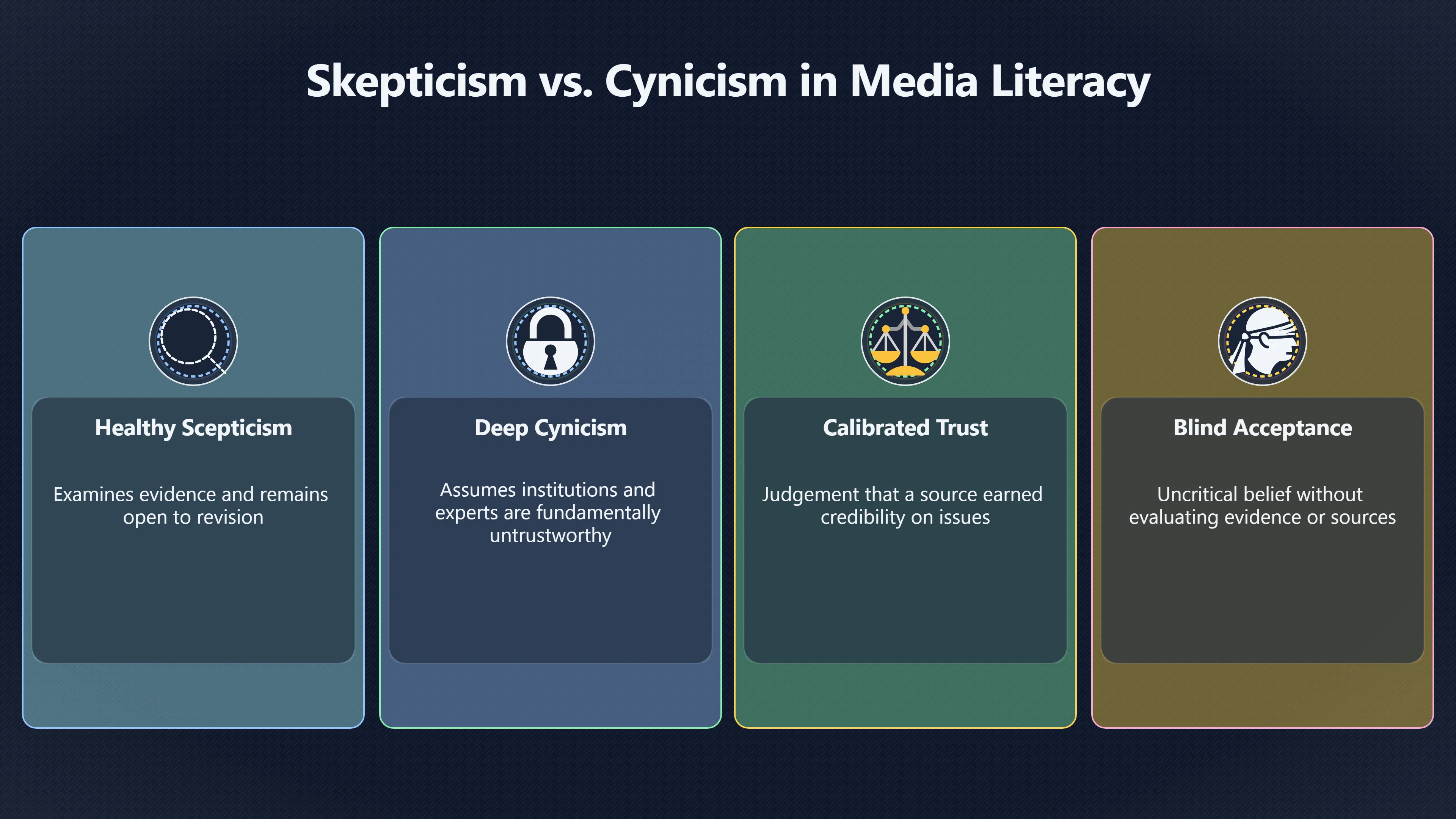
Healthy scepticism asks questions. It examines evidence, checks sources and remains open to revision. Cynicism begins from the assumption that institutions, experts, journalists or official sources are fundamentally untrustworthy. Trust, meanwhile, is not blind acceptance. It is a judgement that a source has earned credibility on a particular issue.
Recent research argues that news scepticism, news cynicism and news trust are separate constructs rather than simple opposites. People can be sceptical while still trusting reliable sources when evidence supports them. They can also be highly cynical while remaining vulnerable to misinformation that confirms their existing beliefs.[Taylor & Francis Online]tandfonline.comThis study explores the role of news skepticism in countering misinformation beliefs and skepticism's connection to greater news…Read…
This distinction helps explain a common failure mode in public discussion. When media literacy is framed primarily as “don’t trust what you see online”, learners may become more suspicious without becoming better evaluators. They learn caution but not judgement.
The practical question is therefore not:
“How can people trust less?”
It is:
“How can people become better at deciding what deserves trust?”
How anti-misinformation tips can backfire
Many anti-misinformation campaigns are designed around warning people about manipulation, fake news, deepfakes and unreliable sources. These concerns are real. The problem is that repeated warnings can sometimes create unintended side effects.
A growing body of research has found that some misinformation interventions reduce belief in false information but also increase scepticism towards accurate information. In other words, people become more cautious, but not necessarily more accurate in their judgements.[PMC]pmc.ncbi.nlm.nih.govPMCMedia literacy tips promoting reliable news improveby S Altay · 2024 · Cited by 32 — Many other interventions against misinformation were shown to increase skepticism in true news or to…
One 2024 study found that interventions focused solely on spotting misinformation can produce what researchers describe as “spillover” effects, making participants more doubtful of true information and more distrustful of generally reliable actors such as scientists or professional news organisations. The authors argue that media literacy efforts should help people identify trustworthy information as well as misleading information.[PMC]pmc.ncbi.nlm.nih.govPMCMedia literacy tips promoting reliable news improveby S Altay · 2024 · Cited by 32 — Many other interventions against misinformation were shown to increase skepticism in true news or to…
Other experimental work comparing traditional scepticism-focused interventions with approaches that also highlight the existence of trustworthy news sources has reached a similar conclusion. The challenge is not simply reducing acceptance of false claims. It is preserving appropriate confidence in accurate information.[ECPR]ecpr.euMedia Literacy or Media Skepticism?Testing Novel Trust-…We investigate the effects of two improved news media literacy interventions on false and true news acceptance, a…
This matters because an information environment full of distrust creates its own vulnerabilities. A person who distrusts every institution may not become evidence-driven. They may instead shift trust towards influencers, rumours, anonymous accounts or communities that feel more authentic.
Why distrust can make misinformation harder to resist
It is tempting to assume that misinformation mainly targets people who are too trusting. In reality, misinformation often exploits distrust as well.
Conspiracy theories frequently begin with the premise that established institutions are hiding the truth. False narratives often gain traction by encouraging audiences to dismiss journalists, scientists, regulators or official records before any evidence is examined. Once that happens, the quality of evidence becomes less important than whether a source feels independent, rebellious or emotionally satisfying.
Research on misinformation consistently finds that belief formation is influenced not only by factual accuracy but also by prior attitudes, identity and motivated reasoning. People do not simply evaluate information objectively; they often judge it through the lens of what they already want to believe.[PMC]pmc.ncbi.nlm.nih.govDeterminants of individuals' belief in fake news: A scoping…by K Bryanov · 2021 · Cited by 299 — In this scoping review, we summari…
This is why cynicism can become self-defeating. If every established source is presumed dishonest, then there is little reason to compare evidence. The result is not greater independence of thought. It is a different form of dependence, often on weaker information sources.
The irony is that some of the same habits that protect people from misinformation—checking original documents, comparing sources, looking for corroboration—require retaining at least some willingness to engage with institutions capable of producing evidence in the first place.

What calibrated trust teaches instead
The most effective media literacy programmes increasingly focus on evaluation rather than rejection.
Instead of teaching people to ask, “Can this source ever be trusted?”, calibrated trust encourages questions such as:
- What evidence supports this claim?
- How was the information gathered?
- Is there independent confirmation?
- Does the source have a record of corrections and transparency?
- Are uncertainty and limitations acknowledged?
- What would change my mind?
This approach treats trust as conditional and evidence-based rather than absolute.
UNESCO’s media and information literacy framework reflects this broader goal. It emphasises the ability to critically access, analyse, evaluate and use information rather than simply distrusting media content. The objective is informed participation in public life, not permanent suspicion.[UNESCO]unesco.orgMedia and Information LiteracyDiscover how UNESCO supports MIL for all to engage critically with information, navigate the digital…
A useful comparison is driving instruction. Teaching road safety does not mean teaching people that every road sign is wrong. It means teaching them how to recognise hazards, understand signals and make sound judgements under uncertainty. Media literacy works best when it follows the same logic.
What implementation looks like in practice
For educators, policymakers and platform designers, the implication is straightforward: interventions should reward accuracy, not merely suspicion.
Research suggests several principles that reduce the risk of creating cynicism:
- Pair warnings with positive guidance. Explain how to identify reliable information, not just unreliable information.[PMC]pmc.ncbi.nlm.nih.govPMCMedia literacy tips promoting reliable news improveby S Altay · 2024 · Cited by 32 — Many other interventions against misinformation were shown to increase skepticism in true news or to…
- Show evidence hierarchies. Teach why some sources deserve greater weight than others rather than implying all sources are equally questionable.
- Explain correction as a strength. Responsible journalism, science and public administration often revise conclusions when better evidence emerges.
- Encourage verification habits. Checking original documents, source trails and corroborating evidence builds judgement rather than reflexive distrust.
- Focus on reasoning processes. The goal is evaluating claims, not categorising entire institutions as trustworthy or untrustworthy.
These principles are particularly important in an environment where AI systems, social media feeds and creator-driven information increasingly shape what people see. UNESCO’s recent work on information integrity and media literacy similarly frames critical thinking as a tool for navigating digital environments rather than rejecting them outright.[UNESCO]unesco.orgUNESCO launches issue brief on Media and Information…3 Jun 2026 — This issue brief highlights the growing role of Media and Info…

Trust less is not enough
The central mistake in many public discussions is assuming that lower trust automatically means better judgement. Evidence suggests otherwise.
Good media literacy does not aim to produce audiences who believe everything. Nor does it aim to produce audiences who believe nothing. It aims to produce audiences who can tell the difference.
That distinction matters because misinformation is only one side of the problem. The other side is losing the ability to recognise trustworthy information when it appears. A society filled with indiscriminate distrust is not necessarily more resilient than a society filled with excessive trust. Both can become vulnerable to manipulation.
Critical thinking works best when trust is earned, questioned, adjusted and sometimes withdrawn according to evidence. The goal is not less trust. The goal is better trust.[Taylor & Francis Online+2PMC]tandfonline.comThis study explores the role of news skepticism in countering misinformation beliefs and skepticism's connection to greater news…Read…
Amazon book picks
Further Reading
Books and field guides related to Trust less is not enough. Use these as the next step if you want deeper reading beyond the article.
The Constitution of Knowledge
Directly addresses calibrated trust and information quality.
The Skeptics' Guide to the Universe
Clarifies the difference between skepticism and cynicism.

eBay marketplace picks
Marketplace Samples
Example marketplace items related to this page. Use the search link to explore similar finds on eBay.
Endnotes
1.
Source: pmc.ncbi.nlm.nih.gov
Title: PMCMedia literacy tips promoting reliable news improve
Link:https://pmc.ncbi.nlm.nih.gov/articles/PMC11332023/
Source snippet
by S Altay · 2024 · Cited by 32 — Many other interventions against misinformation were shown to increase skepticism in true news or to...
2.
Source: ecpr.eu
Title: Media Literacy or Media Skepticism?
Link:https://ecpr.eu/Events/Event/PaperDetails/69449
Source snippet
Testing Novel Trust-...We investigate the effects of two improved news media literacy interventions on false and true news acceptance, a...
3.
Source: pmc.ncbi.nlm.nih.gov
Link:https://pmc.ncbi.nlm.nih.gov/articles/PMC8224890/
Source snippet
Determinants of individuals' belief in fake news: A scoping...by K Bryanov · 2021 · Cited by 299 — In this scoping review, we summari...
4.
Source: unesco.org
Link:https://www.unesco.org/en/media-information-literacy
Source snippet
Media and Information LiteracyDiscover how UNESCO supports MIL for all to engage critically with information, navigate the digital...
5.
Source: unesco.org
Title: media and information literacy critical thinking
Link:https://www.unesco.org/en/articles/media-and-information-literacy-critical-thinking
Source snippet
Media and Information Literacy for Critical Thinking20 Apr 2023 — This has created a serious gap in critical thinking; webbed with the ch...
6.
Source: unesco.org
Link:https://www.unesco.org/en/articles/unesco-launches-issue-brief-media-and-information-literacy-counter-hate-speech-digital-age
Source snippet
UNESCO launches issue brief on Media and Information...3 Jun 2026 — This issue brief highlights the growing role of Media and Info...
7.
Source: unesco.org
Title: do you trust what you watch or read
Link:https://www.unesco.org/en/articles/do-you-trust-what-you-watch-or-read
Source snippet
?30 May 2022 — Media and Information Literacy offers effective strategies to tackle hate speech, fake news and misinformation that can fo...
Published: May 2022
8.
Source: unesco.org
Title: The Organization
Link:https://www.unesco.org/en
Source snippet
Building Peace through Education, Science and...UNESCO is the United Nations organization that promotes cooperation in educatio...
9.
Source: unesco.org
Title: media and information literacy and digital competencies
Link:https://www.unesco.org/en/articles/media-and-information-literacy-and-digital-competencies
Source snippet
12 Apr 2025 — Media and Information Literacy (MIL) initiatives promote critical thinking and ethical AI use, combating misinformation and...
10.
Source: unesco.org
Link:https://www.unesco.org/en/articles/media-and-information-literacy-first-line-defence-against-disinformation
11.
Source: tandfonline.com
Link:https://www.tandfonline.com/doi/full/10.1080/15205436.2025.2534983
Source snippet
This study explores the role of news skepticism in countering misinformation beliefs and skepticism's connection to greater news...Read...
12.
Source: tandfonline.com
Link:https://www.tandfonline.com/doi/full/10.1080/0144929X.2023.2267700
Source snippet
Taylor & Francis OnlineFull article: Striking the balance between fake and realby M Hameleers · 2023 · Cited by 28 — We conclude that the...
13.
Source: pmc.ncbi.nlm.nih.gov
Link:https://pmc.ncbi.nlm.nih.gov/articles/PMC11568353/
Source snippet
Health Media Literacy Intervention Increases Skepticism of...by B Lyons · 2024 · Cited by 18 — Although generic media literacy intervent...
14.
Source: pmc.ncbi.nlm.nih.gov
Title: Journal of Media literacy Education, 15, 99–23.Read more
Link:https://pmc.ncbi.nlm.nih.gov/articles/PMC11968027/
Source snippet
literacy interventions: meta-analytic review of 40 years...by HY Cho · 2025 · Cited by 13 — Online media literacy intervention in Indone...
15.
Source: pmc.ncbi.nlm.nih.gov
Link:https://pmc.ncbi.nlm.nih.gov/articles/PMC12457897/
Source snippet
Strategies Against Disinformation: A Study on...by CM Arribas · 2025 · Cited by 2 — Initiatives in Media and Digital Literacy in Respons...
16.
Source: pmc.ncbi.nlm.nih.gov
Link:https://pmc.ncbi.nlm.nih.gov/articles/PMC3377317/
Source snippet
Literacy Interventions: A Meta-Analytic Review - PMCby SH Jeong · 2012 · Cited by 808 — Media literacy interventions had positive effects...
17.
Source: pmc.ncbi.nlm.nih.gov
Link:https://pmc.ncbi.nlm.nih.gov/articles/PMC11343704/
Source snippet
misinformation interventions reduce... - PMC - NIHby E Hoes · 2024 · Cited by 150 — This study reveals that current interventions agains...
18.
Source: dictionary.cambridge.org
Link:https://dictionary.cambridge.org/dictionary/english-chinese-traditional/media
Source snippet
in Traditional Chinese - Cambridge DictionaryMay 27, 2026 — the internet, newspapers, magazines, television, etc., considered as a group...
Published: May 27, 2026
19.
Source: dictionary.cambridge.org
Link:https://dictionary.cambridge.org/dictionary/english/media
Source snippet
English meaning - Cambridge Dictionary5 days ago — MEDIA definition: 1. the internet, newspapers, magazines, television, etc., consider...
20.
Source: tandfonline.com
Link:https://www.tandfonline.com/doi/abs/10.1080/15205436.2025.2534983
Source snippet
Defining and Validating News Skepticism: Distinctions from...by GH Koo · 2025 · Cited by 1 — This study focuses primarily on skepticism...
21.
Source: facebook.com
Link:https://www.facebook.com/unesco/posts/-stop-the-spread-of-disinformation-verify-the-information-before-you-share-toget/794851252690425/
Source snippet
line community...
22.
Source: facebook.com
Title: the right information and know how are critical in fighting misinformation and d
Link:https://www.facebook.com/mgiep/posts/the-right-information-and-know-how-are-critical-in-fighting-misinformation-and-d/1156347013193735/
Source snippet
unesco mgiep30 Jul 2025 — Media and information literacy empowers people to think critically about information and use of digital tools...
23.
Source: podcasts.apple.com
Link:https://podcasts.apple.com/us/podcast/unesco-media-and-information-literacy/id1737843883
Source snippet
Media and Information Literacy - PodcastThis podcast series is an excerpt from UNESCO's massive open online course: "Think Critically, Cl...
24.
Source: scirp.org
Link:https://www.scirp.org/reference/referencespapers?referenceid=3664288
Source snippet
UNESCO (2021). Think Critically, Click Wisely! Media and...This article investigates the impact of foreign aid on Media and Information...
25.
Source: youtube.com
Link:https://www.youtube.com/playlist?list=PLWuYED1WVJIOKXxgn99Zxwcw18IDKAeVY
Source snippet
UNESCO Media and Information LiteracyThis radio-based podcast series, centered on developing the concepts and competencies of Media and I...
26.
Source: youtube.com
Link:https://www.youtube.com/watch?v=Z8VETXSJAKo
Source snippet
UNESCO Media and Information Literacy Youth Debate...Welcome to the UNESCO Media and Information Literacy Youth Debate Series 2024. It i...
27.
Source: unesco.org.uk
Link:https://unesco.org.uk/site/assets/files/2261/media_and_information_literacy_in_journalism-_a_handbook_for_journalists_and_journalism_educators_2019.pdf
Source snippet
MEDIA AND INFORMATION LITERACY IN JOURNALISMThis guide, although it touches upon misinformation and disinformation and disinformation, fo...
Additional References
28.
Source: linkedin.com
Link:https://www.linkedin.com/posts/unesco_globalmilweek-activity-7387337051563638784-LKkW
Source snippet
#globalmilweek | UNESCO | 21 commentsMedia and Information Literacy (MIL) can help people think critically about AI-generated content. Re...
29.
Source: lebanon.un.org
Link:https://lebanon.un.org/en/298047-ministry-information-unesco-and-oif-launch-national-media-and-information-literacy-campaign-
Source snippet
of Information, UNESCO, and OIF Launch the...15 Jul 2025 — UNESCO is proud to support this national campaign, which puts Media and Infor...
30.
Source: researchgate.net
Link:https://www.researchgate.net/publication/394149155_Defining_and_Validating_News_Skepticism_Distinctions_from_News_Trust_and_Cynicism_and_Links_to_News_Literacy_and_Misinformation_Belief
Source snippet
(PDF) Defining and Validating News SkepticismJul 31, 2025 — The increasing presence of fake news and misinformation in the contemporary d...
31.
Source: pdfs.semanticscholar.org
Link:https://pdfs.semanticscholar.org/a038/778bfac1300f0b20f1355e7be1c3990eaf30.pdf
Source snippet
DisinformationEven though media literacy interventions can increase the accurate discernment between false and real headlines, exposure t...
32.
Source: poradnik.ngo.pl
Link:https://poradnik.ngo.pl/media-czyli-z-kim-wspolpracowac-co-to-sa-media
Source snippet
ngo.plMedia, czyli z kim współpracować? Co to są media?Co to są media? Media to środki masowego przekazu (prasa, radio, telewizja, intern...
33.
Source: news.ku.edu
Link:https://news.ku.edu/news/article/study-finds-people-more-cynical-toward-news-more-likely-to-believe-misinformation-ARTICLE-F26T9T-ARTICLE-F26T9T-ARTICLE-F26T9T
Source snippet
finds people more cynical toward news more likely to...May 11, 2026 — Wilner's research examines media literacy, how it is developed and...
Published: May 11, 2026
34.
Source: ukraine.un.org
Link:https://ukraine.un.org/en/291548-unescos-campaigns-media-and-information-literacy-empower-millions-ukraine-think-critically
Source snippet
un.orgUNESCO's campaigns on media and information literacy...By fostering critical thinking and promoting MIL skills nationwide, UNESCO...
35.
Source: journals.sagepub.com
Link:https://journals.sagepub.com/doi/10.1177/00936502251327717
Source snippet
trust in misinformation that is sometimes disseminated by mainstream media (Pickard, 2017). The insights that follow from the conceptual...
36.
Source: dc.law.utah.edu
Link:https://dc.law.utah.edu/cgi/viewcontent.cgi?article=1267&context=ulr
Source snippet
Literacy Beyond the National Security Frameby L Levi · 2020 · Cited by 17 — information online generally, and because the differences bet...
37.
Source: mediamarkt.pl
Link:https://mediamarkt.pl/
Source snippet
Media MarktOgólnopolska sieć marketów i sklep internetowy. RTV, AGD, Komputery, Foto - tysiące produktów z gwarancją najwyższej jakości...
Topic Tree