Within AI Virality
Viral does not mean believed
A post can shape attention and memory even when many sharers are not fully convinced it is true.
On this page
- How spread differs from belief
- Why half belief still has consequences
- Questions to ask before sharing
Page outline Jump by section
Introduction
A viral AI-generated post on X can attract millions of views without convincing millions of people. This distinction is easy to miss because platform metrics such as views, reposts, likes and replies measure movement through a network, not acceptance of a claim. A post may spread because people find it funny, shocking, confusing, aesthetically impressive or worth discussing, even when many of those sharing it remain uncertain about whether it is true. Research on AI-generated misinformation on X suggests exactly this pattern: AI-made misleading posts tend to be more viral than conventional misinformation while also being slightly less believable on average.[arXiv]arxiv.orgCharacterizing AI-Generated Misinformation on Social Media15 May 2025 — AI-generated misinformation is more often centered on entert…
 For critical thinking, this means that popularity is a poor proxy for credibility. The key question is not only “Do people believe this?” but also “What happens when people pass it along despite incomplete belief?”
How spread differs from belief
On social media, sharing and believing are related but separate actions. A user can repost a synthetic image because it is amusing, because it fits a cultural joke, because it might be true, or because they want others to judge it. None of those motivations requires full acceptance of the underlying claim.
Recent analysis of more than 91,000 misleading X posts identified through Community Notes found that AI-generated misinformation was significantly more likely to go viral than non-AI misinformation despite being judged slightly less believable and less harmful. The same research found that AI-generated misinformation was disproportionately associated with entertainment content.[arXiv]arxiv.orgCharacterizing AI-Generated Misinformation on Social Media15 May 2025 — AI-generated misinformation is more often centered on entert…
This finding challenges a common assumption that misinformation spreads primarily because people are persuaded by it. In many cases, visibility comes first. Belief may be weak, mixed or absent.
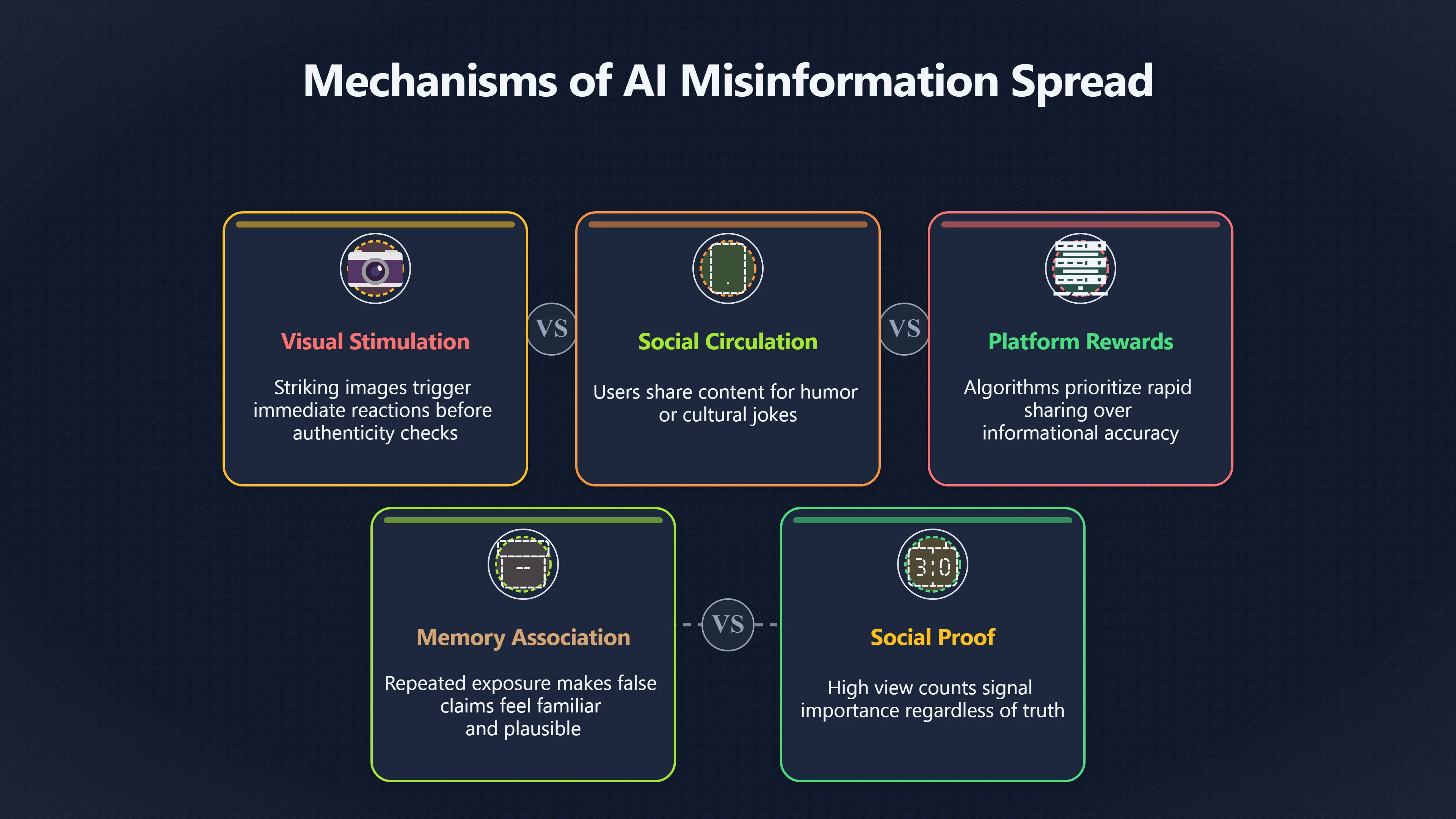
Several broader studies of online behaviour support this distinction. Research on misinformation sharing has found that users often distribute content for social reasons unrelated to truth-seeking, while platform reward systems encourage rapid sharing habits that can make accuracy a secondary consideration.[Nature+2Yale Insights]nature.comWhy people share misinformation on social media?M Wu · 2025 · Cited by 5 — The widespread dissemination of misinformation on social media calls for an empirical investigation o…
The result is a form of social circulation in which a claim can travel far beyond the number of people who genuinely endorse it.
Why AI content is especially prone to this pattern
AI-generated content is particularly suited to attention-driven sharing because it can create material that is visually striking, emotionally neat and instantly understandable.
A synthetic image of a celebrity in an impossible situation, an invented historical photograph, or a fabricated disaster scene may trigger reactions before viewers stop to assess authenticity. The content does not need to be fully convincing. It only needs to be interesting enough to pass along.
Research on synthetic media has shown that realistic AI-generated images can increase belief in false headlines and influence memory, especially when the image appears to provide visual evidence for a claim.[Misinformation Review]misinforeview.hks.harvard.eduMisinformation ReviewPeople are more susceptible to misinformation with realistic AI…November 10, 2025 — In a pre-registered experimen…
At the same time, many viral AI posts operate in a grey zone between sincerity and scepticism. Users may recognise that something “looks AI-generated” yet still interact with it. This creates a situation in which uncertainty does not prevent distribution.
The mechanism is important: virality can emerge from curiosity, humour and ambiguity, not merely from conviction.
Why half-belief still has consequences
A common mistake is to assume that misinformation matters only when people fully believe it. In practice, partial belief can still shape attention, memory and public conversation.
Imagine an AI-generated image attached to a false claim. A viewer may think, “This is probably fake, but maybe not.” Even if they remain doubtful, the image can become associated with the topic in memory. Later corrections may not entirely erase that first impression. Research on AI-generated visual misinformation has found that realistic synthetic images can influence both belief and memory processes surrounding false information and subsequent corrections.[Misinformation Review]misinforeview.hks.harvard.eduMisinformation ReviewPeople are more susceptible to misinformation with realistic AI…November 10, 2025 — In a pre-registered experimen…
The consequences extend beyond individual belief:
- Repeated exposure can make a claim feel familiar.
- Familiar claims often seem more plausible than completely new ones.
- Public discussion can become centred on a false narrative even when participants are debating its accuracy.
- Journalists, fact-checkers and institutions may spend time responding to a claim that gained attention primarily through sharing rather than persuasion.
In this sense, a viral post can reshape the information environment without achieving widespread belief.
When engagement becomes evidence
Another risk is that audiences sometimes treat popularity itself as a signal of credibility.
A post with hundreds of thousands of views may appear important simply because many people have encountered it. Yet those metrics reveal only that attention accumulated. They do not reveal why.
The distinction matters because social proof works indirectly. If users see a claim repeatedly, they may infer that others have already vetted it. But the underlying engagement may have come from ridicule, argument, uncertainty or curiosity rather than agreement.
Research on social-media sharing behaviour suggests that platform incentives often reward engagement regardless of informational quality. Habitual sharing patterns can therefore amplify visibility without reliably filtering for accuracy.[Yale Insights]insights.som.yale.edu“It's not that people are lazy or don'tYale InsightsHow Social Media Rewards Misinformation | Yale Insights31 Mar 2023 — And these habitual users, the research shows, spread a…
This helps explain why some AI-generated misinformation achieves remarkable reach despite generating mixed reactions about its truthfulness.

Questions to ask before sharing
When encountering a viral AI-generated post on X, a useful critical-thinking habit is to separate evidence of spread from evidence of belief.
Before reposting, ask:
- Am I sharing this because I think it is true, or because it is interesting?
- Do I know where the image, video or claim originally came from?
- Would the post still seem persuasive if its engagement numbers were hidden?
- Am I certain about the claim, or am I passing along uncertainty?
- Could sharing this increase visibility for a false narrative even if I remain sceptical?
These questions slow the transition from attention to amplification.
Viral does not mean believed
One of the most important lessons from AI-generated misinformation on X is that visibility and credibility are not the same thing. A synthetic post can dominate timelines because it is entertaining, surprising or socially useful to discuss, even when many participants doubt it. Research increasingly suggests that AI-generated misinformation benefits from this gap: it often spreads exceptionally well while not necessarily achieving equivalent levels of belief.[arXiv+2arXiv]arxiv.orgCharacterizing AI-Generated Misinformation on Social Media15 May 2025 — AI-generated misinformation is more often centered on entert…
For critical thinking, the practical takeaway is simple. When evaluating a viral AI-made post, treat engagement as evidence that people noticed it—not evidence that people verified it, accepted it or agreed with it.
Amazon book picks
Further Reading
Books and field guides related to Viral does not mean believed. Use these as the next step if you want deeper reading beyond the article.
Calling Bullshit
Directly supports the distinction between popularity, evidence and truth.
Factfulness
Encourages evidence-based thinking instead of relying on impressions or popularity.

Chaos Machine
Explores why engagement and spread can diverge from genuine belief or accuracy.
Likewar
Social media has been weaponized, as state hackers and rogue terrorists have seized upon Twitter and Facebook to create chaos and destruc...
eBay marketplace picks
Marketplace Samples
Example marketplace items related to this page. Use the search link to explore similar finds on eBay.



Endnotes
1.
Source: arxiv.org
Link:https://arxiv.org/html/2505.10266v1
Source snippet
Characterizing AI-Generated Misinformation on Social Media15 May 2025 — AI-generated misinformation is more often centered on entert...
Published: May 2025
2.
Source: arxiv.org
Title: arXiv Characterizing AI-Generated Misinformation on Social Media
Link:https://arxiv.org/abs/2505.10266
3.
Source: nature.com
Title: Why people share misinformation on social media?
Link:https://www.nature.com/articles/s41599-025-05511-6
Source snippet
M Wu · 2025 · Cited by 5 — The widespread dissemination of misinformation on social media calls for an empirical investigation o...
4.
Source: insights.som.yale.edu
Title: “It’s not that people are lazy or don’t
Link:https://insights.som.yale.edu/insights/how-social-media-rewards-misinformation
Source snippet
Yale InsightsHow Social Media Rewards Misinformation | Yale Insights31 Mar 2023 — And these habitual users, the research shows, spread a...
5.
Source: arxiv.org
Link:https://arxiv.org/abs/2604.15372
6.
Source: news.yale.edu
Title: flagging misinformation social media reduces engagement study finds
Link:https://news.yale.edu/2025/09/25/flagging-misinformation-social-media-reduces-engagement-study-finds
Source snippet
misinformation on social media reduces... - YaleNewsSep 25, 2025 — Community Notes enables X users to propose and vet fact-checking note...
7.
Source: nature.com
Link:https://www.nature.com/articles/s41467-026-72597-0
Source snippet
Community-based fact-checking reduces the spread of...by Y Chuai · 2026 · Cited by 2 — In this work, we perform a large-scale quasi-expe...
8.
Source: misinforeview.hks.harvard.edu
Link:https://misinforeview.hks.harvard.edu/article/people-are-more-susceptible-to-misinformation-with-realistic-ai-synthesized-images-that-provide-strong-evidence-to-headlines/
Source snippet
Misinformation ReviewPeople are more susceptible to misinformation with realistic AI...November 10, 2025 — In a pre-registered experimen...
Published: November 10, 2025
9.
Source: blogs.deakin.edu.au
Title: deakin.edu.au Don’t believe everything you see: how AI is spreading mis-, dis
Link:https://blogs.deakin.edu.au/article/misinformation/
Source snippet
deakin.edu.auDon't believe everything you see: how AI is spreading mis-, disMay 1, 2025 — Artificial intelligence (AI) has become the sne...
Published: May 1, 2025
10.
Source: Wikipedia
Title: Community Notes
Link:https://en.wikipedia.org/wiki/Community_Notes
Source snippet
Community NotesInitially shown to U.S. users only, notes were popularized in March 2022 over misinformation in the Russian invasion of...
Published: March 2022
11.
Source: ibm.com
Title: A I Misinformation
Link:https://www.ibm.com/think/insights/ai-misinformation
Source snippet
AI Misinformation - IBMMisinformation is false information. Some definitions also note that misinformation is not purposely created to de...
12.
Source: misinforeview.hks.harvard.edu
Title: the spread of synthetic media on x
Link:https://misinforeview.hks.harvard.edu/article/the-spread-of-synthetic-media-on-x/
Source snippet
spread of synthetic media on X3 Jun 2024 — This study examines the prevalence and characteristics of synthetic media on social media plat...
13.
Source: misinforeview.hks.harvard.edu
Title: who knowingly shares false political information online
Link:https://misinforeview.hks.harvard.edu/article/who-knowingly-shares-false-political-information-online/
Source snippet
knowingly shares false political information online?by S Littrell · 2023 · Cited by 28 — We found that 14 percent of respondents reported...
Additional References
14.
Source: unesco.org
Link:https://www.unesco.org/en/articles/2/3-digital-content-creators-do-not-check-their-facts-sharing-want-learn-how-do-so-unesco-survey
Source snippet
2/3 of digital content creators do not check their facts beforeNov 27, 2024 — A UNESCO survey published today reveals that 62% do not car...
15.
Source: cetas.turing.ac.uk
Link:https://cetas.turing.ac.uk/news/everything-could-go-wrong-xs-new-ai-written-community-notes
Source snippet
that could go wrong with X's new AI-written...AI chatbots often struggle with nuance and context but are good at confidently providing a...
16.
Source: theguardian.com
Title: fears ai factcheckers on x could increase promotion of conspiracy theories
Link:https://www.theguardian.com/technology/2025/jul/02/fears-ai-factcheckers-on-x-could-increase-promotion-of-conspiracy-theories
Source snippet
Fears AI factcheckers on X could increase promotion of...2 Jul 2025 — Former UK minister says platform, which will use AI to draft commu...
17.
Source: dco.org
Title: However, there is no commonly agreed typology for information disorders,
Link:https://dco.org/wp-content/uploads/2024/10/From-Social-Media-to-Truth-Countering-Misinformation-for-a-Thriving-Digital-Economy.pdf
Source snippet
From Social Media to Truth: Countering Misinformation for...Misinformation is often used interchangeably with “fake news” and “disinform...
18.
Source: psu.edu
Title: social media users probably wont read beyond headline researchers say
Link:https://www.psu.edu/news/research/story/social-media-users-probably-wont-read-beyond-headline-researchers-say
Source snippet
Social media users probably won't read beyond this...Nov 19, 2024 — A study led by Penn State researchers revealed that more than 75% of...
19.
Source: arstechnica.com
Title: everything that could go wrong with xs new ai written community notes
Link:https://arstechnica.com/tech-policy/2025/07/everything-that-could-go-wrong-with-xs-new-ai-written-community-notes/
Source snippet
Everything that could go wrong with X's new AI-written...2 Jul 2025 — The platform plans to allow AI to write community notes, and that...
20.
Source: swgfl.org.uk
Link:https://swgfl.org.uk/topics/social-media/misinformation-on-social-media-guidance-impact-and-support/
Source snippet
n spread quickly across various platforms such as social media channels.Read more...
21.
Source: researchgate.net
Link:https://www.researchgate.net/publication/385663977_Did_the_Roll-Out_of_Community_Notes_Reduce_Engagement_With_Misinformation_on_XTwitter
Source snippet
ite textual notes to inform others about potentially misleading posts on X/...
22.
Source: news.gsu.edu
Title: new study explains why people fall for fake news
Link:https://news.gsu.edu/2025/12/05/new-study-explains-why-people-fall-for-fake-news/
Source snippet
Study Explains Why People Fall for Fake NewsDec 5, 2025 — In a world where misinformation spreads faster than fact, a new study is offeri...
23.
Source: youtube.com
Title: How AI-generated content affects the spread of disinformation?
Link:https://www.youtube.com/watch?v=ENEfO-0Acxw
Source snippet
July 22, 2024 — Forty-seven percent of Canadians are not confident they can identify AI generated fake news content, according to a recen...
Published: July 22, 2024
Topic Tree