Within Think Before Sharing
Why Better Readers Leave the Page
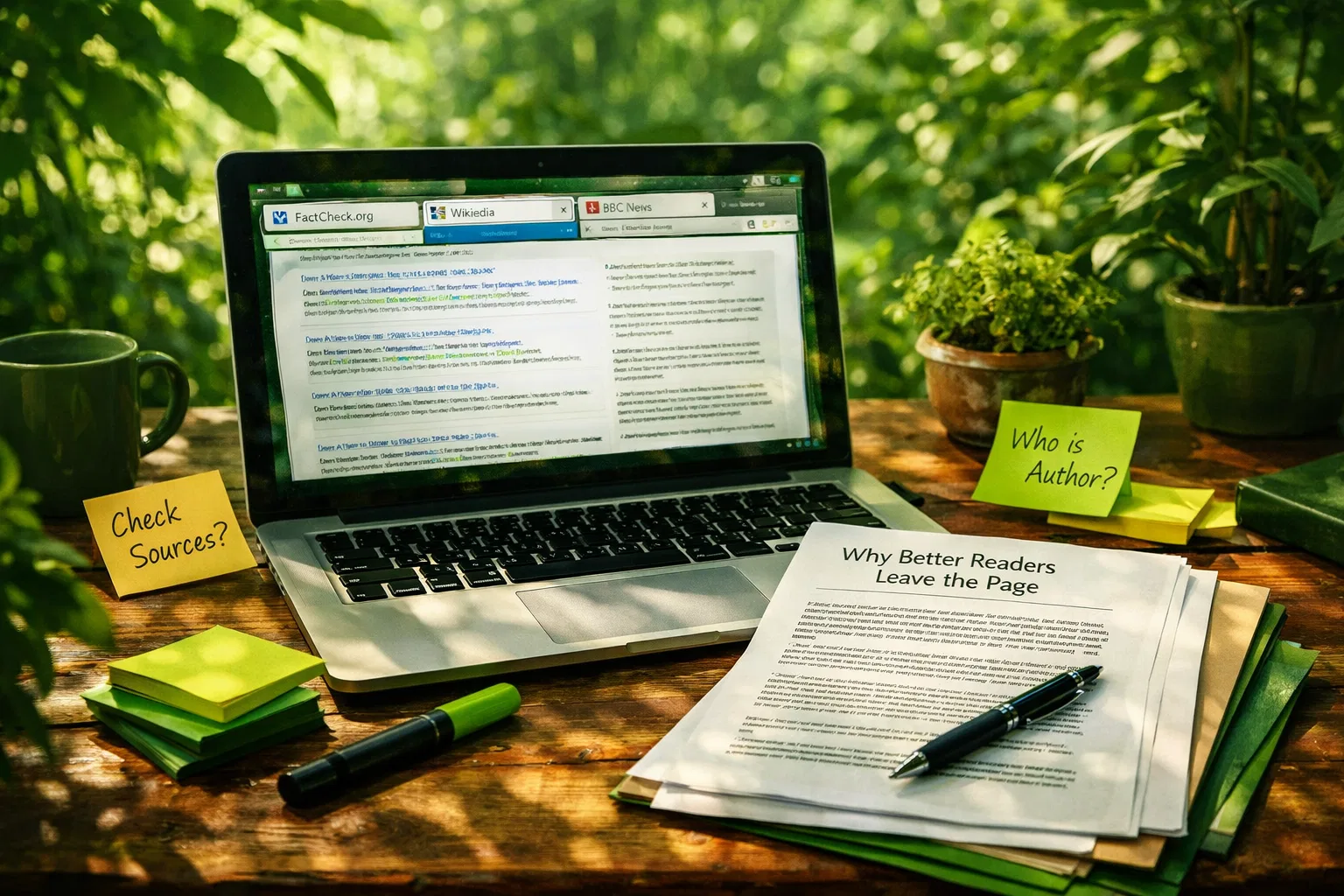
Good online verification often starts by leaving the page and checking what independent sources say about the claim.
On this page
- What lateral reading means
- How fact checkers use it
- A five minute checking routine
Page outline Jump by section
Introduction
Lateral reading is the habit of checking a source by leaving it. Instead of staying on the page, scrolling through its “About” section, admiring its design or trusting its confident tone, a lateral reader opens new tabs and asks what independent sources say about the site, author, organisation, claim or image. In the age of social media and AI, this matters because unreliable information often arrives already packaged to look credible: polished, emotional, shareable and sometimes machine-generated. The practical response is not to read everything more slowly. It is to check the source more intelligently.
The core idea is simple: when a claim matters, do not let the claim’s own presentation be your only evidence. Find out who is behind it, whether other credible outlets confirm it, what context is missing, and whether the original evidence can be traced. Research comparing professional fact-checkers, historians and students found that fact-checkers reached better credibility judgements faster because they left unfamiliar sites quickly and searched across the open web.[Sage Journals]journals.sagepub.comSage JournalsLateral Reading and the Nature of Expertise: Reading Less and Learning More When Evaluating Digital Information - Sam Winebu…
What Lateral Reading Means
Lateral reading is a source-checking strategy built around a small act of resistance: refusing to evaluate an online source only on its own terms. “Vertical” reading stays inside the page. It checks the layout, domain name, internal links, mission statement, biography, references and tone. Those clues can help, but they are also easy to stage. A misleading site can have a professional logo, a respectable-sounding name, a long “About us” page and links to real institutions. Lateral reading moves sideways instead: it opens search results, independent profiles, news coverage, fact-checks, public records, academic sources, archived pages or reputable explainers.
The method became prominent through research by Sam Wineburg and Sarah McGrew, who studied how people evaluated live websites. Their sample included 10 professional fact-checkers, 10 PhD historians and 25 Stanford undergraduates. The striking finding was not that fact-checkers read more deeply; it was that they often read less of the original site before checking elsewhere. Historians and students were more likely to be drawn into the site’s own surface signals, while fact-checkers used outside sources to establish whether the site deserved attention at all.[Sage Journals]journals.sagepub.comSage JournalsLateral Reading and the Nature of Expertise: Reading Less and Learning More When Evaluating Digital Information - Sam Winebu…
This makes lateral reading especially useful for social media. A post may not include a full article, and a screenshot may strip away author, date and publication context. A video may be clipped from another country, year or event. An AI-generated answer may cite sources that sound plausible but are incomplete, misread or fabricated. Lateral reading turns the first question from “Does this look convincing?” into “Can I place this claim in a wider evidence landscape?”
It is not the same as “just Googling it” in a vague way. Good lateral reading is targeted. It asks:
- Who created or published this?
- What do independent sources say about that creator or organisation?
- Has this exact claim, image, quote or statistic appeared elsewhere?
- Is there a stronger original source than the one being shared?
- Are reputable sources agreeing, disagreeing or staying silent?
The habit is humble but powerful. It assumes that first impressions are weak evidence online.
Why Better Readers Leave the Page
The phrase “read less, learn more” sounds counterintuitive, but it captures a real online problem. Many traditional reading skills were built for stable texts: books, articles, reports and documents where close reading helps reveal argument, evidence and bias. Online, however, the first challenge is often not interpretation but placement. Before analysing a page in detail, the reader needs to know what kind of thing it is.
A think tank report, activist website, local rumour, satirical post, sponsored article, AI-generated summary and peer-reviewed paper may all appear in the same feed and use similar visual signals. The page itself may not announce its weaknesses. Lateral reading gives the reader a way to classify the source before investing trust.
The Digital Inquiry Group’s national assessment of 3,446 US high school students illustrates the problem. In one task, 52% of students treated a grainy video said to show US voter fraud as strong evidence, even though the video was actually shot in Russia; among more than 3,000 responses, only three students tracked down the video’s source. In another task, two-thirds of students could not distinguish news stories from “Sponsored Content” on Slate’s homepage.[Digital Inquiry Group]inquirygroup.orgDigital Inquiry Group Students' Civic Online Reasoning | Digital Inquiry GroupDigital Inquiry Group Students' Civic Online Reasoning | Digital Inquiry Group These were not failures of intelligence. They were failures of source routine. Students often looked at what was in front of them, not what could be learned by stepping outside it.
Lateral reading also counters a common trap: mistaking surface credibility for source credibility. A dot-org domain, a sober design or a confident author biography may lower a reader’s guard. In an online nutrition course study, students were explicitly taught to challenge misconceptions such as assuming that a dot-org domain makes a site trustworthy or that links to authoritative sources automatically confer credibility. Before instruction, only 3 of 87 students left the original site to consult another source; after four one-hour modules, 67 of 87 did so.[Misinformation Review]misinforeview.hks.harvard.eduMisinformation ReviewLateral reading: College students learn to critically evaluate internet sources in an online course | HKS Misinforma…
The lesson is not that all unfamiliar sources are bad. It is that unfamiliar sources need triangulation. The more consequential the claim, the more important it is to see whether the source survives contact with outside evidence.
How Fact-Checkers Use It
Professional fact-checkers do not treat every page as a neutral reading assignment. They use quick orientation moves to decide where to spend attention. When they land on an unfamiliar site, they may scan briefly, then search the organisation’s name, its funders, its reputation, its prior work and the claim itself. The aim is not to find a source that agrees with them. It is to understand the source’s standing before accepting its framing.
This is why lateral reading fits well with Mike Caulfield’s SIFT method: Stop, Investigate the source, Find better coverage, and Trace claims, quotes and media back to their original context. Caulfield presents SIFT as a practical set of moves for sorting truth from fiction online, with lateral reading at the heart of investigating sources and finding better coverage.[Hapgood]hapgood.usSIFT (The Four Moves) – HapgoodSIFT (The Four Moves) – Hapgood…
A useful fact-checking sequence looks like this:[Wikipedia]Wikipediaand fact checkingand fact checking
- Stop before reacting. The more a post triggers anger, fear, amusement or tribal loyalty, the more valuable the pause becomes. Emotional urgency is often the reason people skip verification.
- Investigate the source from outside the source. Search the publisher, author, account or organisation in a new tab. Look for independent descriptions, not just the source’s own self-description.
- Find stronger coverage. Ask whether established news organisations, subject experts, official bodies, academic sources or specialist outlets have covered the same claim. Absence of coverage is not proof of falsehood, but it is a reason to slow down when a dramatic claim appears only in low-quality channels.
- Trace the evidence back. Screenshots, quotes, statistics and images often travel without their original setting. Trace them to the first available source, the full document, the complete speech, the original dataset or the uncropped image.
- Decide what level of confidence is justified. Lateral reading rarely needs to produce absolute certainty. Often the right outcome is “confirmed”, “probably true but missing context”, “unverified”, “misleadingly framed” or “not worth sharing”.
This routine is faster than it sounds because it avoids wasting time on weak sources. The point is not to become a full-time investigator for every meme. It is to develop a quick threshold: ordinary claims may need only a glance; health, finance, politics, public safety and reputational claims deserve more.
The Five-Minute Checking Routine
A practical lateral-reading habit should be short enough to use before sharing. Five minutes will not settle every complex issue, but it can catch many common failures: fake authorities, recycled images, missing dates, AI errors, partisan sites posing as neutral institutes and claims that have already been checked.
Minute 1: Name the Source
Identify the actual source, not just the account that shared it. A viral post may be quoting a blog, which quotes a newsletter, which quotes a think tank, which quotes a report. The visible sharer may not be the originator. Search the organisation or author in a separate tab with neutral terms such as “funding”, “about”, “criticism”, “ownership”, “fact check” or “profile”.
For social posts, check whether the account is the official source, a reposting account, a parody account, an engagement-farming account or an anonymous aggregator. Verification badges and follower counts are not substitutes for source identity.
Minute 2: Search the Exact Claim
Copy a distinctive phrase from the claim into a search engine. For a quote, put the phrase in quotation marks. For a statistic, search the number plus a few keywords. For an image, use reverse image search or search distinctive visual details. This often reveals whether the same claim has appeared before, whether it has been debunked, or whether it belongs to a different date or location.
This step is especially useful for screenshots. A screenshot of a headline, government notice or celebrity post can be fabricated, cropped or outdated. Searching the exact wording may reveal whether the original page exists.
Minute 3: Compare Independent Coverage
Look for coverage that is independent of the original source. Independence matters more than quantity. Ten websites repeating the same press release or social post do not count as ten confirmations. Better signs include separate reporting, named evidence, transparent corrections, links to documents, expert comment, and outlets with a track record in the subject area.
For technical topics, “independent” may mean official data, peer-reviewed research, professional guidance or specialist reporting. For local emergencies, it may mean local authorities, transport operators, emergency services or established local journalism. For political claims, it may mean the full speech, bill, court record, budget document or election authority notice.
Minute 4: Trace the Original Evidence
If the claim relies on a report, survey, video, graph or dataset, try to reach the original. Ask whether the shared version accurately represents it. A chart may have a misleading axis. A quote may omit the sentence before it. A study may be preliminary, small, withdrawn or about a narrower question than the post implies.
This is where lateral reading becomes more than reputation checking. A reputable source can still make a mistake, and a low-profile source can still share a genuine document. The strongest habit is to use reputation as a guide, then evidence as the anchor.
Minute 5: Choose a Sharing Decision
At the end of five minutes, do not ask only “Is this true?” Ask “What should I do with it?” The safest choices are often simple: do not share; share with caveat; save for later; ask the sender for the original; or replace the weak source with a stronger one.
A useful personal rule is: if a claim would change how someone votes, spends money, treats their health, fears a group, joins a pile-on or distrusts an institution, it deserves more than a surface read.
Why It Matters More With AI
Generative AI changes the verification problem because fluency is no longer a strong signal of knowledge. AI systems can produce confident prose, plausible citations, realistic images, synthetic voices and tidy summaries at scale. A lateral-reading habit is therefore not only for checking websites. It is also for checking AI output.
UNESCO’s media and information literacy guidance stresses habits such as pausing before sharing, questioning the source, diversifying information sources and learning how AI systems work. It also argues that lasting progress requires platform design and AI developer transparency, not only individual effort.[UNESCO]unesco.orgAI can make mistakes: Why media literacy matters more than everAI can make mistakes: Why media literacy matters more than ever… That distinction matters: lateral reading is a personal defence, but it should not become an excuse for platforms and AI companies to push all responsibility onto users.
Still, the individual habit remains valuable. When an AI answer cites a study, names a legal rule, summarises a breaking news event or gives health-related advice, lateral reading means leaving the chatbot and checking the underlying sources directly. The University of Maryland’s library guidance on fact-checking AI describes this plainly: apply fact-checking techniques by leaving the AI output and consulting other sources to evaluate what the AI has provided.[UMD Library Guides]lib.guides.umd.eduLibrary Guides Fact-checking AI with Lateral ReadingUMD Library GuidesFact-checking AI with Lateral Reading - Research Guides13 Jan 2026 — Lateral reading is done when you apply fact-checki…
Stanford researchers have also connected lateral reading to AI literacy, noting that educational tools such as video tutorials on lateral reading have shown promise for improving digital literacy and may be adapted for AI education. Their broader work focuses on interventions that help users judge AI-generated information and avoid AI-powered deception.[Stanford Report]news.stanford.eduStanford ReportEmpowering users to discern fact from fiction in the age of AI | Stanford Report…
For everyday readers, the AI-era version of lateral reading has three extra rules:[cor.inquirygroup.org]cor.inquirygroup.orgteaching lateral readingLateral Reading - Civic Online ReasoningThese lessons also introduce students to resources they can use when laterally reading: Wikipedia…
- Do not trust a citation because it looks academic. Check whether the source exists, whether the title matches, and whether the cited work actually says what the AI claims.
- Do not trust an image because it looks natural. Search for earlier appearances, original uploads, credible captions and reporting around the event.
- Do not trust a summary without checking the document. AI tools can omit qualifications, confuse dates, overstate findings or blend sources together.
Lateral reading does not require people to detect every synthetic artefact by eye. That is a losing game as AI media improves. It shifts the task from “Can I spot the fake pixels?” to “Can I verify the source, context and corroboration?”

What Good Implementation Looks Like
Teaching lateral reading works best when it is treated as a repeated habit, not a one-off warning about fake news. Research on Civic Online Reasoning across the curriculum emphasises modelling expert processes, guided practice, gradually fading support and formative assessments that reveal how students evaluate digital sources. In that work, teachers used short evaluation tasks to see whether students were actually applying lateral reading and then adjusted instruction accordingly.[ERIC]files.eric.ed.govOpen source on ed.gov.
That has implications beyond schools. Workplaces, universities, newsrooms, libraries, community organisations and public agencies can all make lateral reading easier by embedding it into ordinary routines.
A good implementation has four features:
It is taught with live examples. Static worksheets age quickly. A better exercise uses current posts, real search results, active websites and actual claims. The point is to practise the messy environment readers already inhabit.
It separates source checking from claim checking. “Who is behind this?” and “Is this specific claim true?” are related but different questions. A weak source may share a true claim; a strong source may make an error. Good lateral reading keeps both questions alive.
It rewards uncertainty. Learners should not feel forced to label everything true or false. “I cannot verify this”, “the evidence is too thin”, and “the source has a conflict of interest” are valid outcomes.
It makes the habit socially normal. In group chats, classrooms and workplaces, people should be able to ask “Where did this come from?” without sounding hostile. Lateral reading works better when verification is treated as care for the group, not as point-scoring.
The online-course study of 87 college students is encouraging because it showed that relatively compact instruction can change behaviour: after four one-hour modules, students were much more likely to leave the original site and consult other sources.[Misinformation Review]misinforeview.hks.harvard.eduMisinformation ReviewLateral reading: College students learn to critically evaluate internet sources in an online course | HKS Misinforma… The broader challenge is durability. A habit learned in a lesson must survive the pressure of fast feeds, group identity, humour, anger and convenience.
Common Mistakes to Avoid
Lateral reading is simple, but it can be done badly. The most common mistake is confirmation hunting: opening new tabs only to find a source that agrees with what the reader already wants to believe. That is not lateral reading; it is outsourced bias. A better search includes neutral terms, competing explanations and sources with different incentives.
Another mistake is treating the first search result as the answer. Search rankings are not credibility rankings. They can reflect popularity, search engine optimisation, recency, location, personalisation and advertising. Lateral reading means comparing the quality of results, not simply accepting the top one.
A third mistake is outsourcing judgement entirely to fact-checking websites. Fact-checkers are valuable, especially for widely circulated claims, and research on professional fact-checkers helped define the method. But fact-checks are not available for every local rumour, niche technical claim or newly emerging event. They should be part of the toolkit, not the whole toolkit.
A fourth mistake is assuming that source reputation settles every question. Reputation helps with probability, but evidence still matters. A reputable institution can publish a flawed report; an activist group can surface a real document; a small local outlet can report accurately on something national media has not yet reached. Lateral reading should widen the evidence base, not replace thinking with brand recognition.
Finally, readers should avoid the cynicism trap. Discovering that some information is manipulated does not mean all information is equally suspect. The goal is calibrated trust: more trust when source, evidence and corroboration align; less trust when they do not.
The Real Payoff
Lateral reading is not a glamorous skill. It is a small, repeatable interruption in the path from seeing to believing to sharing. That is exactly why it matters. Social media and AI systems often compress context: they give users a claim, a reaction cue and a share button before they provide a reliable trail of evidence. Lateral reading rebuilds that trail.
Its value is practical. It helps a reader spot when a “research institute” is a lobbying vehicle, when a viral video is from another country, when a quote has no original source, when an AI answer has invented a reference, or when a dramatic claim is being repeated by many accounts but sourced to only one weak post. It also protects good information by helping readers replace poor links with better ones.
The habit does not ask people to become cynical, slow or expert in everything. It asks them to change the first move. When something online matters, leave the page. Check what the wider web knows. Then decide what the claim deserves: trust, doubt, context, correction or silence.
Amazon book picks
Further Reading
Books and field guides related to Why Better Readers Leave the Page. Use these as the next step if you want deeper reading beyond the article.
Foolproof: Why We Fall for Misinformation and How to Build Im...
Provides practical approaches to resisting deceptive claims.

The art of thinking clearly
Supports better judgement when evaluating sources and claims.
eBay marketplace picks
Marketplace Samples
Example marketplace items related to this page. Use the search link to explore similar finds on eBay.



Endnotes
1.
Source: hapgood.us
Title: SIFT (The Four Moves) – Hapgood
Link:https://hapgood.us/2019/06/19/sift-the-four-moves/
Source snippet
SIFT (The Four Moves) – Hapgood...
2.
Source: unesco.org
Title: AI can make mistakes: Why media literacy matters more than ever
Link:https://www.unesco.org/en/articles/ai-can-make-mistakes-why-media-literacy-matters-more-ever
Source snippet
AI can make mistakes: Why media literacy matters more than ever...
3.
Source: lib.guides.umd.edu
Title: Library Guides Fact-checking AI with Lateral Reading
Link:https://lib.guides.umd.edu/c.php?g=1340355&p=9880575
Source snippet
UMD Library GuidesFact-checking AI with Lateral Reading - Research Guides13 Jan 2026 — Lateral reading is done when you apply fact-checki...
4.
Source: news.stanford.edu
Link:https://news.stanford.edu/stories/2026/01/ai-digital-literacy-interventions-misinformation-scams-research
Source snippet
Stanford ReportEmpowering users to discern fact from fiction in the age of AI | Stanford Report...
5.
Source: files.eric.ed.gov
Link:https://files.eric.ed.gov/fulltext/EJ1405276.pdf
6.
Source: stacks.stanford.edu
Title: Wineburg Mc Grew Lateral Reading and the Nature of Expertise
Link:https://stacks.stanford.edu/file/druid%3Ayk133ht8603/Wineburg%20McGrew_Lateral%20Reading%20and%20the%20Nature%20of%20Expertise.pdf
7.
Source: ed.stanford.edu
Link:https://ed.stanford.edu/faculty/wineburg
8.
Source: ed.stanford.edu
Title: it doesn t take long learn how spot misinformation online stanford study finds
Link:https://ed.stanford.edu/news/it-doesn-t-take-long-learn-how-spot-misinformation-online-stanford-study-finds
9.
Source: purl.stanford.edu
Link:https://purl.stanford.edu/yk133ht8603
10.
Source: news.stanford.edu
Title: fact checkers outperform historians evaluating online information
Link:https://news.stanford.edu/stories/2017/10/fact-checkers-outperform-historians-evaluating-online-information
11.
Source: news.stanford.edu
Title: deep lab opening nanotechnology
Link:https://news.stanford.edu/stories/2026/05/deep-lab-opening-nanotechnology
12.
Source: stacks.stanford.edu
Title: COR Curriculum Evaluation
Link:https://stacks.stanford.edu/file/druid%3Axr124mv4805/COR%20Curriculum%20Evaluation.pdf
13.
Source: unesdoc.unesco.org
Link:https://unesdoc.unesco.org/ark%3A/48223/pf0000392035
14.
Source: unesco.org
Title: [deepfakes]({{ ‘deepfakes/’ | relative_url }}) and crisis knowing
Link:https://www.unesco.org/en/articles/deepfakes-and-crisis-knowing
15.
Source: unesco.org
Link:https://www.unesco.org/en/articles/examining-media-and-information-literacy-responses-generative-ai-unesco-policy-brief
16.
Source: hapgood.us
Link:https://hapgood.us/about/
17.
Source: journals.sagepub.com
Link:https://journals.sagepub.com/doi/10.1177/016146811912101102
Source snippet
Sage JournalsLateral Reading and the Nature of Expertise: Reading Less and Learning More When Evaluating Digital Information - Sam Winebu...
18.
Source: inquirygroup.org
Title: Digital Inquiry Group Students’ Civic Online Reasoning | Digital Inquiry Group
Link:https://www.inquirygroup.org/students-civic-online-reasoning
19.
Source: misinforeview.hks.harvard.edu
Link:https://misinforeview.hks.harvard.edu/article/lateral-reading-college-students-learn-to-critically-evaluate-internet-sources-in-an-online-course/
Source snippet
Misinformation ReviewLateral reading: College students learn to critically evaluate internet sources in an online course | HKS Misinforma...
20.
Source: cor.inquirygroup.org
Title: teaching lateral reading
Link:https://cor.inquirygroup.org/curriculum/collections/teaching-lateral-reading/
Source snippet
Lateral Reading - Civic Online ReasoningThese lessons also introduce students to resources they can use when laterally reading: Wikipedia...
21.
Source: cor.inquirygroup.org
Title: lateral reading resources practice
Link:https://cor.inquirygroup.org/curriculum/lessons/lateral-reading-resources-practice/?cuid=teaching-lateral-reading
22.
Source: cor.inquirygroup.org
Title: intro to lateral reading
Link:https://cor.inquirygroup.org/curriculum/lessons/intro-to-lateral-reading/
23.
Source: inquirygroup.org
Link:https://www.inquirygroup.org/about/updates/2018/lateral-reading-reading-less-and-learning-more-online
24.
Source: cor.inquirygroup.org
Title: lateral reading with fact checking websites
Link:https://cor.inquirygroup.org/curriculum/lessons/lateral-reading-with-fact-checking-websites/
25.
Source: Wikipedia
Title: Sam Wineburg
Link:https://en.wikipedia.org/wiki/Sam_Wineburg
26.
Source: Wikipedia
Title: Stanford University
Link:https://en.wikipedia.org/wiki/Stanford_University
27.
Source: Wikipedia
Title: Fact checking
Link:https://en.wikipedia.org/wiki/Fact-checking
28.
Source: Wikipedia
Title: and fact checking
Link:https://en.wikipedia.org/wiki/Wikipedia_and_fact-checking
29.
Source: youtube.com
Link:https://www.youtube.com/playlist?list=PLWuYED1WVJIOKXxgn99Zxwcw18IDKAeVY
30.
Source: uscupstate.libguides.com
Link:https://uscupstate.libguides.com/LateralReading/sift
31.
Source: eric.ed.gov
Link:https://eric.ed.gov/?id=EJ1262001
32.
Source: scienceofboosting.org
Title: Lateral Reading
Link:https://www.scienceofboosting.org/project/lateral-reading/
33.
Source: misinforeview.hks.harvard.edu
Title: new sources of inaccuracy a conceptual framework for studying [ai hallucinations]({{ ‘hallucinations/’ | relative_url }})
Link:https://misinforeview.hks.harvard.edu/article/new-sources-of-inaccuracy-a-conceptual-framework-for-studying-ai-hallucinations/
34.
Source: openlearninglibrary.mit.edu
Link:https://openlearninglibrary.mit.edu/courses/course-v1%3AMITx%2B0.504x%2B3T2020/about
35.
Source: theness.com
Title: Civic Online Reasoning
Link:https://theness.com/neurologicablog/civic-online-reasoning/
36.
Source: libguides.scu.edu
Link:https://libguides.scu.edu/generativeai/evaluation
37.
Source: library.nwacc.edu
Link:https://library.nwacc.edu/lateralreading/sift
38.
Source: libguides.ucmerced.edu
Title: sift method
Link:https://libguides.ucmerced.edu/news/evaluation/sift-method
Additional References
39.
Source: youtube.com
Link:https://www.youtube.com/watch?v=GoQG6Tin-1E
Source snippet
Intro to Lateral Reading - Teaching Online Fact-Checking...
40.
Source: youtube.com
Title: Sam Wineburg: How to improve American students’ fact-checking skills
Link:https://www.youtube.com/watch?v=aP3Dx0LYwis
Source snippet
Evaluating Sources & Fact Checking: Crash Course Scientific Thinking #6...
41.
Source: youtube.com
Title: Evaluating Sources & Fact Checking: Crash Course Scientific Thinking #6
Link:https://www.youtube.com/watch?v=Fm0MpfKIs5w
Source snippet
Sort Fact from Fiction Online with Lateral Reading...
42.
Source: youtube.com
Title: Intro to Lateral Reading
Link:https://www.youtube.com/watch?v=as1IzVljNAw
Source snippet
Sam Wineburg: How to improve American students' fact-checking skills...
43.
Source: researchgate.net
Link:https://www.researchgate.net/publication/349535570_Lateral_reading_College_students_learn_to_critically_evaluate_internet_sources_in_an_online_course
44.
Source: facebook.com
Link:https://www.facebook.com/ETwinningeurope/posts/your-students-are-surrounded-by-misleading-content-every-day-but-do-they-have-th/1440391271468036/
45.
Source: un.org
Link:https://www.un.org/en/observances/media-information-literacy-week
46.
Source: publicmediaalliance.org
Link:https://www.publicmediaalliance.org/knowledge-hub/tools/caribbean-media-literacy-digital-library/global-media-literacy-resources/
47.
Source: researchgate.net
Link:https://www.researchgate.net/publication/356330143_Lateral_Reading_and_the_Nature_of_Expertise_Reading_Less_and_Learning_More_When_Evaluating_Digital_Information
48.
Source: aft.org
Link:https://www.aft.org/ae/spring2025/caulfield_wineburg
Topic Tree
Follow this branch
Parent topic
Think Before SharingRelated pages 24
- Accuracy Nudge Can One Pause Stop a False Share?
- AI Tutors Should You Trust a Chatbot Tutor?
- AI Virality Why AI Misinformation Travels So Easily
- Community Notes Can the Crowd Correct the Feed?
- Corroboration Who Else Can Confirm This Claim?
- Deepfakes How to Check a Voice or Video Claim
- Emotional Posts Why Outrage Is Not Evidence
- Evidence Types Not All Evidence Deserves Equal Weight
- +16 more in sidebar
- Fact Checker Study Why Fact Checkers Read Less First
- Real Source Who Actually Made This Claim?
- SIFT Routine A Four Move Check Before You Share
- Sponsored Content Can You Tell News From Sponsored Content?
- Surface Trust When a Website Looks More Reliable Than It Is
- Video Checks Is This Viral Video From Here and Now?