Within Lateral Reading
Can You Tell News From Sponsored Content?
Native advertising can blur the boundary between news and promotion unless readers check labels and source context.
On this page
- Why ad labels are easy to miss
- What student assessments showed
- Lateral checks for publisher and sponsor context
Page outline Jump by section
Introduction
Sponsored content fools even careful readers because it is designed to blend into the environment around it. Unlike traditional advertisements, which are usually separated from editorial material, sponsored articles, videos and social media posts often mimic the appearance, tone and structure of news reporting. The result is a form of promotion that can be recognised in theory yet overlooked in practice. Research on digital literacy repeatedly shows that many readers focus on the content itself while missing the clues that reveal who paid for it. In an information environment shaped by social media feeds, recommendation algorithms and AI-generated summaries, recognising sponsored content has become a central part of critical thinking and lateral reading.[Stanford Digital Repository]stacks.stanford.eduSHEG Evaluating Information OnlineStanford Digital RepositoryThe Cornerstone of Civic Online Reasoning22 Nov 2016 — Over the last year and a half, the Stanford History Edu…
Can You Tell News From Sponsored Content?
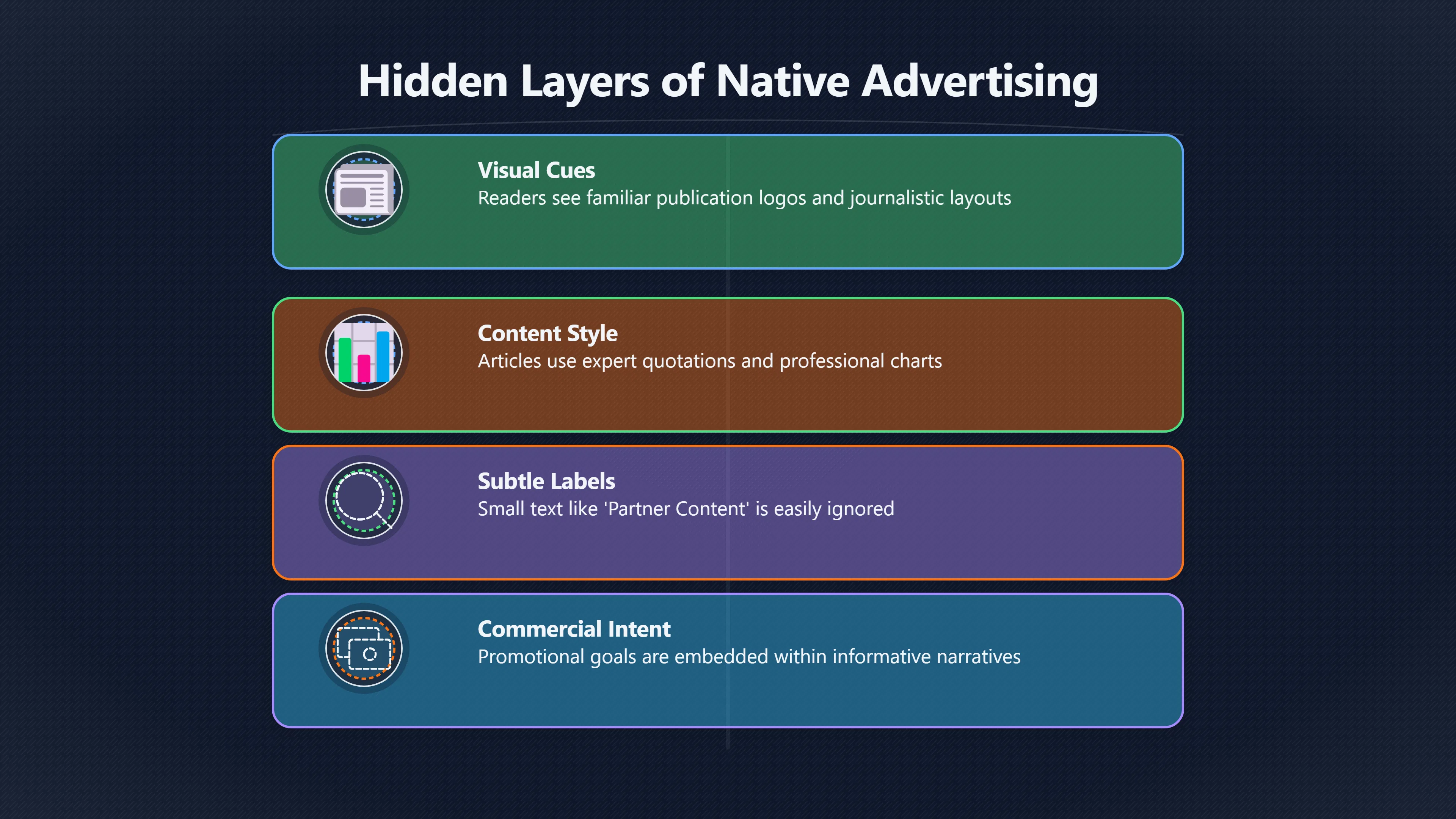
The challenge is not that sponsored content always hides its identity. In many jurisdictions, advertisers are required to disclose paid relationships. The problem is that disclosure often competes with stronger visual and psychological signals. Readers see a familiar publication logo, a headline written in a journalistic style, quotations from experts, charts, photographs and a page layout that closely resembles ordinary reporting. These cues encourage people to process the material as journalism rather than marketing.[Hunton]hunton.comsponsored content into surrounding editorial content and consumers' ability to share such ads…. False Advertising Claims, False Advert…
Native advertising emerged specifically to reduce the interruption associated with conventional advertising. Instead of standing apart from surrounding content, it is designed to fit within it. Regulators have repeatedly warned that advertisements become misleading when they resemble news articles, reviews or editorial features so closely that readers may not recognise their commercial purpose.[www.hoganlovells.com+2Manatt]hoganlovells.comSigns Your Native Ad Needs a Disclosure: The FTC…15 Feb 2016 — Similarly, false claims or omissions about a speaker's bias are presume…
Historically, advertisers have long experimented with formats that resemble non-commercial content, from advertorials in newspapers to television infomercials presented as programmes. Digital publishing expanded these techniques because websites can integrate sponsored material seamlessly into article feeds, search results and recommendation boxes.[Hunton]hunton.comsponsored content into surrounding editorial content and consumers' ability to share such ads…. False Advertising Claims, False Advert…
Why Ad Labels Are Easy to Miss
Many readers assume they would notice a label such as “Sponsored”, “Advertisement” or “Paid Content”. In reality, those labels often compete with habits developed from years of online browsing.
Several factors make disclosures easy to overlook:
- Readers scan rather than read. People often decide whether an article is trustworthy within seconds, focusing on headlines, images and publication branding rather than small disclosure notices.
- Visual similarity reduces attention. Sponsored content is frequently formatted to resemble neighbouring articles, making the disclosure one of the few elements that differs.
- Platform design encourages speed. Social media feeds, news apps and search results reward rapid scrolling and clicking rather than careful inspection.
- Familiar brands create trust. When sponsored content appears on a respected publication’s website, readers may transfer trust from the publisher to the sponsored material itself.
- Ambiguous labels cause confusion. Terms such as “Partner Content”, “Brand Voice”, “Presented By” or “From Around the Web” may be less immediately clear than a direct label such as “Advertisement”. Regulators have noted that some common disclosure formats can fail to communicate commercial intent effectively.[Kelley Drye & Warren LLP+2Loeb & Loeb]kelleydrye.comnavigating native advertisingKelley Drye & Warren LLPNavigating Native Advertising6 Jan 2016 — According to the FTC, disclosures in native advertising must often appe…
Research on digital advertising disclosures has found that subtle sponsorship labels often attract less attention than traditional advertising markers. Studies of influencer and affiliate marketing similarly show that short or unclear disclosures are frequently misunderstood or ignored.[PMC+2arXiv]pmc.ncbi.nlm.nih.govPMCBlending in or standing out?The disclosure dilemma of ad…by M Hübner · 2025 · Cited by 9 — However, these disclosures often appear as subtle “sponsored” labels, r…
What Student Assessments Showed
One of the most influential findings in media literacy research came from assessments conducted by the Stanford History Education Group, later known as the Digital Inquiry Group. Researchers examined how students evaluated online information and found widespread difficulty distinguishing advertising from journalism.[Stanford Digital Repository]stacks.stanford.eduSHEG Evaluating Information OnlineStanford Digital RepositoryThe Cornerstone of Civic Online Reasoning22 Nov 2016 — Over the last year and a half, the Stanford History Edu…
In a well-known assessment involving middle-school students, participants were shown a webpage containing a native advertisement labelled as sponsored content. More than 80 per cent treated the material as a genuine news story despite the disclosure. Some students even recognised the phrase “sponsored content” while still judging the article to be credible journalism.[Campus Technology]campustechnology.comCampus TechnologyReport: Digital Natives 'Easily Duped' by Information Online7 Dec 2016 — More than 80 percent of students believed that…
These findings are significant because the students were not being tested on obscure facts. They were being asked to recognise the nature of the source itself. The difficulty was not understanding the article’s words; it was understanding its context.
Researchers argued that traditional reading skills did not adequately prepare students for this task. Many students evaluated the article by examining its content and appearance while paying insufficient attention to who created it, who funded it and why it existed. Professional fact-checkers, by contrast, tended to leave the page and investigate the publisher or sponsor before judging credibility.[American Federation of Teachers]aft.orgUnfortunately, our research at the Stanford History Education Group…Read more…

Why Careful Readers Still Get Caught
The common assumption is that sponsored content mainly deceives inattentive readers. Evidence suggests the situation is more complicated.
Careful readers often focus on evaluating arguments, evidence and writing quality. Sponsored content exploits this tendency by presenting information that appears well researched and professionally produced. Because the material may contain many accurate facts, readers can conclude that it is trustworthy without recognising that the selection and framing of those facts serve a commercial objective.
Another challenge is that modern sponsored content frequently avoids direct sales language. Instead of saying “buy this product”, it may discuss industry trends, health concerns, financial planning or technological developments. The promotional goal is embedded within the broader narrative. This can make the material appear informative rather than persuasive.[JSTOR]jstor.orgThe Challenges Native Advertising Posesby C Campbell · 2019 · Cited by 417 — The FTC's (1983) “Policy Statement on Deception” addres…
Social media adds a further complication. Influencers often build audiences through authenticity and personal connection. When sponsorship disclosures are weak or absent, promotional messages may be interpreted as genuine recommendations. Studies of affiliate marketing and influencer content have found that disclosures are often missing or ineffective, making it harder for audiences to recognise commercial relationships.[arXiv]arxiv.orgOpen source on arxiv.org.
Lateral Checks for Publisher and Sponsor Context
The most reliable defence against sponsored content is not memorising disclosure labels. It is learning to investigate context.
Lateral reading offers a practical approach:
- Identify the publisher. Is the page part of a news organisation, a corporate marketing programme or a content partnership?
- Look for the sponsor. Search the company, brand or organisation associated with the article.
- Check independent coverage. Are the same claims reported by sources with no financial connection to the topic?
- Search the article title or key claim. Sometimes the same sponsored piece appears across multiple sites with different branding.
- Ask who benefits. If the article encourages a particular product, service, policy or industry viewpoint, investigate whether a sponsor has an interest in that outcome.
The key move is leaving the page. Rather than judging credibility solely from design, tone or apparent professionalism, readers gather outside information about the source and its incentives. This mirrors the behaviour observed among professional fact-checkers, who often verify a source’s identity before spending time analysing its content.[American Federation of Teachers]aft.orgUnfortunately, our research at the Stanford History Education Group…Read more…
The Bigger Lesson for the AI and Social Media Era
Sponsored content demonstrates a broader lesson about online credibility: appearance is weak evidence. A polished layout, reputable-looking branding and sophisticated writing can signal professionalism without revealing the purpose behind the message.
As social platforms, recommendation systems and AI tools increasingly mix journalism, commentary, promotion and generated content into the same streams, recognising source context becomes more important than recognising style alone. Sponsored content succeeds when readers focus only on what is being said. Lateral reading shifts attention to who is speaking, who is paying and why the message exists in the first place. That habit does not eliminate deception, but it makes one of the most effective forms of online persuasion much easier to spot.[Stanford Education+2Stanford Digital Repository]ed.stanford.eduresearchers find students have trouble judging credibility information onlineStanford EducationStanford researchers find students have trouble judging the…22 Nov 2016 — Education scholars say youth are duped by…
Amazon book picks
Further Reading
Books and field guides related to Can You Tell News From Sponsored Content?. Use these as the next step if you want deeper reading beyond the article.
Trust Me I'm Lying
Explains how promotional content can masquerade as independent coverage.
The Attention Merchants
Explores advertising systems that blur editorial and commercial content.
The Skeptics' Guide to the Universe
Supports evaluation of persuasive and potentially misleading material.

eBay marketplace picks
Marketplace Samples
Example marketplace items related to this page. Use the search link to explore similar finds on eBay.



Endnotes
1.
Source: stacks.stanford.edu
Title: SHEG Evaluating Information Online
Link:https://stacks.stanford.edu/file/druid%3Afv751yt5934/SHEG%20Evaluating%20Information%20Online.pdf
Source snippet
Stanford Digital RepositoryThe Cornerstone of Civic Online Reasoning22 Nov 2016 — Over the last year and a half, the Stanford History Edu...
2.
Source: ed.stanford.edu
Title: researchers find students have trouble judging credibility information online
Link:https://ed.stanford.edu/news/stanford-researchers-find-students-have-trouble-judging-credibility-information-online
Source snippet
Stanford EducationStanford researchers find students have trouble judging the...22 Nov 2016 — Education scholars say youth are duped by...
3.
Source: hunton.com
Link:https://www.hunton.com/hunton-retail-law-resource/ftc-issues-guidance-on-native-advertising-businesses-must-consider-the-likelihood-of-consumer-confusion
Source snippet
sponsored content into surrounding editorial content and consumers' ability to share such ads.... False Advertising Claims, False Advert...
4.
Source: hoganlovells.com
Link:https://www.hoganlovells.com/en/publications/three-signs-your-native-ad-needs-a-disclosure-the-ftc-issues-native-advertising-guidelines
Source snippet
Signs Your Native Ad Needs a Disclosure: The FTC...15 Feb 2016 — Similarly, false claims or omissions about a speaker's bias are presume...
5.
Source: manatt.com
Title: special focus ftc issues long awaited native adve
Link:https://www.manatt.com/insights/newsletters/advertising-law/special-focus-ftc-issues-long-awaited-native-adve
Source snippet
FTC Issues Long-Awaited Native Advertising GuidanceDec 22, 2015 — The FTC makes clear that consumers must know before they choose to view...
6.
Source: kelleydrye.com
Title: navigating native advertising
Link:https://www.kelleydrye.com/viewpoints/blogs/ad-law-access/navigating-native-advertising
Source snippet
Kelley Drye & Warren LLPNavigating Native Advertising6 Jan 2016 — According to the FTC, disclosures in native advertising must often appe...
7.
Source: loeb.com
Link:https://www.loeb.com/en/insights/publications/2015/12/ftc-issues-enforcement-statement-business-guide-__
Source snippet
Loeb & LoebFTC Issues Enforcement Statement, Business Guide on...A disclosure also must be clear and prominent on all devices and platfo...
8.
Source: pmc.ncbi.nlm.nih.gov
Title: PMCBlending in or standing out?
Link:https://pmc.ncbi.nlm.nih.gov/articles/PMC12380683/
Source snippet
The disclosure dilemma of ad...by M Hübner · 2025 · Cited by 9 — However, these disclosures often appear as subtle “sponsored” labels, r...
9.
Source: arxiv.org
Link:https://arxiv.org/abs/1809.00620
10.
Source: jstor.org
Link:https://www.jstor.org/stable/26992837
Source snippet
The Challenges Native Advertising Posesby C Campbell · 2019 · Cited by 417 — The FTC's (1983) “Policy Statement on Deception” addres...
11.
Source: arxiv.org
Title: arXiv Sponsorship Disclosure in Native Advertising: A Theoretical Framework
Link:https://arxiv.org/abs/2311.01051
12.
Source: aft.org
Link:https://www.aft.org/ae/fall2017/mcgrew_ortega_breakstone_wineburg
Source snippet
Unfortunately, our research at the Stanford History Education Group...Read more...
13.
Source: campustechnology.com
Link:https://campustechnology.com/articles/2016/12/07/report-digital-natives-easily-duped-by-information-online.aspx
Source snippet
Campus TechnologyReport: Digital Natives 'Easily Duped' by Information Online7 Dec 2016 — More than 80 percent of students believed that...
14.
Source: ftc.gov
Link:https://www.ftc.gov/
Source snippet
Federal Trade Commission | Protecting America's ConsumersThe official website of the Federal Trade Commission, protecting America's consu...
15.
Source: ftc.gov
Link:https://www.ftc.gov/sites/default/files/attachments/press-releases/ftc-staff-revises-online-advertising-disclosure-guidelines/130312dotcomdisclosures.pdf
Source snippet
It cannot cure a false claim. If a disclosure provides information that...Read more...
16.
Source: ftc.gov
Link:https://www.ftc.gov/business-guidance/resources/ftcs-endorsement-guides-what-people-are-asking
Source snippet
FTC's Endorsement Guides: What People Are AskingWhether a particular disclosure is easy to understand or difficult to miss depends on the...
Additional References
17.
Source: ftcdefenselawyer.com
Link:https://ftcdefenselawyer.com/ftc-native-advertising-guideline-lawyer/
Source snippet
FTC Native Advertising Guideline LawyerFTC Native Advertising Guideline Lawyer Defending Investigations Targeting Deceptively Formatted A...
18.
Source: nativeadvertisinginstitute.com
Link:https://www.nativeadvertisinginstitute.com/native-advertising-glossary/ftc-native-advertising-guidelines
Source snippet
FTC Native Advertising GuidelinesUse Clear Disclosures: Ensure that native ads are labeled with clear, prominent disclosures, such as “Sp...
19.
Source: linkedin.com
Link:https://www.linkedin.com/pulse/ftc-publishes-policy-statement-business-guide-native-amanda-schreyer
Source snippet
FTC Publishes Policy Statement and Business Guide on...From time to time, the FTC issues guidance on what advertisers can do to avoid de...
20.
Source: instituteforpr.org
Link:https://instituteforpr.org/wp-content/uploads/IPR-Native-Advertising-Edited-2.pdf
Source snippet
FTC Regulation of Native Advertising: How New Federal...by C Myers — While states may pass individual laws about false advertising, PR p...
21.
Source: fkks.com
Link:https://fkks.com/uploads/news/6.30.2015Native_Advertising-The_Old_Is_New_Again.pdf
Source snippet
Native Advertising: The Old Is New AgainBy producing fake reviews, these com- panies violated multiple state laws against false adver- ti...
22.
Source: prweek.com
Link:https://www.prweek.com/article/1378766/4-important-takeaways-ftcs-native-advertising-guidelines
Source snippet
FTC guidelines on sponsored content & native adsDisclosures need to appear in close proximity to (in front of or above) the native advert...
23.
Source: bclplaw.com
Link:https://www.bclplaw.com/en-US/events-insights-news/native-advertising-recent-ftc-cases-require-disclosure-of-paid-endorsements-on-social-media.html
Source snippet
Native Advertising: Recent FTC Cases Require Disclosure...12 May 2016 — Two recent cases by the Federal Trade Commission (“FTC”) demonst...
Published: May 2016
24.
Source: ssoar.info
Title: ssoar mediacomm 2022 1 balaban et al Adolescents Understanding of the Model
Link:https://www.ssoar.info/ssoar/bitstream/handle/document/79868/ssoar-mediacomm-2022-1-balaban_et_al-Adolescents_Understanding_of_the_Model.pdf?sequence=2
Source snippet
Adolescents' Understanding of the Model of Sponsored...by DC Balaban · 2022 · Cited by 47 — Our study stresses the importance of develop...
25.
Source: wsj.com
Title: most students dont know when news is fake stanford study finds 1479752576
Link:https://www.wsj.com/articles/most-students-dont-know-when-news-is-fake-stanford-study-finds-1479752576
Source snippet
Wall Street JournalMost Students Don't Know When News Is Fake, Stanford...21 Nov 2016 — Some 82% of middle-schoolers couldn't distinguis...
26.
Source: siia.net
Title: ftc delivers stern warning on native advertising and sponsored content
Link:https://www.siia.net/ftc-delivers-stern-warning-on-native-advertising-and-sponsored-content/
Source snippet
FTC Delivers Stern Warning on Native Advertising and...6 Jan 2021 — With these new materials, the FTC maintains that not all native adve...
Topic Tree