Within Own Research
Check the Source Before the Story
Leaving the page to check who is behind it often reveals more than reading the page itself.
On this page
- What lateral reading asks first
- How to investigate authors and organizations
- When source checks should change confidence
Page outline Jump by section
Introduction
When people encounter an unfamiliar website, article, think tank, advocacy group, or expert profile, their instinct is often to stay on the page and inspect it carefully. Lateral reading turns that instinct on its head. Instead of spending more time studying the source’s own presentation, it asks readers to leave the page and investigate who is behind it, what other independent sources say about it, and whether its claims hold up elsewhere. Professional fact-checkers routinely use this approach because a polished website can be misleading, while information about the organisation behind it is often easier to verify than the claims it makes about itself. Research comparing professional fact-checkers with historians and university students found that fact-checkers were more effective because they quickly moved beyond the page and checked outside sources before reaching conclusions.[Sage Journals+2Stanford News]journals.sagepub.comSage JournalsReading Less and Learning More When Evaluating Digital…by S Wineburg · 2019 · Cited by 603 — Our purpose in this study wa…
 Within the broader goal of doing your own research without cherry-picking, lateral reading is one of the most practical habits a person can develop. It shifts attention away from appearances and towards independent verification.
Check the Source Before the Story
A common mistake in online research is evaluating a source by reading it more carefully. Readers examine the design, the writing style, the presence of references, or the professionalism of the layout. These features can matter, but they are also easy to imitate.
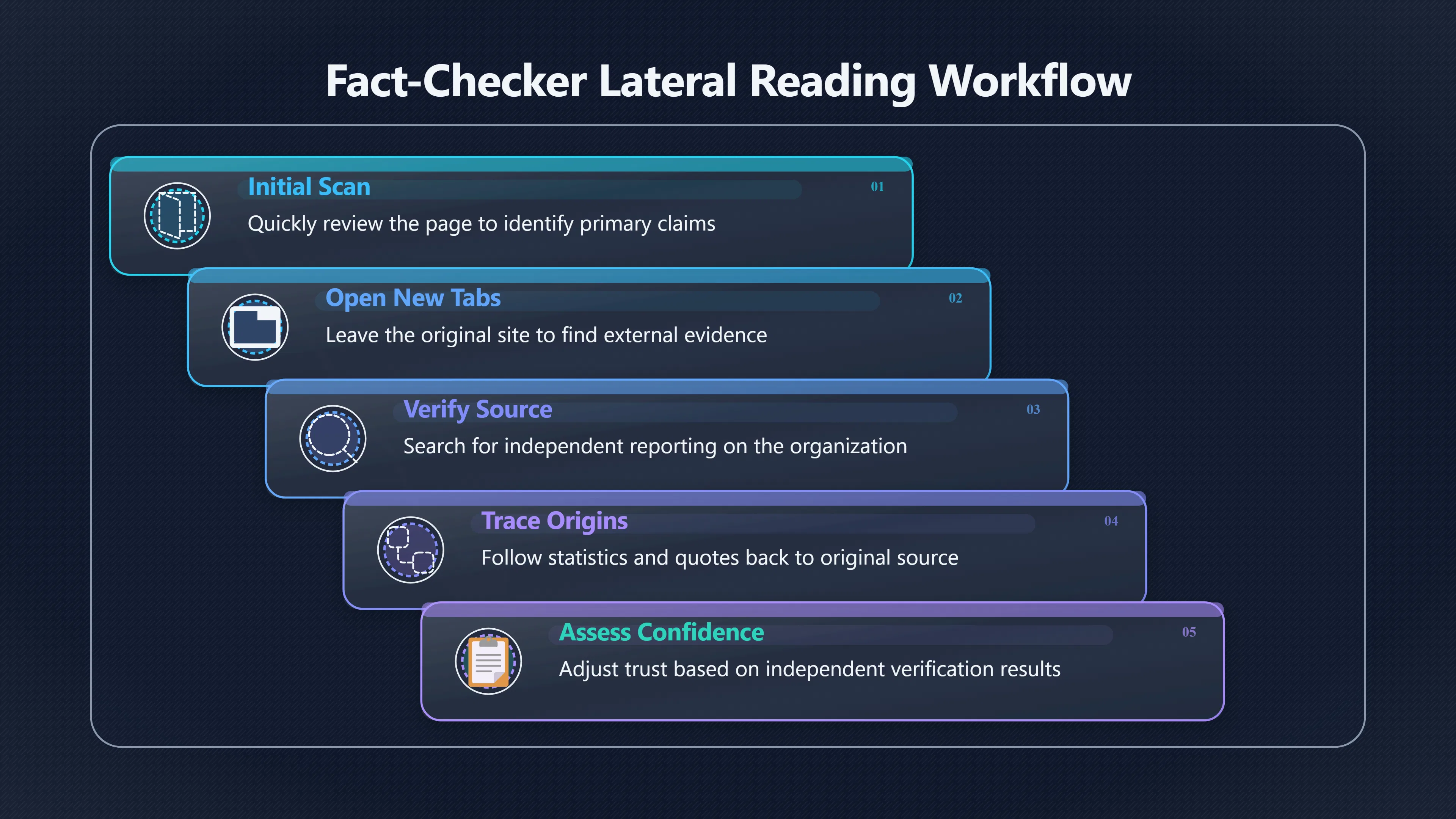
Studies from the Stanford History Education Group, now the Digital Inquiry Group, found a striking difference between expert fact-checkers and other highly educated readers. Historians and students often stayed within a website, examining its internal features. Fact-checkers did the opposite: they opened new tabs, searched for information about the source, and sought outside evidence before investing much attention in the page itself. Researchers described this approach as “reading less and learning more”.[Sage Journals+2SSRN]journals.sagepub.comSage JournalsReading Less and Learning More When Evaluating Digital…by S Wineburg · 2019 · Cited by 603 — Our purpose in this study wa…
This matters because many misleading websites are designed to answer the very questions readers might ask. An organisation’s “About Us” page may emphasise expertise while omitting funding sources, political affiliations, commercial incentives, or previous controversies. Reading only what the source says about itself leaves the source in control of the investigation.
Lateral reading deliberately removes that advantage.[poynter.org]poynter.orglateral reading the best media literacy tip to vet credible sourcesLateral reading: The best media literacy tip to vet credible…20 Jul 2023 — There are two ways that you can use lateral reading…
What Lateral Reading Asks First
Before evaluating a claim, lateral readers ask a small set of questions about the source itself.
Who created this?
Is the page produced by a news organisation, government agency, university, company, campaign group, influencer, or anonymous publisher?
What is the organisation’s purpose?
Some sources exist to inform, others to persuade, sell, recruit, campaign, or generate advertising revenue. Purpose does not automatically determine truthfulness, but it provides important context.
What do independent sources say about them?
Instead of accepting self-descriptions, lateral readers search for reporting, reference works, academic discussions, regulatory records, or fact-checking analyses that discuss the organisation.
Do other credible sources recognise them as authoritative?
Expertise is often visible through reputation, citations, professional affiliations, or a track record of accurate work.
Is there independent confirmation of the claim?
A claim supported only by sources that quote one another is weaker than one independently verified by multiple organisations.
The key insight is that credibility often becomes clearer after a few minutes of searching outside the original page than after twenty minutes of reading it.
How to Investigate Authors and Organisations
Lateral reading is not a complex research method. It is a sequence of quick checks designed to establish context before confidence.
Search the Author or Organisation
A simple search for the author’s name or organisation can reveal information that the page itself never mentions.
Useful findings include:
- Professional background and qualifications.
- Previous publications.
- Organisational affiliations.
- Funding sources.
- Public criticism or corrections.
- Recognition by relevant experts.
For example, an article on public health may appear authoritative until a quick search reveals that its author has no relevant expertise or primarily works as a marketer rather than a researcher.

Look Beyond Self-Descriptions
One of the most important habits is refusing to rely solely on a source’s own biography or mission statement.
Professional fact-checkers frequently consult independent descriptions, including encyclopaedic references, major news coverage, regulatory filings, academic discussions, and established fact-checking organisations. The goal is not to find praise or criticism but to understand how the source is viewed by others.[Inquiry Group+2Inquiry Group]cor.inquirygroup.orgInquiry GroupIntro to Lateral Reading | Civic Online ReasoningThis lesson introduces students to lateral reading, a strategy for investig…
Check Funding and Incentives
Organisations often have financial, political, or ideological interests that shape their priorities.
Questions worth asking include:
- Who funds the organisation?
- Is it affiliated with a political movement?
- Does it sell products connected to the claims being made?
- Does it depend on attention, subscriptions, donations, or advertising?
Knowing the answers does not prove a claim true or false. It helps readers interpret evidence in context.
Trace Claims to Their Origin
Many viral claims become detached from their original source.
A statistic may be copied from article to article until nobody checks where it came from. Images, quotations, and graphs often circulate without context. Effective lateral readers trace material back to the earliest identifiable source and evaluate that source directly. This principle forms part of Mike Caulfield’s widely used SIFT framework, which encourages readers to investigate sources, find better coverage, and trace information back to its original context. Pressbooks+3University of Chicago Library Guides+3libguides.cmich.edu[guides.lib.uchicago.edu]guides.lib.uchicago.eduUniversity of Chicago Library Guides The SIFT MethodUniversity of Chicago Library GuidesThe SIFT Method - Evaluating Resources and Misinformation30 Jun 2025 — The SIFT method is an evaluati…
Why Professional Fact-Checkers Leave the Page
One of the most influential findings in digital literacy research came from observing how different groups evaluated unfamiliar online information.
Researchers compared professional fact-checkers, historians, and Stanford students. Historians possessed deep expertise in evaluating historical documents, yet they often approached websites as if they were traditional texts. They scrutinised details within the page itself. Fact-checkers instead treated unfamiliar websites as objects requiring external investigation. They searched for information about the source, checked outside references, and quickly established context before analysing content.[Sage Journals+2ERIC]journals.sagepub.comSage JournalsReading Less and Learning More When Evaluating Digital…by S Wineburg · 2019 · Cited by 603 — Our purpose in this study wa…
The difference was significant. Fact-checkers reached more reliable conclusions in less time because they recognised that modern websites can be engineered to look trustworthy regardless of their actual credibility.[Stanford News]news.stanford.edufact checkers outperform historians evaluating online informationStanford NewsFact checkers outperform historians when evaluating online…Oct 24, 2017 — A new report from the Stanford History Educatio…
This finding is particularly relevant in an era of AI-generated content. Large language models can produce polished text at scale, making surface-level cues even less reliable than before. A persuasive article is no longer strong evidence that the underlying source deserves trust.
When Source Checks Should Change Confidence
Lateral reading is not about sorting sources into simple categories of trustworthy and untrustworthy. It is about adjusting confidence appropriately.
Certain findings should increase confidence:
- Independent recognition by relevant experts.
- Transparent authorship and funding.
- A history of accurate reporting or scholarship.
- Evidence confirmed by multiple independent sources.
- Clear corrections when mistakes occur.
Other findings should reduce confidence:
- Anonymous or hidden ownership.
- Unsupported expertise claims.
- Evidence available only from a single network of aligned sources.
- Repeated factual corrections by independent reviewers.
- Financial or ideological interests that are concealed rather than disclosed.
Confidence should also remain provisional. Sometimes source checks reveal mixed evidence. An organisation may have genuine expertise in one area but make weaker claims in another. The goal is not certainty but proportionate trust.
Lateral Reading in the Social Media and AI Era
Social media rewards speed, emotional reaction, and sharing. AI systems can rapidly generate convincing articles, profiles, and websites. Together, these forces increase the value of source checking.
A post may accumulate thousands of shares before anyone asks who created it. An AI-generated article may look professional despite being based on unreliable information. In both cases, the crucial question is often not “How convincing is this page?” but “Who is behind it, and what do independent sources say?”
Educational research suggests that lateral reading skills can be taught and improved. Studies have found that relatively brief instruction can help students become better at identifying dubious online sources and evaluating credibility.[Stanford Education]ed.stanford.eduit doesn t take long learn how spot misinformation online stanford study findsStanford EducationIt doesn't take long to learn how to spot misinformation online…19 Apr 2022 — Research from the Stanford History Edu…
The broader lesson is simple: when confronted with an unfamiliar source, resist the urge to read deeper immediately. Open another tab. Search for the author. Search for the organisation. Look for independent coverage. In many cases, the most important information about a source exists somewhere other than the source itself.[Poynter+2Inquiry Group]poynter.orglateral reading the best media literacy tip to vet credible sourcesLateral reading: The best media literacy tip to vet credible…20 Jul 2023 — There are two ways that you can use lateral reading…
Amazon book picks
Further Reading
Books and field guides related to Check the Source Before the Story. Use these as the next step if you want deeper reading beyond the article.
Calling Bullshit: The Art of Skepticism in a Data-Driven World
Encourages independent verification of claims.

Critical Thinking: Your Guide to Effective Argument, Successf...
Supports evidence evaluation and source assessment.
Verified: How to Think Straight, Get Duped Less, and Make Bet...
Built around lateral reading and source verification.
eBay marketplace picks
Marketplace Samples
Example marketplace items related to this page. Use the search link to explore similar finds on eBay.
![Listing image for NCT 127 [FACT CHECK] 5th Album CHANDELIER Ver/CD+Photo Book+Photo Card+Poster](/assets/images/marketplace-covers/0ec43911bad3ef719bae.jpg)
Endnotes
1.
Source: news.stanford.edu
Title: fact checkers outperform historians evaluating online information
Link:https://news.stanford.edu/stories/2017/10/fact-checkers-outperform-historians-evaluating-online-information
Source snippet
Stanford NewsFact checkers outperform historians when evaluating online...Oct 24, 2017 — A new report from the Stanford History Educatio...
2.
Source: papers.ssrn.com
Link:https://papers.ssrn.com/sol3/papers.cfm?abstract_id=3048994
Source snippet
Reading Less and Learning More When Evaluating Digital...by S Wineburg · 2019 · Cited by 71 — Lateral Reading: Reading Less and Lear...
3.
Source: poynter.org
Title: lateral reading the best media literacy tip to vet credible sources
Link:https://www.poynter.org/fact-checking/media-literacy/2023/lateral-reading-the-best-media-literacy-tip-to-vet-credible-sources/
Source snippet
Lateral reading: The best media literacy tip to vet credible...20 Jul 2023 — There are two ways that you can use lateral reading...
4.
Source: libguides.cmich.edu
Link:https://libguides.cmich.edu/web_research/lateral
Source snippet
Online Research: Lateral Reading and SIFT12 Dec 2024 — SIFT stands for Stop; Investigate the source; Find better coverage; and Trace clai...
5.
Source: wisconsin.pressbooks.pub
Link:https://wisconsin.pressbooks.pub/info-lit/chapter/evaluating-sources/
Source snippet
Investigate the source with lateral reading. Find trusted coverage. Trace claims, quotes, and media to the original source.Read more...
6.
Source: pressbooks.pub
Title: The SIFT Method –
Link:https://pressbooks.pub/introtocollegeresearch/chapter/the-sift-method/
Source snippet
Investigate the source. Find better coverage. Trace claims, quotes and media to the original context.Read more...
7.
Source: eric.ed.gov
Link:https://eric.ed.gov/?id=EJ1262001
Source snippet
historians, 10 professional fact checkers, and 25 Stanford University undergraduates. Analysis focused...Read more...
8.
Source: ed.stanford.edu
Title: it doesn t take long learn how spot misinformation online stanford study finds
Link:https://ed.stanford.edu/news/it-doesn-t-take-long-learn-how-spot-misinformation-online-stanford-study-finds
Source snippet
Stanford EducationIt doesn't take long to learn how to spot misinformation online...19 Apr 2022 — Research from the Stanford History Edu...
9.
Source: stacks.stanford.edu
Title: Wineburg Mc Grew Lateral Reading and the Nature of Expertise
Link:https://stacks.stanford.edu/file/druid%3Ayk133ht8603/Wineburg%20McGrew_Lateral%20Reading%20and%20the%20Nature%20of%20Expertise.pdf
Source snippet
Reading and the Nature of Expertise28 Jul 2018 — Resources and professional education opportunities for members are featured, including d...
10.
Source: nwtc.libguides.com
Link:https://nwtc.libguides.com/evaluating_resources/sift
Source snippet
Resources: SIFT Method17 Feb 2026 — Covers three key lateral reading strategies that fact-checkers use: Investigate the Source; Check the...
11.
Source: harcum.libguides.com
Link:https://harcum.libguides.com/reshelp/lateralreading
Source snippet
Help: Lateral Reading - Library GuidesLateral Reading is a process of evaluating online resources where you fact-check your source using...
12.
Source: ecampusontario.pressbooks.pub
Link:https://ecampusontario.pressbooks.pub/westernlibrariestutorials/chapter/lateral-reading/
Source snippet
Reading – Western Libraries TutorialsMike Caulfield (Washington State University) developed the Four Moves or SIFT to support lateral rea...
13.
Source: youtube.com
Title: Time to cut the CRAAP
Link:https://www.youtube.com/watch?v=Niu0HRFlmsQ
Source snippet
3 Lateral Reading...
14.
Source: youtube.com
Title: Lateral Reading
Link:https://www.youtube.com/watch?v=2UzNyz6ujH8
Source snippet
4 Evaluating Sources: Lateral Reading...
15.
Source: journals.sagepub.com
Link:https://journals.sagepub.com/doi/10.1177/016146811912101102
Source snippet
Sage JournalsReading Less and Learning More When Evaluating Digital...by S Wineburg · 2019 · Cited by 603 — Our purpose in this study wa...
16.
Source: cor.inquirygroup.org
Link:https://cor.inquirygroup.org/curriculum/lessons/intro-to-lateral-reading/
Source snippet
Inquiry GroupIntro to Lateral Reading | Civic Online ReasoningThis lesson introduces students to lateral reading, a strategy for investig...
17.
Source: cor.inquirygroup.org
Title: Inquiry Group Teaching Lateral Reading
Link:https://cor.inquirygroup.org/curriculum/collections/teaching-lateral-reading/
Source snippet
Lateral Reading - Civic Online ReasoningThese lessons also introduce students to resources they can use when laterally reading: Wikipedia...
18.
Source: guides.lib.uchicago.edu
Title: University of Chicago Library Guides The SIFT Method
Link:https://guides.lib.uchicago.edu/c.php?g=1241077&p=9082322
Source snippet
University of Chicago Library GuidesThe SIFT Method - Evaluating Resources and Misinformation30 Jun 2025 — The SIFT method is an evaluati...
19.
Source: libguides.milton.edu
Title: lateral reading
Link:https://libguides.milton.edu/lateral-reading
Source snippet
milton.eduLIB: Source Evaluation: Lateral Reading - Resource Guides5 Mar 2026 — A recent study from the Stanford History Education Group...
20.
Source: library.nwacc.edu
Link:https://library.nwacc.edu/lateralreading/sift
Source snippet
nwacc.eduLibGuides: Lateral Reading: SIFT It9 Mar 2026 — SIFT is a list of things to do when looking and a source. These "things to do" a...
21.
Source: scienceofboosting.org
Title: Lateral Reading
Link:https://www.scienceofboosting.org/project/lateral-reading/
Source snippet
Boosting4 May 2023 — Lateral reading is a simple heuristic for online fact-checking: Open multiple tabs in your browser and search the We...
Published: May 2023
22.
Source: dictionary.cambridge.org
Link:https://dictionary.cambridge.org/us/dictionary/english/lateral
Source snippet
definition in the Cambridge English Dictionaryrelating to the sides of an object or plant or to sideways movement: lateral movement Tri...
23.
Source: dictionary.cambridge.org
Link:https://dictionary.cambridge.org/dictionary/english/lateral
Source snippet
English meaning - Cambridge Dictionary5 days ago — LATERAL definition: 1. relating to the sides of an object or plant or to sideways mo...
24.
Source: libguides.chowan.edu
Link:https://libguides.chowan.edu/evaluate
Source snippet
Whitaker Library18 Sept 2024 — A lot of the SIFT strategies use a concept called lateral reading. That is doing an internet search to see...
25.
Source: medlineplus.gov
Link:https://medlineplus.gov/ency/article/002244.htm
Source snippet
Medical EncyclopediaOct 9, 2024 — Lateral means to the side of, or away from, the middle of the body. Examples: The ears are lateral to t...
26.
Source: libguides.pvcc.edu
Title: lateral reading
Link:https://libguides.pvcc.edu/lateral_reading
Source snippet
Jessup Playbooks at Piedmont...3 Feb 2026 — The concept of lateral reading originated out of research from the Stanford History Educatio...
27.
Source: Wikipedia
Link:https://en.wikipedia.org/wiki/Lateral
Source snippet
LateralBiology and healthcare · Lateral (anatomy), a term of location meaning "towards the side" · Lateral cricoarytenoid muscle, an i...
28.
Source: kenhub.com
Link:https://www.kenhub.com/en/library/anatomy/lateral
Source snippet
Directional terminologyThe term lateral is a directional term that is used to describe the position of a structure relative to the median...
Additional References
29.
Source: merriam-webster.com
Link:https://www.merriam-webster.com/dictionary/lateral
Source snippet
LATERAL Definition & Meaning7 days ago — 1. of or relating to the side; a lateral view. 2. situated on, directed toward, or coming from t...
30.
Source: openmindsfoundation.org
Link:https://www.openmindsfoundation.org/blog/the-power-of-lateral-reading/
Source snippet
The power of lateral readingThe purpose of lateral reading is the pursuit of a deeper level of understanding, focussing on deep thought a...
31.
Source: misinforeview.hks.harvard.edu
Link:https://misinforeview.hks.harvard.edu/article/lateral-reading-college-students-learn-to-critically-evaluate-internet-sources-in-an-online-course/
Source snippet
Misinformation ReviewLateral reading: College students learn to critically...23 Feb 2021 — A small body of research suggests that studen...
32.
Source: researchgate.net
Link:https://www.researchgate.net/publication/356330143_Lateral_Reading_and_the_Nature_of_Expertise_Reading_Less_and_Learning_More_When_Evaluating_Digital_Information
Source snippet
Reading Less and Learning More When Evaluating Digital...Fact checkers read laterally, leaving a site after a quick scan and opening up...
33.
Source: youtube.com
Link:https://www.youtube.com/watch?v=qsrXJGpxwIE
Source snippet
Using SIFT to Evaluate Sources for Credibility TutorialCaulfield's SIFT method of source evaluation. Use this method to find credible sou...
34.
Source: en.wiktionary.org
Link:https://en.wiktionary.org/wiki/lateral
Source snippet
wiktionary.orglateralSearch. lateral. Entry · Discussion. Language; Loading… Download PDF; Watch · Edit. See also: latéral.Read more...
35.
Source: guides.lib.uiowa.edu
Link:https://guides.lib.uiowa.edu/c.php?g=849536&p=6077640
Source snippet
Online Information: Lateral Reading - Guides24 Nov 2025 — Good lateral readers use the simple techniques of the fact-checkers in the Stan...
36.
Source: researchgate.net
Link:https://www.researchgate.net/publication/349535570_Lateral_reading_College_students_learn_to_critically_evaluate_internet_sources_in_an_online_course
Source snippet
an improve at judging the credibility of online sources.Read more...
37.
Source: projectcora.org
Title: sift pick fact checking source evaluation
Link:https://projectcora.org/assignment/sift-pick-fact-checking-source-evaluation
Source snippet
SIFT & PICK Fact Checking & Source Evaluation14 Apr 2023 — The SIFT & PICK approach to evaluating sources adapts and builds on Mike Caulf...
38.
Source: libguides.sccsc.edu
Title: Evaluating Sources with Lateral Reading
Link:https://libguides.sccsc.edu/evaluatingsources/lateralreading
Source snippet
Research Guides17 Feb 2026 — Reading laterally is a skill used by professional fact-checkers that helps them quickly review a source and...
Topic Tree