Within Evidence Types
What a warning letter really proves
Regulator warnings are strong evidence of official concern, but they rarely settle every fact or future outcome on their own.
On this page
- The strength of named regulator records
- Why notices are not final verdicts
- How to read dates, parties and updates
Page outline Jump by section
Introduction
In the hierarchy of evidence for online claims, regulator notices occupy an unusual position. They are often stronger than rumours, screenshots, company statements or anonymous allegations because they are official records issued by bodies with legal authority. When a regulator publishes a warning letter, notice of concern, deficiency finding or enforcement communication, it proves that a named authority has identified a specific issue and considered it serious enough to document publicly. That alone can be highly significant. However, regulator notices are frequently misunderstood. They are evidence of official concern, not always proof that every allegation has been conclusively established, nor a guarantee about what will happen next. Understanding both their strengths and limits is essential for evaluating claims circulating on social media, especially when posts present a notice as either definitive guilt or complete exoneration.
The strength of named regulator records
A regulator notice is usually far more valuable than a second-hand description of the same event because it creates a traceable public record. Readers can often inspect the original document, identify the issuing authority, check dates, review cited laws or regulations, and see exactly which conduct is being questioned.
This matters because online discussions often collapse several different questions into one. A regulator notice can answer some of them clearly:
- Did a regulator examine the issue?
- Did the regulator identify a specific concern?
- Who was notified?
- What conduct, product, claim or practice was named?
- When was the concern formally raised?
For example, the U.S. Food and Drug Administration (FDA) states that warning letters are used when it believes significant violations have occurred and wants the recipient to address those concerns. The letters identify specific issues and request corrective action.[U.S. Food and Drug Administration]fda.govabout warning and close out lettersFood and Drug AdministrationWarning Letters - About Warning and Close-Out LettersMar 20, 2024 — The Warning Letter identifies the concern…
Similarly, the U.S. Federal Trade Commission (FTC) explains that warning letters are issued when the agency believes conduct is likely unlawful and that failure to correct it could lead to legal consequences.[Federal Trade Commission]ftc.govFederal Trade CommissionLegal Library: Warning LettersThe purpose of FTC warning letters is to warn companies that their conduct is likel…
For critical thinkers, this means a regulator notice can strongly support a claim such as:
“A government regulator formally challenged this company’s advertising.”
If the notice exists and says exactly that, the claim is supported by a primary source.
Why a warning letter is not a final verdict
A common mistake online is treating a regulator notice as equivalent to a court judgment. In many regulatory systems, it is not.
The FDA explicitly states that warning letters are advisory and are not final agency action. They communicate the agency’s position but do not commit the agency to taking enforcement action. The agency may later escalate, modify its position, accept corrective actions or close the matter.[U.S. Food and Drug Administration]fda.govcompliance enforcementFood and Drug AdministrationCompliance & EnforcementJan 27, 2026 — Warning letters are not final agency action. They communicate the agen…
This distinction is important because several separate questions can exist at the same time:
- Did the regulator raise concerns? Yes.
- Are those concerns serious? Often yes.
- Has every factual dispute been resolved? Not necessarily.
- Has a court ruled on the matter? Not necessarily.
- Will penalties definitely follow? Not necessarily.
Courts in the United States have repeatedly recognised this distinction. FDA warning letters have often been treated as non-final regulatory communications rather than final legal determinations.[Duane Morris+2lexology.com]duanemorris.comDuane Morris U.SCourt of Appeals for the District of Columbia Circuit…Jan 20, 2012 — "Warning letters" do not constitute "final agency action" subject…
As a result, social-media posts that claim “the regulator proved fraud” or “the regulator proved the company broke the law” may overstate what the document actually establishes. The notice may show that regulators believe violations occurred, but the legal process may still be incomplete.
What regulator notices usually prove
When evaluating a notice, focus first on the facts that the document itself establishes.
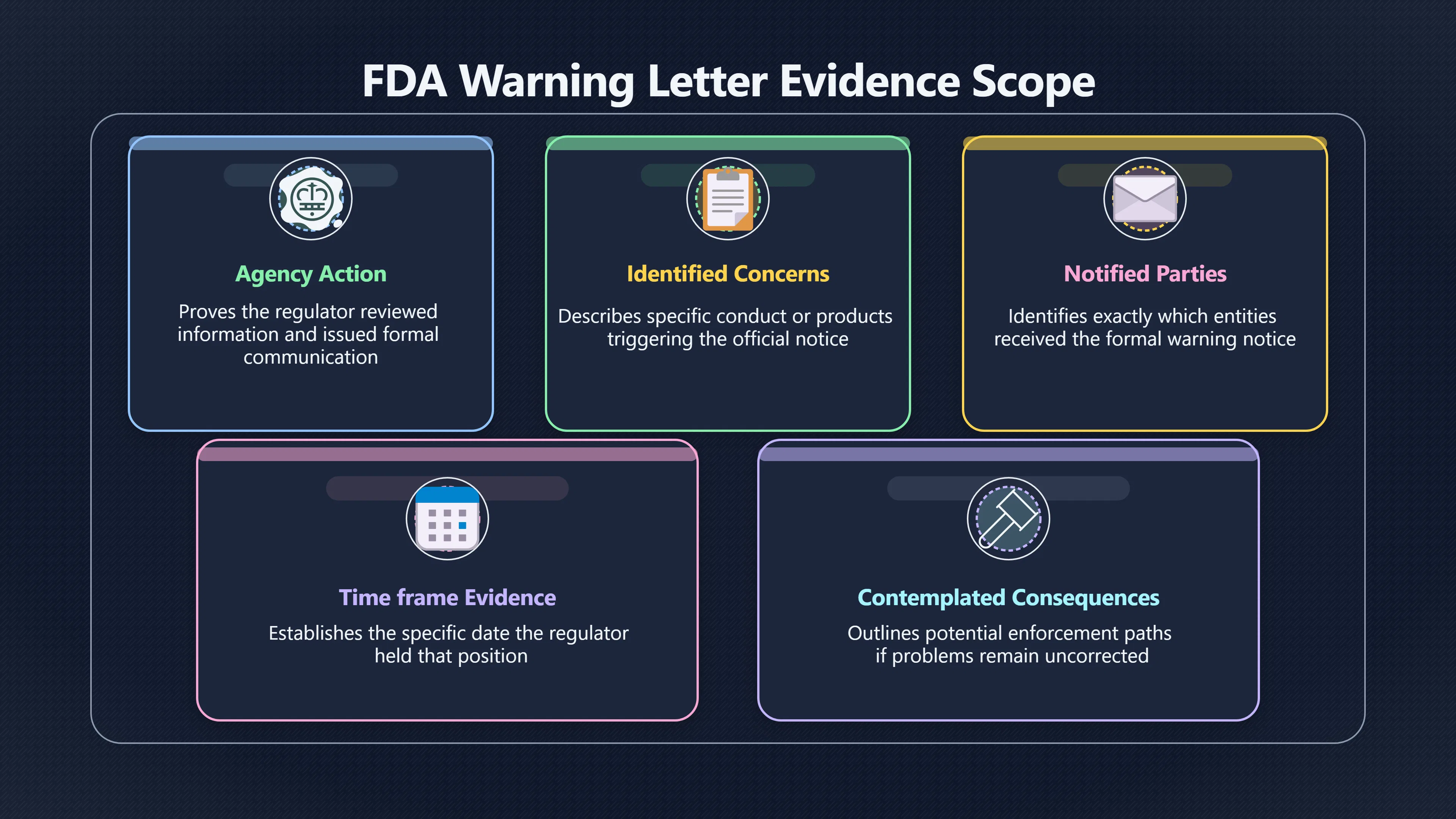
A regulator notice generally proves:
The regulator acted.
The existence of the document demonstrates that the authority reviewed information and decided formal communication was warranted.[U.S. Food and Drug Administration]fda.govabout warning and close out lettersFood and Drug AdministrationWarning Letters - About Warning and Close-Out LettersMar 20, 2024 — The Warning Letter identifies the concern…
Specific concerns were identified.
Notices normally describe the conduct, product, advertisement, process or practice that triggered concern.[Federal Lawyer]federal-lawyer.comwarning lettersFederal LawyerFDA Warning Letters (Overview & Response Strategies)Jun 8, 2023 — These warning letters inform recipients that the FDA beli…
Named parties were notified.
The document identifies who received the notice and who was expected to respond.
The concern existed at a particular time.
The date is evidence that the regulator held that position when the notice was issued.
Potential consequences were contemplated.
Many notices explain possible enforcement paths if problems are not corrected.[Federal Trade Commission]ftc.govFederal Trade CommissionLegal Library: Warning LettersThe purpose of FTC warning letters is to warn companies that their conduct is likel…
These are powerful evidential points because they rely on official records rather than hearsay.
What regulator notices do not prove
The limits are just as important.
A notice typically does not prove:
That all allegations were ultimately sustained.
Recipients may challenge findings, submit evidence, correct deficiencies or persuade regulators to revise their assessment.[Duane Morris]duanemorris.comIn other words, a Warning Letter is not “final agency action.Read moreDuane MorrisFDA Warning Letters Explained: An Opportunity, Not a ThreatNov 21, 2023 — The Warning Letter also does not necessarily repres…
That enforcement occurred.
Many matters end with voluntary correction rather than lawsuits, fines or other sanctions. Regulators often issue notices specifically to encourage compliance before escalation.[U.S. Food and Drug Administration]fda.govcompliance enforcementFood and Drug AdministrationCompliance & EnforcementJan 27, 2026 — Warning letters are not final agency action. They communicate the agen…
That current conditions remain the same.
A notice describes a situation at a specific point in time. Years later, the issue may have been corrected, settled or superseded.
That the regulator’s interpretation is the final legal answer.
Courts, tribunals or later administrative proceedings may reach different conclusions.
That every online claim about the notice is accurate.
People frequently exaggerate notices by adding allegations that never appeared in the original document.
For critical evaluation, the safest approach is to distinguish between “the regulator alleged” and “the matter was conclusively established”.
How to read dates, parties and updates
The most useful reading habit is to treat a regulator notice as the start of a timeline rather than the end of one.
When encountering a notice shared online, check:
When was it issued?
An old notice may still be relevant, but it may no longer describe the current situation. Viral posts often recycle years-old documents without mentioning subsequent developments.
Who exactly received it?
A notice directed at one subsidiary, product line or facility does not automatically apply to every part of a larger organisation.

Was there a response?
Many regulatory systems publish company responses, corrective-action plans or follow-up correspondence. These documents can provide important context about disputed facts or remediation efforts.[U.S. Food and Drug Administration]fda.govU.S. Food and Drug AdministrationWarning LettersLearn about the types of warning letters on FDA's website. Search Filter by Issuing Offic…
Was the matter closed?
Some agencies issue close-out letters or other records indicating that identified concerns have been addressed. Looking only at the original warning can create a misleading picture of the final outcome.[U.S. Food and Drug Administration]fda.govabout warning and close out lettersFood and Drug AdministrationWarning Letters - About Warning and Close-Out LettersMar 20, 2024 — The Warning Letter identifies the concern…
A practical rule for social-media claims
When a post cites a regulator notice, the strongest defensible statement is usually narrower than the most viral one.
Instead of saying:
“This proves the company committed fraud.”
A more evidence-based reading is:
“This proves a regulator formally alleged specific problems and considered them significant enough to issue an official notice.”
That distinction may sound small, but it is central to critical thinking. Regulator notices are valuable because they provide documented evidence of official concern. Their authority gives them substantial weight in an evidence hierarchy. Yet they remain bounded by scope, timing and legal process. Understanding both what they establish and what they leave unresolved helps readers avoid two common errors: dismissing official warnings as meaningless, or treating them as final verdicts when they are not.

eBay marketplace picks
Marketplace Samples
Example marketplace items related to this page. Use the search link to explore similar finds on eBay.




Endnotes
1.
Source: fda.gov
Title: about warning and close out letters
Link:https://www.fda.gov/inspections-compliance-enforcement-and-criminal-investigations/warning-letters/about-warning-and-close-out-letters
Source snippet
Food and Drug AdministrationWarning Letters - About Warning and Close-Out LettersMar 20, 2024 — The Warning Letter identifies the concern...
2.
Source: federal-lawyer.com
Title: warning letters
Link:https://federal-lawyer.com/healthcare/fda/warning-letters/
Source snippet
Federal LawyerFDA Warning Letters (Overview & Response Strategies)Jun 8, 2023 — These warning letters inform recipients that the FDA beli...
3.
Source: ftc.gov
Link:https://www.ftc.gov/legal-library/browse/warning-letters
Source snippet
Federal Trade CommissionLegal Library: Warning LettersThe purpose of FTC warning letters is to warn companies that their conduct is likel...
4.
Source: fda.gov
Title: compliance enforcement
Link:https://www.fda.gov/animal-veterinary/compliance-enforcement
Source snippet
Food and Drug AdministrationCompliance & EnforcementJan 27, 2026 — Warning letters are not final agency action. They communicate the agen...
5.
Source: lexology.com
Link:https://www.lexology.com/library/detail.aspx?g=6557360a-134e-43ab-ab9b-37aba4f3fe60
Source snippet
It communicates the agency's position on a matter, but it does not commit FDA to taking enforcement action.Read more...
6.
Source: fda.gov
Link:https://www.fda.gov/inspections-compliance-enforcement-and-criminal-investigations/compliance-actions-and-activities/warning-letters
Source snippet
U.S. Food and Drug AdministrationWarning LettersLearn about the types of warning letters on FDA's website. Search Filter by Issuing Offic...
7.
Source: fda.gov
Title: Regulatory Procedures Manual
Link:https://www.fda.gov/downloads/ICECI/ComplianceManuals/RegulatoryProceduresManual/UCM074330.pdf
Source snippet
Chapter 4A Warning Letter constitutes official but not final agency action. Inspections will be classified Official Action Indicated (OAI...
8.
Source: duanemorris.com
Title: Duane Morris U.S
Link:https://www.duanemorris.com/alerts/dc_circuit_determines_that_FDA_warning_letters_are_not_final_agency_action_4337.html
Source snippet
Court of Appeals for the District of Columbia Circuit...Jan 20, 2012 — "Warning letters" do not constitute "final agency action" subject...
9.
Source: duanemorris.com
Title: In other words, a Warning Letter is not “final agency action.Read more
Link:https://www.duanemorris.com/alerts/fda_warning_letters_explained_an_opportunity_not_threat_1123.html
Source snippet
Duane MorrisFDA Warning Letters Explained: An Opportunity, Not a ThreatNov 21, 2023 — The Warning Letter also does not necessarily repres...
Additional References
10.
Source: codacorpusa.com
Link:https://codacorpusa.com/warning-letters-roadmap-to-corrective-action-2/
Source snippet
Coda Corp USAWarning Letters: Roadmap to Corrective ActionA Warning Letter constitutes official but not final, agency action.... In case...
11.
Source: hoganlovells.com
Link:https://www.hoganlovells.com/en/publications/ftc-sends-dozens-of-warning-letters-to-companies-over-advertising-disclosures
Source snippet
FTC Sends Dozens of Warning Letters to Companies Over...The warnings serve as a reminder that organizations should review their disclaim...
12.
Source: consumerfinancialserviceslawmonitor.com
Link:https://www.consumerfinancialserviceslawmonitor.com/2026/04/ftc-warning-letters-signal-continued-federal-focus-on-debanking-and-financial-access/
Source snippet
FTC Warning Letters Signal Continued Federal Focus on...3 Apr 2026 — '” The letters emphasize that denying law‑abiding individuals acces...
13.
Source: classdismissed.mofo.com
Link:https://classdismissed.mofo.com/topics/under-review-ftc-puts-companies-on-notice-with-consumer-reviews-rule-warning-letters
Source snippet
Puts Companies on Notice with Consumer Reviews Rule...2 Feb 2026 — The FTC's warning-letter template outlining practices the agency view...
14.
Source: pmc.ncbi.nlm.nih.gov
Title: PMCChanges in FDA enforcement activities following
Link:https://pmc.ncbi.nlm.nih.gov/articles/PMC3582490/
Source snippet
by D Nguyen · 2013 · Cited by 20 — A regulatory letter can result from awareness of a FDCA violation from an inspection or other sourc...
15.
Source: wiley.law
Title: alert FTC Sends Warning Letters to Data Brokers on PADFA Compliance
Link:https://www.wiley.law/alert-FTC-Sends-Warning-Letters-to-Data-Brokers-on-PADFA-Compliance
Source snippet
FTC Sends Warning Letters to Data Brokers on PADFA...10 Feb 2026 — The Federal Trade Commission (FTC) announced it sent warning letters...
16.
Source: insideprivacy.com
Title: ftc issues warning letters for violations of consumer reviews rule
Link:https://www.insideprivacy.com/united-states/federal-trade-commission/ftc-issues-warning-letters-for-violations-of-consumer-reviews-rule/
Source snippet
FTC Issues Warning Letters for Violations of Consumer...2 Jan 2026 — According to the letter template, the FTC's warnings were based on...
17.
Source: jjccgroup.org
Link:https://jjccgroup.org/fda-483-response-guide/
Source snippet
Get step-by-step guidance, response templates, and CAPA tips to protect your business in 2025...
18.
Source: gmp-compliance.org
Title: fda warning letters structure and the lessons learnt effect
Link:https://www.gmp-compliance.org/gmp-news/fda-warning-letters-structure-and-the-lessons-learnt-effect
Source snippet
FDA Warning Letters: Structure and the "Lessons Learnt...9 Sept 2020 — The Warning Letters are official deficiency letters from the FDA...
19.
Source: michiganlawreview.org
Link:https://michiganlawreview.org/journal/the-new-frontier-of-guidance-reviewability/
Source snippet
Neither the issuance nor the withdrawal of a no-action letter constitutes a...Read more...
Topic Tree