Within Own Research
Can You Trust the AI Footnotes?
AI can organize research, but fluent answers and realistic citations still need to be checked against original sources.
On this page
- Why fluent AI answers feel more settled than they are
- How hallucinated references enter research
- Safe uses of AI before checking original sources
Page outline Jump by section
Introduction
AI can be an excellent research assistant, but it is a poor authority. One of the most important habits in modern critical thinking is learning to use AI for organisation, summarisation and question generation without automatically trusting the citations it provides. The problem is not that AI always invents sources. The problem is that it can mix genuine references, distorted references and entirely fabricated references into a response that sounds equally confident throughout. As a result, readers may mistake polished presentation for verified evidence.
 Within the broader goal of doing your own research without cherry-picking, AI creates a new challenge: it can make unsupported claims feel researched. The solution is not to avoid AI altogether. It is to treat every citation, quotation and source attribution as a lead to investigate rather than proof that the investigation has already been done.
Can You Trust the AI Footnotes?
The safest answer is: trust citations only after you have verified them yourself.
Large language models generate text by predicting plausible sequences of words. They are designed to produce answers that sound coherent, not to guarantee that every source reference exists or supports the claim attached to it. Researchers and academic integrity specialists have repeatedly documented fabricated references, incorrect author names, wrong publication dates and citations that point to real papers but misrepresent what those papers actually concluded.[Taylor & Francis Online+2PMC]tandfonline.comTaylor & Francis OnlineHallucinated citations produced by generative artificial…by DB Resnik · 2026 · Cited by 2 — In this article, we…
This problem is significant enough that universities, publishers and research organisations increasingly advise users to independently verify every AI-generated reference before relying on it. Cornell University’s guidance on AI and academic integrity explicitly recommends verifying the accuracy of all citations and references generated with AI tools.[Center for Teaching Innovation]teaching.cornell.eduRequest that students provide verification of references…Read more…
The key lesson is simple: a citation is not evidence until you have checked the original source.
Why Fluent AI Answers Feel More Settled Than They Are
Human beings often use confidence as a shortcut for credibility. AI systems exploit this tendency unintentionally because they usually present information in a smooth, authoritative style.
A traditional search engine shows uncertainty openly. You see competing links, conflicting headlines and different viewpoints. An AI assistant often compresses that messy landscape into a single narrative. The resulting answer may feel more settled and complete than the underlying evidence actually is.
Several warning signs deserve attention:
- Highly specific references that are difficult to locate.
- Quotations without page numbers or direct links.
- Academic-looking citations with plausible titles but no traceable publication record.
- Responses that become inconsistent when asked to show the original source.
- Claims supported by references that discuss a different topic from the one being cited.[TechRadar]techradar.comTech Radar5 signs that Chat GPT is hallucinatingThese hallucinations stem from how AI is trained: by predicting text sequences without verifying facts. 1. **Strange specificity without…
The danger is not merely factual error. A polished answer can discourage further checking by creating the impression that the checking has already been done.
How Hallucinated References Enter Research
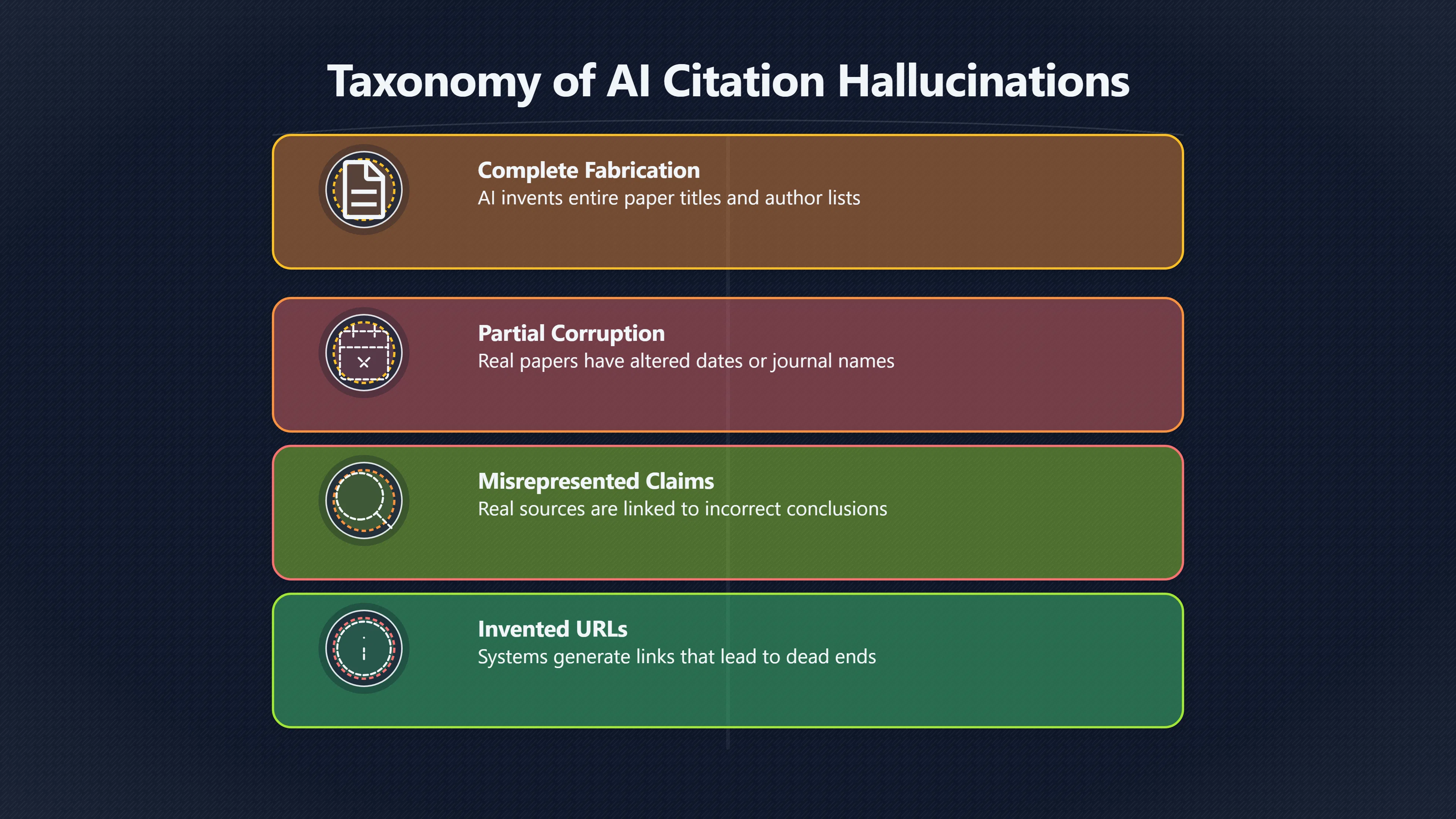
A hallucinated citation is a reference that appears legitimate but is inaccurate or entirely invented.
These errors typically enter research in several ways:
Complete fabrication. The AI invents a paper title, author list, journal or publication year that never existed. Researchers studying citation hallucinations have identified this as a common failure mode.[arXiv]arxiv.orgCompound Deception in Elite Peer Review: A Failure Mode Taxonomy of 100 Fabricated Citations at NeurIPS 2025February 5, 2026…
Partial corruption. A real paper exists, but details such as authors, publication dates or journal names are altered.[arXiv]arxiv.orgCompound Deception in Elite Peer Review: A Failure Mode Taxonomy of 100 Fabricated Citations at NeurIPS 2025February 5, 2026…
Real source, wrong claim. The reference exists, but the AI incorrectly describes its findings or conclusions. Studies examining AI-generated references have found that citation errors often involve misrepresenting the content of genuine sources.[Wikipedia]WikipediaHallucination (artificial intelligenceHallucination (artificial intelligence
Invented URLs and documents. Some systems generate links or reports that appear credible but cannot be located because they never existed. Recent research auditing AI-generated citations found measurable rates of non-existent URLs and fabricated references.[arXiv]arxiv.orgDetecting and Correcting Reference Hallucinations in Commercial LLMs and Deep Research AgentsApril 3, 2026…
Because the fabricated references often resemble real scholarly work, they can evade casual inspection. A reader who checks only the title may not notice that the article, DOI or publication record is missing.
Real-World Failures Show Why Verification Matters
The citation problem is no longer a laboratory curiosity. It has appeared in legal filings, government reports, consulting documents and academic publications.
In 2026, a United States federal judge sanctioned and disqualified multiple lawyers after court filings contained AI-generated legal citations that did not exist. The court emphasised that responsibility for verification remained with the attorneys, regardless of which tool produced the errors.[Reuters]reuters.comJudge rules both sides in lawsuit misused AI, disqualifies lawyersDistrict Judge in Mississippi, Sharion Aycock, has disqualified all attorneys involved in a contract dispute case after discovering both…
The same year, analyses of scientific literature identified a sharp rise in non-existent references associated with AI-assisted writing. One large-scale study estimated that nearly 147,000 hallucinated citations entered scholarly literature during 2025. Researchers warned that these errors were appearing not only in preprints but also in peer-reviewed publications.[arXiv+2Nature]arxiv.orgOpen source on arxiv.org.
Investigations have also found fabricated or distorted references in high-profile reports and books. In one widely discussed case, an AI-related consulting report was found to contain numerous inaccurate citations despite appearing professional and authoritative.[TechRadar]techradar.comThe report contained 45 citations, with only five found to be accurate; the rest were either fabricated, distorted, or misleading. GPTZer…
These incidents matter because citations do more than support arguments. They shape future research. Once a false reference enters circulation, other writers may repeat it without checking the original source.
Safe Uses of AI Before Checking Original Sources
The existence of citation errors does not make AI useless. It simply changes where trust should be placed.
AI is often valuable for:
- Generating research questions.
- Producing summaries that help orient a reader to a topic.
- Identifying competing viewpoints worth investigating.
- Suggesting search terms and keywords.
- Explaining technical concepts in simpler language.
- Creating preliminary outlines for further research.
In these roles, AI acts as an organiser rather than an authority.
A useful mental model is to treat AI as a research assistant who is energetic, fast and sometimes careless. Its suggestions may be valuable, but every important claim still requires independent verification.
A Practical Verification Routine
When AI provides a citation, a few checks can dramatically reduce the risk of being misled.
Find the original document. Do not rely on the citation text alone. Open the paper, report or article itself.
Confirm that it exists. Search library databases, publisher websites or recognised indexing services.
Check whether the source says what the AI claims it says. Many citation errors involve real sources being attached to inaccurate summaries.[Wikipedia]WikipediaHallucination (artificial intelligenceHallucination (artificial intelligence
Look for independent confirmation. Strong claims should usually appear in multiple credible sources.
Follow citations outward. If a source makes an important factual claim, examine where that source obtained its information.
Treat missing sources as a warning sign. If a paper, report or legal case cannot be located despite detailed citation information, assume the reference may be fabricated until proven otherwise.
This process is slower than accepting an AI answer at face value, but it is still far faster than conducting all research manually from scratch.
The Governance Challenge
The growing use of AI in research, journalism, policy and professional work raises governance questions that go beyond individual mistakes.
Institutions increasingly face decisions about how AI-generated citations should be handled, audited and disclosed. Universities are developing verification requirements. Publishers are exploring automated citation-checking tools. Researchers are studying ways to detect fabricated references before publication.[Center for Teaching Innovation+2arXiv]teaching.cornell.eduRequest that students provide verification of references…Read more…
The broader issue is accountability. An AI system cannot be held responsible for a false citation in the way a researcher, journalist, lawyer or policymaker can. For that reason, governance efforts generally focus on human responsibility for verification rather than assuming that citation errors will disappear through technical improvements alone.
In a world where AI can produce convincing evidence trails as easily as convincing prose, critical thinking increasingly means separating the appearance of sourcing from actual sourcing. The strongest defence remains the oldest research habit: go back to the original source and see what it really says.
Amazon book picks
Further Reading
Books and field guides related to Can You Trust the AI Footnotes?. Use these as the next step if you want deeper reading beyond the article.
Calling Bullshit
Encourages source checking and skepticism toward unsupported references.

The Craft of Research (Chicago Guides to Writing, Editing, an...
First published 1995. Subjects: Technical writing, Methodology, Research, Recherche, Guides, manuels.
eBay marketplace picks
Marketplace Samples
Example marketplace items related to this page. Use the search link to explore similar finds on eBay.



Endnotes
1.
Source: pmc.ncbi.nlm.nih.gov
Link:https://pmc.ncbi.nlm.nih.gov/articles/PMC12658395/
Source snippet
by J Linardon · 2025 · Cited by 31 — One type of hallucination generated by LLMs that has received increasing attention among research...
2.
Source: teaching.cornell.edu
Link:https://teaching.cornell.edu/generative-artificial-intelligence/ai-academic-integrity
Source snippet
Request that students provide verification of references...Read more...
3.
Source: techradar.com
Title: Tech Radar5 signs that Chat GPT is hallucinating
Link:https://www.techradar.com/ai-platforms-assistants/5-signs-that-chatgpt-is-hallucinating
Source snippet
These hallucinations stem from how AI is trained: by predicting text sequences without verifying facts. 1. **Strange specificity without...
4.
Source: arxiv.org
Link:https://arxiv.org/abs/2602.05930
Source snippet
Compound Deception in Elite Peer Review: A Failure Mode Taxonomy of 100 Fabricated Citations at NeurIPS 2025February 5, 2026...
Published: February 5, 2026
5.
Source: arxiv.org
Link:https://arxiv.org/abs/2602.15871
Source snippet
CheckIfExist: Detecting Citation Hallucinations in the Era of...by D Abbonato · 2026 · Cited by 2 — Recent investigations have documente...
6.
Source: Wikipedia
Title: Hallucination (artificial intelligence)
Link:https://en.wikipedia.org/wiki/Hallucination_%28artificial_intelligence%29
7.
Source: arxiv.org
Link:https://arxiv.org/abs/2604.03173
Source snippet
Detecting and Correcting Reference Hallucinations in Commercial LLMs and Deep Research AgentsApril 3, 2026...
Published: April 3, 2026
8.
Source: arxiv.org
Link:https://arxiv.org/abs/2605.07723
9.
Source: reuters.com
Title: Judge rules both sides in lawsuit misused AI, disqualifies lawyers
Link:https://www.reuters.com/legal/litigation/judge-rules-both-sides-lawsuit-misused-ai-disqualifies-lawyers-2026-06-09/
Source snippet
District Judge in Mississippi, Sharion Aycock, has disqualified all attorneys involved in a contract dispute case after discovering both...
10.
Source: nature.com
Link:https://www.nature.com/articles/d41586-026-01545-1
Source snippet
Hallucinated citations highest in social sciences preprints site14 May 2026 — More than 140,000 fake citations across four research repos...
Published: May 2026
11.
Source: nature.com
Link:https://www.nature.com/articles/d41586-026-00969-z
Source snippet
Hallucinated citations are polluting the scientific literature....1 Apr 2026 — Tens of thousands of publications from 2025 might include...
12.
Source: techradar.com
Link:https://www.techradar.com/pro/a-major-kpmg-report-on-ai-was-found-to-be-chock-full-of-ai-hallucinations
Source snippet
The report contained 45 citations, with only five found to be accurate; the rest were either fabricated, distorted, or misleading. GPTZer...
13.
Source: arxiv.org
Link:https://arxiv.org/abs/2509.04664
Source snippet
[2509.04664] Why Language Models Hallucinateby AT Kalai · 2025 · Cited by 272 — We argue that language models hallucinate because the tra...
14.
Source: Wikipedia
Title: Generative AI
Link:https://en.wikipedia.org/wiki/Generative_AI
Source snippet
Generative AIGenerative artificial intelligence (GenAI) is a subfield of artificial intelligence (AI) that uses generative models to g...
15.
Source: research-and-innovation.cornell.edu
Title: generative ai in academic research
Link:https://www.research-and-innovation.cornell.edu/generative-ai-in-academic-research/
Source snippet
AI in Academic Research: Perspectives and...This report offers perspectives and practical guidelines to the Cornell community, specifica...
16.
Source: tandfonline.com
Link:https://www.tandfonline.com/doi/full/10.1080/08989621.2026.2645390
Source snippet
Taylor & Francis OnlineHallucinated citations produced by generative artificial...by DB Resnik · 2026 · Cited by 2 — In this article, we...
17.
Source: library.hkust.edu.hk
Link:https://library.hkust.edu.hk/news-events/news/five-ai-research-tools-referencing-genuine-sources
Source snippet
AI Research Tools That Referencing Genuine Sources31 Aug 2023 — In this post, we introduce five AI research tools that can generate answe...
18.
Source: cabidigitallibrary.org
Link:https://www.cabidigitallibrary.org/do/10.5555/blog-artificial-intelligence-hallucinations-best-practice/abs/
Source snippet
Nevertheless, verifying responses using other means...Read more...
19.
Source: library.yale.edu
Title: using ai research
Link:https://library.yale.edu/help-and-research-support/research-support/using-ai-research
Source snippet
AI in Research | Yale LibraryWe can help you get started with AI, evaluate the outputs of AI systems, and provide tailored advice on effe...
20.
Source: developers.google.com
Link:https://developers.google.com/machine-learning/gan/generative
Source snippet
Machine LearningAug 25, 2025 — A generative model includes the distribution of the data itself, and tells you how likely a given exampl...
Additional References
21.
Source: clinicallab.com
Link:https://www.clinicallab.com/ai-generated-[fake-references
Source snippet
AI-Generated Fake References Increasing Across...6 days ago — Study finds AI-generated fake citations are becoming increasingly common i...
22.
Source: merriam-webster.com
Link:https://www.merriam-webster.com/dictionary/generative
Source snippet
GENERATIVE Definition & Meaning: having the power or function of generating, originating, producing, or reproducing; Elizabeth Gilbert di...
23.
Source: pcgamer.com
Link:https://www.pcgamer.com/software/ai/both-lawyers-in-case-use-hallucinating-ai-causing-judge-to-throw-up-hands-bar-them-for-2-years-fine-everybody-and-call-the-whole-thing-off-for-60-days/
Source snippet
Attorneys Kathleen M. Wilson and Kathryn Y. Williams used generative AI and did not verify the fictitious legal references it produced. T...
24.
Source: researchgate.net
Title: How do you view hallucinations of a Large Language Model
Link:https://www.researchgate.net/post/How_do_you_view_hallucinations_of_a_Large_Language_Model
Source snippet
?8 Sept 2024 — An inaccurate or incorrect response of a Large Language Model, sometimes referred to as "Hallucinations", is attributed to...
25.
Source: insidehighered.com
Link:https://www.insidehighered.com/opinion/columns/just-visiting/2026/05/06/what-happens-when-fake-citations-layer-bs-bs
Source snippet
n author does something like instruct a large language model to help...Read more...
26.
Source: sourcely.net
Title: A I Hallucinated Citations: How to Spot Fake Sources
Link:https://www.sourcely.net/resources/ai-hallucinated-citations-spot-fake-sources-before-submit
Source snippet
AI Hallucinated Citations: How to Spot Fake Sources...May 15, 2026 — Learn quick checks and a step-by-step workflow to verify AI-generat...
Published: May 15, 2026
27.
Source: nursing.ufl.edu
Link:https://nursing.ufl.edu/2026/03/17/the-illusion-of-evidence-why-fake-ai-citations-demand-caution-in-nursing/
Source snippet
Illusion of Evidence: Why Fake AI Citations Demand...17 Mar 2026 — If that foundation is false, the work's credibility is weakened from...
28.
Source: enago.com
Title: ai generated fake references scholarly integrity
Link:https://www.enago.com/responsible-ai-movement/resources/ai-generated-fake-references-scholarly-integrity
Source snippet
AI-Generated References: 1 in 5 Are Fake20 Jan 2026 — Discover how AI tools like ChatGPT are polluting scholarly research with fake citat...
29.
Source: medium.com
Link:https://medium.com/%40nomannayeem/the-fabrication-problem-how-ai-models-generate-fake-citations-urls-and-references-55c052299936
Source snippet
heir citations, with some producing fake references more than...Read more...
30.
Source: pvrticka.com
Title: hallucinated citations and phantom references
Link:https://pvrticka.com/2026/01/11/hallucinated-citations-and-phantom-references/
Source snippet
11 Jan 2026 — 'Hallucinated citations' and 'phantom references' are citations and references invented by Large Language Models (LLMs) tha...
Topic Tree