Within Platform Incentives
Why angry posts keep climbing feeds
Engagement-based feeds can turn anger, disbelief and correction into signals that push posts to more people.
On this page
- What engagement systems usually measure
- Why hostile or emotional posts can win reach
- How to read a feed shaped by reactions
Page outline Jump by section
Introduction
Engagement-based ranking systems are designed to predict what users are most likely to interact with next. In practice, that means feeds often give extra visibility to content that attracts clicks, replies, shares, reactions or long viewing times. The problem is that outrage frequently generates exactly those signals. An angry post may attract supporters, critics, fact-checkers, mockery, arguments and repeat sharing all at once. To a ranking system optimised for engagement, those reactions can look like success. As a result, content that provokes anger, hostility or disbelief can receive more reach than calmer, more nuanced material. Research increasingly suggests that this is not simply a matter of individual bad actors. It is a consequence of how engagement metrics translate human reactions into distribution decisions.[OUP Academic]academic.oup.comOUP AcademicEngagement, user satisfaction, and the amplification of…by S Milli · 2025 · Cited by 180 — We found that the engagement-ba…

What engagement systems usually measure
Most large social platforms no longer rely primarily on chronological feeds. Instead, ranking systems estimate which posts are likely to keep users active and engaged. Common signals include:
- Likes and reactions[niemanlab.org]niemanlab.orgNieman LabMore internal documents show how Facebook's algorithm…Oct 26, 2021 — The ranking algorithm treated reactions such as “angry…
- Comments and replies
- Shares, reposts and quote posts
- Click-throughs
- Watch time and completion rates
- Follow-on activity after viewing a post
These measures are attractive because they are easy to record at enormous scale. They provide a continuous stream of behavioural data that can be used to predict future engagement. However, they measure activity rather than quality, accuracy or social value. A ranking model may know that a post generated thousands of comments, but not whether those comments reflected agreement, anger, correction or confusion.[OUP Academic]academic.oup.comOUP AcademicEngagement, user satisfaction, and the amplification of…by S Milli · 2025 · Cited by 180 — We found that the engagement-ba…
This distinction matters because many forms of negative attention look similar to positive attention when reduced to numerical engagement signals. A user who shares a post to condemn it still contributes to its visibility. A user who replies to correct a false claim still increases interaction counts. The system records engagement first; understanding the reason behind that engagement is much harder.
Why hostile or emotional posts can win reach
Anger creates unusually strong reactions
Human beings are more likely to react to emotionally charged information than to neutral information. Anger, moral condemnation and conflict can motivate people to comment, argue, share warnings and recruit allies. This means emotionally provocative content often generates more measurable activity than cautious or balanced content.[PMC]pmc.ncbi.nlm.nih.govdesign to amplify moral outrage in online social networks…
Research on online political behaviour has found that hostility directed at perceived opponents is especially effective at generating sharing. One influential study reported that content attacking political out-groups was substantially more likely to be shared than many other kinds of political content.[PMC]nih.govPMCOut-group animosity drives engagement on social mediaPMCby S Rathje · 2021 · Cited by 914 — We report evidence that posts about political opponents are substantially more likely to be shared…
From the perspective of a ranking algorithm, such posts can appear highly successful because they consistently stimulate interaction.
Correction and outrage can look identical to interest
A common misunderstanding is that algorithms necessarily reward agreement. In reality, many engagement systems reward reaction.
Imagine a misleading post that attracts:
- Supportive comments
- Angry rebuttals
- Fact-checking threads
- Quote posts criticising it
- Extended viewing time from confused users
All of these actions increase measurable engagement. The system may conclude that the content is highly engaging even though much of the attention is negative. The ranking process therefore risks promoting material that people dislike but cannot ignore.[OUP Academic]academic.oup.comOUP AcademicEngagement, user satisfaction, and the amplification of…by S Milli · 2025 · Cited by 180 — We found that the engagement-ba…
This helps explain why some users feel that their feeds contain content that seems designed to provoke rather than inform. The algorithm may be responding to patterns of interaction rather than attempting to maximise user wellbeing.
Engagement and satisfaction are not the same thing
A significant recent audit of engagement-based ranking on Twitter/X-style feeds found that algorithmic ranking amplified emotionally charged and out-group-hostile political content compared with a reverse-chronological timeline. Importantly, the researchers also found evidence that users did not necessarily prefer the content selected by the engagement-driven system when asked directly about their preferences.[OUP Academic+2OUP Academic]academic.oup.comOUP AcademicEngagement, user satisfaction, and the amplification of…by S Milli · 2025 · Cited by 180 — We found that the engagement-ba…
This highlights an important distinction between revealed preferences and stated preferences.
- Revealed preferences are inferred from behaviour such as clicking, replying and watching.
- Stated preferences are what users say they actually want to see.
A person may spend time reacting to an infuriating post without wanting more of that experience. Yet engagement metrics can interpret the reaction as evidence of interest.
When platform design amplifies the effect
The influence of outrage is not limited to ranking formulas alone. Platform design choices can increase the weight of emotional reactions.
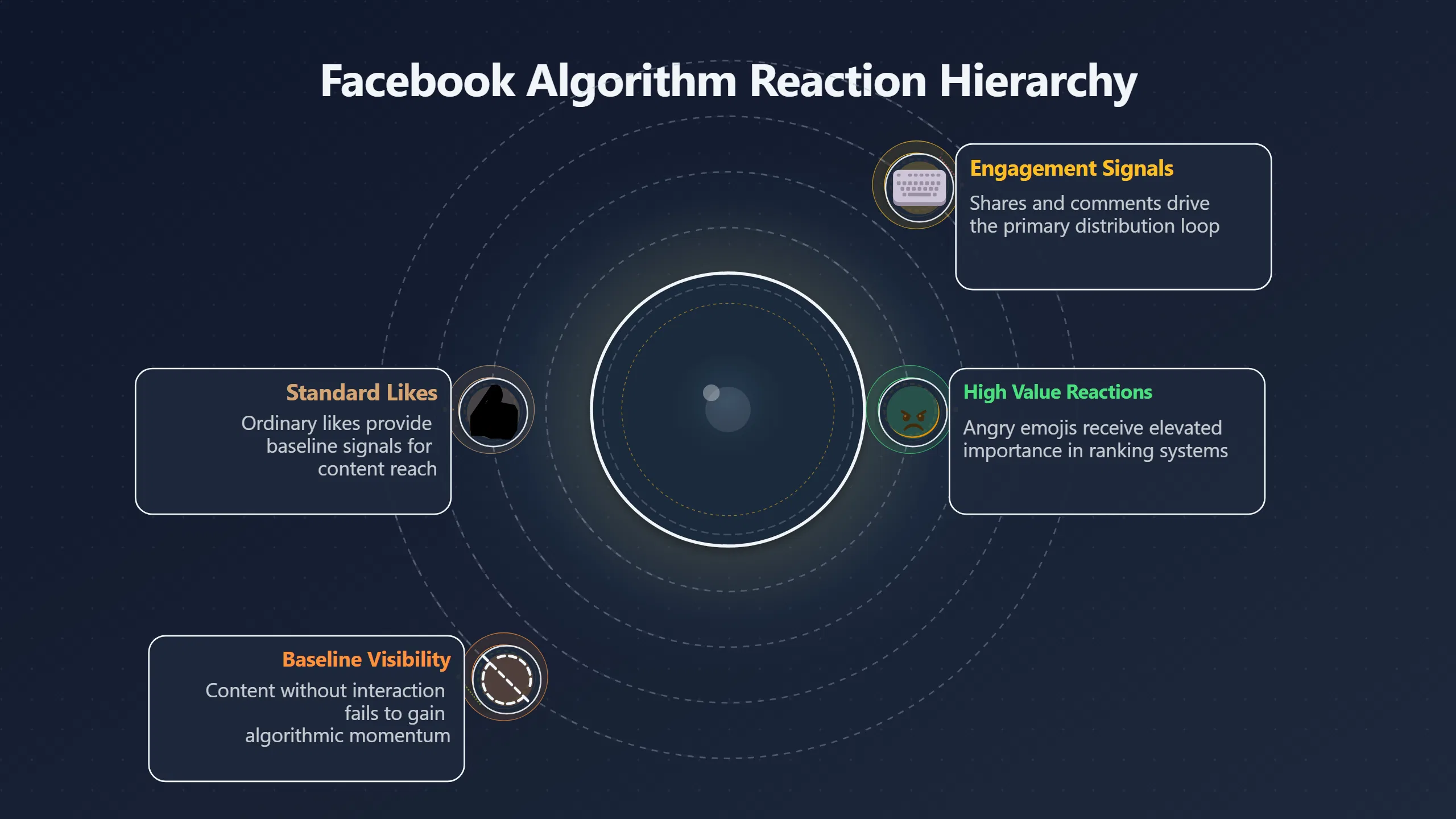
Internal Facebook documents reported by major news organisations showed that reaction-based signals received elevated importance in parts of the platform’s ranking system. At one stage, reactions such as “angry” carried greater ranking value than ordinary likes. Company researchers reportedly warned that this could favour content associated with misinformation, toxicity and outrage because such material generated strong emotional responses.[Nieman Lab+2The Washington Post]niemanlab.orgNieman LabMore internal documents show how Facebook's algorithm…Oct 26, 2021 — The ranking algorithm treated reactions such as “angry…
The broader lesson is not that every platform deliberately promotes anger. Rather, systems that heavily reward strong reactions can unintentionally create incentives for content creators to produce material that provokes those reactions.
Over time, users and publishers learn what works. If outrage repeatedly earns greater reach, creators may adapt their style accordingly:
- Stronger accusations
- More dramatic framing
- Simpler villains and heroes
- Greater certainty and less nuance
- More emotionally charged language[academic.oup.com]academic.oup.comOUP AcademicEngagement, user satisfaction, and the amplification of…by S Milli · 2025 · Cited by 180 — We found that the engagement-ba…
The result can be a feedback loop in which engagement signals encourage content styles that generate even more engagement.[PMC]pmc.ncbi.nlm.nih.govdesign to amplify moral outrage in online social networks…
How to read a feed shaped by reactions
For critical thinking, the key insight is that visibility is often partly a measure of engagement performance rather than informational quality.
When encountering a highly visible post, it helps to ask:
Why is this appearing in my feed?
It may be attracting reactions rather than providing reliable information.
Are people sharing this because it is true, or because it is shocking?
Those are not the same thing.
Would this claim still seem persuasive without the comments, repost count or viral momentum?
Social proof can make weak claims feel stronger than they are.
Is disagreement being counted as popularity?
Large amounts of criticism can still increase distribution.
Research on accuracy prompts provides an important counterpoint. Studies have found that simply encouraging people to think about whether information is accurate can improve the quality of what they choose to share. This suggests that engagement-driven environments often shift attention away from truthfulness and towards reaction. Reintroducing accuracy as a conscious consideration can partially counter that effect.[Sage Journals+3Nature+3PMC]nature.commisinformation on social media: experimental evidence for a scalable accuracy nudge intervention. Psychol Sci. 31, 770–780 (2020). Articl…
The central risk
The most important point is not that anger is always irrational or that emotional content should never spread. Public outrage can draw attention to genuine problems, injustice or misconduct. The risk arises when ranking systems treat intensity of reaction as a proxy for value.
Because outrage generates comments, shares, corrections and arguments, it often produces the behavioural signals that engagement-based systems are designed to reward. When those signals become the primary route to visibility, feeds can end up favouring content that provokes people over content that informs them. For anyone practising critical thinking in the age of social media and AI, recognising that difference is essential.[OUP Academic+2PubMed]academic.oup.comOUP AcademicEngagement, user satisfaction, and the amplification of…by S Milli · 2025 · Cited by 180 — We found that the engagement-ba…
Amazon book picks
Further Reading
Books and field guides related to Why angry posts keep climbing feeds. Use these as the next step if you want deeper reading beyond the article.
The Attention Merchants
Explains the business logic behind attention capture and engagement optimisation.
Stolen Focus
Helps readers understand the human consequences of engagement-focused environments.
Amusing Ourselves to Death
Provides a broader framework for understanding why emotionally engaging content often dominates public attention.

Chaos Machine
Directly addresses how engagement-driven ranking can elevate outrage and division.
eBay marketplace picks
Marketplace Samples
Example marketplace items related to this page. Use the search link to explore similar finds on eBay.



Endnotes
1.
Source: academic.oup.com
Link:https://academic.oup.com/pnasnexus/article/4/3/pgaf062/8052060
Source snippet
OUP AcademicEngagement, user satisfaction, and the amplification of...by S Milli · 2025 · Cited by 180 — We found that the engagement-ba...
2.
Source: pmc.ncbi.nlm.nih.gov
Link:https://pmc.ncbi.nlm.nih.gov/articles/PMC8363141/
Source snippet
design to amplify moral outrage in online social networks...
3.
Source: pmc.ncbi.nlm.nih.gov
Title: PMCOut-group animosity drives engagement on social media
Link:https://pmc.ncbi.nlm.nih.gov/articles/PMC8256037/
Source snippet
by S Rathje · 2021 · Cited by 914 — We report evidence that posts about political opponents are substantially more likely to be shared...
4.
Source: academic.oup.com
Link:https://academic.oup.com/pnasnexus/advance-article/doi/10.1093/pnasnexus/pgaf062/8052060
Source snippet
OUP AcademicEngagement, user satisfaction, and the amplification of...by S Milli · 2025 · Cited by 138 — Twitter's engagement-based rank...
5.
Source: nature.com
Link:https://www.nature.com/articles/s41586-021-03344-2
Source snippet
misinformation on social media: experimental evidence for a scalable [accuracy nudge]({{ 'accuracy-nudge/' | relative_url }}) intervention. Psychol Sci. 31, 770–780 (2020). Articl...
6.
Source: pmc.ncbi.nlm.nih.gov
Title: PMCNudging Social Media toward Accuracy
Link:https://pmc.ncbi.nlm.nih.gov/articles/PMC9082967/
Source snippet
[2021], who find no relationship between cognitive reflection and fake news sharing on...Read more...
7.
Source: nature.com
Link:https://www.nature.com/articles/s41562-025-02205-6
Source snippet
Following news on social media boosts knowledge, belief...by S Altay · 2025 · Cited by 25 — These trends may exacerbate polarization, ra...
8.
Source: facebook.com
Link:https://www.facebook.com/
Source snippet
log in or sign upCreate an account or log into Facebook. Connect with friends, family and other people you know. Share photos...
9.
Source: facebook.com
Link:https://www.facebook.com/?locale=en_GB
Source snippet
log in or sign upCreate an account or log in to Facebook. Connect with friends, family and other people you know. Share photos...
10.
Source: facebook.com
Link:https://www.facebook.com/Prof.Yuval.Noah.Harari/posts/social-media-algorithms-quickly-learned-how-to-drive-engagement-hate-fear-and-an/1486183576197817/
Source snippet
nd shares - especially posts that trigger anger and outrage...
11.
Source: academic.oup.com
Link:https://academic.oup.com/jcmc/article/30/4/zmaf009/8173297
Source snippet
cross-national examination of the effects of accuracy nudges...by M Chan · 2025 · Cited by 9 — The belief in and spread of misinformatio...
12.
Source: nature.com
Link:https://www.nature.com/nature-index/topics/l4/psychological-mechanisms-of-misinformation-sharing-on-social-media
Source snippet
Misinformation on Social Media: Experimental Evidence for a Scalable Accuracy-Nudge Intervention. Psychological Science (2020). The Psych...
13.
Source: nature.com
Link:https://www.nature.com/articles/s41467-022-30073-5
Source snippet
Accuracy prompts are a replicable and generalizable...by G Pennycook · 2022 · Cited by 364 — Interventions that shift users attention to...
14.
Source: pnas.org
Link:https://www.pnas.org/doi/abs/10.1093/pnasnexus/pgaf062
Source snippet
engagement-based ranking algorithm amplifies emotionally charged, out-group hostile content that users say makes them feel worse about th...
15.
Source: pubmed.ncbi.nlm.nih.gov
Link:https://pubmed.ncbi.nlm.nih.gov/40070432/
Source snippet
nih.govEngagement, user satisfaction, and the amplification of...by S Milli · 2025 · Cited by 180 — Twitter's engagement-based ranking a...
16.
Source: niemanlab.org
Link:https://www.niemanlab.org/2021/10/more-internal-documents-show-how-facebooks-algorithm-prioritized-anger-and-posts-that-triggered-it/
Source snippet
Nieman LabMore internal documents show how Facebook's algorithm...Oct 26, 2021 — The ranking algorithm treated reactions such as “angry...
17.
Source: washingtonpost.com
Title: facebook angry emoji algorithm
Link:https://www.washingtonpost.com/technology/2021/10/26/facebook-angry-emoji-algorithm/
Source snippet
Facebook's formula fostered rage and misinformation. Facebook engineers gave extra value to emoji reactions, including 'angry,' pushing more...
18.
Source: journals.sagepub.com
Link:https://journals.sagepub.com/doi/abs/10.1177/00027162221092342
Source snippet
Nature, 1–...
6
- Available from https://doi.org/10.1038/s41586-021-03344-2…Read more
19.
Source: pmc.ncbi.nlm.nih.gov
Link:https://pmc.ncbi.nlm.nih.gov/articles/PMC8277334/
Source snippet
by D Pócs · 2021 · Cited by 31 — This research aimed at understanding how Facebook users' interactions correlate with organic reach an...
Additional References
20.
Source: researchgate.net
Link:https://www.researchgate.net/publication/389590032_Engagement_user_satisfaction_and_the_amplification_of_divisive_content_on_social_media
Source snippet
(PDF) Engagement, user satisfaction, and the amplification...28 Mar 2026 — Experimental research indicates that engagement-based algorit...
21.
Source: merriam-webster.com
Link:https://www.merriam-webster.com/dictionary/accuracy
Source snippet
ACCURACY Definition & Meaning4 days ago — The meaning of <b>ACCURACY</b> is freedom from mistake or error: correctness. degree of confor...
22.
Source: medium.com
Link:https://medium.com/%40blazecurrie/the-algorithm-of-outrage-e4795d444684
Source snippet
The Algorithm of OutrageHow social media brings out the worst in us. · The Machine Measures Attention; Anger Gets the Most Attention · Ou...
23.
Source: en.wiktionary.org
Link:https://en.wiktionary.org/wiki/accuracy
Source snippet
+ -cy Pronunciation edit (Received Pronunciation) A Vocabulary of the Common Errors of Speech [1]...
24.
Source: news.tulane.edu
Title: A new Tulane University study explains why politically charged
Link:https://news.tulane.edu/pr/rage-clicks-study-shows-how-political-outrage-fuels-social-media-engagement
Source snippet
clicks: Study shows how political outrage fuels social...Oct 9, 2024 — Rage clicks: Study shows how political outrage fuels social media...
25.
Source: semanticscholar.org
Link:https://www.semanticscholar.org/paper/de681ff508f2aadc5dca158d1f9da1b74c527c11
Source snippet
ngagement-based ranking algorithm amplifies emotionally charged, out-group hostile...Read more...
26.
Source: knightcolumbia.org
Link:https://knightcolumbia.org/content/engagement-user-satisfaction-and-the-amplification-of-divisive-content-on-social-media
Source snippet
hm tends to amplify emotionally charged content, particularly that which expresses anger and...
27.
Source: news.cornell.edu
Title: accuracy nudges decrease misinformation sharing left right
Link:https://news.cornell.edu/stories/2024/04/accuracy-nudges-decrease-misinformation-sharing-left-right
Source snippet
Cornell ChronicleAccuracy 'nudges' decrease misinformation-sharing on left, rightApr 4, 2024 — They found that “nudges” regarding the imp...
28.
Source: peasec.de
Title: Mitigating Misinformation Sharing on Social Media through
Link:https://www.peasec.de/paper/2025/2025_BiselliHartwigReuter_PersonalisedNudges_CSCW.pdf
Source snippet
nudge presentation has the potential to reduce the sharing of misinformation on social media. All experimental and control groups taken t...
29.
Source: thedailytexan.com
Title: the outrage algorithm social media benefits from division
Link:https://thedailytexan.com/2025/04/01/the-outrage-algorithm-social-media-benefits-from-division/
Source snippet
The outrage algorithm: Social media benefits from division1 Apr 2025 — Social media platforms are designed to maximize engagement, and st...
Topic Tree