Within Mixed Feeds
When influencers become accidental news sources
Many people get news from influencers because it appears in entertainment spaces, not because they deliberately chose that source.
On this page
- Why accidental exposure changes the trust setting
- How expertise, personality and sponsorship blur together
- Questions to ask before treating a creator as a news source
Page outline Jump by section
Introduction
Many people do not consciously decide that a social media creator will become one of their news sources. Instead, news reaches them through entertainment feeds, lifestyle videos, gaming streams, podcasts, comedy clips, and personality-driven content. Trust often develops before audiences realise they are making a judgement about news at all.
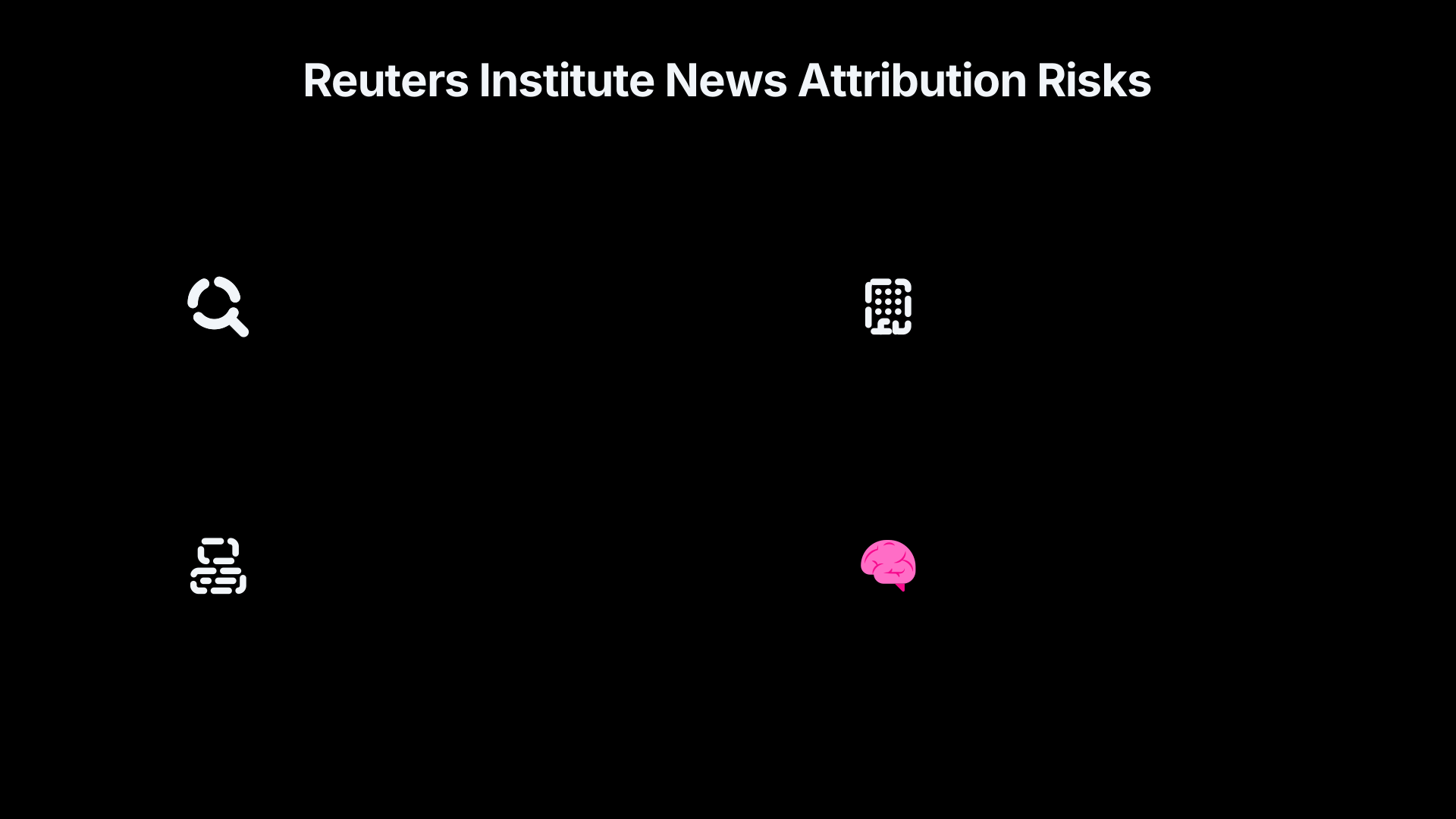 This matters because the cues that normally help people evaluate journalism—editorial standards, corrections policies, sourcing practices, and institutional accountability—are less visible in creator-led environments. As social feeds increasingly mix entertainment and current affairs, audiences may extend trust built in one context to information delivered in another. Research from the Reuters Institute shows that social and search environments weaken people’s ability to remember who originally produced a news story, making source evaluation harder at exactly the moment it becomes most important.[reutersinstitute.politics.ox.ac.uk]reutersinstitute.politics.ox.ac.uka news brand if they accessed it directly rather than via search or social.Read more…
Why accidental exposure changes the trust setting
In traditional news consumption, people usually enter a deliberate information-seeking mode. They open a newspaper, visit a news website, watch a bulletin, or search for information about a specific event. The act itself signals that evaluation and verification matter.
Social media works differently. Users often arrive looking for entertainment, social connection, humour, or relaxation. News appears alongside everything else. A creator discussing a political development may be encountered immediately after a cooking tutorial or football highlight reel. The audience has not necessarily switched into a more sceptical or analytical mindset.
This creates what might be called accidental trust transfer. People already familiar with a creator’s personality may unconsciously apply that familiarity to claims about current events. The creator feels known, even though the audience has little information about how they gathered or verified the information being presented.
Research on news attribution suggests that distributed social environments weaken awareness of original sources. Users are significantly less likely to correctly identify where information came from when they encounter it through social feeds rather than directly from news organisations.[reutersinstitute.politics.ox.ac.uk]reutersinstitute.politics.ox.ac.uka news brand if they accessed it directly rather than via search or social.Read more…
The result is a subtle shift in the question being asked. Instead of “Do I trust this reporting?” people may find themselves asking “Do I trust this person?”
Familiarity can look like expertise
One reason accidental trust develops is that repeated exposure creates a feeling of reliability.
Psychologists and media researchers describe parasocial relationships as one-sided relationships in which audiences feel connected to public figures they regularly watch. Social platforms intensify these effects because creators share personal stories, respond to comments, reveal aspects of their daily lives, and cultivate a sense of intimacy.[DIVA Portal]diva-portal.orgDIVA PortalParasocial Relationships & its Influence on Followersby P Ohlin · 2025 · Cited by 1 — The concept has provided a framework for…
That familiarity can be valuable. Many creators explain complex issues accessibly and help audiences engage with topics they might otherwise ignore. The difficulty arises when familiarity becomes a substitute for evidence.
Studies examining influencer credibility repeatedly find that perceived authenticity and parasocial relationships increase trust and acceptance of information. Followers often interpret relatability and openness as signals of trustworthiness.[ResearchGate+2Sage Journals]researchgate.netTrust, Authenticity, and Parasocial Interaction in Influencer…12 Jan 2026 — This study examines the roles of trust, authen…
Yet being trustworthy in one area does not automatically create expertise in another. A creator may be knowledgeable about fitness, technology, fashion, finance, gaming, or culture while having little training in journalism, source verification, statistics, public policy, or scientific interpretation.
Because social feeds reward confident presentation, the distinction between confidence and expertise can become difficult to see.
How expertise, personality and sponsorship blur together
Professional journalism separates several roles that are often merged in creator content.
A news organisation may distinguish between reporting, opinion, advertising, sponsorship, commentary, and personal reflection. Creator content frequently combines all of these elements within a single video or post.
A creator might:
- Explain a news event.[youtube.com]youtube.comMapping news creators and influencers: online launch eventThe most comprehensive international study yet of news creators across 24 count…
- Offer a personal reaction.
- Promote a sponsor.
- Share anecdotal experience.
- Recommend a product.
- Interpret new information.
All within a few minutes.
For audiences, this blending can make it difficult to determine which claims are based on reporting, which are personal interpretations, and which may be influenced by commercial incentives.
Research on influencer commercialisation shows that trust, sponsorship disclosures, authenticity, and audience relationships are closely connected. Audiences often evaluate content through the creator relationship rather than through the evidence supporting specific claims.[Taylor & Francis Online]tandfonline.comTaylor & Francis OnlineCommercialization of influencer content on social mediaby WM Lim · 2025 · Cited by 12 — This study provides valuab…
The problem is not necessarily deception. Many creators act in good faith. The challenge is transparency. Journalistic processes are often visible and institutionalised. Creator verification practices may be informal, inconsistent, or largely invisible to viewers.
UNESCO has warned that many creators receive little training in fact-checking and that significant numbers do not consistently verify information before sharing it. Its research also found uneven understanding of journalistic standards and sponsorship disclosure practices among creators.[The Guardian]theguardian.comAccording to a survey by Unesco, two-thirds of content creators do not verify the accuracy of their information before sharing, leaving b…
The platform rewards the messenger
Another reason accidental trust emerges is that social platforms are built around people rather than institutions.
Users follow personalities. Algorithms learn which creators hold attention. Recommendations often prioritise engagement rather than demonstrated expertise.
As a result, audiences may encounter the same creator repeatedly across different topics. The creator becomes a stable reference point in an otherwise chaotic information environment.
This can be psychologically appealing. A familiar guide is easier to follow than a constantly changing collection of reporters, experts, and publications. Research on influencer relationships suggests that credibility, perceived authenticity, and emotional connection help explain why audiences continue returning to particular creators.[Sage Journals+2ResearchGate]journals.sagepub.comSage JournalsIncreasing Social Media Stickiness Through Parasocial…by VC Vu · 2025 · Cited by 25 — Social media influencers (SMIs) pre…
The risk is that audiences may evaluate claims through identity and familiarity rather than through sourcing and evidence. When a creator covers a topic outside their area of competence, followers may not adjust their trust level accordingly.
Questions to ask before treating a creator as a news source
The goal is not to dismiss creators. Some produce valuable original reporting, conduct interviews, explain complex issues effectively, and bring attention to underreported stories. The more useful question is whether the creator is functioning as a reliable news source in a particular instance.
Before relying on information from a creator, ask:
Where did this information originate?
Can the creator point to documents, interviews, official records, data, or original reporting?
What evidence is being shown?
Are viewers being asked to trust the creator’s confidence, or are they being shown verifiable support?
What expertise is relevant here?
Does the creator have demonstrated knowledge of the topic, or are they primarily known for something unrelated?
What incentives are present?
Could sponsorships, audience expectations, political identity, or platform engagement rewards influence presentation?
Would the claim survive without the personality?
If the same information came from an unfamiliar account, would it still appear convincing?
Can the information be confirmed elsewhere?
Do independent news organisations, subject experts, or primary sources support the claim?
These questions help shift attention away from the creator and back toward the information itself.
Why accidental trust matters in the age of AI and social media
As social feeds become the main gateway to news for many people, the distinction between “person I follow” and “source I trust” becomes increasingly blurred. Research shows that news creators and influencers now play a significant role in how audiences encounter current affairs across many countries.[reutersinstitute.politics.ox.ac.uk]reutersinstitute.politics.ox.ac.ukmapping news creators and influencers social and video networksMapping news creators and influencers in social and video…28 Oct 2025 — In this report we aim to show how the trend towards online and…
The central challenge is not that creators discuss the news. It is that trust can be inherited from entertainment, familiarity, humour, attractiveness, lifestyle advice, or personal connection rather than earned through transparent evidence and verification.
Critical thinking in mixed social feeds therefore requires recognising when a creator has quietly shifted roles. A person who entered the feed as an entertainer, commentator, educator, or lifestyle personality may, without any formal transition, become a news source. The moment that happens is precisely when audiences need to become more attentive to evidence, sourcing, and accountability rather than less.
Amazon book picks
Further Reading
Books and field guides related to When influencers become accidental news sources. Use these as the next step if you want deeper reading beyond the article.
Trust Me I'm Lying
Shows how online attention systems can elevate unreliable information sources.

Chaos Machine
Explains how social media personalities and platform dynamics shape what people treat as news.

The death of expertise
Helps readers assess expertise claims made by influencers and creators.
eBay marketplace picks
Marketplace Samples
Example marketplace items related to this page. Use the search link to explore similar finds on eBay.
Endnotes
1.
Source: reutersinstitute.politics.ox.ac.uk
Link:https://reutersinstitute.politics.ox.ac.uk/our-research/news-brand-attribution-distributed-environments-do-people-know-where-they-get-their
Source snippet
a news brand if they accessed it directly rather than via search or social.Read more...
2.
Source: reutersinstitute.politics.ox.ac.uk
Link:https://reutersinstitute.politics.ox.ac.uk/our-research/i-saw-news-facebook-brand-attribution-when-accessing-news-distributed-environments
Source snippet
cular story when coming from search engines or social media.Read more...
3.
Source: diva-portal.org
Link:https://www.diva-portal.org/smash/get/diva2%3A1934697/FULLTEXT01.pdf
Source snippet
DIVA PortalParasocial Relationships & its Influence on Followersby P Ohlin · 2025 · Cited by 1 — The concept has provided a framework for...
4.
Source: researchgate.net
Link:https://www.researchgate.net/publication/399532593_Trust_Authenticity_and_Parasocial_Interaction_in_Influencer_Marketing_A_Facebook-Instagram_Comparison
Source snippet
Trust, Authenticity, and Parasocial Interaction in Influencer...12 Jan 2026 — This study examines the roles of trust, authen...
5.
Source: researchgate.net
Link:https://www.researchgate.net/publication/352926879_The_effects_of_social_media_influencers%27_self-disclosure_on_behavioral_intentions_The_role_of_source_credibility_parasocial_relationships_and_brand_trust
Source snippet
The effects of social media influencers' self-disclosure on...The effects of social media influencers' self-disclosure on behavioral int...
6.
Source: reutersinstitute.politics.ox.ac.uk
Title: mapping news creators and influencers social and video networks
Link:https://reutersinstitute.politics.ox.ac.uk/news-creators-influencers/2025/mapping-news-creators-and-influencers-social-and-video-networks
Source snippet
Mapping news creators and influencers in social and video...28 Oct 2025 — In this report we aim to show how the trend towards online and...
7.
Source: reutersinstitute.politics.ox.ac.uk
Title: understanding young news audiences time rapid change
Link:https://reutersinstitute.politics.ox.ac.uk/understanding-young-news-audiences-time-rapid-change
Source snippet
Brand Attribution in Distributed Environments: Do People Know Where They Get Their News?Read more...
8.
Source: reutersinstitute.politics.ox.ac.uk
Link:https://reutersinstitute.politics.ox.ac.uk/our-research/brand-and-trust-fragmented-news-environment
Source snippet
more...
9.
Source: reutersinstitute.politics.ox.ac.uk
Link:https://reutersinstitute.politics.ox.ac.uk/sites/default/files/research/files/Brand%2520and%2520trust%2520in%2520a%2520fragmented%2520news%2520environment.pdf
Source snippet
and trust in a fragmented news environmentThe qualitative study explored issues of brand and trust in an increasingly fragmented news env...
10.
Source: reutersinstitute.politics.ox.ac.uk
Title: dnr executive
Link:https://reutersinstitute.politics.ox.ac.uk/digital-news-report/2025/dnr-executive-summary
Source snippet
and key findings of the 2025 Digital News Report17 Jun 2025 — The proportion that say social media are their main source of news, for exa...
11.
Source: researchgate.net
Link:https://www.researchgate.net/publication/387359523_Increasing_Social_Media_Stickiness_Through_Parasocial_Interaction_and_Influencer_Source_Credibility
Source snippet
physical attractiveness, social attractiveness...Read more...
12.
Source: researchgate.net
Link:https://www.researchgate.net/publication/391157239_Influencing_the_news_how_social_media_influencers_affect_news_media_trust
Source snippet
SMI followers reported more trust than non-followers.Read more...
13.
Source: researchgate.net
Link:https://www.researchgate.net/publication/399535883_From_Expertise_to_Trust_How_Parasocial_Relationships_and_Influencer_Popularity_Shape_New_Energy_Vehicle_Purchase_Intention_in_China
Source snippet
From Expertise to Trust: How Parasocial Relationships and...7 Jan 2026 — In this research, influencer expertise and influencer popularit...
14.
Source: journals.sagepub.com
Link:https://journals.sagepub.com/doi/abs/10.1177/1461444818801313
Source snippet
We call this “news brand attribution...Read more...
15.
Source: journals.sagepub.com
Link:https://journals.sagepub.com/doi/10.1177/14614448251373020
Source snippet
Sage JournalsMe, myself, and the influencer: Examining how parasocial...6 Oct 2025 — This study examined how these influencer–follower r...
16.
Source: tandfonline.com
Link:https://www.tandfonline.com/doi/full/10.1080/0965254X.2025.2510384
Source snippet
Taylor & Francis OnlineCommercialization of influencer content on social mediaby WM Lim · 2025 · Cited by 12 — This study provides valuab...
17.
Source: theguardian.com
Link:https://www.theguardian.com/media/2024/nov/26/online-influencers-need-urgent-fact-checking-training-warns-unesco
Source snippet
According to a survey by Unesco, two-thirds of content creators do not verify the accuracy of their information before sharing, leaving b...
18.
Source: journals.sagepub.com
Link:https://journals.sagepub.com/doi/10.1177/14413582241306130
Source snippet
Sage JournalsIncreasing Social Media Stickiness Through Parasocial...by VC Vu · 2025 · Cited by 25 — Social media influencers (SMIs) pre...
19.
Source: journals.sagepub.com
Link:https://journals.sagepub.com/doi/pdf/10.1177/07395329221105507
Source snippet
Legacy news consumption was found to be a predictor of getting news from social media influencers (SMIs) among respondents.Read more...
Additional References
20.
Source: natcen.ac.uk
Link:https://natcen.ac.uk/publications/bsa-42-politics-and-social-media
Source snippet
BSA 42 | Politics and social mediaby J Curtice · Cited by 2 — This report examines whether social media platforms are reshaping political...
21.
Source: papers.ssrn.com
Link:https://papers.ssrn.com/sol3/Delivery.cfm/2c2980fa-8c92-4057-b251-925ce937aa2b-MECA.pdf?abstractid=5857898&mirid=1
Source snippet
Relationships and Source CredibilityThe increasing prominence of social media influencers (SMIs) has transformed how brands cultivate tru...
22.
Source: youtube.com
Link:http://www.youtube.com/watch?v=0d2ALco_9eE
Source snippet
Reuters Institute young people [news influencers]({{ 'news-influencers/' | relative_url }}) digital news report Study: Influencers overtake journalists as news source | ANC ABS-CBN...
23.
Source: youtube.com
Link:https://www.youtube.com/watch?v=u1chBqaGXXc
Source snippet
Mapping news creators and influencers: online launch eventThe most comprehensive international study yet of news creators across 24 count...
24.
Source: frontiersin.org
Link:https://www.frontiersin.org/journals/communication/articles/10.3389/fcomm.2026.1723759/full
Source snippet
arasocial relationship and purchase intention in a high-engagement digital context, while...Read more...
25.
Source: researchportal.hw.ac.uk
Title: parasocial relationship in relation to the impact of social media
Link:https://researchportal.hw.ac.uk/en/publications/parasocial-relationship-in-relation-to-the-impact-of-social-media/
Source snippet
Relationship in relation to the Impact of Social...by S Samadi · 2025 · Cited by 6 — This study aimed to explore the ways in which xenoc...
26.
Source: cmpf.eui.eu
Title: influencers as news creators implications for media regulation
Link:https://cmpf.eui.eu/influencers-as-news-creators-implications-for-media-regulation/
Source snippet
as news creators: implications for media regulation1 Nov 2025 — Influencers as news creators, what are the implications for media regulat...
27.
Source: youtube.com
Title: Building relationship and trust on Tik Tok
Link:http://www.youtube.com/watch?v=bY3VyqwlpFM
Source snippet
Everything You Need to Know About How People Get their NEWS Today: Trends and Huge Shifts Underway...
28.
Source: observatory.tec.mx
Title: the impact of influencers on misinformation
Link:https://observatory.tec.mx/edu-news/the-impact-of-influencers-on-misinformation/
Source snippet
Impact of Influencers on Misinformation10 Feb 2025 — Many content creators do not verify the information they share, affecting their foll...
29.
Source: linkedin.com
Link:https://www.linkedin.com/posts/reutersinstitute_how-can-news-brands-respond-to-the-increasing-activity-7420456107489316864-90Ik
Source snippet
ding to the 2024 Reuters Digital News Report). So how...Read more...
Topic Tree