Within Own Research
What Would Make This Claim Weaker?
A claim becomes stronger when it survives the best counterevidence, not when a reader only finds supporting links.
On this page
- Turning a claim into a testable question
- Finding the strongest counterevidence
- Separating uncertainty from motivated dismissal
Page outline Jump by section
Introduction
A claim becomes more credible when it survives serious attempts to disprove it. In an online environment filled with social media posts, persuasive videos, search-engine results and AI-generated summaries, the biggest research mistake is often not a lack of information but a lack of challenge. People can easily gather supporting material for almost any position. The harder and more useful task is to ask: What evidence would make me less confident that this claim is true?
 Testing a claim against opposing evidence is the practical antidote to cherry-picking. Instead of treating research as a hunt for agreement, it treats research as a stress test. This approach reflects a long tradition in science, journalism and fact-checking: strong ideas are expected to withstand scrutiny, while weak ones often depend on ignoring or dismissing contradictory evidence.[Wikipedia]WikipediaConfirmation biasConfirmation bias
Turning a Claim Into a Testable Question
Many online claims are framed in ways that make them difficult to challenge. They are often vague, emotionally loaded or so broad that any supporting example appears to count as proof.
A better approach is to rewrite the claim into a question that could, in principle, have different answers.
Consider the difference:
- “This policy is a disaster.”
- “Did this policy improve or worsen the outcomes it was intended to affect?”
Or:
- “AI is destroying education.”
- “What measurable effects has AI use had on student learning, and what evidence points in different directions?”
The second versions force the researcher to identify relevant evidence before deciding on a conclusion.
One useful technique is to write down three items before searching:
- The claim being tested.
- Evidence that would support it.
- Evidence that would weaken it.
If the third box remains empty because nothing is allowed to count against the claim, the exercise has already stopped being research and become defence of a preferred answer.
This principle resembles the logic of falsification in scientific thinking, where a hypothesis gains strength by surviving potential refutation rather than by accumulating only favourable examples.[Statistical Modeling Blog]statmodeling.stat.columbia.eduHow do these two forms of reasoning differ?Read moreStatistical Modeling BlogConfirmationist and falsificationist paradigms of science5 Sept 2014 — In falsificationist reasoning, it is the…
Finding the Strongest Counterevidence
Not all opposing evidence is equally valuable. A common mistake is to select weak criticism, defeat it easily, and then declare the original claim validated.
The real test is to seek the strongest challenge available.
Look for the Best Critics, Not the Loudest Ones
Suppose a social-media post claims that a health intervention, technology or public policy is highly effective.
Rather than searching only for praise, look for:
- Major reviews or meta-analyses.
- Expert critiques from people familiar with the subject.
- Data that failed to replicate earlier findings.
- Investigations from reputable organisations.
- Evidence from places where the claim should have worked but did not.
Strong counterevidence is often more informative than additional supporting anecdotes because it identifies conditions under which the claim may fail.
Search Against Your Own Position
Search wording matters. A person who searches only:
- “Evidence that policy X works”
- “Proof that claim Y is true”
is likely to receive a different information environment than someone who also searches:
- “Criticism of policy X”
- “Evidence against claim Y”
- “What do experts disagree about regarding Y?”
Research on confirmation bias shows that people naturally gravitate towards information that fits existing expectations, often without realising they are doing so.[Encyclopedia Britannica]britannica.comconfirmation biasEncyclopedia BritannicaConfirmation bias | Definition, Examples, Psychology, & FactsMar 30, 2026 — Confirmation bias, people's tendency t…
A practical rule is to spend at least as much effort reading the strongest opposing case as the strongest supporting case.
Trace Claims Beyond the Original Source
Professional fact-checkers often use a method known as lateral reading. Instead of staying on the original page and evaluating its appearance, they leave the page, open new tabs and investigate what other reliable sources say about the claim, source or evidence.[SSRN+2ResearchGate]papers.ssrn.comReading Less and Learning More When Evaluating Digital…by S Wineburg · 2019 · Cited by 79 — Fact checkers read laterally, leaving…
This is especially important on social media because presentation can create an illusion of credibility. A polished video, confident thread or AI-generated explanation may appear convincing even when the underlying evidence is weak.
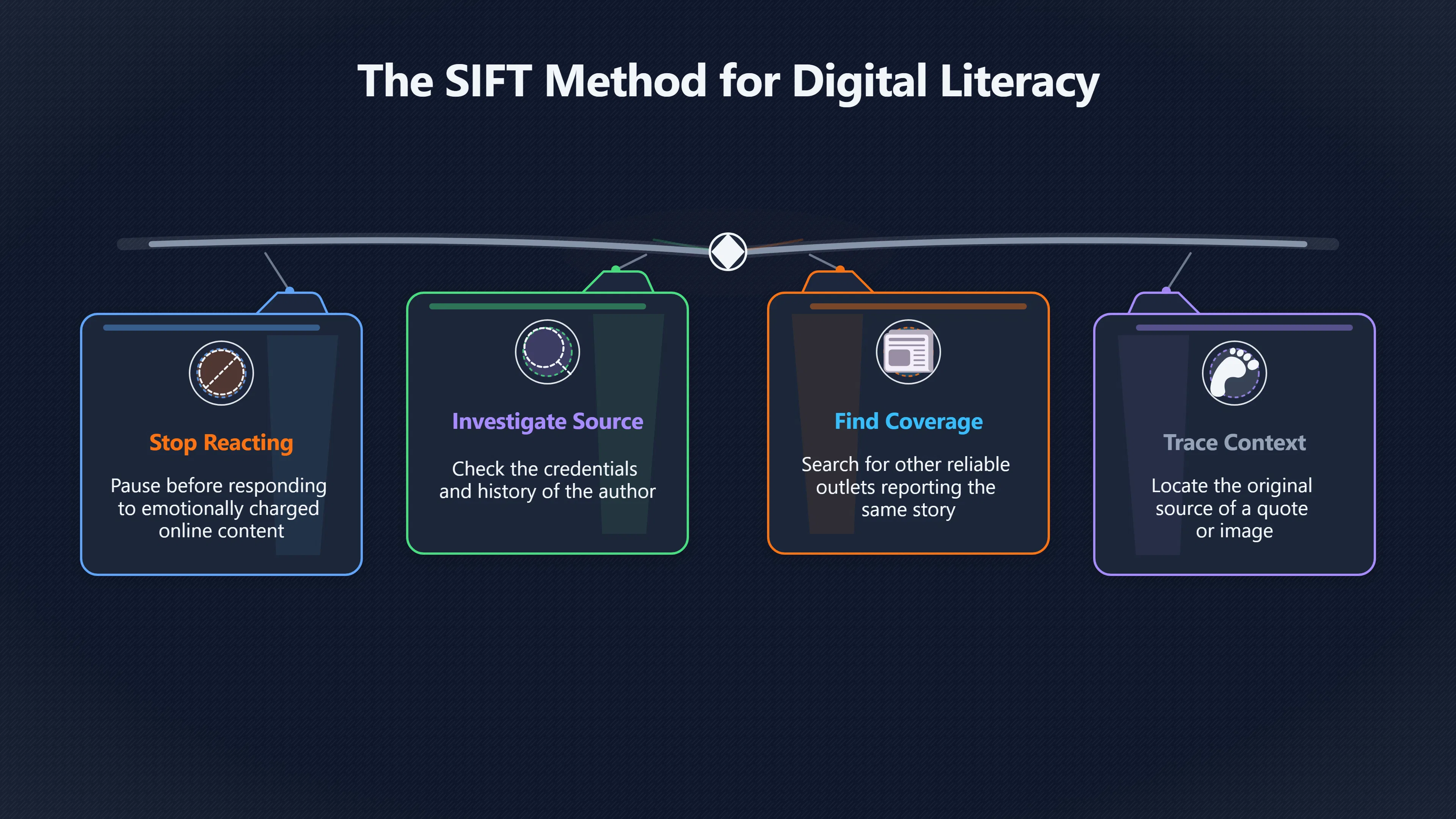
The SIFT approach developed by digital literacy researcher Mike Caulfield encourages readers to:
- Stop before reacting. * Investigate the source.[hapgood.us]hapgood.usSIFT (The Four MovesSIFT (The Four Moves) - Hapgood19 Jun 2019 — We call the “things to do” moves and there are four of them: The four moves: Stop, In… * Find better coverage.[hapgood.us]hapgood.usSIFT (The Four MovesSIFT (The Four Moves) - Hapgood19 Jun 2019 — We call the “things to do” moves and there are four of them: The four moves: Stop, In…
- Trace claims to their original context.[Hapgood+2University of Chicago Library Guides]hapgood.usSIFT (The Four MovesSIFT (The Four Moves) - Hapgood19 Jun 2019 — We call the “things to do” moves and there are four of them: The four moves: Stop, In…
These steps help separate the evidence itself from the way it is being presented.
What Counts as Genuine Counterevidence?
People often claim to have considered opposing views when they have only encountered disagreement.
A useful distinction is between opposition and counterevidence.
Counterevidence is information that, if true, should reduce confidence in the claim.
Examples include:
- Reliable data showing the predicted effect failed to occur.
- Evidence that an alternative explanation better fits the facts.
- Findings that cannot be reconciled with the claim’s predictions.
- Repeated failures to reproduce a supposedly robust result.
By contrast, insults, partisan talking points and unsupported opinions are not meaningful counterevidence even when they come from the opposite side of a debate.
The goal is not to collect disagreement. The goal is to identify facts that create genuine pressure on the claim.
Separating Uncertainty From Motivated Dismissal
One of the easiest ways to protect a favoured belief is to apply different standards to different evidence.
Supporting evidence may be accepted quickly:
“That sounds right.”
Contradictory evidence may face endless scrutiny:
“Maybe the study is flawed.” “Perhaps the data were manipulated.” “The source could be biased.”
Sometimes those concerns are justified. The problem arises when the standards change depending on whether the evidence supports or challenges the preferred conclusion.
Research on motivated reasoning has repeatedly found that people often evaluate supporting and opposing information differently, scrutinising unwelcome evidence more aggressively while accepting congenial evidence with less effort.[Frank Baumgartner+2Wikipedia]fbaum.unc.eduAJPS 2006 TaberFrank BaumgartnerMotivated Skepticism in the Evaluation of Political Beliefs…by CS Taber · 2006 · Cited by 6073 — When reading pro and…
A useful self-check is to ask:
- Would I accept this evidence if it supported my position?
- Would I reject it if it supported the other side?
- Am I applying the same standard in both directions?
Consistent standards do not eliminate bias, but they make it easier to detect.
When Opposing Evidence Does Not Completely Refute a Claim
Many real-world questions are not settled by a single decisive piece of evidence.
A claim can survive some criticism while becoming weaker. It can remain plausible while requiring revision. It can be partly true rather than entirely true.
This is where many online debates go wrong. Participants often treat every challenge as requiring total surrender or total victory.
A more realistic approach is to adjust confidence gradually.
For example:
- Strong supporting evidence and weak counterevidence may justify high confidence.
- Mixed evidence may justify moderate confidence.
- Serious unresolved contradictions may justify caution.
- Repeated failures under testing may justify rejection.
Critical thinking is often less about choosing between certainty and disbelief than about deciding how confident the available evidence allows you to be.
AI Tools and the Risk of Synthetic Confirmation
AI systems can make confirmation bias feel more productive because they can rapidly generate arguments, summaries and evidence lists supporting almost any position.
This creates a new research hazard: receiving large amounts of coherent text that appears balanced but is actually built around the user’s framing.
Recent research has found that language models can exhibit confirmation-style behaviour during hypothesis testing, favouring examples that support a current idea rather than seeking disconfirming cases. Researchers also found that prompting models to consider counterexamples reduced this tendency.[arXiv]arxiv.orgFailing to Falsify: Evaluating and Mitigating Confirmation Bias in Language ModelsApril 2, 2026…
When using AI for research, it is often helpful to ask:
- “What is the strongest evidence against this claim?”
- “What would a knowledgeable critic say?”
- “What findings would weaken this conclusion?”
- “Which assumptions am I taking for granted?”
The value comes not from treating the AI as a judge, but from using it to generate alternative hypotheses that can then be checked against independent sources.
A Simple Stress-Test for Any Claim
Before accepting a conclusion reached through personal research, run it through four questions:
- What evidence would make me less confident in this claim?
- Have I actively searched for that evidence?
- Did I seek the strongest opposing case rather than a weak version of it?
- Am I applying the same standards to evidence on both sides?
A claim that survives those tests deserves more confidence than one supported only by a pile of agreeable links. In the age of social media and AI, the quality of research is measured less by how much supporting material you can find and more by whether your preferred conclusion can withstand its best critics.
Amazon book picks
Further Reading
Books and field guides related to What Would Make This Claim Weaker?. Use these as the next step if you want deeper reading beyond the article.

Scout Mindset
First published 2021. Subjects: Economics, Psychology, Cognition, Skepticism, Critical thinking.
eBay marketplace picks
Marketplace Samples
Example marketplace items related to this page. Use the search link to explore similar finds on eBay.



Endnotes
1.
Source: Wikipedia
Title: Confirmation bias
Link:https://en.wikipedia.org/wiki/Confirmation_bias
2.
Source: britannica.com
Title: confirmation bias
Link:https://www.britannica.com/science/confirmation-bias
Source snippet
Encyclopedia BritannicaConfirmation bias | Definition, Examples, Psychology, & FactsMar 30, 2026 — Confirmation bias, people's tendency t...
3.
Source: papers.ssrn.com
Link:https://papers.ssrn.com/sol3/papers.cfm?abstract_id=3048994
Source snippet
Reading Less and Learning More When Evaluating Digital...by S Wineburg · 2019 · Cited by 79 — Fact checkers read laterally, leaving...
4.
Source: researchgate.net
Link:https://www.researchgate.net/publication/349535570_Lateral_reading_College_students_learn_to_critically_evaluate_internet_sources_in_an_online_course
Source snippet
(PDF) Lateral reading: College students learn to critically...It involves evaluating the credibility of information read online by movin...
5.
Source: hapgood.us
Title: SIFT (The Four Moves)
Link:https://hapgood.us/2019/06/19/sift-the-four-moves/
Source snippet
SIFT (The Four Moves) - Hapgood19 Jun 2019 — We call the “things to do” moves and there are four of them: The four moves: Stop, In...
6.
Source: Wikipedia
Title: Motivated reasoning
Link:https://en.wikipedia.org/wiki/Motivated_reasoning
Source snippet
Motivated reasoningMotivated reasoning is the mental process through which individuals access, construct, and evaluate their beliefs i...
7.
Source: arxiv.org
Link:https://arxiv.org/abs/2604.02485
Source snippet
Failing to Falsify: Evaluating and Mitigating Confirmation Bias in Language ModelsApril 2, 2026...
Published: April 2, 2026
8.
Source: confirmation.com
Link:https://www.confirmation.com/home.aspx
Source snippet
LoginSign in to Confirmation... Forgot User ID/Password?... Don't have an account? Create one now. Thomson Reuters. User...
9.
Source: Wikipedia
Link:https://en.wikipedia.org/wiki/Confirmation
Source snippet
ConfirmationConfirmation is a rite that often includes a profession of faith by an already baptized person. Confirmation is required b...
10.
Source: Wikipedia
Title: Scale invariant feature transform
Link:https://en.wikipedia.org/wiki/Scale-invariant_feature_transform
Source snippet
Scale-invariant feature transformThe scale-invariant feature transform (SIFT) is a computer vision algorithm to detect, describe, and...
11.
Source: researchgate.net
Link:https://www.researchgate.net/publication/320657723_Lateral_Reading_Reading_Less_and_Learning_More_When_Evaluating_Digital_Information
Source snippet
Reading Less and Learning More When Evaluating Digital...SIFT was influenced by Wineburg and McGrew's (2017) study, which found that pro...
12.
Source: researchgate.net
Link:https://www.researchgate.net/publication/375081144_Using_the_SIFT_strategy_to_enhance_the_Lateral_Reading_skills_of_undergraduate_students_for_detecting_digital_misinformation
Source snippet
The experimental study...Read more...
13.
Source: researchgate.net
Link:https://www.researchgate.net/publication/314116099_Evaluating_Contradicting_and_Confirming_Evidence_A_Study_on_Beliefs_and_Motivated_Reasoning
Source snippet
A Study on Beliefs and Motivated ReasoningMar 1, 2017 — The purpose of this study is to examine ideological, psychological, and demograph...
14.
Source: britannica.com
Link:https://www.britannica.com/topic/confirmation
Source snippet
Confirmation | Definition, Description, History, & SacramentConfirmation, Christian rite by which admission to the church, established pr...
15.
Source: statmodeling.stat.columbia.edu
Title: How do these two forms of reasoning differ?Read more
Link:https://statmodeling.stat.columbia.edu/2014/09/05/confirmationist-falsificationist-paradigms-science/
Source snippet
Statistical Modeling BlogConfirmationist and falsificationist paradigms of science5 Sept 2014 — In falsificationist reasoning, it is the...
16.
Source: scienceofboosting.org
Title: Boosting Lateral Reading
Link:https://www.scienceofboosting.org/project/lateral-reading/
Source snippet
Lateral Reading - Boosting4 May 2023 — Lateral reading is a simple heuristic for online fact-checking: Open multiple tabs in your browser...
Published: May 2023
17.
Source: guides.lib.uchicago.edu
Title: University of Chicago Library Guides The SIFT Method
Link:https://guides.lib.uchicago.edu/c.php?g=1241077&p=9082322
Source snippet
University of Chicago Library GuidesThe SIFT Method - Evaluating Resources and Misinformation30 Jun 2025 — The SIFT method is an evaluati...
18.
Source: fbaum.unc.edu
Title: AJPS 2006 Taber
Link:https://fbaum.unc.edu/teaching/articles/AJPS-2006-Taber.pdf
Source snippet
Frank BaumgartnerMotivated Skepticism in the Evaluation of Political Beliefs...by CS Taber · 2006 · Cited by 6073 — When reading pro and...
19.
Source: wordreference.com
Link:https://www.wordreference.com/enfr/motivated
Source snippet
English-French DictionaryPrincipales traductions. Anglais, Français. motivated adj, (person: enthusiastic, keen) (personne), motivé adj...
20.
Source: linguee.fr
Link:https://www.linguee.fr/anglais-francais/traduction/motivated.html
Source snippet
Traduction françaisemotiver qqch./qqn. v · encourager qqn. · inspirer qqch. · pousser v. Exemples: self-motivated—. motivé · highly moti...
21.
Source: dictionary.cambridge.org
Link:https://dictionary.cambridge.org/dictionary/english/confirmation
Source snippet
English meaning - Cambridge Dictionarya statement, often written, that an arrangement or meeting is certain: a letter of confirmation m...
22.
Source: dictionary.cambridge.org
Link:https://dictionary.cambridge.org/dictionary/english/motivated
Source snippet
English meaning - Cambridge DictionaryMOTIVATED definition: 1. very enthusiastic or determined because you really want to do something...
23.
Source: library.csum.edu
Link:https://library.csum.edu/NAU330/SIFT
Source snippet
330 Meteorology: SIFT Method for Misinformation6 Nov 2025 — The SIFT method is based on recent research on methods used by professional f...
Additional References
24.
Source: merriam-webster.com
Link:https://www.merriam-webster.com/dictionary/confirmation
Source snippet
CONFIRMATION Definition & Meaning4 days ago — 1. an act or process of confirming: such as a (1): a Christian rite conferring the gift of...
25.
Source: merriam-webster.com
Link:https://www.merriam-webster.com/dictionary/motivated
Source snippet
MOTIVATED Definition & Meaning2 days ago —: provided with a motive: having an incentive or a strong desire to do well or succeed in som...
26.
Source: motivatedapp.com
Link:https://motivatedapp.com/
Source snippet
Motivated – Habit TrackerMotivated is a habit tracker app that helps you build good habits and quit bad habits with a streak-free approac...
27.
Source: wordwebonline.com
Link:https://www.wordwebonline.com/en/CONFIRMATION
Source snippet
confirmation, confirmations- WordWeb dictionary definitionNoun: confirmation,kón-fu(r)'mey-shun. Additional proof that something that wa...
28.
Source: ivyshelden.medium.com
Link:https://ivyshelden.medium.com/the-difference-between-feeling-motivated-and-being-motivated-and-why-it-matters-c99105147f02
Source snippet
Difference Between Feeling Motivated and Being...Feeling motivated has to do with your emotions and mood, which naturally fluctuate, eve...
29.
Source: ed.stanford.edu
Title: it doesn t take long learn how spot misinformation online stanford study finds
Link:https://ed.stanford.edu/news/it-doesn-t-take-long-learn-how-spot-misinformation-online-stanford-study-finds
Source snippet
doesn't take long to learn how to spot misinformation online...19 Apr 2022 — Research from the Stanford History Education Group finds th...
30.
Source: youtube.com
Link:https://www.youtube.com/watch?v=SHNprb2hgzU
Source snippet
Sort Fact from Fiction Online with Lateral ReadingThe Facts about Fact Checking: Crash Course... Check Yourself with Lateral Reading: Cr...
31.
Source: do-my-best.tistory.com
Title: SIFT Scale Invariant Feature TRansform를 활용한 이미지 특징 추출 및 매칭 알고리즘
Link:https://do-my-best.tistory.com/entry/SIFT-Scale-Invariant-Feature-TRansform%EB%A5%BC-%ED%99%9C%EC%9A%A9%ED%95%9C-%EC%9D%B4%EB%AF%B8%EC%A7%80-%ED%8A%B9%EC%A7%95-%EC%B6%94%EC%B6%9C-%EB%B0%8F-%EB%A7%A4%EC%B9%AD-%EC%95%8C%EA%B3%A0%EB%A6%AC%EC%A6%98
Source snippet
(Scale-Invariant-Feature TRansform)를 활용한 이미지...Jul 20, 2021 — 크기, 회전, 조도, affine의 변화 및 noise에 불변하는 특징을 추출하는 알고리즘이다. 이는 다음과 같은 절차로 이루어 진다...
32.
Source: philarchive.org
Title: Phil Archive Why Is It So Hard to Change Our Minds?
Link:https://philarchive.org/rec/MATWII-7
Source snippet
Confirmation Bias...by D Matta — Belief revision is often assumed to depend primarily on information quality: individuals change their m...
33.
Source: ultralytics.com
Title: what is the scale invariant feature transform sift
Link:https://www.ultralytics.com/blog/what-is-the-scale-invariant-feature-transform-sift
Source snippet
SIFT Algorithm: How Feature Matching WorksSep 9, 2025 — SIFT is a feature detection and description algorithm that can reliably identify...
Topic Tree