Within AI Tutors
When AI Tutoring Becomes a Shortcut
A chatbot tutor can weaken learning when trust, convenience or quick answers replace struggle, recall and self-correction.
On this page
- What overreliance looks like in study sessions
- Why effort matters for durable learning
- Checks that keep the learner in control
Page outline Jump by section
Introduction
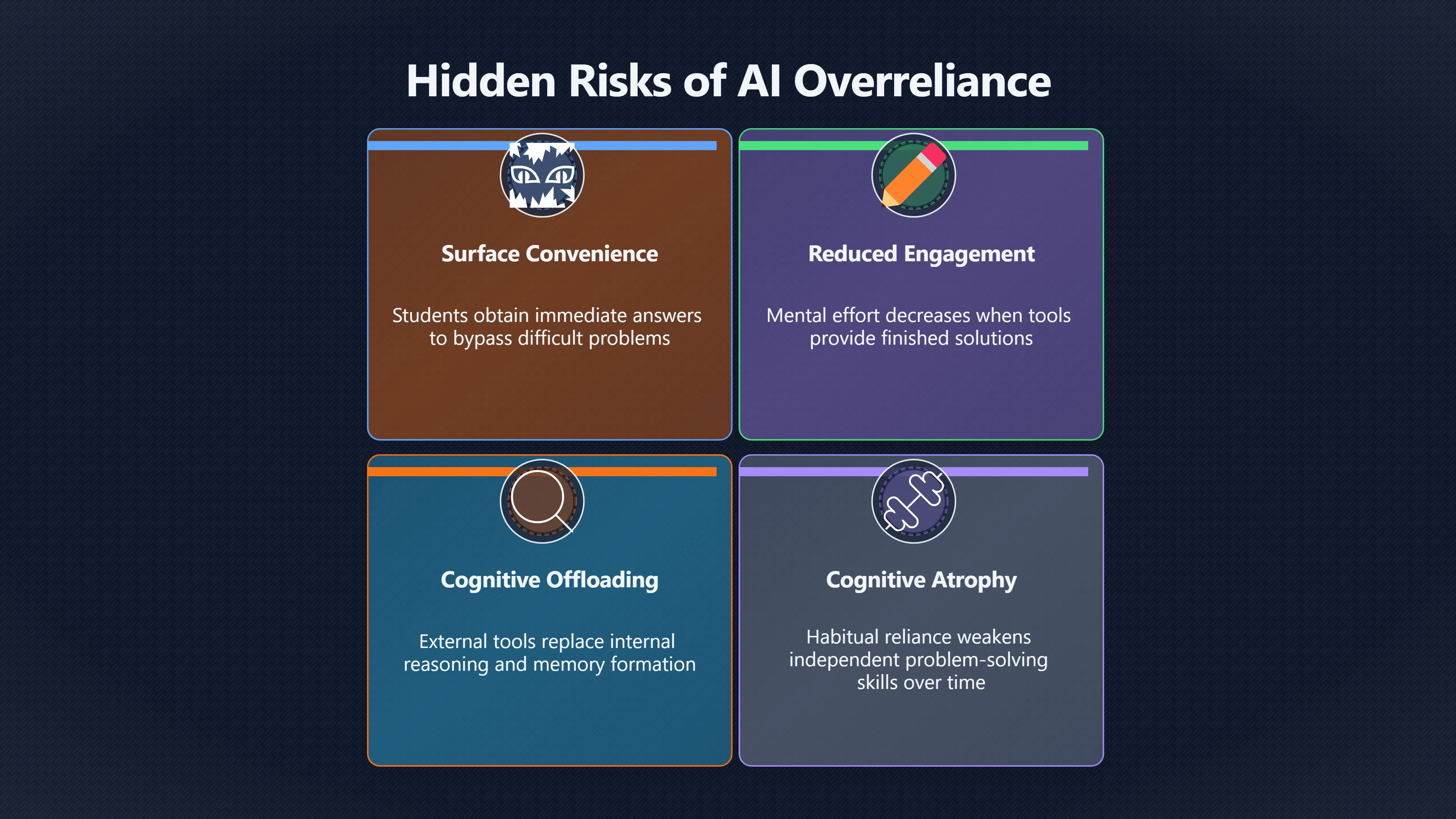
AI tutors can be powerful learning tools, but their value depends heavily on how students use them. When learners use a chatbot to explain difficult concepts, generate practice questions, or provide feedback, it can support understanding and confidence. When they use it to avoid uncertainty, skip problem-solving, or obtain finished answers immediately, the same tool can weaken learning. The central issue is not the presence of AI but the replacement of mental effort with convenience.
 This matters because critical thinking develops through active engagement: recalling information, testing ideas, making mistakes, and correcting them. If students increasingly treat AI tutors as answer machines rather than learning partners, tutoring shifts from a process that strengthens understanding to one that bypasses it. Research increasingly suggests that the difference between beneficial and harmful AI tutoring often lies in whether students remain cognitively engaged during difficult moments.[PMC+2PMC]pmc.ncbi.nlm.nih.govEffects of generative artificial intelligence on cognitive effort…by Y Chen · 2025 · Cited by 26 — A subsequent study has found tha…
What Overreliance Looks Like in Study Sessions
Overreliance rarely begins as deliberate cheating. More often, it develops through small habits that feel efficient.
A student encounters a difficult mathematics problem and asks the chatbot for the solution instead of attempting a method first. Another pastes a reading assignment into an AI tutor and requests a summary rather than working through the text. A third repeatedly asks for model answers and studies those answers instead of generating their own explanations.
These behaviours reduce what educational researchers call cognitive engagement—the mental work involved in understanding and remembering information. Over time, students may become less willing to tolerate confusion or uncertainty because an immediate answer is always available.[PMC+2Springer]pmc.ncbi.nlm.nih.govPMCThe cognitive paradox of AI in educationNIHby B Jose · 2025 · Cited by 212 — The study examines the influence of AI on learning processes and cognitive elements such as co…
Several studies distinguish between productive and unproductive AI use. Students who engage in dialogue, ask for explanations, request hints, and compare alternative solutions often benefit from AI support. By contrast, students who primarily seek direct answers show weaker learning gains because they bypass the reasoning process that builds durable knowledge.[PMC+2VoxDev]pmc.ncbi.nlm.nih.govEffects of generative artificial intelligence on cognitive effort…by Y Chen · 2025 · Cited by 26 — A subsequent study has found tha…
Research on student-AI interactions has also found that reliance patterns can become self-reinforcing. Learners who quickly adopt AI-generated answers may continue doing so even after receiving poor guidance, suggesting that convenience can become a habit rather than a carefully considered choice.[arXiv]arxiv.orgDo Students Rely on AI? Analysis of Student-ChatGPT Conversations from a Field StudyAugust 27, 2025…
Why Effort Matters for Durable Learning
One of the most important findings from cognitive science is that learning is strengthened by effortful retrieval and problem-solving. Information becomes easier to remember when learners actively reconstruct it rather than merely reread or receive it.
This principle helps explain why excessive dependence on AI tutoring can be problematic. If a chatbot supplies answers before students have attempted a task themselves, it may remove the very struggle that supports long-term retention. Educational researchers often refer to this as “productive struggle”—the period when learners wrestle with a problem, experience uncertainty, and gradually develop understanding.[Bellwether]bellwether.orgProductive Struggle: How Artificial Intelligence Is ChangingProductive Struggle: How Artificial Intelligence Is Changing…June 25, 2025 — by AC Kulesa — AI may reduce surface-level barr…
The challenge is that AI can eliminate this struggle almost instantly. A difficult question that might have required ten minutes of thinking can be solved in seconds. While this feels efficient, the learner may remember less because the brain never performed the necessary work. Recent research on cognitive effort and generative AI suggests that learning benefits depend strongly on whether students remain intellectually active during AI-assisted tasks. Deep conversational use can enhance learning, whereas answer-seeking behaviour can reduce it.[PMC]pmc.ncbi.nlm.nih.govEffects of generative artificial intelligence on cognitive effort…by Y Chen · 2025 · Cited by 26 — A subsequent study has found tha…
This pattern resembles a broader phenomenon known as cognitive offloading: transferring mental tasks to an external tool. Offloading can be useful when it frees attention for higher-level thinking, but it becomes harmful when it replaces the thinking itself. In educational settings, overreliance may reduce memory formation, self-regulation, and independent problem-solving skills.[Bera Journals+2Sage Journals]bera-journals.onlinelibrary.wiley.comBera JournalsStudents' use patterns of generative artificial intelligence…26 Feb 2026 — Maladaptive cognitive offloading may further l…
When Trust Becomes a Learning Risk
AI tutors are designed to sound fluent, confident, and helpful. That presentation can encourage students to trust answers without sufficient evaluation.
The danger is not simply factual error. Even accurate answers can weaken learning if students stop questioning them. Critical thinking requires evaluating evidence, identifying assumptions, and considering alternatives. When trust becomes automatic, these habits can fade.
Research examining trust and reliance in educational AI systems has found that high trust does not always lead to better learning. In some studies, students with greater trust were less able to distinguish between correct and incorrect AI recommendations, particularly when they lacked strong AI literacy or motivation to scrutinise answers.[arXiv]arxiv.orgTrust and Reliance on AI in Education: AI Literacy and Need for Cognition as ModeratorsApril 1, 2026…
Student perceptions reflect similar concerns. Surveys have reported that many learners believe AI can make academic work “too easy” and reduce opportunities for original thinking and problem-solving. Notably, these concerns often come from students who use AI regularly rather than from those who avoid it.[The Guardian]theguardian.comThe Guardian Pupils fear AI is eroding their ability to study, research findsWhile 80% of students report regularly using AI tools in their schoolwork, 62% believe these tools negatively affect their learning and s…
Overreliance therefore changes the role of tutoring. Instead of helping students build judgement, the tutor becomes a substitute for judgement. The learner gradually shifts from evaluating ideas to accepting them.

The Difference Between Guidance and Substitution
The strongest evidence for AI tutoring does not show that students learn best when AI does everything. Instead, successful systems tend to guide thinking while keeping learners actively involved.
Studies reporting positive outcomes often use structured tutoring approaches that encourage questioning, reasoning, and explanation rather than simple answer delivery. In a Nigerian trial involving GPT-4-supported learning, students worked under teacher supervision with prompts designed to encourage reasoning. The programme produced learning gains while maintaining student engagement with the material.[VoxDev]voxdev.orgHow AI tutors improved learning in Nigeriaby M De Simone — In an RCT in Nigeria, we tested a six-week after-school programme where…
Similarly, emerging research on Socratic-style educational chatbots focuses on systems that ask questions, challenge assumptions, and encourage reflection rather than immediately providing solutions. These designs attempt to preserve the learner’s intellectual agency.[ai-tools-for-thought.github.io]ai-tools-for-thought.github.ioMaike: Designing a Socratic Educational Chatbot to FosterIn. International Workshop on AI in Education and Educational Research. Springer. 17…Read more…
This distinction is crucial. An AI tutor that provides hints, asks follow-up questions, and encourages explanation can strengthen learning. An AI tutor that routinely supplies complete solutions risks becoming a shortcut around learning itself.
Checks That Keep the Learner in Control
Students do not need to avoid AI tutors to avoid overreliance. The more effective approach is to structure interactions so that thinking remains with the learner.
Useful habits include:
- Attempt the problem before asking the AI for help.
- Request hints or questions rather than complete answers.
- Explain the solution back in your own words after receiving assistance.
- Compare the AI’s reasoning with class materials or trusted sources.
- Delay asking for the answer until you can identify exactly where you are stuck.
- Use the chatbot to generate practice questions instead of solving every question for you.
These practices preserve the benefits of AI tutoring while maintaining the effort needed for learning. They turn the chatbot into a coach rather than a replacement thinker.
Why Overreliance Matters for Critical Thinking
Within the broader challenge of critical thinking in the age of AI, overreliance changes tutoring because it changes who performs the intellectual work. The greatest educational risk is not that AI tutors sometimes make mistakes. It is that students may stop exercising the habits that allow them to recognise mistakes, evaluate evidence, and solve problems independently.
The evidence so far suggests a balanced conclusion. AI tutoring can improve learning, increase access to support, and personalise instruction. Yet those benefits are strongest when students remain active participants. When convenience replaces effort, the tutor becomes less a tool for learning and more a mechanism for avoiding it. In that sense, the future of AI tutoring depends as much on learner behaviour as on the technology itself.[PMC+3Brookings+3Econstor]brookings.eduwhat the research shows about generative ai in tutoringWhat the research shows about generative AI in tutoring27 Jan 2026 — Mary Burns unpacks the evidence of generative AI in tutorin…
eBay marketplace picks
Marketplace Samples
Example marketplace items related to this page. Use the search link to explore similar finds on eBay.




Endnotes
1.
Source: pmc.ncbi.nlm.nih.gov
Link:https://pmc.ncbi.nlm.nih.gov/articles/PMC12255134/
Source snippet
Effects of generative artificial intelligence on cognitive effort...by Y Chen · 2025 · Cited by 26 — A subsequent study has found tha...
2.
Source: pmc.ncbi.nlm.nih.gov
Title: PMCThe cognitive paradox of AI in education
Link:https://pmc.ncbi.nlm.nih.gov/articles/PMC12036037/
Source snippet
NIHby B Jose · 2025 · Cited by 212 — The study examines the influence of AI on learning processes and cognitive elements such as co...
3.
Source: link.springer.com
Link:https://link.springer.com/article/10.1186/s40561-024-00316-7
Source snippet
effects of over-reliance on AI dialogue systems on...by C Zhai · 2024 · Cited by 1970 — This systematic review investigates how students...
4.
Source: voxdev.org
Link:https://voxdev.org/topic/education/how-ai-tutors-improved-learning-nigeria
Source snippet
How AI tutors improved learning in Nigeriaby M De Simone — In an RCT in Nigeria, we tested a six-week after-school programme where...
5.
Source: brookings.edu
Title: what the research shows about generative ai in tutoring
Link:https://www.brookings.edu/articles/what-the-research-shows-about-generative-ai-in-tutoring/
Source snippet
What the research shows about generative AI in tutoring27 Jan 2026 — Mary Burns unpacks the evidence of generative AI in tutorin...
6.
Source: arxiv.org
Link:https://arxiv.org/abs/2508.20244
Source snippet
Do Students Rely on AI? Analysis of Student-ChatGPT Conversations from a Field StudyAugust 27, 2025...
Published: August 27, 2025
7.
Source: bellwether.org
Title: Productive Struggle: How Artificial Intelligence Is Changing
Link:https://bellwether.org/publications/productive-struggle/
Source snippet
Productive Struggle: How Artificial Intelligence Is Changing...June 25, 2025 — by AC Kulesa — AI may reduce surface-level barr...
Published: June 25, 2025
8.
Source: arxiv.org
Link:https://arxiv.org/abs/2604.01114
Source snippet
Trust and Reliance on AI in Education: AI Literacy and Need for Cognition as ModeratorsApril 1, 2026...
Published: April 1, 2026
9.
Source: ai-tools-for-thought.github.io
Title: Maike: Designing a Socratic Educational Chatbot to Foster
Link:https://ai-tools-for-thought.github.io/workshop/documents/chi26/Favero_et_al_Maike_Educational_Chatbot_TfT_CHI26.pdf
Source snippet
In. International Workshop on AI in Education and Educational Research. Springer. 17...Read more...
10.
Source: econstor.eu
Link:https://www.econstor.eu/bitstream/10419/336607/1/557.pdf
Source snippet
AI Tutoring Enhances Student Learning Without Crowding...by M Fischer · 2025 · Cited by 7 — We study how AI tutoring affects learning in...
11.
Source: arxiv.org
Link:https://arxiv.org/html/2510.16019v1
Source snippet
Impact of AI Tools on Learning Outcomes15 Oct 2025 — Students at all levels of education are increasingly relying on generative artificia...
12.
Source: bera-journals.onlinelibrary.wiley.com
Link:https://bera-journals.onlinelibrary.wiley.com/doi/10.1111/bjet.70059?af=R
Source snippet
Bera JournalsStudents' use patterns of generative artificial intelligence...26 Feb 2026 — Maladaptive cognitive offloading may further l...
13.
Source: journals.sagepub.com
Link:https://journals.sagepub.com/doi/10.1177/07319487261439132
Source snippet
Sage JournalsCognitive Offloading in the Age of Generative AIApr 19, 2026 — The emergence of generative artificial intelligence (GenAI) h...
14.
Source: theguardian.com
Title: The Guardian Pupils fear AI is eroding their ability to study, research finds
Link:https://www.theguardian.com/technology/2025/oct/15/pupils-fear-ai-eroding-study-ability-research
Source snippet
While 80% of students report regularly using AI tools in their schoolwork, 62% believe these tools negatively affect their learning and s...
15.
Source: dictionary.cambridge.org
Link:https://dictionary.cambridge.org/dictionary/english-chinese-traditional/cognitive
Source snippet
in Traditional Chinese - Cambridge Dictionaryconnected with thinking or conscious mental processes 感知的;認知的;認識力的 Some of her cognitive fun...
16.
Source: generativeai.net
Link:https://generativeai.net/
Source snippet
ul form of this AI, generating...Read more...
17.
Source: melbourne-cshe.unimelb.edu.au
Title: unimelb.edu.au Cognitive Offloading or Effective Practice?
Link:https://melbourne-cshe.unimelb.edu.au/events/symposia-on-higher-education-research-informed-practice/cognitive-offloading-and-the-future-of-learning
Source snippet
Exploring the...As generative AI tools become embedded in everyday academic practice, they are reshaping how students learn, communicate...
18.
Source: pmc.ncbi.nlm.nih.gov
Link:https://pmc.ncbi.nlm.nih.gov/articles/PMC12179260/
Source snippet
tutoring outperforms in-class active learning - PMC - NIHby G Kestin · 2025 · Cited by 210 — We find that students learn significantly mo...
19.
Source: uts.edu.au
Title: ai cognitive offloading and implications for education
Link:https://www.uts.edu.au/news/2026/03/experts-warn-unstructured-ai-use-in-schools-risks-cognitive-atrophy/contentassets/ai-cognitive-offloading-and-implications-for-education.pdf
Source snippet
It can both counteract — or compound. — non-technological factors that propel learning gaps...Read more...
Additional References
20.
Source: researchgate.net
Link:https://www.researchgate.net/publication/397300205_Overreliance_on_AI_and_Its_Effects_on_Student_Cognition_What_Can_Teachers_and_Students_Do
Source snippet
(PDF) Overreliance on AI and Its Effects on Student Cognition5 Nov 2025 — This study explores the influence of motivation on the cognitiv...
21.
Source: linkedin.com
Link:https://www.linkedin.com/posts/chris-agnew-74bb8217_ai-activity-7331522910970372098-uUQo
22.
Source: linkedin.com
Link:https://www.linkedin.com/pulse/cognitive-offloading-ai-why-educationalists-should-worried-winthrop-w8dgc
Source snippet
Cognitive Offloading with AI: Why Educationalists Should...MIT researcher Nataliya Kosmyna and her colleagues made headlines by releasin...
23.
Source: microsoft.com
Link:https://www.microsoft.com/en-us/research/wp-content/uploads/2025/10/GenAILearningOutcomes_published_2025-12-16.pdf
Source snippet
Learning outcomes with GenAI in the classroomThis report presents a review of recent empirical evidence of generative AI (GenAI) impact o...
24.
Source: hellopraxis.com
Link:https://www.hellopraxis.com/en/praxisnotes/ai-tutors-outperform-traditional-teaching-methods-in-groundbreaking-harvard-study
Source snippet
AI Tutors Outperform Traditional Teaching Methods in...2 Dec 2024 — AI-powered tutoring systems can help students learn more than twice...
25.
Source: linkedin.com
Link:https://www.linkedin.com/posts/aldendorosario_very-interesting-harvard-study-ai-tutoring-activity-7257538337614217218-1nMg
Source snippet
Alden Do Rosario's PostStudents learn more than twice as much in less time with an AI tutor compared to an active learning classroom, whi...
26.
Source: genio.co
Link:https://genio.co/resources/research-and-insights/the-impact-of-ai-on-note-taking-in-higher-education
Source snippet
students who already take fewer notes will rely even more heavily on full automation (Chen...
27.
Source: researchgate.net
Title: (PDF) Do AI tutors empower or enslave learners?
Link:https://www.researchgate.net/publication/393539175_Do_AI_tutors_empower_or_enslave_learners_Toward_a_critical_use_of_AI_in_education
Source snippet
Toward a...This position paper argues that while AI can support learning, its unchecked use may lead to cognitive atrophy, loss of agenc...
28.
Source: emerald.com
Link:https://www.emerald.com/books/edited-volume/17219/chapter/94201706/Impact-of-Critical-Thinking-Approach-on-Learners
Source snippet
cial Intelligence (AI) has been examined in this chapter.Read more...
29.
Source: youtube.com
Title: How AI Could Save (Not Destroy) Education | Sal Khan | TED
Link:http://www.youtube.com/watch?v=hJP5GqnTrNo
Source snippet
AI tutoring overreliance cognitive engagement student learning loss Is AI making us dumber? Maybe. | Charlie Gedeon | TEDxSherbrooke Stre...
Topic Tree