Within Mixed Feeds
Is this reporting or just a reaction?
A feed post may look news-like, but its trust value changes depending on whether it reports facts, argues a view, or reacts to someone else.
On this page
- Visible signs of reporting, commentary, testimony and satire
- Why the same claim feels different as a headline, clip or monologue
- A quick sorting routine before judging accuracy
Page outline Jump by section
Introduction
When a post appears in a social feed, the first question is not “Is this true?” but “What kind of content is this?” A feed can place a reported news story, a columnist’s argument, a witness account, a comedian’s joke and an influencer’s reaction side by side. They may use similar formats, attract similar engagement and even discuss the same event. Yet they deserve different forms of trust and scrutiny.
 This distinction matters because people often struggle to separate factual reporting from opinion. Research by the Pew Research Center found that many people have difficulty correctly identifying whether statements in news-related content are factual claims or opinions, especially when the statements align with their existing views.[Pew Research Center]pewresearch.orgdistinguishing between factual and opinion statements in the newsPew Research CenterDistinguishing between factual and opinion statements inJun 18, 2018 — The politically aware, digitally savvy and thos… In social-first news environments, where information increasingly arrives through platforms rather than directly from news organisations, recognising the type of content has become a core critical-thinking skill.[reutersinstitute.politics.ox.ac.uk]reutersinstitute.politics.ox.ac.ukunderstanding young news audiences time rapid changeUnderstanding young news audiences at a time of rapid…24 Mar 2026 — Based on secondary analysis of Reuters Institute research, we pres…
Is this reporting or just a reaction?
A useful starting point is to ask what the creator is trying to do.
Journalistic reporting primarily aims to tell readers what happened. It gathers information from sources, documents, observations and interviews, then presents verifiable claims. Professional news organisations generally maintain standards around accuracy, corrections, sourcing and separation of reporting from personal views.[mediareform.org.uk]mediareform.org.ukReuters Handbook of Journalism Standards and ValuesEverything we do as Reuters journalists has to be independent, free from bias and exec…
Opinion or commentary aims to persuade, interpret or evaluate. It may use facts, but the central purpose is to advance a viewpoint or explain why events matter. Opinion is not necessarily inaccurate; it simply serves a different function.[Poynter]poynter.orgHow do you sort fact from opinion?What's bias?Dec 11, 2023 — News presents factual information about events, providing objective reporting without the author's opinion, wh…
Reaction content is another category common in social feeds. A creator may respond emotionally to a news event, criticise coverage, speculate about motives or share a personal interpretation. Such content can be informative, but it is usually not original reporting.
A quick test is to remove the speaker’s conclusions and ask: What independently verified information remains? The more a post depends on the creator’s interpretation, the more likely it belongs in the opinion or reaction category.
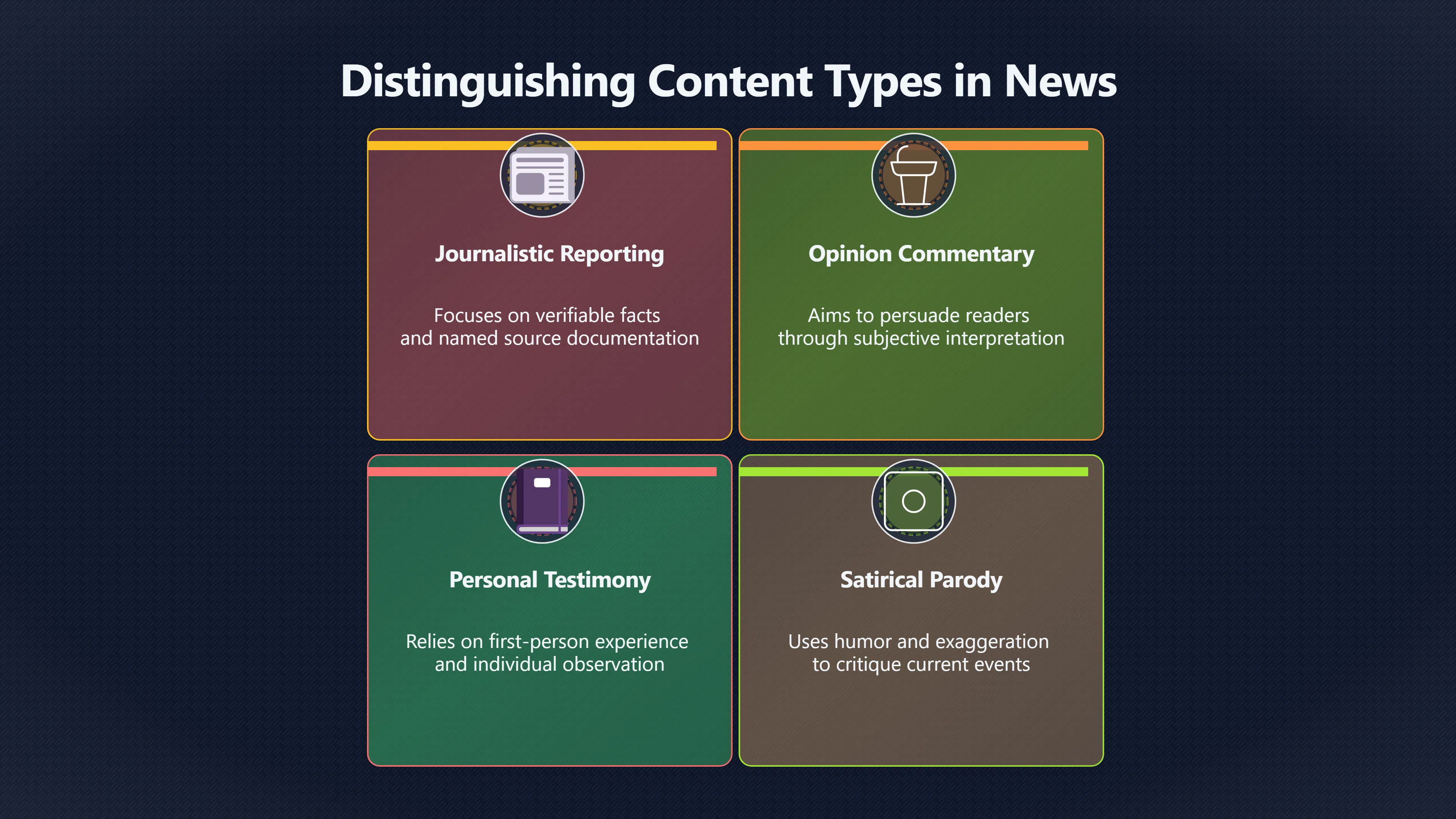
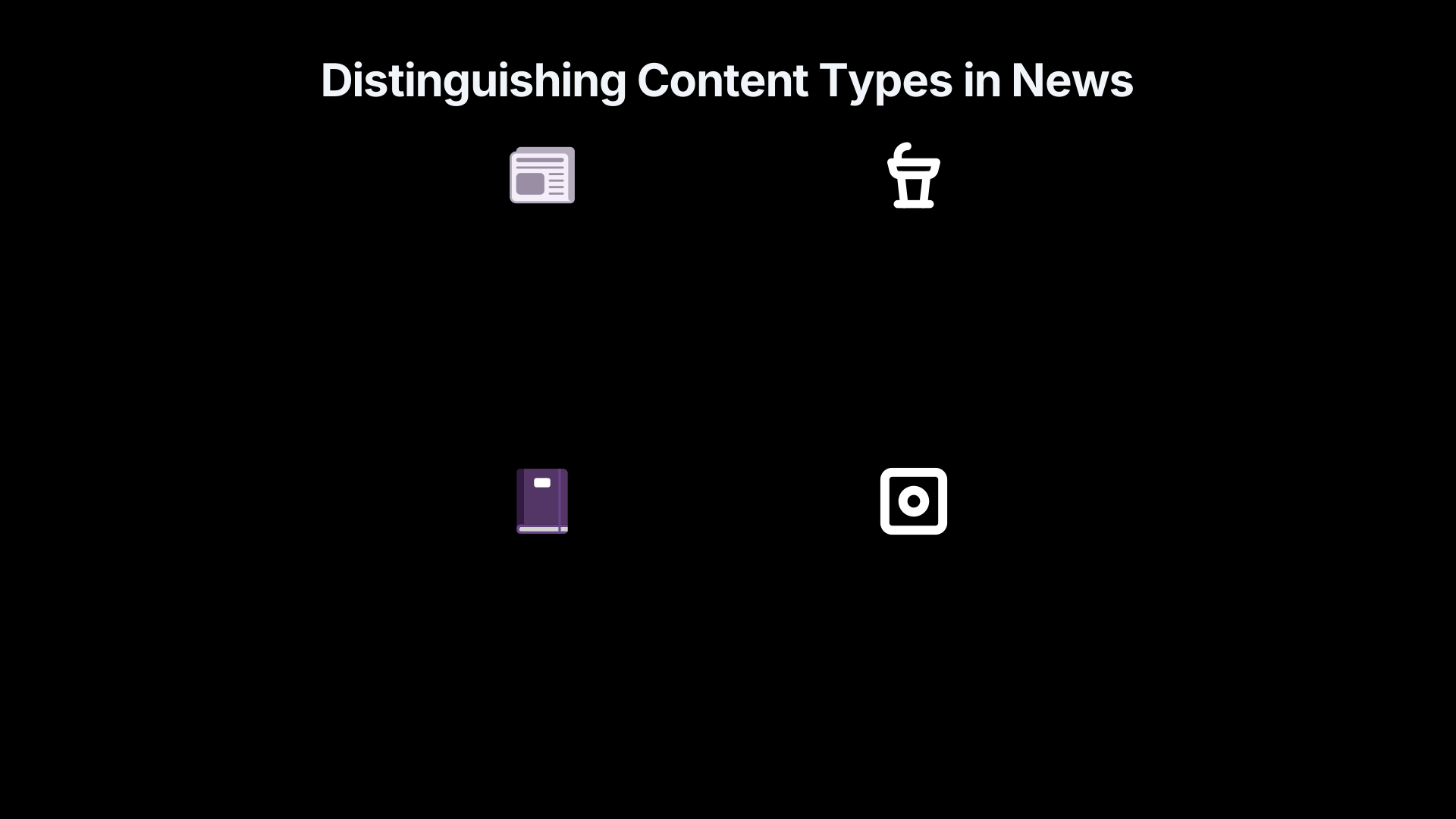
Visible signs of reporting, commentary, testimony and satire
Different content types leave different clues.
Reporting
Reporting often includes:
- Named sources, documents or witnesses.
- Specific dates, places and factual details.
- Attribution such as “according to court records” or “officials said”.
- Evidence that can potentially be checked elsewhere.
- Corrections, updates or links to supporting material.[mediareform.org.uk]mediareform.org.ukReuters Handbook of Journalism Standards and ValuesEverything we do as Reuters journalists has to be independent, free from bias and exec…
The strongest reporting usually shows readers how information was obtained rather than asking them to trust the author’s authority alone.
Commentary
Commentary often includes:
- Judgements about what events mean.[poynter.org]poynter.orgHow do you sort fact from opinion?What's bias?Dec 11, 2023 — News presents factual information about events, providing objective reporting without the author's opinion, wh…
- Arguments about what should happen next.
- Selective emphasis on particular facts.
- Persuasive language aimed at agreement.
Phrases such as “this proves”, “the real story is”, “what people fail to understand” or “here’s why this matters” often signal a shift from reporting into interpretation.
Testimony
Testimony is first-person experience.
Examples include:
- “I was there.”
- “This happened to me.”
- “I work in this industry.”
- “I witnessed the incident.”
Such accounts can provide valuable evidence, but they remain individual observations. A witness may accurately describe what they saw while still misunderstanding the wider situation. Journalism often incorporates testimony but also attempts to verify it through additional sources.
Satire
Satire deliberately imitates news while pursuing humour, criticism or parody.
Common signals include:
- Absurd conclusions.
- Exaggerated scenarios.
- Deliberate contradictions.
- Humorous framing rather than evidence gathering.
The challenge in mixed feeds is that satirical content can be detached from its original context and shared as though it were genuine reporting.

Why the same claim feels different as a headline, clip or monologue
People often judge information partly by its presentation rather than its substance.
Imagine a claim that a government agency released a new report.
As a news article, the focus might be on what the report says, who produced it and how experts responded.
As a video monologue, the focus might shift to whether the report proves a broader political argument.
As a short clip, only the most dramatic sentence might remain.
As a social-media reaction, the report may become merely a launching point for criticism, praise or speculation.
The underlying fact can remain unchanged while the surrounding frame changes dramatically. Research on media literacy repeatedly shows that presentation and framing influence how audiences interpret information, particularly when content is encountered through social platforms rather than direct news consumption.[World Economic Forum+2UNESCO]reports.weforum.orgWorld Economic ForumRethinking Media Literacy: A New Ecosystem Model for…Encouraging students to analyse real-world examples of misinf…
This is why source identification alone is not enough. Even reputable organisations produce multiple content types: news reports, analysis, reviews, editorials, opinion columns and commentary. Some publishers have recently expanded labelling efforts precisely because audiences often struggle to distinguish these formats.[The Guardian]theguardian.comThe Guardian LA Times to display AI-generated political rating on opinion piecesThe feature, called "Insights," will independently identify political leanings as "Left, Center Left, Center, Center Right, or Right" in…
A quick sorting routine before judging accuracy
Before deciding whether to trust a claim, use a three-step sorting routine.
Step 1: Identify the content type
Ask:
- Is this trying to report facts?
- Is it arguing a position?
- Is it describing personal experience?
- Is it making a joke or parody?
Do not move on until you can answer this question.
Step 2: Look for the evidence path
Ask:
- Where did this information come from?
- Is there a named source?
- Is there a document, recording or dataset?
- Can another independent source verify it?
Reporting usually provides an evidence trail. Pure reaction often does not.
Step 3: Separate facts from conclusions
Many posts combine both.
For example:
- Fact: a document exists.
- Fact: a statement was made.
- Conclusion: the statement proves corruption.
- Conclusion: the event will cause a crisis.
The factual elements may be verifiable while the conclusions remain open to debate.
Common mistakes in mixed feeds
Several errors repeatedly cause confusion.
Mistaking confidence for reporting. A creator who speaks forcefully may sound authoritative without presenting original evidence.
Mistaking popularity for verification. Likes, shares and views indicate attention, not accuracy.
Mistaking agreement for fact. Pew research found that people are more likely to classify statements as factual when those statements fit their political or ideological preferences.[Pew Research Center]pewresearch.orgdistinguishing between factual and opinion statements in the newsPew Research CenterDistinguishing between factual and opinion statements inJun 18, 2018 — The politically aware, digitally savvy and thos…
Mistaking analysis for news. Analysis can be valuable and evidence-based, but it still involves interpretation rather than straightforward reporting.
Mistaking eyewitness accounts for complete explanations. Witnesses can describe events directly, yet they rarely possess all relevant information.
The practical trust question
Trust does not begin with deciding whether a post is right or wrong. It begins with recognising what kind of communication you are looking at.
A reported news story asks to be evaluated through evidence, sourcing and verification. An opinion piece asks to be evaluated through reasoning and argument. Testimony asks to be evaluated through credibility and corroboration. Satire asks to be understood as commentary through humour rather than literal description.
In mixed social feeds, these categories often share the same screen and visual design. The reader’s first task is therefore not fact-checking but classification. Once a post has been correctly identified as reporting, opinion, testimony or satire, the question of accuracy becomes much easier to answer.
Amazon book picks
Further Reading
Books and field guides related to Is this reporting or just a reaction?. Use these as the next step if you want deeper reading beyond the article.
The Elements of Journalism
Directly explains what distinguishes reporting from commentary and opinion.

Manufacturing Consent
Provides a framework for analysing media claims and perspectives.
eBay marketplace picks
Marketplace Samples
Example marketplace items related to this page. Use the search link to explore similar finds on eBay.



Endnotes
1.
Source: reutersinstitute.politics.ox.ac.uk
Title: understanding young news audiences time rapid change
Link:https://reutersinstitute.politics.ox.ac.uk/understanding-young-news-audiences-time-rapid-change
Source snippet
Understanding young news audiences at a time of rapid...24 Mar 2026 — Based on secondary analysis of Reuters Institute research, we pres...
2.
Source: mediareform.org.uk
Link:https://www.mediareform.org.uk/wp-content/uploads/2015/12/Reuters_Handbook_of_Journalism.pdf
Source snippet
Reuters Handbook of Journalism Standards and ValuesEverything we do as Reuters journalists has to be independent, free from bias and exec...
3.
Source: poynter.org
Title: How do you sort fact from opinion?
Link:https://www.poynter.org/mediawise/misinformation-resilience-toolkit-libraries/how-do-you-sort-fact-from-opinion/
Source snippet
What's bias?Dec 11, 2023 — News presents factual information about events, providing objective reporting without the author's opinion, wh...
4.
Source: unesdoc.unesco.org
Link:https://unesdoc.unesco.org/ark%3A/48223/pf0000265552
Source snippet
UNESCO DocsJournalism, fake news & disinformation: handbook for...news report or editorial comment this handbook is designed to give jou...
5.
Source: unesco.org
Link:https://www.unesco.org/en/media-information-literacy
Source snippet
Media and Information LiteracyMedia and Information Literacy provides a set of essential skills to address the challenges of the 21 st ce...
6.
Source: unesdoc.unesco.org
Title: The more you study media (through media), the more media literate you are
Link:https://unesdoc.unesco.org/ark%3A/48223/pf0000374920
Source snippet
and information literacy in journalism: a handbook...Media content frequently reflects gender inequality, stereotypes, and discrimination...
7.
Source: pewresearch.org
Title: distinguishing between factual and opinion statements in the news
Link:https://www.pewresearch.org/journalism/2018/06/18/distinguishing-between-factual-and-opinion-statements-in-the-news/
Source snippet
Pew Research CenterDistinguishing between factual and opinion statements inJun 18, 2018 — The politically aware, digitally savvy and thos...
8.
Source: pewresearch.org
Title: factual opinion appendix b detailed tables
Link:https://www.pewresearch.org/journalism/2018/06/18/factual-opinion-appendix-b-detailed-tables/
Source snippet
Pew Research CenterAppendix B: Detailed tablesJun 18, 2018 — The politically aware, digitally savvy and those more trusting of the news m...
9.
Source: reports.weforum.org
Link:https://reports.weforum.org/docs/WEF_Rethinking_Media_Literacy_2025.pdf
Source snippet
World Economic ForumRethinking Media Literacy: A New Ecosystem Model for...Encouraging students to analyse real-world examples of misinf...
10.
Source: theguardian.com
Title: The Guardian LA Times to display AI-generated political rating on opinion pieces
Link:https://www.theguardian.com/us-news/2025/mar/03/la-times-ai-opinion-rating
Source snippet
The feature, called "Insights," will independently identify political leanings as "Left, Center Left, Center, Center Right, or Right" in...
11.
Source: pewresearch.org
Title: What News Is (and Isn’t) According to Americans
Link:https://www.pewresearch.org/journalism/2025/05/13/what-is-news/
Source snippet
May 13, 2025 — This unique study from the Pew-Knight Initiative explores the question: What is “news” to Americans – and what isn't?Read...
Published: May 13, 2025
12.
Source: committees.parliament.uk
Link:https://committees.parliament.uk/writtenevidence/86625/pdf/
Source snippet
parliament.ukFKN0041 - Evidence on Disinformation and 'fake news'This cites research conducted by Pew Research Center that speaks to spec...
13.
Source: europeanjournalists.org
Link:https://europeanjournalists.org/blog/2024/12/06/unesco-report-highlights-urgent-need-for-media-literacy-training-for-digital-content-creators-who-report-the-news/
Source snippet
UNESCO report highlights urgent need for media literacy...6 Dec 2024 — The report concludes that there is an urgent need to provide digi...
14.
Source: coe.int
Title: Media Literacy
Link:https://www.coe.int/en/web/freedom-expression/media-literacy
Source snippet
Freedom of Expression - The Council of EuropeMedia and information literacy is the main tools for empowering people, communities, and nat...
Additional References
15.
Source: schoolofconvergence.com
Link:https://schoolofconvergence.com/media-literacy-separating-news-opinion-and-commentary
Source snippet
Media Literacy: Separating News, Opinion, And CommentaryThis practice allows for a more comprehensive understanding of differing viewpoin...
16.
Source: asset.library.wisc.edu
Link:https://asset.library.wisc.edu/1711.dl/I5BRT3FLIRLVQ8I/R/file-8562f.pdf
Source snippet
wisc.edujournalism, polling, and the battle to define public opinion...This dissertation draws on the wisdom of a great many political j...
17.
Source: thenextweb.com
Link:https://thenextweb.com/news/pew-research-shows-fewer-than-50-percent-of-americans-can-tell-the-difference-between-fact-and-opinion
Source snippet
Pew Research shows fewer than 50 percent of Americans...Jun 19, 2018 — Pew Research shows fewer than 50 percent of Americans can tell th...
18.
Source: niemanlab.org
Link:https://www.niemanlab.org/2020/06/journalists-know-news-and-opinion-are-separate-but-readers-often-cant-tell-the-difference/
Source snippet
Journalists know news and opinion are separate, but...Jun 22, 2020 — It is a tenet of American journalism that reporters working for the...
19.
Source: youtube.com
Link:http://www.youtube.com/watch?v=ASJyWcLKeBI
Source snippet
News Literacy Project fact opinion journalism National News Literacy Week: Misinformation vs. fact-based journalism WTKR News 3...
20.
Source: ehnewspaper.ca
Title: news vs analysis vs opinion types of articles in a newspaper
Link:https://www.ehnewspaper.ca/journalism-blog/news-vs-analysis-vs-opinion-types-of-articles-in-a-newspaper
Source snippet
News vs. Opinion vs. AnalysisDec 28, 2021 — The aim of a news report is to deliver an unbiased record of an event, whereas an opinion's a...
21.
Source: article19.org
Link:https://www.article19.org/wp-content/uploads/2020/12/WPFD-paper-Understanding-the-link-between-a-media-and-information-literate-citizenry-and-the-unsafety-of-journalism-Chocarro-Harrison-Shala-and-Torsner_FINAL.pdf
Source snippet
nding of the link between a media and information literate citizenry and the (un)-safety of...
22.
Source: asianjournal.com
Link:https://asianjournal.com/features/opinion-editorial-columnists/opinion-americas-ideological-divide-this-pew-research-study-examines-why-certain-viewers-trust-fox-news/
Source snippet
s asked about in the survey, including network sources such as ABC News (33...Read more...
23.
Source: courthousenews.com
Title: pew tackles opinion quandary for news consumers
Link:https://www.courthousenews.com/pew-tackles-opinion-quandary-for-news-consumers/
Source snippet
Jun 18, 2018 — The ability to distinguish between a factual and opinion statement is just one early step in being an informed news consum...
24.
Source: facebook.com
Link:https://www.facebook.com/groups/unctt/posts/1201712266588978/
Source snippet
f facts, vetting their sources, and not reporting speculation.Read more...
Topic Tree