Within Lateral Reading
When a Website Looks More Reliable Than It Is
Professional design, dot-org domains and confident biographies can create trust before the source has earned it.
On this page
- Surface clues that are easy to stage
- Why About pages are not enough
- Outside checks that test credibility
Page outline Jump by section
Introduction
A polished website can be misleading because professional appearance is cheap to copy while genuine credibility is expensive to earn. Clean design, impressive logos, confident biographies, institutional-sounding names and carefully written mission statements can create an immediate feeling of trust before readers know who is behind the information or whether the claims are accurate. In an online environment shaped by social media sharing and AI-assisted content production, this gap matters. A site can look like a research institute, news organisation or public-interest group without following the standards those institutions use to verify information. Research on lateral reading repeatedly shows that people who stay on the page are more likely to be influenced by these surface signals than those who quickly check independent sources.[Stanford Report]news.stanford.edufact checkers outperform historians evaluating online informationStanford ReportFact checkers outperform historians when evaluating online…24 Oct 2017 — The fact checkers proved to be fastest and mos…
Surface Clues That Are Easy to Stage
Many of the features people associate with credibility are not difficult to reproduce. Modern website templates, stock photography, AI-generated graphics and inexpensive branding tools allow almost anyone to create a site that resembles a professional publication.
Research on online credibility has found that visual design plays an important role in how users judge trustworthiness. People often interpret a polished layout, organised navigation and familiar news-style formatting as signs of reliability. The problem is that misleading publishers know this too. Studies of misinformation websites have shown that they frequently imitate the visual conventions of established news organisations in order to appear legitimate.[Taylor & Francis Online+2ResearchGate]tandfonline.comTaylor & Francis OnlineDesign Style, Political Ideology, and Trust in “Fake” News…by TJ Billard · 2023 · Cited by 39 — Assessments of…
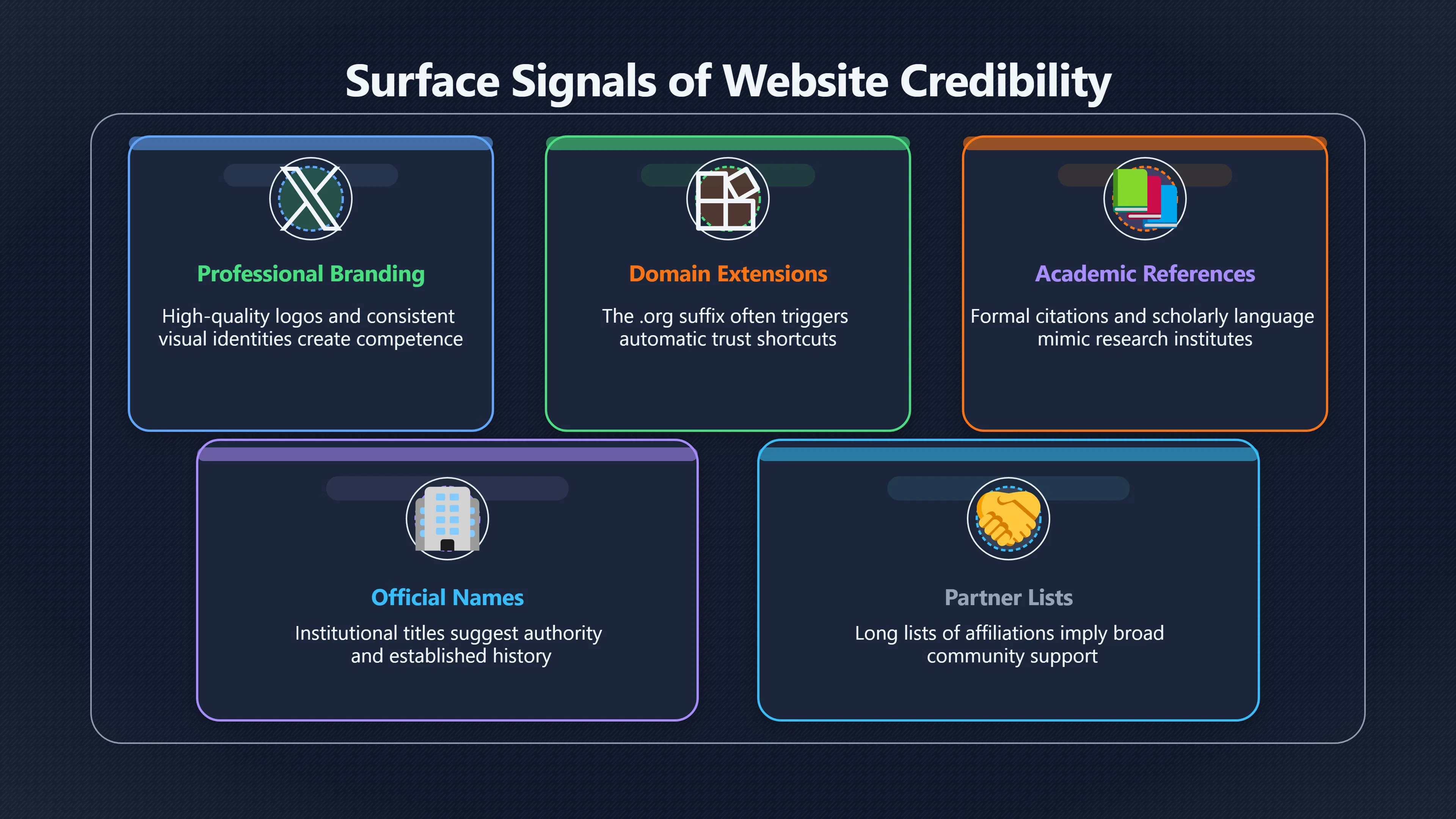
Some common signals that can create trust without proving it include:
- Professional logos and branding
- High-quality photographs and graphics
- Academic-looking references
- Institutional names that sound official
- A “.org” domain
- Long lists of partners, awards or affiliations
- Author biographies filled with credentials that readers do not independently verify
These elements are not necessarily deceptive. Many trustworthy organisations use them. The problem is that they are easy to imitate, which makes them weak evidence when viewed in isolation. Researchers studying how people evaluate websites found that students and even highly educated readers were often influenced by official-looking logos, domain names and professional presentation when those features were disconnected from genuine credibility.[SSRN]papers.ssrn.comReading Less and Learning More When Evaluating Digital…by S Wineburg · 2019 · Cited by 83 — Historians and students often fell vic…
A useful distinction is between signals of professionalism and evidence of reliability. A site can have the first without the second.
Why Attractive Design Triggers Trust
Human beings rely on shortcuts when making rapid judgements. Online, design often acts as one of those shortcuts.
A well-designed page creates a sense of competence and order. Readers may unconsciously transfer those impressions to the site’s claims. Communication researchers have documented how visual design influences perceptions of trust and authority, even when users have little information about the underlying source.[Taylor & Francis Online+2Sage Journals]tandfonline.comTaylor & Francis OnlineDesign Style, Political Ideology, and Trust in “Fake” News…by TJ Billard · 2023 · Cited by 39 — Assessments of…
This effect becomes especially powerful when information is encountered quickly through social feeds, search results or AI-generated summaries. Readers may spend only a few seconds deciding whether a source seems trustworthy. In those conditions, visual presentation can shape judgement before factual evaluation begins.
The risk is not merely that people trust attractive websites. The deeper problem is that good design can delay scepticism. A reader who encounters a sloppy site may immediately ask questions. A reader who encounters a polished one may not feel the need.
That is one reason professional fact-checkers use lateral reading. Rather than spending time analysing the site’s appearance, they leave the page and search for independent information about the organisation, author or claim. Studies comparing fact-checkers with historians and students found that fact-checkers reached more accurate conclusions precisely because they did not rely on surface impressions.[Stanford Report+2PMC]news.stanford.edufact checkers outperform historians evaluating online informationStanford ReportFact checkers outperform historians when evaluating online…24 Oct 2017 — The fact checkers proved to be fastest and mos…
Why About Pages Are Not Enough
An “About Us” page often feels like a natural place to check credibility. Unfortunately, it is also a place where organisations present themselves in the most favourable possible light.
An About page can tell readers what a group claims to be, but it cannot independently verify those claims. A site may describe itself as non-partisan, research-based, community-driven or expert-led without providing evidence that those descriptions are accurate.
This is not merely a theoretical concern. The Stanford research on online source evaluation found that readers who stayed within a website often became absorbed in internal signals such as mission statements, biographies and organisational descriptions. Fact-checkers, by contrast, immediately looked elsewhere to discover what outside sources said about the organisation.[Stanford Report]news.stanford.edufact checkers outperform historians evaluating online informationStanford ReportFact checkers outperform historians when evaluating online…24 Oct 2017 — The fact checkers proved to be fastest and mos…
Several questions cannot be answered reliably by reading a site’s own self-description:
- Does the organisation have a history of corrections?
- How do independent experts describe it?
- Has it been involved in controversies or misinformation campaigns?
- Who funds it?
- Do other reputable sources rely on it?
- Are its credentials recognised outside its own network?
The answers usually exist beyond the website itself.

The Dot-Org Myth and Other Reputation Shortcuts
Many readers assume that certain domain endings automatically indicate trustworthiness. The “.org” domain is a common example.
In reality, domain names are often weaker indicators than people think. While many respected charities, educational projects and public-interest organisations use “.org”, registration alone does not guarantee quality, expertise or honesty. Anyone who meets registration requirements can often obtain similar domains.
The same principle applies to impressive-sounding institutional names. A title that resembles a research centre, policy institute or scientific organisation may create an aura of authority even when the group’s track record is unclear.
Researchers examining website reliability increasingly distinguish between cues that are easy to manipulate and indicators that are harder to fake. Visual branding, domain choices and self-description are relatively easy to create. Reputation built through years of transparent work, independent recognition and accountable publishing practices is much harder to manufacture.[arXiv]arxiv.orgarXiv Reliability Criteria for News WebsitesReliability Criteria for News WebsitesJuly 4, 2024…
This is why lateral reading shifts attention away from what a source calls itself and toward how it is regarded by others.
Outside Checks That Test Credibility
The strongest response to a polished but unfamiliar website is not deeper inspection of the page. It is strategic verification elsewhere.
A few quick checks often reveal more than careful reading of the site’s design:
Search for Independent Descriptions
Look for coverage from established news organisations, academic institutions, libraries or professional fact-checkers. If a group is influential or controversial, others have often written about it.
Investigate the Authors
Search for authors separately from the site. Do they have recognised expertise in the subject they discuss? Are they cited by credible organisations? Have they published elsewhere?
Check the Organisation’s History
Search for the organisation alongside words such as “criticism”, “fact check”, “controversy” or “funding”. This can reveal information that never appears on the site’s own pages.
Trace Claims Backward
If a statistic, quotation or study is important, follow it to the original source. Many misleading websites rely on secondary references that distort what the original evidence actually showed.

Look for Independent Confirmation
A credible claim can usually be confirmed by multiple trustworthy sources. If a dramatic assertion appears only within a small network of closely connected sites, caution is warranted.
These habits reflect the core insight of lateral reading: credibility is often best assessed from the outside in, not from the inside out.[Poynter Institute+2PMC]poynter.orglateral reading the best media literacy tip to vet credible sourcesPoynter InstituteLateral reading: The best media literacy tip to vet credible…20 Jul 2023 — Lateral reading — opening up other tabs in…
What Changes in the Age of AI
AI lowers the cost of producing convincing content at scale. Professional copy, realistic images, detailed biographies and institution-like websites can now be generated much faster than in previous years.
This does not mean polished websites are automatically suspicious. Many are entirely legitimate. It does mean that visual sophistication has become an even weaker stand-alone indicator of trustworthiness. As the cost of looking credible falls, the value of independent verification rises.
For readers practising critical thinking, the key lesson is simple: appearance should be treated as a clue, not a conclusion. A professional website may deserve trust, but it has not earned that trust merely by looking the part. The decisive evidence comes from what can be verified beyond the page itself.[ed.stanford.edu+2Stanford Report]ed.stanford.eduit doesn t take long learn how spot misinformation online stanford study findsIt doesn't take long to learn how to spot misinformation online…19 Apr 2022 — Research from the Stanford History Education Group finds…
Amazon book picks
Further Reading
Books and field guides related to When a Website Looks More Reliable Than It Is. Use these as the next step if you want deeper reading beyond the article.
Calling Bullshit
Teaches readers to question appearances, authority signals, and unsupported claims.
The Skeptics' Guide to the Universe
Explains cognitive errors and unreliable indicators of trustworthiness.

eBay marketplace picks
Marketplace Samples
Example marketplace items related to this page. Use the search link to explore similar finds on eBay.



Endnotes
1.
Source: news.stanford.edu
Title: fact checkers outperform historians evaluating online information
Link:https://news.stanford.edu/stories/2017/10/fact-checkers-outperform-historians-evaluating-online-information
Source snippet
Stanford ReportFact checkers outperform historians when evaluating online...24 Oct 2017 — The fact checkers proved to be fastest and mos...
2.
Source: papers.ssrn.com
Link:https://papers.ssrn.com/sol3/papers.cfm?abstract_id=3048994
Source snippet
Reading Less and Learning More When Evaluating Digital...by S Wineburg · 2019 · Cited by 83 — Historians and students often fell vic...
3.
Source: researchgate.net
Link:https://www.researchgate.net/publication/361176293_Designing_Trust_Design_Style_Political_Ideology_and_Trust_in_Fake_News_Websites
Source snippet
Design Style, Political Ideology, and Trust in “Fake” News...Assessments of the trustworthiness of news outlets necessarily...
4.
Source: pmc.ncbi.nlm.nih.gov
Title: PMCEmotional news affects social judgments independent
Link:https://pmc.ncbi.nlm.nih.gov/articles/PMC7943368/
Source snippet
by J Baum · 2020 · Cited by 66 —... visual design of websites play an important role in assessing the credibility of a source (Metzge...
5.
Source: papers.ssrn.com
Link:https://papers.ssrn.com/sol3/Delivery.cfm/122fdcd4-98cb-4199-b70d-be18be8af762-MECA.pdf?abstractid=4797709
Source snippet
Some examples of these features are...
6.
Source: pmc.ncbi.nlm.nih.gov
Link:https://pmc.ncbi.nlm.nih.gov/articles/PMC8012470/
Source snippet
Improving college students' fact-checking strategies through...by JE Brodsky · 2021 · Cited by 144 — When assessing the credibility o...
7.
Source: arxiv.org
Title: arXiv Reliability Criteria for News Websites
Link:https://arxiv.org/abs/2407.03865
Source snippet
Reliability Criteria for News WebsitesJuly 4, 2024...
Published: July 4, 2024
8.
Source: poynter.org
Title: lateral reading the best media literacy tip to vet credible sources
Link:https://www.poynter.org/fact-checking/media-literacy/2023/lateral-reading-the-best-media-literacy-tip-to-vet-credible-sources/
Source snippet
Poynter InstituteLateral reading: The best media literacy tip to vet credible...20 Jul 2023 — Lateral reading — opening up other tabs in...
9.
Source: ed.stanford.edu
Title: it doesn t take long learn how spot misinformation online stanford study finds
Link:https://ed.stanford.edu/news/it-doesn-t-take-long-learn-how-spot-misinformation-online-stanford-study-finds
Source snippet
It doesn't take long to learn how to spot misinformation online...19 Apr 2022 — Research from the Stanford History Education Group finds...
10.
Source: news.stanford.edu
Title: judging fact fiction online
Link:https://news.stanford.edu/stories/2020/10/judging-fact-fiction-online
Source snippet
Stanford ReportJudging fact from fiction online | Stanford Report7 Oct 2020 — Research from the Stanford History Education Group finds th...
11.
Source: purl.stanford.edu
Link:https://purl.stanford.edu/fv751yt5934
Source snippet
Information: The Cornerstone of Civic Online...22 Nov 2016 — tested, and validated a bank of assessments that tap civic online reasoning...
12.
Source: researchgate.net
Link:https://www.researchgate.net/publication/336172458_Learning_to_evaluate_An_intervention_in_civic_online_reasoning
Source snippet
Learning to evaluate: An intervention in civic online...This study reports on the results of an attempt to teach students to reason abou...
13.
Source: researchgate.net
Link:https://www.researchgate.net/publication/349535570_Lateral_reading_College_students_learn_to_critically_evaluate_internet_sources_in_an_online_course
Source snippet
an improve at judging the credibility of online sources.Read more...
14.
Source: arxiv.org
Link:https://arxiv.org/html/2407.03865v1
Source snippet
Reliability Criteria for News Websites4 Jul 2024 — the visual design and structure of a website. Report issue for... News Dataset for Th...
15.
Source: animorepository.dlsu.edu.ph
Title: dlsu.edu.ph Exploring fake news website design patterns
Link:https://animorepository.dlsu.edu.ph/etd_masteral/5548/
Source snippet
fake news website design patterns - Animo Repositoryby JMG Ruiz · 2018 · Cited by 2 — 23 fake news websites in the Philippines were analy...
16.
Source: tandfonline.com
Link:https://www.tandfonline.com/doi/abs/10.1080/21670811.2022.2087098
Source snippet
Taylor & Francis OnlineDesign Style, Political Ideology, and Trust in “Fake” News...by TJ Billard · 2023 · Cited by 39 — Assessments of...
17.
Source: journals.sagepub.com
Link:https://journals.sagepub.com/doi/full/10.1177/14648849261418348
Source snippet
Sage JournalsVisual news values in the age of AI: Exploring...by V Papa — As Aitamurto (2019) illustrates, visual design contributes to...
18.
Source: libguides.milton.edu
Title: lateral reading
Link:https://libguides.milton.edu/lateral-reading
Source snippet
milton.eduLIB: Source Evaluation: Lateral Reading5 Mar 2026 — A recent study from the Stanford History Education Group tested the online...
Additional References
19.
Source: ivingocreative.com
Link:https://www.ivingocreative.com/why-trust-is-key-to-website-conversions/
Source snippet
5 Trust-Building Elements Your Website Needs to ConvertVisitors won't convert if they don't trust your website. Learn the 5 trust signals...
20.
Source: credibilitycoalition.org
Link:https://credibilitycoalition.org/credcatalog/project/civic-online-reasoning/
Source snippet
Civic Online Reasoning | CredCatalogStudents are confused about how to evaluate online information. We all are. The COR curriculum provid...
21.
Source: youtube.com
Link:https://www.youtube.com/watch?v=2w6sb3DFhGw
Source snippet
Civic Online Reasoning in ActionWe're talking about skills of a democracy when we think about who's behind the information our goal is re...
22.
Source: bestversionmedia.com
Title: why trust signals are the missing link on most local business websites
Link:https://www.bestversionmedia.com/why-trust-signals-are-the-missing-link-on-most-local-business-websites/
Source snippet
Why Trust Signals Are the Missing Link on Most Local...9 Sept 2025 — Trust signals entail things like reviews, certifications and accura...
23.
Source: granthaalayahpublication.org
Link:https://www.granthaalayahpublication.org/Arts-Journal/ShodhKosh/article/download/6682/6192/35229
Source snippet
ty cues in Indian print newspapers and web-based news portals and how the use of layout...
24.
Source: youtube.com
Link:https://www.youtube.com/watch?v=GoQG6Tin-1E
Source snippet
The Facts about Fact Checking: Crash Course Navigating Digital Information #2...
25.
Source: cor.inquirygroup.org
Title: Civic Online Reasoning
Link:https://cor.inquirygroup.org/
Source snippet
Digital Inquiry GroupFree lessons and assessments that help you teach students to evaluate online information that affects them, their co...
26.
Source: 43clicksnorth.co.uk
Title: website trust signals
Link:https://43clicksnorth.co.uk/news-insights/website-trust-signals
Source snippet
Build Customer Confidence with Website Trust Signals3 Nov 2025 — Show shoppers your brand is reliable and safe with website trust signals...
27.
Source: edwardyoung.digital
Title: website trust signals
Link:https://www.edwardyoung.digital/website-trust-signals/
Source snippet
15 Powerful Website Trust Signals Every Online Business...24 Jun 2025 — Your detailed “About Us” story; Those glowing customer reviews...
28.
Source: youtube.com
Title: The Facts about Fact Checking: Crash Course Navigating Digital Information #2
Link:https://www.youtube.com/watch?v=EZsaA0w_0z0
Source snippet
Intro to Lateral Reading - Teaching Online Fact-Checking...
Topic Tree