Within Corroboration
Who really started the claim?
The strongest check is often not another share, but finding who first made the claim and what evidence they actually had.
On this page
- Finding the earliest reachable version
- Separating quotation from confirmation
- Checking whether the origin had access
Page outline Jump by section
Introduction
When a breaking claim spreads online, the most important question is often not whether many people are repeating it, but who first made it and what evidence they actually had. A claim cannot be independently corroborated until its visible source trail has been separated from genuine new reporting, eyewitness evidence, official records, or other independently obtained information. The same rumour can appear in thousands of posts within minutes, creating the illusion of confirmation even when every version ultimately traces back to a single unverified source. Professional fact-checkers and verification researchers therefore emphasise tracing claims, quotes, images, and reports back to their original context before treating repetition as evidence. Eurovision News Spotlight+2Austin Community College Research Guides[spotlight.ebu.ch]spotlight.ebu.chLearn investigative lateral reading to vet sources, find better coverage, and trace original media…
 In the context of critical thinking on social media and AI-driven platforms, source tracing is one of the most practical tools available to ordinary readers. It helps distinguish genuine corroboration from amplification.
Who really started the claim?
A source trail is the path a claim takes as it moves through the information ecosystem. The visible version that reaches your feed is often several steps removed from the earliest known source.
Consider a common pattern:
- An anonymous account posts a claim.
- A larger account shares it.
- News aggregators repeat the share.
- AI systems summarise the growing discussion.
- Thousands of users cite the summaries as evidence.
At that point, the claim may appear to have dozens of sources. In reality, there may still be only one.
This is why verification specialists recommend “tracing claims to the original context” rather than evaluating only the version currently in front of you. Research on lateral reading similarly shows that skilled fact-checkers leave the page they are viewing and investigate where information originated instead of relying on surface presentation.[Austin Community College Research Guides+2Hapgood]researchguides.austincc.eduTry to rephrase it in different terms, in order to be clear about what you are tracing back to its…Read more…
Finding the earliest reachable version
The goal is not always to find the absolute first person who said something. That may be impossible. The practical objective is to find the earliest reachable version that contains evidence rather than repetition.
Start with the oldest citation you can find
Work backwards through shares, reposts, screenshots, and articles.
Ask:
- Who is this source quoting?
- Where did this screenshot come from?
- Is there a linked document, video, statement, or post?
- Does every version point to the same earlier source?
Often the trail collapses quickly. A viral post may cite a news article, which cites a social media account, which cites an unnamed source. The apparent network of confirmation may reduce to a single origin point.
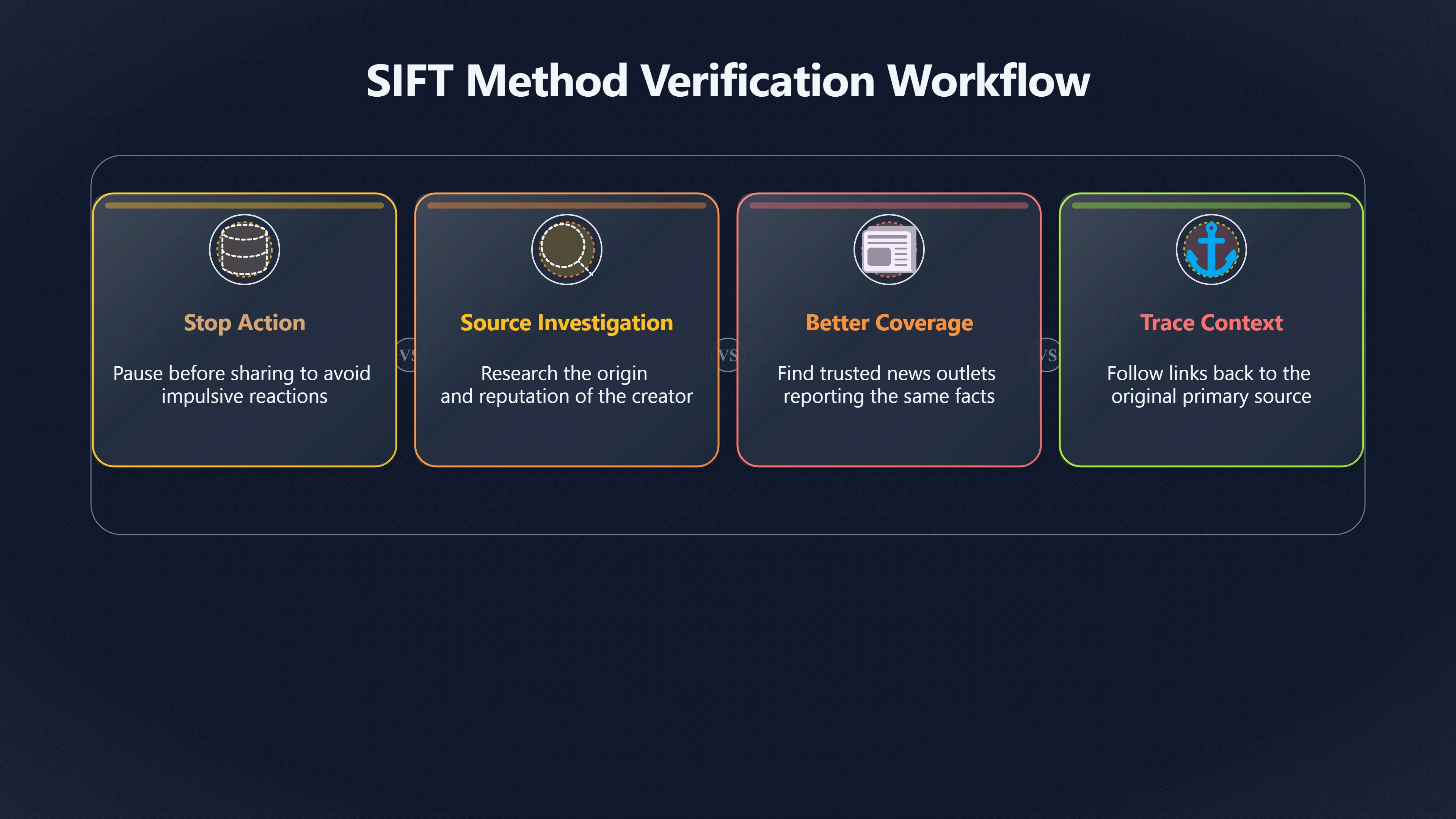
The SIFT verification framework specifically recommends tracing claims back to their original source and context rather than relying on downstream summaries. Clackamas Library Guides+2Wisconsin Open Ed Network[libguides.clackamas.edu]libguides.clackamas.eduLibrary Guides SIFTClackamas Library GuidesSIFT - Research help18 May 2026 — The SIFT Method · S - Stop · I - Investigate the Source · F - Find Better Cover…
Look for missing context
Breaking claims frequently travel as screenshots rather than links.
A screenshot can hide:
- The posting date.
- Later corrections.
- Replies providing context.
- The account’s identity.
- Whether the post was satire or speculation.
Whenever possible, find the original post rather than evaluating a cropped image of it.
Search distinctive phrases
Copy a unique sentence or unusual wording and search for exact matches.
This often reveals:
- Earlier appearances.
- Archived versions.
- Forum discussions.
- Original reporting.
- Whether the wording has been copied across multiple sites.
Identical phrasing across supposedly independent accounts is often a clue that they are all drawing from the same source rather than conducting separate reporting.
Separating quotation from confirmation
One of the most common verification mistakes is treating quotation as corroboration.
A news article that says, “Social media users claim…” is not confirming the claim. It is reporting that the claim exists.
Similarly:
- A commentator discussing a rumour is not validating it.
- An AI-generated summary is not independent evidence.
- A reaction video is not confirmation.
- A repost with additional commentary is still a repost.
The key question is whether the later source obtained information independently.
Imagine twenty accounts repeating that an airport has closed. If all twenty reference the same initial post, there is still only one source. Independent corroboration would require additional evidence such as airport announcements, airline notices, eyewitness reports from different people, or reporting from journalists who verified the situation directly.
Journalistic sourcing standards explicitly warn against presenting multiple references to the same origin as though they were independent confirmations.[Reuters Agency]reutersagency.comOpen source on reutersagency.com.
Watch for circular sourcing
Circular sourcing occurs when sources appear to confirm each other but ultimately rely on the same origin.
A typical cycle looks like this:
- Account A makes a claim.
- Website B cites Account A.
- Influencer C cites Website B.
- Account A later cites Influencer C as evidence.
The information appears reinforced even though no new evidence has entered the chain.
Tracing the source trail helps expose these loops.
Checking whether the origin had access
Finding the origin is only half the task. The next question is whether the origin was in a position to know.
First-hand access versus second-hand reporting
The strongest origins are sources with direct access to events or evidence.
Examples include:
- A witness present at the scene.
- An official statement from a responsible organisation.
- A public document.
- Original video recorded by the uploader.
- A reporter who directly interviewed participants.
Weaker origins include:
- “Someone told me.”
- Anonymous screenshots.
- Unsourced rumours.
- Accounts reposting claims from elsewhere.
A source may be early without being reliable. Being first is not evidence of being correct.
Ask what evidence existed at the time
Many breaking claims spread before evidence becomes available.
Questions worth asking include:
- Did the source provide photographs, documents, recordings, or direct observations?
- Were they describing something they saw themselves?
- Did they explain how they obtained the information?
- Could they realistically have known this information when they posted it?
If an account claims detailed knowledge of an unfolding event minutes after it began, the timeline itself may justify scepticism.
A practical source-tracing workflow
When confronted with a fast-moving claim:
- Stop before sharing.
- Identify the earliest source you can find.
- Trace links, screenshots, and quotations backwards.
- Separate repetition from independent reporting.
- Determine whether the origin had direct access to evidence.
- Look for genuinely separate confirmations.
- Reassess once new information emerges.
This workflow closely mirrors the lateral-reading habits used by professional fact-checkers, who typically investigate the source ecosystem around a claim rather than staying on a single page and analysing it in isolation. Research consistently finds that this approach is more effective than evaluating credibility based solely on presentation, design, confidence, or popularity.[Sage Journals+2Stanford Report]journals.sagepub.comSage JournalsLateral Reading and the Nature of Expertiseby S Wineburg · 2019 · Cited by 583 — Our purpose in this study was to seek out t…
Why source trails matter in the AI era
AI systems can accelerate the spread of a claim without adding any new evidence. A rumour may appear in chatbots, summaries, newsletters, aggregation tools, and recommendation feeds within minutes. The resulting volume can create a false impression that the information has been widely verified.
Source tracing counters this illusion by forcing a simple question: where did this information actually come from?
If every path leads back to the same unsupported statement, then no amount of repetition changes the underlying evidential situation. Independent corroboration begins only when genuinely separate sources contribute new information, observations, documents, or verification. Until then, the most important fact about a breaking claim may be that there is still only one source behind it.[Eurovision News Spotlight+2centralmethodist.libguides.com]spotlight.ebu.chLearn investigative lateral reading to vet sources, find better coverage, and trace original media…
Amazon book picks
Further Reading
Books and field guides related to Who really started the claim?. Use these as the next step if you want deeper reading beyond the article.
Calling Bullshit
Encourages tracing claims and demanding evidence rather than accepting amplification.
Factfulness
When asked simple questions about global trends -- what percentage of the world's population live in poverty; why the world's population...
Unspun Finding Facts in a World of Disinformation
Focuses on evaluating evidence and tracing claims back to reliable sources.
eBay marketplace picks
Marketplace Samples
Example marketplace items related to this page. Use the search link to explore similar finds on eBay.


Endnotes
1.
Source: libguides.clackamas.edu
Title: Library Guides SIFT
Link:https://libguides.clackamas.edu/research-help/sift
Source snippet
Clackamas Library GuidesSIFT - Research help18 May 2026 — The SIFT Method · S - Stop · I - Investigate the Source · F - Find Better Cover...
Published: May 2026
2.
Source: hapgood.us
Title: SIFT (The Four Moves)
Link:https://hapgood.us/2019/06/19/sift-the-four-moves/
Source snippet
19 Jun 2019 — First we should apply simple frameworks like the SIFT methodology: Stop, Investigate the source, Find trusted covera...
3.
Source: news.stanford.edu
Title: fact checkers outperform historians evaluating online information
Link:https://news.stanford.edu/stories/2017/10/fact-checkers-outperform-historians-evaluating-online-information
Source snippet
Stanford ReportFact checkers outperform historians when evaluating online...24 Oct 2017 — A new report from the Stanford History Educati...
4.
Source: centralmethodist.libguides.com
Title: Lateral Reading and the SIFT Method
Link:https://centralmethodist.libguides.com/fake_news/lateral_reading_and_sift
Source snippet
Fake News & Digital...27 May 2026 — Lateral reading involves leaving the website, opening a new tab, and seeing what trusted digital sou...
Published: May 2026
5.
Source: reuters.com
Link:https://www.reuters.com/fact-check/
Source snippet
Reuters Fact CheckReuters Fact Check addresses online misinformation with coverage that maintains accuracy, integrity and impartiality. T...
6.
Source: reuters.com
Link:https://www.reuters.com/fact-check/about/
7.
Source: news.stanford.edu
Title: judging fact fiction online
Link:https://news.stanford.edu/stories/2020/10/judging-fact-fiction-online
Source snippet
fact from fiction online | Stanford Report7 Oct 2020 — Research from the Stanford History Education Group shows how easily young people a...
8.
Source: stacks.stanford.edu
Link:https://stacks.stanford.edu/file/druid%3Ayk133ht8603/Wineburg%20McGrew_Lateral%20Reading%20and%20the%20Nature%20of%20Expertise.pdf
Source snippet
Reading and the Nature of Expertise28 Jul 2018 — Evaluating information: The cornerstone of civic online reasoning...
9.
Source: ed.stanford.edu
Title: it doesn t take long learn how spot misinformation online stanford study finds
Link:https://ed.stanford.edu/news/it-doesn-t-take-long-learn-how-spot-misinformation-online-stanford-study-finds
Source snippet
doesn't take long to learn how to spot misinformation online...19 Apr 2022 — Research from the Stanford History Education Group finds th...
10.
Source: spotlight.ebu.ch
Link:https://spotlight.ebu.ch/p/sift-method-investigative-verification-guide
Source snippet
Learn investigative lateral reading to vet sources, find better coverage, and trace original media...
11.
Source: researchguides.austincc.edu
Link:https://researchguides.austincc.edu/c.php?g=612891&p=10451614
Source snippet
Try to rephrase it in different terms, in order to be clear about what you are tracing back to its...Read more...
12.
Source: journals.sagepub.com
Link:https://journals.sagepub.com/doi/10.1177/016146811912101102
Source snippet
Sage JournalsLateral Reading and the Nature of Expertiseby S Wineburg · 2019 · Cited by 583 — Our purpose in this study was to seek out t...
13.
Source: wisconsin.pressbooks.pub
Link:https://wisconsin.pressbooks.pub/info-lit/chapter/evaluating-sources/
Source snippet
Wisconsin Open Ed NetworkEvaluating Sources – Information Literacy: A Practical GuideDescribe the four steps of the SIFT method (Stop, In...
14.
Source: reutersagency.com
Link:https://reutersagency.com/about/standards-values/
15.
Source: scienceofboosting.org
Title: Lateral Reading
Link:https://www.scienceofboosting.org/project/lateral-reading/
Source snippet
Boosting4 May 2023 — This short video from the Stanford History Education Group explains how to use lateral reading and outlines the rese...
Published: May 2023
Additional References
16.
Source: misinforeview.hks.harvard.edu
Link:https://misinforeview.hks.harvard.edu/article/lateral-reading-college-students-learn-to-critically-evaluate-internet-sources-in-an-online-course/
Source snippet
reading: College students learn to critically...23 Feb 2021 — A small body of research suggests that students in face-to-face settings c...
17.
Source: niemanlab.org
Link:https://www.niemanlab.org/2016/11/reuters-built-its-own-algorithmic-prediction-tool-to-help-it-spot-and-verify-breaking-news-on-twitter/
Source snippet
Reuters built its own algorithmic prediction tool to help...30 Nov 2016 — Reuters discovered this firsthand over the past two years as i...
18.
Source: youtube.com
Link:https://www.youtube.com/watch?v=gnS5UtxqbGA
Source snippet
How to Think Like a Fact-Checker with Joel BreakstoneDr breakstone shares his journey from teaching High School history to Leading resear...
19.
Source: youtube.com
Link:https://www.youtube.com/watch?v=SHNprb2hgzU
Source snippet
"Sort Fact from Fiction Online with Lateral ReadingFree Civic Online Reasoning lessons, assessments and videos are available at [https://co..."](https://co...")...
20.
Source: firstdraftnews.org
Link:https://firstdraftnews.org/articles/verifying-online-information-the-absolute-essentials/
Source snippet
Verifying online information: The absolute essentials14 Oct 2019 — This is your little condensed guide to the wizardry of verification...
21.
Source: journalistsresource.org
Title: 5 takeaways first draft identifying misinformation course
Link:https://journalistsresource.org/politics-and-government/5-takeaways-first-draft-identifying-misinformation-course/
Source snippet
5 Takeaways from First Draft's identifying misinformation...19 Mar 2018 — A new online course from First Draft helps journalists use fre...
22.
Source: reutersinstitute.politics.ox.ac.uk
Title: how public checks information it thinks might be wrong
Link:https://reutersinstitute.politics.ox.ac.uk/digital-news-report/2025/how-public-checks-information-it-thinks-might-be-wrong
Source snippet
the public checks information it thinks might be wrong17 Jun 2025 — So what do people do if and when they want to check something importa...
23.
Source: nowcomment.com
Link:https://nowcomment.com/documents/117206
Source snippet
read less but learn more – far outpacing historians and top college...Read more...
24.
Source: nowcomment.com
Link:https://nowcomment.com/documents/117208
Source snippet
read less but learn more – far outpacing historians and top college...Read more...
25.
Source: researchgate.net
Link:https://www.researchgate.net/publication/320657723_Lateral_Reading_Reading_Less_and_Learning_More_When_Evaluating_Digital_Information
Source snippet
verify claims and cross-check sources rather than relying solely on the content...
Topic Tree