Within Think Before Sharing
When Official Looking Posts Are Not Official
Fake council notices, invented quotes, and official-looking graphics exploit trust in institutions without providing real provenance.

On this page
- Why official style persuades
- Local notice verification
- Checking quotes and announcements
Page outline Jump by section
Introduction
Authority impersonation in local online posts happens when a false claim borrows the look, language or implied voice of a trusted institution: a council notice, a planning application sheet, a police-style warning, a councillor quote, a government poster or a local-news screenshot. It works because people often treat official style as evidence of official origin. In local Facebook groups, WhatsApp chats and neighbourhood apps, that can turn a rumour into something that looks actionable: “share this”, “object now”, “avoid this area”, “the council has approved it”.
The critical thinking challenge is not simply spotting bad grammar or suspicious accounts. Many fake or misleading local posts are plausible because they imitate familiar civic paperwork and appear in spaces where residents already exchange practical local information. Recent UK evidence shows fabricated local authority communications, fake quotes and AI-assisted material circulating in local online environments, especially where trusted local news is weaker.[The Guardian]theguardian.comThe Guardian'Killer of trust': social media groups fuel misinformation in UK, report findsTopics such as immigration and Islamophobia are the most frequent subjects of false claims. The spread intensifies around elections, with…
Why Official Style Persuades
A post that looks official does not need to be beautifully designed. It only needs enough institutional cues to pass a quick glance: a council crest, a planning-reference format, a formal tone, a screenshot of a supposed email, a police-like heading, a staged quote card or a familiar colour palette. These cues invite the reader to skip a harder question: “Where did this actually come from?”
The UK Government Communication Service’s RESIST guidance treats this as a distinct disinformation signal. It tells communicators to look for fabrication, such as forged documents or falsified citations, and for identity deception, such as a fake account claiming to be a person or organisation it is not.[Government Communication Service]communications.gov.ukernment Communication Service RESIST 3: A quick reference guideernment Communication ServiceRESIST 3: A quick reference guide - GCS… That distinction matters. A fake local post may not invent a whole story from nothing; it may attach an invented claim to a recognisable authority, making the claim seem less like gossip and more like disclosure.
Local posts are especially vulnerable because they often concern things people cannot easily verify from personal knowledge: planning applications, asylum accommodation, school policies, road restrictions, parking enforcement, council-tax changes, public-safety warnings, or what was supposedly said in a closed meeting. A resident may know the street, the car park or the building, but not the council process behind it. That gap gives fake authority room to operate.
The persuasive effect is also social. In a neighbourhood group, a post is not encountered as an anonymous artefact on the open web; it arrives through a familiar local channel, perhaps shared by someone who seems worried or helpful. The Local Government Association warns that disinformation can mislead the public, destabilise council meetings, radicalise people with genuine grievances, and even contribute to violence or criminal damage.[Local Government Association]local.gov.ukOpen source on local.gov.uk. The harm is not only that one post is false. It is that repeated official-looking falsehoods teach residents to treat institutions as secretive, corrupt or hostile before any evidence has been checked.
The Fake Council Notice Pattern
A clear example is the fake planning notice in Stockport, which falsely claimed a planning application had been lodged for temporary asylum-seeker accommodation. Full Fact reported that an image of the notice circulated with captions claiming “800 asylum seekers” were planned for Stockport. Stockport Council told Full Fact that the notices were “not legitimate” and that no such planning application had been submitted or approved; the council also said genuine applications are published on its website.[Full Fact]fullfact.orgOpen source on fullfact.org.
This case shows why fake authority posts are more powerful than ordinary rumours. The claim did not merely say, “I heard this is happening.” It appeared to offer documentary evidence. The target was also local and concrete: a place residents could picture, a process they knew existed, and a topic likely to provoke strong reaction. The fake notice borrowed the procedural seriousness of planning law while bypassing the public record where genuine planning documents can be checked.
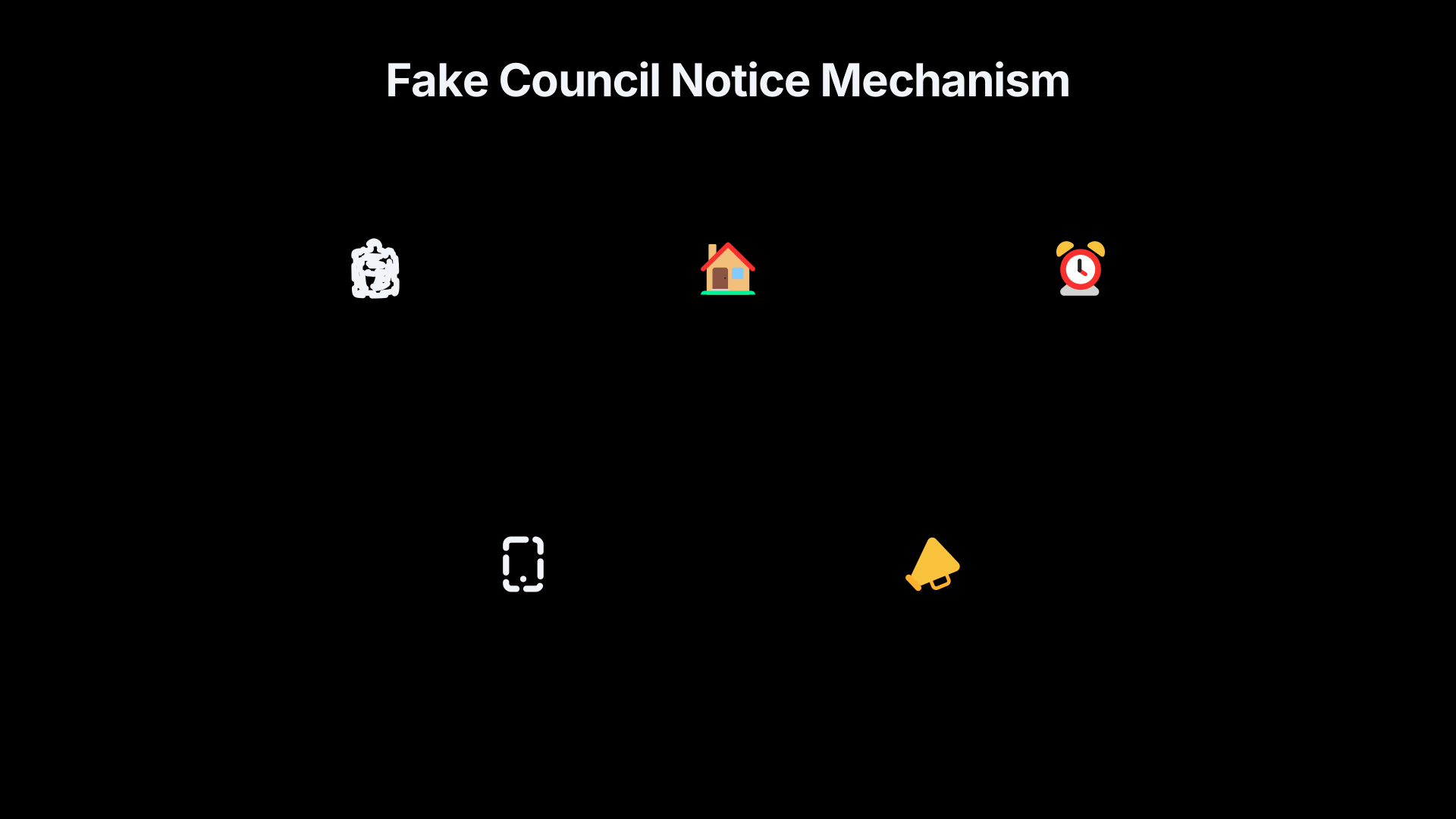
The mechanism has several common steps:
- Borrow the form. Use a notice, screenshot, letterhead, map, agenda extract or announcement graphic.
- Attach a high-emotion claim. Housing, immigration, crime, traffic restrictions, fines and local services are frequent targets because they affect daily life.
- Create urgency. Suggest residents must object, warn others, attend a meeting, avoid a place or act before it is “too late”.
- Avoid provenance. Circulate a screenshot rather than a link to a council page, a meeting paper, a planning portal entry or a named statement.
- Exploit correction lag. Let the claim travel before the council, police or local journalists have issued a clear rebuttal.
This is why “does it look official?” is a weak test. The stronger test is “can I reach the same claim through an official route that did not come from the post itself?”
Local Notice Verification
Local verification should be boring, direct and source-led. The aim is not to investigate the entire internet; it is to trace the claim back to a live institutional record or to recognise that no such record is visible.
For a supposed council notice, start with the council’s own website, not the screenshot. Genuine planning applications, consultations, traffic orders, council-tax information and public meetings normally leave a trace in searchable official systems. In the Stockport case, the decisive check was not whether the notice looked plausible; it was whether the claimed planning application existed on the council’s published records. Stockport Council said genuine applications are published on its website.[Full Fact]fullfact.orgOpen source on fullfact.org.
For a supposed enforcement warning, check the exact payment or appeal route. Parking scams show how easily official enforcement language can be misused. The British Parking Association warns about fake QR codes, fraudulent penalty charge notice text messages and contactless payment fraud, while councils have also warned residents about fake PCN messages that link to fraudulent sites.[British Parking Association]britishparking.co.ukBritish Parking AssociationProtect yourself from fraudRecent scams involve fake QR codes, fraudulent Penalty Charge Notice (PCN) text mes… A real-looking demand for payment is not enough; the payment route, reference number and appeal information need to match the official process.
For a supposed emergency or public-safety announcement, check the relevant authority’s current channel: council website, police force website, verified social account, or local resilience partnership. Full Fact’s evidence to Parliament after the Southport disorder stressed that harmful information that starts online can spill into real-world danger and require police, health services and local authorities to intervene.[UK Parliament Committees]committees.parliament.ukUK Parliament Committees That is precisely why emergency-style screenshots deserve a pause before sharing.
A practical verification sequence is:
- Search the exact claim outside the platform. Use distinctive wording from the post plus the council, police force or place name.
- Check the official record. Look for a planning portal entry, consultation page, press release, meeting agenda, traffic notice, or enforcement guidance.
- Check the account path. Did the claim come from an official account linked from the institution’s website, or from a lookalike account, community group, screenshot or repost?
- Look for a correction. Councils, police, local media and fact checkers often issue rebuttals when false notices circulate.
- Do not treat comments as confirmation. Many worried comments can make a claim feel true without adding any independent evidence.
The Local Government Association’s guidance for councillors makes the same point from the other side: councillors are advised to verify the accuracy of what they post or share, and to report relevant false posts to social media companies or council authorities where a rebuttal may be needed.[Local Government Association]local.gov.ukOpen source on local.gov.uk. Residents can apply the same discipline before amplifying a claim.
Checking Quotes and Announcements
Invented quotes are a softer form of authority impersonation. They may not use a forged document, but they still borrow status: “the council leader said”, “a police source confirmed”, “a school official admitted”, “the mayor announced”. Quote cards and screenshot captions are particularly risky because they detach words from the place where they were supposedly said.
The first question is not whether the quote sounds like something the person might say. It is whether the quote appears in a primary or accountable source: a council webcast, minutes, a press release, a public statement, a named interview, a court document, or a reputable local news report. A screenshot of text over a headshot is not enough. A clipped video is better than a quote card, but still needs context: when was it recorded, what question was being answered, and has the clip been reused from another place or date?
Recent fact checks show how impersonation can work through format as well as words. Reuters found that a screenshot claiming the official UK government X account had been suspended actually showed a fake handle, not the official account, which is @GOVUK.[Reuters]reuters.comOpen source on reuters.com. In another case, Reuters found that a fake image mimicking The Telegraph’s layout and byline falsely claimed Keir Starmer was considering overseas detention camps; The Telegraph said no such article existed, and Reuters noted the fabricated screenshot used the newspaper’s familiar visual style.[Reuters]reuters.comOpen source on reuters.com. These are national examples, but the local lesson is direct: a familiar format can impersonate authority even when the underlying claim has no institutional source.
Official-looking graphics can also blur satire, protest and misinformation. Reuters reported that a poster using UK government branding and telling people to “eat” their children was not an official campaign but a work by a street artist; the government said it was not a government poster, and the displayed GOV.UK link did not exist.[Reuters]reuters.comOpen source on reuters.com. In a local context, similar ambiguity can arise when parody posters, activist graphics or edited screenshots are recirculated without the original context. A post may begin as satire or protest and become misinformation when later sharers present it as real.
A careful reader should treat quote and announcement posts as unverified when they lack:
- a direct link to the original statement;
- a date, venue and named speaker;
- a searchable record in minutes, webcasts or press releases;
- confirmation from an official account linked from the institution’s website;
- coverage from a reputable local or national outlet that has contacted the authority.
Why Local Groups Magnify the Risk
Local online groups are useful precisely because they are fast, practical and socially close. They warn residents about road closures, lost pets, crime concerns, school disruptions and public meetings. The same strengths make them vulnerable to authority impersonation. A false council-style notice about a nearby building feels more urgent than a national rumour because it seems to concern the reader’s street, taxes, safety or services.
The wider evidence suggests that this is not just a matter of isolated hoaxes. The Social Market Foundation’s 2026 work on local misinformation, reported by the Guardian, analysed more than 125,000 posts across local Facebook groups, X searches and Nextdoor communities. The reporting said misinformation was nearly three times more common in areas with little or no recognised local journalism, and that the study found fabricated local authority communications, AI-generated content and misleading claims about councils.[The Guardian]theguardian.comThe Guardian'Killer of trust': social media groups fuel misinformation in UK, report findsTopics such as immigration and Islamophobia are the most frequent subjects of false claims. The spread intensifies around elections, with…
That finding is important because authority impersonation thrives in a trust vacuum. Where local reporting is thin, residents may rely more heavily on group administrators, influencers, anonymous pages and screenshots. The decline is not just a loss of articles; it is a loss of routine verification infrastructure. A local reporter who phones the council, checks the planning portal, attends meetings or asks police for a statement can slow down false authority claims. Without that layer, the first convincing graphic may dominate the conversation.
Full Fact’s 2026 report describes a broader information environment in which reliable information competes with conspiracy theories, synthetic content, manipulated media and politically motivated distortion, while many credibility signals are weakening.[Full Fact]fullfact.orgfull fact report 2026 DIGITALfull fact report 2026 DIGITAL The same report says misinformation can spread when authoritative information is delayed or lacks reach, and it highlights the risk of false claims circulating before verified information is available during public crises.[Full Fact]fullfact.orgfull fact report 2026 DIGITALfull fact report 2026 DIGITAL Local authority impersonation is one concrete expression of that wider problem.
AI Makes the Costume Cheaper
Generative AI does not create the basic tactic of impersonating authority, but it lowers the cost of doing it. A person can now draft formal-sounding notices, produce clean graphics, imitate local-news styles, generate plausible quote cards, or create synthetic voiceovers without design or communications expertise. Full Fact’s investigation into false stories about supposed UK restrictions found videos claiming that government or other authorities were introducing new limits on personal freedoms had been shared more than 300,000 times; some were styled as TV news reports, and at least one used a fake clip of a news presenter that Full Fact said was almost certainly AI-generated.[Full Fact]fullfact.orgOpen source on fullfact.org.
For local posts, the AI risk is not only deepfakes. It is volume and polish. A forged notice no longer has to be manually designed by someone who understands council paperwork. A false quote can be phrased in bureaucratic language. A fake “breaking local update” can be made to look like a news segment. A misleading post can be quickly adapted to different towns by changing a place name, a logo and a few details.
That makes old verification habits less reliable. Spelling mistakes, crude design and obvious absurdity still matter, but their absence no longer proves authenticity. The better question is provenance: does the claim connect back to an official record, a named accountable source, or independent reporting?
What Not to Over-Correct
Critical thinking should not turn into reflexive distrust of every local authority message. Councils and police forces do use social media, posters, text alerts, emails and graphics. Councillors do speak informally online. Local journalists do use screenshots. A post being shareable or emotional does not automatically make it false.
The danger is a different habit: treating the surface of authority as a substitute for the chain of authority. A genuine council announcement should survive a basic provenance check. A fake one often collapses when asked for a planning reference, committee paper, official URL, named spokesperson, meeting timestamp or matching post from an account linked on the council’s website.
Nor should residents assume that every person sharing a false notice is malicious. Many people share because they are worried, angry or trying to protect neighbours. Full Fact’s investigation into false restriction claims noted that some false claims may have been shared in good faith, even as they spread across multiple accounts and platforms.[Full Fact]fullfact.orgOpen source on fullfact.org. The practical response is to reduce amplification before verification, not to shame every sharer as a deliberate deceiver.
A Stronger Test for Official-Looking Posts
The simplest rule is: official-looking is not the same as official. A trustworthy local announcement should have a route back to a source that is accountable for it. That route might be a council page, a planning portal entry, a police statement, a meeting agenda, a recorded meeting, a named press office response, or a reputable local report that has done the checking.
Before sharing a local post that claims institutional authority, ask:
- Who is speaking? A named authority, a councillor, a local group admin, an anonymous page, or a screenshot with no source?
- Where is the original? Can the announcement be found outside the reposted image?
- What record should exist? Planning applications, consultations, meeting decisions and enforcement notices usually leave official traces.
- Is the post asking for instant reaction? Urgency is common in both legitimate alerts and manipulative falsehoods, so it raises the need for verification rather than proving truth or falsehood.
- Could the format be borrowed? Logos, bylines, news layouts and formal language are easy to copy.
- Has a correction appeared? Check council, police, fact-checking and local news sources before assuming silence confirms the claim.
Authority impersonation is effective because it turns trust into a shortcut. Critical thinking restores the longer route: source, record, context, confirmation. In local online spaces, that pause can prevent a forged notice, invented quote or official-looking graphic from becoming the next “everybody knows” claim.


eBay marketplace picks
Marketplace Samples
Example marketplace items related to this page. Use the search link to explore similar finds on eBay.




Endnotes
1.
Source: communications.gov.uk
Title: ernment Communication Service RESIST 3: A quick reference guide
Link:https://www.communications.gov.uk/publications/resist-3-a-quick-reference-guide/
Source snippet
ernment Communication ServiceRESIST 3: A quick reference guide - GCS...
2.
Source: local.gov.uk
Link:https://www.local.gov.uk/guide-disinformation-affecting-local-authorities-and-their-communities
3.
Source: hackney.gov.uk
Link:https://www.hackney.gov.uk/council-tax-and-benefits/financial-advice-and-resources/watch-out-scams
4.
Source: committees.parliament.uk
Title: UK Parliament Committees
Link:https://committees.parliament.uk/writtenevidence/138329/html/
5.
Source: local.gov.uk
Link:https://www.local.gov.uk/our-support/communications-and-community-engagement/social-media-guidance-councillors/guide-role
6.
Source: reuters.com
Link:https://www.reuters.com/fact-check/image-shows-suspended-fake-handle-not-official-uk-government-x-account-2024-08-12/
7.
Source: reuters.com
Link:https://www.reuters.com/fact-check/headline-about-starmer-building-detainment-camps-anti-immigrant-rioters-is-fake-2024-08-09/
8.
Source: reuters.com
Link:https://www.reuters.com/fact-check/eat-your-children-poster-was-created-by-artist-not-uk-government-2024-03-19/
9.
Source: local.gov.uk
Link:https://www.local.gov.uk/our-support/communications-and-community-engagement/model-guidance-councils-elected-members-use
10.
Source: local.gov.uk
Link:https://www.local.gov.uk/our-support/communications-and-community-engagement/guide-disinformation-local-councillors
11.
Source: local.gov.uk
Link:https://www.local.gov.uk/our-support/communications-and-community-engagement/social-media-guidance-councillors
12.
Source: facebook.com
Link:https://www.facebook.com/BBCYorkshire/posts/in-recent-months-fake-council-posts-have-been-spread-far-and-wide-with-one-conte/1330031249169036/
13.
Source: facebook.com
Link:https://www.facebook.com/khaleejtimes/posts/authorities-said-the-fake-websites-resemble-official-consumer-protection-entitie/1543186120801541/
14.
Source: facebook.com
Link:https://www.facebook.com/WellsNubNews/posts/could-you-spot-a-fake-council-scandal-before-sharing-itour-newsletter-exclusive-/1631700205624458/
15.
Source: facebook.com
Link:https://www.facebook.com/Huntingdonshire/photos/-scam-alert-fake-parking-fine-texts-huntingdonshire-district-council-is-warning-/1429470509226845/
16.
Source: facebook.com
Link:https://www.facebook.com/groups/706385562837050/posts/2148973401911585/
17.
Source: facebook.com
Link:https://www.facebook.com/BridgendCBC/photos/%EF%B8%8F-be-aware-fake-parking-warning-noticethe-council-would-like-to-make-residents-a/778577267634574/
18.
Source: facebook.com
Link:https://www.facebook.com/groups/hockleyandhawkwellpeople/posts/4253100118246940/
19.
Source: facebook.com
Link:https://www.facebook.com/Readingcouncil/photos/beware-of-fake-text-messages-which-attempt-to-trick-you-into-making-payments-for/1322673543201757/
20.
Source: facebook.com
Link:https://www.facebook.com/groups/685944924901218/posts/3011187379043616/
21.
Source: facebook.com
Link:https://www.facebook.com/CheshireEastCouncil/videos/-scam-alert-fake-parking-fine-texts-weve-been-made-aware-of-a-scam-where-fraudst/2190687358073341/
22.
Source: facebook.com
Link:https://www.facebook.com/groups/OurFrome/posts/10162604608898188/
23.
Source: facebook.com
Link:https://www.facebook.com/FullFact.org/videos/we-fact-check-this-video-being-shared-widely-online-with-false-claims-it-depicts/1649648112817739/
24.
Source: reuters.com
Link:https://www.reuters.com/fact-check/
25.
Source: reuters.com
Link:https://www.reuters.com/
26.
Source: gov.ky
Link:https://gov.ky/misinformation
27.
Source: newsroom.bathnes.gov.uk
Link:https://newsroom.bathnes.gov.uk/understanding-what-you-see-online
28.
Source: newsroom.bathnes.gov.uk
Title: new online webpage helps residents check facts and find trustworthy information
Link:https://newsroom.bathnes.gov.uk/news/new-online-webpage-helps-residents-check-facts-and-find-trustworthy-information
29.
Source: liverpoolcityregion-ca.gov.uk
Link:https://www.liverpoolcityregion-ca.gov.uk/tackling-misinformation
30.
Source: liverpoolcityregion-ca.gov.uk
Link:https://www.liverpoolcityregion-ca.gov.uk/think-before-you-share
31.
Source: democracy.towerhamlets.gov.uk
Link:https://democracy.towerhamlets.gov.uk/documents/s147076/Social%20media%20policy%20and%20guidance.pdf
32.
Source: communications.gov.uk
Title: RESIST Counter Disinformation Toolkit
Link:https://www.communications.gov.uk/wp-content/uploads/2020/03/RESIST-Counter-Disinformation-Toolkit.pdf
33.
Source: communications.gov.uk
Link:https://www.communications.gov.uk/wp-content/uploads/2021/11/RESIST-2-counter-disinformation-toolkit.pdf
34.
Source: communications.gov.uk
Title: RESIS T 3: Building resilience to information threats
Link:https://www.communications.gov.uk/publications/resist-3-building-resilience-to-information-threats/
35.
Source: bills.parliament.uk
Title: uk Full Fact
Link:https://bills.parliament.uk/publications/65476/documents/8047
36.
Source: committees.parliament.uk
Link:https://committees.parliament.uk/writtenevidence/132605/html/
37.
Source: researchbriefings.files.parliament.uk
Title: POST PN 0719
Link:https://researchbriefings.files.parliament.uk/documents/POST-PN-0719/POST-PN-0719.pdf
38.
Source: meetings.cotswold.gov.uk
Link:https://meetings.cotswold.gov.uk/documents/s8055/Part%20E9%20-%20Social%20Media%20Guidance%20for%20Councillors.pdf
39.
Source: cambridge.gov.uk
Link:https://www.cambridge.gov.uk/understanding-what-you-see-online
40.
Source: colchester.gov.uk
Link:https://www.colchester.gov.uk/info/cbc-article/?catid=policy-framework-local-choice&id=KA-01480
41.
Source: scamshield.gov.sg
Link:https://www.scamshield.gov.sg/i-want-protection-from-scams/learn-to-recognise-scams/government-officials-impersonation-scams/
42.
Source: csa.gov.gh
Link:https://www.csa.gov.gh/impersonating.php
43.
Source: nottinghamcity.gov.uk
Link:https://www.nottinghamcity.gov.uk/your-council/contact-us/social-media/acceptable-use-guidance-for-social-media/
44.
Source: GOV.UK
Link:https://www.gov.uk/government/publications/security-guidance-for-may-2021-elections/online-disinformation-and-ai-threat-guidance-for-electoral-candidates-and-officials
45.
Source: GOV.UK
Title: growing up in the online world a national conversation
Link:https://www.gov.uk/government/consultations/growing-up-in-the-online-world-a-national-consultation/growing-up-in-the-online-world-a-national-conversation
46.
Source: norfolk-pcc.gov.uk
Link:https://www.norfolk-pcc.gov.uk/assets/NCSP/A-guide-to-false-information-affecting-local-authorities-and-their-communities-February-2026.pdf
47.
Source: warwickdc.gov.uk
Title: Our social media guidelines
Link:https://www.warwickdc.gov.uk/info/20606/about_this_website/892/social_media_sites/2
48.
Source: lancaster.gov.uk
Link:https://www.lancaster.gov.uk/newsearch?k=facebook+email+fake+%E3%80%90+Visit+Kungx.cc+%E3%80%91sjpcq8651.MSNQ&page=114
49.
Source: oldham.gov.uk
Link:https://www.oldham.gov.uk/info/100004/about_the_council/1320/social_media/2
50.
Source: durham.gov.uk
Link:https://www.durham.gov.uk/socialmedia
51.
Source: democracy.northtyneside.gov.uk
Link:https://democracy.northtyneside.gov.uk/documents/s15692/App%20D%20-%20NT15.2022-23%20-%20Final%20Report.pdf
52.
Source: theguardian.com
Link:https://www.theguardian.com/media/2026/jun/08/social-media-groups-fuel-misinfomation-uk-[news-deserts
Source snippet
Topics such as immigration and Islamophobia are the most frequent subjects of false claims. The spread intensifies around elections, with...
53.
Source: fullfact.org
Link:https://fullfact.org/immigration/asylum-seekers-housing-stockport-fake-application/
54.
Source: britishparking.co.uk
Link:https://www.britishparking.co.uk/protect-yourself-from-fraud
Source snippet
British Parking AssociationProtect yourself from fraudRecent scams involve fake QR codes, fraudulent Penalty Charge Notice (PCN) text mes...
55.
Source: fullfact.org
Title: full fact report 2026 DIGITAL
Link:https://fullfact.org/documents/419/full-fact-report-2026-DIGITAL.pdf
56.
Source: fullfact.org
Link:https://fullfact.org/politics/fake-stories-uk-government-limit-personal-freedoms/
57.
Source: fullfact.org
Title: Ealing 15 minute cities
Link:https://fullfact.org/online/Ealing-15-minute-cities/
58.
Source: fullfact.org
Title: purchases over 1000 not reported hmrc january 2026
Link:https://fullfact.org/politics/purchases-over-1000-not-reported-hmrc-january-2026/
Published: january 2026
59.
Source: fullfact.org
Title: law holiday fines hasnt changed
Link:https://fullfact.org/education/law-holiday-fines-hasnt-changed/
60.
Source: fullfact.org
Title: birth certificate freeman land
Link:https://fullfact.org/online/birth-certificate-freeman-land/
61.
Source: fullfact.org
Title: reform farage opposition
Link:https://fullfact.org/politics/reform-farage-opposition/
62.
Source: fullfact.org
Title: east london dog walking
Link:https://fullfact.org/online/east-london-dog-walking/
63.
Source: fullfact.org
Link:https://fullfact.org/online/M1-M25-72mph/
64.
Source: fullfact.org
Title: en tackling health misinfo
Link:https://fullfact.org/media/uploads/en-tackling-health-misinfo.pdf
65.
Source: fullfact.org
Link:https://fullfact.org/
66.
Source: fullfact.org
Title: map reform councils uk [missing context]({{ ‘missing-context/’ | relative_url }})
Link:https://fullfact.org/politics/map-reform-councils-uk-missing-context/
67.
Source: fullfact.org
Title: science committees report on social media misinformation and harmful algorithms
Link:https://fullfact.org/technology/science-committees-report-on-social-media-misinformation-and-harmful-algorithms/
68.
Source: fullfact.org
Title: full fact report 2026
Link:https://fullfact.org/policy/reports/full-fact-report-2026/
69.
Source: fullfact.org
Title: full fact report 2025
Link:https://fullfact.org/policy/reports/full-fact-report-2025/
70.
Source: fullfact.org
Link:https://fullfact.org/online/
71.
Source: fullfact.org
Link:https://fullfact.org/latest/
72.
Source: fullfact.org
Title: fake stories uk government policies still viewed millions
Link:https://fullfact.org/politics/fake-stories-uk-government-policies-still-viewed-millions/
73.
Source: reutersinstitute.politics.ox.ac.uk
Link:https://reutersinstitute.politics.ox.ac.uk/digital-news-report/archive/publications/2016/rise-fact-checking-sites-europe/index.html
74.
Source: thebaron.info
Title: reuters to fact check fake news and more for facebook
Link:https://www.thebaron.info/news/article/2020/02/12/reuters-to-fact-check-fake-news-and-more-for-facebook
75.
Source: hal.science
Link:https://hal.science/hal-02363455/document
Additional References
76.
Source: smf.co.uk
Link:https://www.smf.co.uk/publications/social-media-local-misinformation/
Source snippet
st social media platforms' ability to tackle misinformation and fake...Read more...
77.
Source: youtube.com
Title: How Social Media Undermines Democracy | Michael Kaufmann | TEDx Linz
Link:https://www.youtube.com/watch?v=5BtfcYRaxls
Source snippet
When local news disappears, social media fills the void WRAL · 91 views...
78.
Source: oecd.org
Link:https://www.oecd.org/content/dam/oecd/en/publications/reports/2023/04/good-practice-principles-for-public-communication-responses-to-mis-and-disinformation_e047ea9c/6d141b44-en.pdf
79.
Source: youtube.com
Link:https://www.youtube.com/watch?v=b7-lapKPjBE
Source snippet
How Social Media Undermines Democracy | Michael Kaufmann | TEDxLinz...
80.
Source: youtube.com
Title: When local news disappears, social media fills the void
Link:https://www.youtube.com/watch?v=utcpwphDjdE
Source snippet
The Battle to Save Local News | GBH Media Summit 2025...
81.
Source: ox.ac.uk
Link:https://www.ox.ac.uk/news/2021-01-13-social-media-manipulation-political-actors-industrial-scale-problem-oxford-report
82.
Source: standardscommissionscotland.org.uk
Link:https://www.standardscommissionscotland.org.uk/uploads/files/1707913145240214AdviceNoteCouncillorsSocialMedia.pdf
83.
Source: asean.org
Link:https://asean.org/wp-content/uploads/2023/06/ASEAN-Guideline-in-Combating-Fake-News-and-Disinformation-in-the-Media-ISBN.pdf
84.
Source: mma.org
Link:https://www.mma.org/wp-content/uploads/2023/03/MMA-webinar-BestPracticesforUsingSocialMediainMunicipalGovernment-3.7.23.pdf
85.
Source: qa.com
Link:https://www.qa.com/course-catalogue/courses/certified-information-systems-auditor-qacisa/
Topic Tree
Follow this branch
Parent topic
Think Before SharingRelated pages 24
- Accuracy Nudge Can One Pause Stop a False Share?
- AI Tutors Should You Trust a Chatbot Tutor?
- AI Virality Why AI Misinformation Travels So Easily
- Community Notes Can the Crowd Correct the Feed?
- Corroboration Who Else Can Confirm This Claim?
- Deepfakes How to Check a Voice or Video Claim
- Emotional Posts Why Outrage Is Not Evidence
- Evidence Types Not All Evidence Deserves Equal Weight
- +16 more in sidebar
- Correction Lag Why Local Corrections Arrive Too Late
- Fake Notices When a Council Notice Is Not Real
- Parking Scams When a Fine Message Borrows Authority
- Quote Cards Did They Really Say That Locally?
- Safety Warnings Pause Before Sharing Emergency Screenshots
- Screenshots Why Screenshots Make Rumours Look Official